Leading on from my recent post about voice control and autism, this week I’d like to briefly talk about non-verbal autism.
Granted, I cannot provide any personal insight into the matter, (I could never be described as non verbal 😛 ), but I’ll do my best to explain it! 🙂
So first things first, what is non-verbal autism?
Affecting approximately 25-50% of autists, non-verbal autism is pretty self explanatory- the autist is unable to speak.
So what causes non-verbal autism?
Again, as with most aspects of the spectrum, the cause is unclear. Non-verbal autism is highly under-researched and therefore poorly understood. However, one particular study does indicate that there may be differences in the structure of the brains of verbal and non-verbal autists in areas associated with language. Brain imaging analysis of toddlers indicated that autists who grew up to be verbal showed similar signs of activity in these areas to their neurotypical peers. Toddlers who grew up nonverbal however displayed signs of reduced brain activity in the same areas which would likely explain their struggles to formulate speech.
With early intervention and improved techniques, many nonverbal children can now learn to speak, however, a minority of autists will remain silent. But don’t despair, technological advancements in speech generating devices are now helping to reveal the inner voice of nonverbal autists.
Take the inspirational Carly Fleischmann for example. As I have discussed previously (lesser known ASDs), Carly is a non-verbal autist…and talk show host! :O Carly never let her inability to speak to keep her from her dreams of being a talk show host 🙂
Following a recent trip to Amsterdam a very wise friend suggested that I discuss the subject of autism and travel in this weeks blog 🙂
We all love nothing more than a nice trip away for a new adventure or some much needed R and R. For autists however, travelling overseas, (like life in general 😛 ), can be very stressful.
The crowds, the smells, lack of sleep, ear popping, travel sickness, the stress of beeping going through airport security knowing that random people may invade your personal space- it’s a lot to process!
So how might one navigate some of these difficulties?
Pack plenty of snacks– one of the trickiest aspects of travel I find is to find “Aoife friendly” food. If you’re travelling long hours without something decent in your stomach, it can be very difficult to stay sane. Eating healthier snacks may also help you avoid some travel sickness. Aoife’s Top Tip– the discovery of Belvita Breakfast Biscuits has made my life sooooo much easier!
Sleep/Caffeine– I know it’s not the easiest of tasks, but try to get as much sleep as possible before/during a flight. Nothing frays my temper quicker than sleep deprivation. Caffeine is also useful to help get you through the slumps- or Diet Coke if you like me have sensory issues with hot drinks 🙂
Vigilance with metal– To avoid any unexpected pat downs, be sure to double check your pockets before security (you wouldn’t believe the things security have found in my granddad’s pockets- drill-bits to name but one memorable example! 😛 ). Be sure to also double check your hair clips and jewelry- real metals such as silver and gold won’t set the alarm off 🙂
Neck pillows- there’s a lot to be said for a good neck pillow on a flight! These can really help to make an autist more comfortable in the cramped confinings of a plane
Noise Cancelling Headphones/earplugs– These can be quite useful to help decrease the volume of your surroundings, and can also help to decrease the pressure round your ears in my experience. However, on my flight this week I learned that the use of large headphones is now forbidden for take off and landing- so you may need to check this out with your airline
In addition to this, airports are beginning to realize the importance of creating an autism friendly environment. Shannon Airport here in Ireland for example has established Europe’s first airport sensory room in the departures lounge. You can check it out here:Â http://www.shannonairport.ie/gns/passengers/prepare/autismandspecialneeds.aspx
Shannon airport have also implemented a customer care program for autists where special caps and wristbands are assigned so that airport staff can readily recognize and help an autist appropriately.
It’s only a matter of time before other international airports begin to follow suit 🙂
Today we’re going to briefly talk about an aspect of the spectrum that many of you may not be familiar with- voice control.
We’re all aware that autism is often accompanied by difficulties with speech (non verbal autism, apraxia, speaking in monotones etc.) however, few are aware of the challenges to control the pitch and volume of our voices.
This is especially challenging for me as I often struggle to accurately gauge my volume. For example, I may think that I am singing along at an appropriate volume, buuuuuut those who are listening to me may have slightly different reactions…
I’ve probably deafened several members of my friends and family at this stage! 😛
For years I could never understand how I was chastised for my mumbling in school, but a shouter at home- I just could never seem to get the balance right.
I naturally tried to rationalize my shouting with waxy ears and struggles to be heard over the din of the school- but is there any scientific explanation for my struggles to regulate tone?
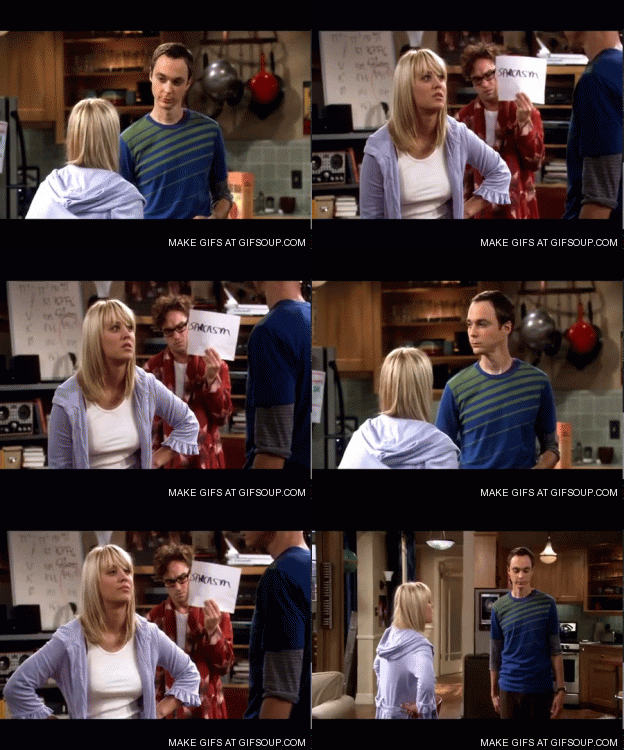
Many acoustic studies have found that prosody (an area of linguistics that focuses on linguistic functions such as tone, intonation, stress and rhythm of speech) is impaired in autists. Prosody is used to reflect emotional states, sarcasm, stress, emphasis and other areas of language that are not conveyed through grammar and vocabulary- an area where many autists struggle.
MRI studies have shown that the areas of the brain involved in the perception and processing of prosody (the left supramarginal gyrus (SMG)) are abnormally activated in autists compared to their neurotypical peers. Neurons in the left precuneus, the left medial prefrontal cortex and the right anterior cingulate cortex should be deactivated when exposed to prosody, however these areas are active in the autistic brain.
As a result, we are often unable to discern the exact pitch, tone or emphasis we should use in conversation. This abnormal activation also explains why autists often struggle to accurately interpret another persons meaning/intention through their use of prosody in their speech.
Impairments in auditory processing of sound in the brain may also feed into this issue- so try not to judge me too harshly the next time I blow your eardrums out 😬 😉
This week I’d like to discuss something I’ve briefly touched upon in previous posts (women and autism, ‘Please Stand By‘)- autism and masking.
So what is masking?
Masking is a common behavioural trait within the autistic community wherein social mimicry is used to “mask” other autistic behaviours in social settings.
Basically this means that autists consciously employ techniques from social observation (such as forced eye contact and rehearsed conversations) in order to better blend into the social landscape to prevent their autistic traits from sticking out. You may not see the autism, but it’s still there behind the mask. Some autists even carry multiple masks to be used for different audiences.
Masking mainly tends to happen among girls with autism rather than boys (boys have also shown signs of masking but not to the same extent). Studies have shown that autistic women are generally better at recognizing emotions than their male peers (almost as good in fact as neurotypicals) and show greater social attentiveness which feeds into our ability to mask.
For example, take a quick look at this video I shared in my previous post where a group of autistic women go speed dating with an oblivious group of neurotypical men:
For me personally, social masking kept me under the ASD radar for many years. Without realizing it, I had been giving an Oscar worthy performance for most of my life.
I figured out how I was “supposed” to act from observing those around me, reading books and watching films (though sadly the amount of rom coms/romance films/novels I consume led to some unfortunate learning curves! 😛 ). I forced myself to make eye contact and to watch my mouth more, I even devised a sort of mental go-to phrase card with acceptable answers to such tricky questions as ‘How are you?’ or how to appropriately answer the phone (which I still dread by the way 😛 )
In one of my more extreme forms of masking, I somehow developed the ability to cry only out of my right eye when I would experience mini meltdowns in school so that the tears would roll down unseen behind a curtain of hair! 😬
I became really good at being invisible….well, at least between meltdowns! 😛 😉
Social masking in girls is thought to be one of the primary reasons that women with autism often go undetected into adulthood, if at all. Research suggests that the ability to mask may even prevent those who have been flagged for assessment from getting the formal diagnosis that they need. In addition to this, a recent survey of autistic adults reported universal exhaustion from their masking exertions which is why it is so important that we develop better diagnostic tools for women on the spectrum.
In this weeks edition of ‘autism on screen’, we’re going to take a look at a brand new film about autism- the 2018 film ‘Please Stand By.‘
What’s that I see in the poster? A young woman with autism?! 😲
FINALLY!
Nice to see Hollywood change things up a bit!
So what’s the story about?
Starring Dakota Fanning (was wondering what she was up to these days after Twlight!), ‘Please Stand By‘ tells the story of Wendy, a girl with Asperger’s syndrome living in a home for people with disabilities. When the opportunity arises to enter a screenwriting contest for ‘Star Trek‘ fan-fiction, Wendy must step outside her comfort zone and boldly cross the country alone (she ran away- a common trait in autistic women) in order to get her script to the studio on time.
You can check out the trailer for the film here:
So how did this film fare in it’s depiction of autism?
Well…as excited as I was to see this film…the reality did not live up to my expectations.
Indeed, Wendy showed the classic signs of autism- meltdowns, lack of eye contact, preference for routine, social awkwardness, literal thinking etc., but she did not stand out as a unique character. She was quirky, but there was nothing unique about her quirks, unlike Sigourney Weaver and her fondness for snow in ‘Snow Cake.‘
Surprisingly, Wendy didn’t appear to be a savant as in other films, however, she did have superb recall of the minutia of her specialist interest ‘Star Trek‘!
I am a little shocked seeing as her character was so derivative in other respects! 😛
What really bugs me about this film however were the missed opportunities. As Wendy spends much of this film by herself, ‘Please Stand By‘ had the perfect opportunity to focus in on the challenges of a high functioning female autist. To the outside world, most autistic women appear fine; we employ learned/observed techniques to blend in- known as ‘masking’. However, behind closed doors it’s a very different story.
Case in point-check out this clip from last week’s Channel 4 documentary ‘Are You Autistic‘:
You would never know that these women are on the spectrum, but you could pick Wendy out of a lineup!
The film uses a lot of narrative introspection to give us some insight (albeit minor) into the autistic psyche, but alas the full potential here was not harnessed. Wendy mainly spoke in ‘Star Trek‘ quotes which while poignant, this narrative could have been put to better use to give us true insight into the speed/and or disordered array of thought within the autistic mind. I often compare my thoughts to that of Marisa Tomei’s character in ‘What Women Want‘ (which by the way is just as funny 18 years on as it was when it was released… Man I feel old!😬).
To be quite frank, the film is kind of forgettable (I even had to look up Wendy’s name she left that little of an impression on me!)- it just didn’t draw me in and I found it incredibly tedious.
But as I say with all these films- if you think it’s your thing, why not check it out? One man’s trash is another man’s treasure after all! 🙂
Continuing on from my post discussing if you should tell your child that they have autism, this week I’m going to discuss how to talk to your child about their diagnosis.
When should I tell my child they are autistic?
As with autism, the answer to this question is entirely individual. Some higher functioning autists may be ready for this information at a younger age than others, or may even be so high functioning as to not need this information during their formative years (as in my case- though in hindsight it would have helped a lot!). Timing can also vary with the age of diagnosis. Girls for example are often diagnosed much later in life than boys with autism.
In general, many experts recommend telling your child around the time they start to become self aware of their differences to their peers- roughly around 6 years old, but this awareness will vary among autists. I, for example, always felt that I was different to my peers, but I never openly questioned it until after I had received my diagnosis in my 20’s.
How do I tell my child they are autistic?
As with when, there is no right or wrong way as to how you talk to your child about autism (just maybe don’t spring it on them out of nowhere the way my parents did 😛 ), but here are some tips and tricks that may help you:
Pick your moment– be very careful with you timing. Make sure that your child is content and calm in a familiar place, things will be much harder if they are anxious
Don’t rush– Ensure that there is plenty of time to talk things through with your child. They will have questions and may need extra time to process what you are saying
Keep it simple– There will be plenty of time to introduce them to the world of neurodiversity as they grow. Just introduce them to autism one toe in the water at a time. Top Tip– There are a lot of useful kids TV shows (such as Sesame street and Arthur) and books explaining autism in an age appropriate way which could help this conversation 🙂
Emphasize that this is a good thing– Whilst an autism diagnosis can be difficult to process initially, ultimately it is a good thing. Your child will get the help and supports they need to thrive, they will better understand themselves and be understood. However, the black and white autistic mind deals in good and bad. Sometimes an autist cannot perceive the difference between a little bit bad and plain bad which can cause great distress (à la 6 year old Aoife who thought she had to leave home as she could not be good! 😛 ). Highlight the importance of difference and make it clear that this is not a bad thing for them- different, but not bad 🙂
How do I explain autism to my child’s siblings?
In much the same way as you would tell a child they are autistic, sit them down and have a casual chat about their sibling (or even friend- awareness in the community is crucial to changing societies attitudes for future generations of autists 🙂 ). Depending on the age of the child, what you tell them can vary to suit. Show them videos, give them a book, tell them a helpful analogy (I do love my Supergirl one!) etc to help them understand. Explain that their friend/sibling works a little bit differently and that they don’t always mean to say or do certain things, but we must love and accept them as they are 🙂
This week I’m going to discuss an important issue for many people on the spectrum- going to the dentist.
I know- no one ever really enjoys going to the dentist (except maybe Bill Murray in ‘Little Shop of Horrors‘! 😛 ), but for autists in particular, visits to the dentist can be quite traumatic. For many, the invasion of space can be an issue, for others, a trip to the dentist can aggravate sensory sensitivities (the sensation of brushing, the taste of toothpaste, the smell of latex gloves etc).
Thankfully I have never had any major issues with going to the dentist (aside from one unpleasant incident where the anesthetic didn’t take and I felt the drill hit a nerve…), nevertheless it wouldn’t be one of my favourite activities. The high pitched squeal of the tools, the scraping sensation against my teeth, the needles (shudder!)- it’s not the most pleasant of experiences inside my head! There’s a lot of fist clenching! 😛
So how might we navigate an autists difficulties at the dentist?
Here are just a few tips and tricks that might benefit parents, dentists and autists alike:
Inquire if your dentist is autism friendly– Have they had autistic patients before? Do they have any special tools or techniques to make the visit more comfortable? Do they take any sensory interventions such as dimming the lights, providing sunglasses or minimizing any loud noises that may startle the child?
Prepare for a dental visit– Help to desensitize an autist to the experience by story-boarding a trip to the dentist with them so that they know what to expect. When it comes to anxiety, the fear of the unknown is often greater than the reality of the experience. Why not inquire if your dentist will allow you to visit the surgery/send pictures to desensitize your child to the environment and meet the staff before coming in for the real thing? 🙂
Wear noise cancelling headphones– whilst this may not be as effective as in other situations given that the tools are operating so close to the ears, nevertheless this may help to take the edge off any noise related issues.
Weighted blanket– A weighted blanket sitting on your lap could be quite beneficial in calming an autist. As I’ve discussed previously, the deep pressure stimulation can calm the mind and put the autist at ease. X-ray jackets can also be used to substitute for a weighted blanket. Comforters such as soft toys or other sensory items that autists use to ‘stim‘ can also be useful to help put them at ease.
Communication is key– as I’ve said above, the unknown is often one of the more unsettling aspects of a dental visit for an autist. Talk them through each step, show them what you are planning to do to their teeth, allow them to see and feel the tools- testing a motion on the hand can be useful to desensitize an autist prior to the oral exam.
Rewards and Bribery– what child doesn’t love a good bribe to motivate them to get through their dental appointment?! There’s a lot to be said for the power and promise of a treat (I may have even bribed myself with a trip to the cinema to motivate me to get this post finished on time! 😂)
Sedation– though not the best of options, this can sometimes be the only way for particularly anxious autists or those with gagging issues to get through a visit to the dentist.
I’ve also found this useful video about visiting the dentist if you want to check it out:
You can also find more information in the following link:
So there we have it Earthlings! I hope you’ve found this post useful 🙂
Dental care isn’t always the easiest for an autist, but remember, prevention is always best- so get try to find a toothpaste that you like, pick the right toothbrush (soft bristles can be helpful) and take care of those pearly whites! 🙂
In continuation from my blog post about autism in the workplace, this week I’m going to give some of my tips and tricks for finding and maintaining employment for autists.
Finding employment:
Job seeking can be a daunting prospect for anyone, but for autists in particular, this can be quite the overwhelming experience. Navigating career search engines, filling out applications, preparing for interviews, coping with rejection- it’s a lot to handle.
When it comes to applying for jobs, there are a few important questions that an autist should consider:
Is this job a good fit for me?
What areas may be challenging for me in this role?
Is this an equal opportunities employer?
It’s important that you apply to jobs that cater to your strengths with an employer that will support both you and your needs 🙂
Top Tip: Glassdoor is an excellent online tool for job hunters. It allows you to look up different companies, read employee reviews and interview experiences, giving you invaluable insight into what life could be like for you within that company.
Next comes the dreaded interview- a real struggle for autists, but it doesn’t have to be 🙂
Fun Fact: According to career experts, 95% of interview questions can in fact be predicted and prepared for in advance! And there’s nothing we love more than predictability 😉
There are a number of organisations out there that are dedicated to advising, training and preparing people with autism for the workplace. For example, Specialisterne is an international organisation dedicated to creating jobs for people with autism through partnership with several companies in the science and technology sector. Specialisterne coaches people with autism and Asperger’s syndrome to prepare them for the workplace and additionally provides employers with training so to best support their employees.
There are also numerous career coaches and communications agencies out there which can sit you down and help you to prepare for an interview, run through mock questions, give you tips on body language etc.
Here are a few tips that I’ve found helpful to get you through an interview:
Preparation is Key– research the company, prepare answers to common questions, look up your interviewers on LinkedIn (don’t worry, you can use a private setting so they won’t know you’ve looked them up! 😉 ) etc. A mock interview can also be very useful. The more you prepare, the more comfortable you will feel in the interview.
Keep your answers relevant to the question– I know it sounds obvious, but if you’re anything like me, beware of tangents!
Ask for a moment to think– if a question throws you, drink some water and ask for a minute to think. It’s perfectly acceptable to ask for this. It gives you time to gather your thoughts whilst remaining in control.
Aoife says ‘Relax’! – Easier said than done, I know, but it was only when I began to relax in interviews that I was finally offered a job 🙂
Maintaining Employment:
Congratulations-you’ve gotten through the interview stage and the job is yours! 😀 However, a number of people with autism will struggle to maintain this job. The workplace can be quite overwhelming as I’ve discussed, and we often do not receive the support we need from our employers.
So what can you do?
If you feel comfortable disclosing your diagnosis to your employer, steps can be taken to help accommodate your needs. For example, autism training can be arranged so that other members of staff can better understand and support you.
Having a work mentor or job coach to talk to and advise you about your workplace can also be helpful. This person can advise you on workplace ettiquette, social skills, interacting with co-workers and the unwritten rules of your place of work.
There are also some steps that you can take to better cope with the pressures of working life:
If you struggle with organization as I often do, making use of lists, diaries and Google Calendar can help you to stay on top of things
As I’ve said before, talk to someone about your problems with work- let it all out!
Take a breath- if you feel overwhelmed or a meltdown coming on, take a moment away from your workstation. Go to the bathroom, step outside the door (if possible), grab a coffee or a glass of water- do anything to distract yourself until you feel well enough to return to work 🙂
Try to maintain a good work- life separation. At the end of the day, we all need to leave work at work. It can be hard to switch off at the end of the day, especially for autists, so try to relax! Why not take up a hobby that will engage a different part of your brain such as art, exercise, music or gaming? Do what you have to do to unwind!
Take care of yourself- Keep snacks nearby, stay hydrated and get to bed early! Sleep tip– Blue light from screens interferes with the hormone that induces sleep, Melatonin. So ditch the laptop before bed; read a book instead!
Finding and maintaining employment as an autistic adult can be challenging, but remember, you have just as much to offer as any other candidate out there 🙂
Time for another autism on screen again, this time exploring the portrayal of autism in the 2004 musical drama film ‘Killer Diller.‘
The film follows Wesley, a young musician and troublemaker who is sent to live at a Christian halfway house for young offenders. Reluctantly drafted into the choir, Wesley encounters Vernon, an autistic savant with a gift for music. His captivating piano playing inspires Wesley to invite Vernon to form a blues band with the choir members and embark on a journey of music, understanding and friendship.
You can check out the trailer below (apologies for the poor quality, it’s not a very well known film- I found it very difficult to source):
So how did this film fair in terms of representation of autism?
Well, by now you all know how I feel about the over-representation of autistic savants in TV and film, so as you can imagine I was yet again disappointed to see this rare trait highlighted in another film. So let’s quickly move on from that! 😛
Much of the behaviours exhibited by Vernon were consistent with classical autism symptoms like rocking, missing social cues, inappropriate social behaviour etc.; however, as I previously found while watching ‘Cube‘, nothing felt unique about the character, Vernon was just another Hollywood carbon copy of autistic stereotypes.
In addition to this, many film scholars have noted that in films featuring autistic characters, the filmmakers choose to use autism for the purposes of redeeming the main character. This film is a prime example of this. Vernon’s presence in the film is used to redeem Wesley, who up until he meets Vernon, is selfish and wayward. However, like ‘Rain Man‘, ‘Snow Cake‘ and several other films featuring an autistic character, the protagonist is transformed following his encounter with an autist.
Thankfully in more recent years, the focus has since changed wherein autistic characters are no longer seen as secondary, but are protagonists in their own right as we have seen in ‘Atypical‘ and ‘The Good Doctor‘ (which by the way, is proving to be an excellent series as the year has moved on 🙂 )
Huzzah for Progress! 😀
All in all, this film (if you can find it) was worth a watch at least once- especially if you’re into blues music. It may not have been the greatest depiction of autism, but it’s an easy watch with some decent music to boot 🙂
Today we’re going to discuss a type of autism that lies just outside the spectrum- the broad or broader autism phenotype (BAP).
What on earth is that when it’s at home?!
BAP is a term used to describe a wider range of individuals just beyond the spectrum who have difficulties with language, personality, and exhibit a number of social and behavioural traits at a higher level than the average neurotypical, but not so high as to be diagnosed with autism.
In other words, this means that you have “a touch of autism” or “not quite autism (NQA)”. The individual has a high number of mild traits, but not enough to interfere with daily life.
So what do we know about BAP?
Relatively little- it doesn’t even have a Wikipedia page!
This intermediate description is most commonly associated with family members (parents, siblings, and other extended family members) of those with ASD diagnoses (14–23%), but it can also be found in the general population as well (5–9%).
Interestingly, evidence of an intermediate autism phenotype has existed since the late 1970’s (the term itself was coined in 1994), but it is only in recent years, with the expansion of the spectrum, that it has become a source of research interest for scientists seeking to understand the range of ASD’s that lie beneath the spectrum rainbow.
Much of the research in this area involves using the BAP to better understand autism- in particular it’s severity and genetics. By analyzing autism traits in families through the prism of BAP for example, researchers may be better able to identify the specific genes which underpin ASDs, paving the way for better therapies for autists.
Apologies for the shortness of this post dear Earthlings, but there is sadly very little information out there about BAP. Perhaps in the future there may be new research that will shed greater light on this subject 🙂