Autism on Stage: ‘What I (Don’t) Know About Autism’

Greetings Earthlings! 🙂

This week I’d like to shake things up a bit and talk to you about a unique play about autism called ‘What I (Don’t) Know About Autism‘ based on the best selling book by Jody O’Neill.

What I (Don't) Know About Autism by Jody O'Neill

So what’s the play about?

The play takes you on a journey through autism with each scene exploring a different aspect of life on the spectrum such as education, interventions and treatments, socializing, getting a diagnosis etc. told through a combination of song, dance and narrative, with built in question times for the audience to ask their own questions from the cast- a mix of both autistic and neurotypical actors. The play is a celebration of autistic identity, whilst also giving non-autistic audiences a deeper insight into the autistic experience.

Here’s a clip of Jody discussing her story and the play:

The play is unique in that it is a “relaxed” performance so to be more autism friendly. This means that the audience lights will remain on, warnings will be given ahead of loud noises (to allow for earplug insertion), audience members are allowed to come and go as they need and if they need to make noise or move around, this is also permitted. The performance is also captioned and the scenes are labelled and crossed out on a white board when they are completed so that the audience can keep track of the 80 minute run time. Here’s a quick video about the relaxed structure:

So what did I make of it?

The play is a unique and entertaining insight into the autistic experience and I thoroughly enjoyed my online viewing. It was so real and relatable without the overt Hollywood dramatics that one often finds when seeing autistic stories played out in a theatrical setting. There were no tricks, just reality to help us all understand autism a little better, and to appreciate and embrace neurodiversity. Myths were debunked, questions were answered and the play did not shy away from some of the difficult realities of autism, giving a well rounded, heartfelt and educational play about the autistic experience.

What I (Don't) Know About Autism: An Autistic Review - AsIAm.ie

It’s hard to give any further details without spoiling the show for you, so if you think you might like to see it, you can catch the recording online through the Abbey Theatre website until the 20th of November on demand.

Hope you enjoyed this post dear Earthlings!

Have a lovely weekend! 🙂

Aoife

Autism and Early Intervention

Greetings Earthlings! 🙂

This week I’d like to talk about a recent landmark study showing the importance of early intervention for long term outcomes for autists.

For many years, studies have reported great benefits for autists when early interventions are taken. The research suggests that the earlier interventions are put in place, the better the outcomes for autists. Putting the right behavioural therapies in place as early as 18 months, such as applied behavioural analysis (APA), can be effective in improving language ability, social interactions and IQ for autists. Other programs advocate practical social interventions, peer intervention programs and active family involvement.

Recently, a new type of early intervention has been in the news showing really interesting results. An Australian clinical trial was conducted on a group of autists that showed early behavioural signs of autism to assess the impact of preemptive interventions long before any autism diagnosis (the group were all between 9-14 months old). The intervention used in this study is called iBASIS-VIPP (Intervention within the British Autism Study of Infant Siblings- Video Interaction to Promote Positive Parenting. Talk about a mouthful!). This intervention is a parent led, video aided therapy which is used to improve social communication and development in infants by helping parents to understand their child’s communication style and to learn how to adapt to it. Parent-child interactions were filmed during 12, 2 hour sessions over a period of 5 months and discussions were held focusing on both child and parent behaviours and how to address them to improve social interaction.

So what did the study find?

Results showed significant reductions in the severity of autistic behaviours throughout early childhood. The most interesting finding however, was that this preemptive intervention had greatly reduced the odds for meeting the diagnostic criteria for autism than those who received normal care from 21% down to 7%- that’s 2/3 reduction! 😲 In other words, use of iBASIS-VIPP in early childhood greatly reduces the severity of autism symptoms, and the odds of receiving an autism diagnosis.

Although given how many of us pass through the radar undetected, implementing a program like iBASIS-VIPP on a wider scale is easier said than done. Some early signs may be too subtle to detect, so later bloomers may not reap the same benefits. Nevertheless, early intervention, where possible can have serious lifelong benefits for autists.

Hope you enjoyed this post dear Earthlings!

Have a lovely weekend! 🙂

Aoife

Autism in Tuner and Hooch (TV Series)

Greetings Earthlings! 🙂

This week I’ve been binge watching the Disney+ TV revival of Turner and Hooch, and in the midst of my fading interest in the show (it’s a bit meh, but grand background watching while you’re doing other things), I encountered some autistic characters on screen, so I decided to give my 2 cents on the representation of autism in this series.

Turner & Hooch (TV Series 2021– ) - IMDb

Based on the 1989 film starring Tom Hanks, the series picks up in the present day following Turner’s son Scott as he enters the police force shortly after the passing of his father. Suddenly, his life get’s turned upside down as his father has willed his dog Hooch to him, a police dog in training whom his dad believed to be a reincarnation of his first canine buddy Hooch. Together, Turner and the wayward Hooch embark on a series of wacky adventures, solving crimes and making friends along the way.

Here’s a trailer for the TV series if you haven’t checked it out yet:

So where does autism fit in with the show?

For starters, Hooch’s trainer Erica has an autistic brother Curtis, who helps her out with the police dog training program. We don’t get to see much of Curtis, but as it turns out, the actor who plays Curtis, Jonathan Simao, does in fact have Asperger’s syndrome; so when you are seeing him on screen, you’re getting the real deal.

In episode 9 of the series, we get a much closer look at autism. Scott and Hooch have been assigned to protect an autistic child Anthony, who has witnessed an attack on his neighbour by an assassin, but due to his communication difficulties, he finds it hard to give the police a description. What follows is an endearing episode where Erica is brought in to help Turner and Hooch to communicate with Anthony, where Hooch is instrumental in getting him to open up.

Interestingly, Lucas Yao who portrays Anthony, is a renowned child prodigy and is himself mildly on the spectrum. You can read more about him here. This is very positive to see the show runners employing autistic actors to play autistic roles- something that many in the community have been crying out for.

The episode handles autism with great sensitivity without resorting to overt stereotypes (although having Anthony obsessed with trains is veering a little bit into this territory). It was particularly lovely to see the “paws-itive” impact that Hooch has on Anthony, as studies have shown significant benefits for autists who own dogs as I’ve discussed in a previous post.

While the TV show itself may not be the most thrilling, this was a lovely episode to see, and is a real step forward in screen portrayals of autism.

Hope you enjoyed this post dear Earthlings! 🙂

Have a lovely weekend!

Aoife

Autism and Twins

Greetings Earthlings! 🙂

This week I’d like to talk about a really interesting research area- autism and twins.

Oh my God two Aoife’s! 😲

Haha don’t worry there’s only one me- I don’t think the world is ready for me to have a clone!

But have you ever wondered what happens if an autist is a twin? Researchers have- they’ve been examining autism in pairs of twins for years and the results have a lot to tell us.

The evidence shows that in up to 90% of twins where one sibling is autistic, the second sibling is also on the spectrum. Identical twins share the exact same DNA (although fun fact, they have different fingerprints due to varying blood flow levels to each baby in the womb! 😀 ), so given that the root of autism is thought to be largely genetic, it makes sense that they would also be identical in this regard.

Interestingly, as no two cases of autism are the same, this holds true for identical twins. Severity can vary greatly among twins, so while both may be autistic, they may each have very different traits. Social trait severity in particular can vary between twins. In one study for example, one twin was nonverbal while the other had no speech issues. This demonstrates that while genetics may cause autism, they don’t always influence traits and severity, so just because your DNA says that you’re autistic, doesn’t mean that your quality of life is defined by your genome. That being said however, the reason for these differences has slightly baffled researchers as identical twins share the same DNA and environment, so the differences in severity is intriguing.

In the case of fraternal twins who do not share the same DNA, there is also a high chance that both twins will be autistic. It’s thought that this may happen as both twins share the same womb, they are exposed to the same in utero environmental factors such as stress, diet, drugs, maternal age etc.

The factors for autism development are many and varied, but twin studies certainly give us a lot of food for thought.

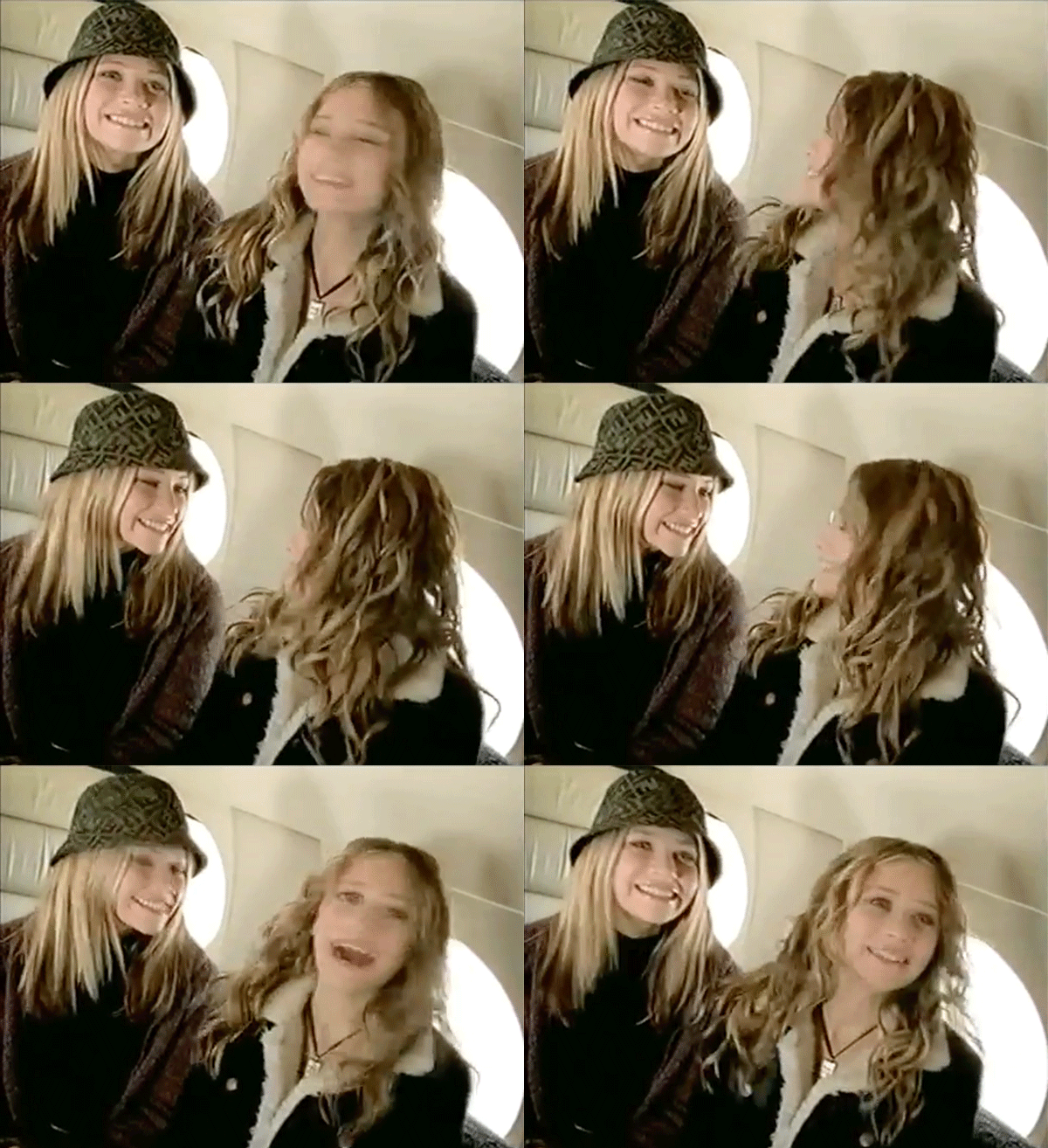
Let the Olsen Twins' Teen Movies Be Your Summer Style Guide

Hope you enjoyed this post dear Earthlings!

Have a lovely weekend! 🙂

Aoife

Autism in Derry Girls

Greetings Earthlings! 🙂

This week I’d like to talk about one of the main character’s in the acclaimed comedy show ‘Derry Girls‘ whom many consider to be autistic- Orla McCool.

So what’s ‘Derry Girls’ about?

Set during the Northern Ireland Troubles in the early 1990’s, ‘Derry Girls’ follows the lives of four teenage girls, and the honorary Derry “Girl” James, growing up in Derry in the years preceding the signing of the Good Friday Agreement. Despite the sectarian clashes of The Troubles around them, the gang navigate life with good humour, getting themselves into all sorts of wacky and hilarious situations- just like any other “normal” teenagers.

If you’ve never seen Derry Girls you can check out a trailer for the show here:

Among the fab five is Orla (played by Dubliner Louisa Harland), a quirky, somewhat innocent girl who lives in a complete world of her own and is one of the show’s biggest sources of comic relief. She has really niche interests (she’s obsessed with sweets, step aerobics and Renault Clios), is very literal and truthful, is sensitive to loud noises and is often completely oblivious to social norms, cues and potential dangers. For example, Orla once expressed interest in joining the Orange Order for their drumming skills despite being a Catholic… She also appears to be sensitive to textures as can be seen in the picture above where she is rubbing her face with a sponge.

Here are some of Orla’s best moments from the show (Fun fact- her clips are the most viewed of all the gang on YouTube):

Now one of the most interesting things about Orla is that it appears she was not originally intended to be portrayed as an autist, just a complete individual. Back in the 1990’s in Ireland, ASD’s were relatively unheard of (hence why yours truly flew under the radar for 24 years), so Orla is simply just seen as an odd girl. In a recent interview, Louisa Harland revealed that she has had an overwhelmingly positive response from the autistic community with many female autists writing letters to her to say how much they loved her portrayal of Orla and how they finally felt like they were being represented. Louisa took this info forward into season 2 to really add more depth to Orla 🙂

Regardless of whether Orla is autistic or not, ‘Derry Girls’ is a very enjoyable show and worth adding to your watch list 🙂

Derry Girls - Rip Poster | All posters in one place | 3+1 FREE

Hope you enjoyed this post dear Earthlings! 🙂

Have a lovely weekend! 😀

Aoife

Autism in ‘The Night Clerk’

Greetings Earthlings! 🙂

This week I’d like to take a look at the portrayal of autism in the 2020 crime-drama film ‘The Night Clerk‘ starring Tye Sheridan, Helen Hunt and Ana de Aramas.

Watch The Night Clerk | Prime Video

So what’s the movie about?

The Night Clerk tells the story of Bart, a 23 year old with Asperger’s Syndrome who works as a night clerk in a local hotel. Bart secretly films the guests in the hotel through a number of hidden cameras he has installed in order to observe people and learn social cues to help him navigate the world, becoming embroiled in a murder investigation as a result.

If you haven’t seen the film you can see the trailer here:

So how did the film fare in it’s portrayal of autism?

The film generally get’s a lot of the classic traits right such as struggles with eye contact, colour sensitivity, lack of filter, social awkwardness, stimming, coordination issues (in particular Bart runs awkwardly with his hands flapping at his sides) and echolalia. I particularly enjoyed Bart’s response when people asked him “How are you?” and he replied with “That’s a very complicated question!” As I’ve discussed in previous posts, I have often found in the past that this is one of the worst questions to be asked and it’s great to see that portrayed on screen.

Bart’s voyeurism on the other hand, while well intentioned, does portray the community somewhat negatively and further adds to the wealth of negative portrayals of autism. Interestingly though, it does sort of in a weird way shake things up a bit- yes it’s not the best look for autist’s, but it does highlight that just because you’re on the spectrum, doesn’t mean you can’t also be a bit of a creep 😛

Overall however, the depiction falls into the stereotypical pit showing us a lot of the same tired autistic tropes like Bart’s primarily monotonous tone of voice. Just once I’d like to see an autist show a little bit of varied inflection on screen- every single autist I know uses a variety of tones when speaking; monotonal speech is clearly not as common as film makers would have us believe.

The Night Clerk Review: Tye Sheridan's Thriller Is a Dud | Observer

Hope you enjoyed this post dear Earthlings! 🙂

Have a lovely weekend!

Aoife

Autism and Cholesterol

Greetings Earthlings! 🙂

Following on from my recent post about diet and autism, this week I’d like to discuss a biomolecule that is not often talked about in the literature about autism- cholesterol.

When it comes to cholesterol, we usually think of it as a bad thing- that fatty yellow stuff that clogs up our arteries when we eat too much of the wrong foods. But there is so much more to cholesterol than most people realize. Cholesterol is an essential biomolecule involved in the synthesis of numerous other bodily substances such as steroid hormones, vitamin D and bile. It’s also an essential component of our cell membranes.

There are 2 types of cholesterol- LDL and HDL. LDL (low-density lipoprotein) makes up most of the cholesterol in the body. This is often referred to as the bad type of cholesterol as a build up of this can clog the arteries. HDL (high-density lipoprotein) on the other hand, is considered the good kind of cholesterol as it absorbs waste cholesterol and shuttles it to the liver for removal from the body.

So what has cholesterol got to do with autism?

Here’s where things get interesting. Cholesterol is involved in modulating the oxytocin receptor and the serotonin 1-A receptor- neurotransmitters that are dysregulated in the autistic brain which contribute to a number of autistic symptoms. Multiple studies have reported that some autists have hypocholesterolemia (i.e low cholesterol levels). Cholesterol deficits could interfere with the functioning of the oxytocin and serotonin receptors and contribute to autistic symptoms. Recent research has identified mutations in a cluster of genes involved in cholesterol metabolism in certain forms of autism which likely causes these lowered cholesterol levels. Cholesterol and omega fish oil supplementation may be useful to help counter the impact of low cholesterol on the brain.

Cholesterol Fat The Structural - Free image on Pixabay

Hope you enjoyed this post dear Earthlings! 🙂

Have a lovely weekend!

Aoife

Autism and Menopause

Greetings Earthlings! 🙂

Leading on from my post about periods and autism, this week I’d like to explore another taboo aspect of life on the spectrum- autism and the menopause.

Apologies once again to my male readers!

I may be too young to give a personal slant on this subject, but I’d like to create some visibility for the often overlooked adult female members of the spectrum. Public discussions surrounding autism are so often centered on childhood, potential issues for adult autists can be forgotten.

The change brings many difficult physical and emotional changes for women such as hot flashes, memory issues, mood swings, sexual dysfunction and issues with mental health. Now imagine how these changes might impact an autist who is already sensitive to change and temperature, sleep disturbances, struggles to manage their emotions and can be predisposed to mental health difficulties?

The autistic life is already a roller-coaster, but throw in the menopause and the cart may just fly off the tracks.

Our knowledge of autism and the menopause is very limited as autism as a diagnosis in itself is only emerging from it’s infancy. Some of the first women to be diagnosed with autism are only now reaching menopause, so there is little available research about their experiences of the change. Of the studies that do exist, experiences of menopause for autistic women vary, however, many reported worsening of autistic symptoms. Some women reported that it they found it extremely difficult to mask their struggles and suffered serious deterioration in their mental health.

We clearly need to start a conversation about menopause and autism so that we can properly develop tools and supports to help women navigate this challenging time of life.

For those of you going through the menopause, have a look at this blog post about “Menopautism” from journalist Jane Renton writing about her experiences of the change as an adult with Asperger’s syndrome:

You can also find some useful additional resources for managing the menopause here:

https://www.aspireireland.ie/cmsWP/information/women-girls/menopause/

Hope you enjoyed this post dear Earthlings!

Have a lovely weekend! 🙂

Aoife

Autism and Tics

Greetings Earthlings! 🙂

This week I’d like to talk about a topic that’s not discussed very often in conversations about autism- tics and tic syndromes.

So what exactly is a tic?

A tic is a sudden, repetitive muscle movement that can cause unexpected and often uncontrollable body movements or sounds. Affecting approximately 10-25% of autists, tics differ from stimming and other repetitive behaviours in that they are generally involuntary in nature such as abnormal blinking, head jerking, sniffing, throat clearing, or repeating phrases. Like autism, there is a spectrum of tic disorder’s, with Tourette Syndrome being the most common of these. Tic frequency and severity varies depending on activity levels, stress, boredom and even high energy emotions.

Thankfully my own experience of tics has not been severe, however, in times of serious stress I have been known to develop a bad eye twitch in my left eye. It was first brought on by the stress of my final school exams at 18, and has resurfaced a small handful of times since during particularly stressful work periods. Amazingly, no one has noticed this tic as it’s so mild, but it is a very odd sensation on the inside to feel your eyelid fluttering of it’s own accord. I was initially quite freaked out when it first started, but now I know that it just means I need to step back and manage my stress levels 🙂

But why are tics so common for autists?

Although they are often comorbid, as with many aspects of the spectrum, the research into this phenomenon is once again limited. Recent genetic research has shown that there may be an overlap where genes thought to contribute to autism can also cause Tourette syndrome which could explain why they often appear together. At the biochemical level, tics have been linked to imbalances in dopamine and other neurotransmitters, imbalances that have also been linked to autistic behaviours.

So are there any treatment options?

As the frequency and severity can vary with life’s changes, learning what your triggers are and how to manage or avoid them is one of the best approaches. Comprehensive Behavioral Intervention for Tics or CBIT (a form of CBT) is the favoured interventional approach, however, in some severe cases, medications can be used to help control tics.

Hope you enjoyed this post dear Earthlings! 🙂

Have a lovely weekend!

Aoife

Autism and Periods

Greetings Earthlings! 🙂

Continuing on from last week’s post about autism and puberty, this week I’d like to talk about autism and periods. I know, I’m about to alienate about half of my readers (sorry guys!), but this is a very important topic to cover for the often overlooked autistic female demographic.

Periods can be challenging for lot’s of women, however, for autists the experience can be somewhat of an ordeal. There can be a lot of overwhelming sensory issues where periods are concerned- new smells, sensations, and sensory issues related to the use of feminine hygiene products. Autists struggle greatly with change, and periods can be quite unpredictable over the course of our lives due to stress, hormonal changes, childbirth and eventually menopause (which I will discuss in a separate post at a later stage). As a result of this, female autists can develop a number of behavioural issues related to menstruation such as increased aggression and repetitive behaviours, not to mention changes in mood and mental health. Throw in a side of cramps and it’s no picnic!

In addition to the mental and behavioural toll, research has shown that periods are biologically much tougher on the autistic body. Studies have shown that women on the spectrum have higher levels of testosterone than their neurotypical peers (likely caused by dysfunction in the hypothalamus in the brain), leading to a number of menstrual related issues such as severe acne, hirsutism, irregular periods, polycystic ovary syndrome and dysmenorrhea. Premenstrual syndrome (PMS) is also highly prevalent in autistic women. Autists are also known to have high levels of inflammation in the body, which can further aggravate menstrual symptoms. Periods can even cause an increase in seizures in autists who also suffer from epilepsy due to hormonal fluctuations.

So what can you do to help a young autist through her period?

  • Educate them clearly about their changing bodies– autistic women can be particularly vulnerable, so they need to know exactly how their reproductive system works and the importance of consent. Use clear language that can not be misinterpreted or taken too literally. Understanding their body will also help them to better normalize menstruation so it is far less scary. As discussed in my last post, autistic women enter puberty much earlier than their peers, so it is essential that they are educated sooner rather than later about their changing bodies.
  • Check out autism friendly books about puberty/periods– there are a number of books available targeted at growing autists to help them navigate this challenging time. There are even books specifically about periods for young autistic women that may help.
  • Chat about different feminine hygiene options– as no two autists are the same, so no one option is better or worse when it comes to feminine hygiene products. There are far more options available these days to young women than just sanitary towels and tampons- they even make absorbent period underwear which could be very helpful for girls with sensory issues.
  • Setup a calendar/diary to track periods- the unpredictable nature of life and unexpected change can be particularly frustrating for autists. While periods can oftentimes be unpredictable and don’t always run on time, a calendar can nevertheless be very helpful to prepare an autist for upcoming periods and establish a routine. Knowing that an event is approaching can help to offset the scariness of it.
  • Break the taboo– reassure them that periods are a normal part of life and that there is nothing to be ashamed of. Periods may be overwhelming for autists, but they are by no means alone in their menstrual struggles.

Hope my female Earthlings at least enjoyed this week’s post! 😉

Have a lovely weekend! 🙂

Aoife

Blog at WordPress.com.

Up ↑