Autism and Food

Greetings Earthlings! 😀

Following a recent report about a teenager who has been left blind from a restrictive diet of roughly 4 nutritionally lacking food items, this week I’d like to discuss the topic of food and autism.

bitmoji-20190517071624.png

Did you know that feeding difficulties are estimated to occur in as many as 70 to 90% of children with autism?

It’s a shocking statistic!

People with autism are often described as selective or picky eaters, often favouring carbohydrates and highly processed foods while rejecting fruits and vegetables- but why is that?

Research has found that food issues in autism overlap with sensory sensitivities to taste, texture, colour  and smell. As such, autists will often actively avoid these foods to avoid adverse sensory reactions. In the animal kingdom, many species develop conditioned aversions to certain unpleasant tastes, associating them with danger and illness. As the autistic tongue is so sensitive, it’s thought that autists can also develop aversions to foods in this manner.

In my case, although my autistic traits are extremely mild, food continues to be an issue for me. Certain smells, tastes and textures in particular will make me want to throw up. Fruit and veg in particular have been troublesome on a sensory level- for example I love the taste of strawberry, but I can’t tolerate physically eating one due to the texture.

bleh

It’s made things quite difficult at times when I’ve been out eating with friends to try to maintain a neutral expression when a foodstuff disagrees with my brain to avoid hurting someone’s feeling. A lot of the time it’s just easier to pretend that I’m not hungry to avoid an awkward social/sensory situation- pro tip, always keep snacks in your car/handbag.

Selective eating habits are commonplace for autists, however, serious food aversions can can be diagnosed clinically as avoidant/restrictive food intake disorder (ARFID), previously known as selective eating disorder (SED).

But is there any getting around these sensory issues?

CBT as with many other aspects of autism, cognitive behavioural therapy can help to change behaviours surrounding food over time.

Persistence- keep trying to build up your tolerance to certain textures/tastes. When I was younger, I could not stand to drink a glass of water as it felt so weird compared with other soft drinks. It was not easy to adjust to this texture at first  (I even had to swap shots of water for shots of orange juice to get it down! 😂), but I stuck with it, and now I drink several litres a day willingly 🙂

Prepare food in different ways- this has perhaps been the most helpful for me. Changing the way some foodstuffs are prepared/cooked can really impact the textural outcome. Smoothies have been particularly useful to help me achieve my 5 a day. I may not be able to eat the fruit itself, but throw it in a blender and bye-bye textural issues. Similarly, with apple tart, if the apples are too chewy, I find it extremely difficult to stomach, but if you bake the tart until the apples are soft and mushy I can’t get enough of it!

tart

Hope you enjoyed this post dear Earthlings! 😀

Have a good weekend!

Aoife


Autism and Stress

Greetings Earthlings! 🙂

Stress- it’s hard to escape it in the modern world; even more so for an autist.

bitmoji-20190828093747

Ordinary day to day life can be very stressful to navigate. Such simple things as responding to an email, dealing with crowds, sensory triggers and social interactions can be completely overwhelming. The thought alone of these seemingly innocuous situations can be incredibly stressful for an autist.

In my case, just the mere idea of driving in Dublin city centre for example majorly stresses me out- I have genuinely told my friend that if his directions landed us there I would get my car towed and grab a taxi 😛 Any unexpected scenarios, detours or maneuvers in my car will leave me hot under the collar, praying out loud for help to keep from freaking out!

bitmoji-20180406032839

But are there any scientific reasons why autists are more predisposed to stress?

Interestingly, autists show signs of greater biological stress than their neurotypical peers. In particular, studies have indicated that autists have higher levels of stress hormones than neurotypicals. As I’ve previously discussed, stress hormones such as cortisol and adrenaline are released in response to stressful situations from the hypothalamic–pituitary–adrenal axis or HPA axis. This is a complex interconnecting network that comprises the hypothalamus, the pituitary gland and the adrenal gland (i.e. HPA) to control our response to stress- a network that is hyperactive in autists.

Following exposure to a stressful situation, stress hormone levels should return to normal, however, research has shown that stress hormone levels tend to persist in autists, which can make us more susceptible to stress related outbursts and meltdowns. In other words, we’re constantly living in a state of fight or flight.

bitmoji-35911512

Long term activation of the stress system can lead to a number of health problems such as poor mental health, weight gain, sleep issues, digestive and cardiovascular problems to name but a few- many of which are regularly comorbid with autism.

In addition to this, studies have shown that autists have higher levels of oxidative stress in the body. Oxidative stress occurs when there is an imbalance between anitoxidants and free radicals (unstable oxygen atoms that can damage cells causing illness and aging – not so fun fact, free radicals are thought to contribute to hair greying) in our bodies. Several studies have indicated that antioxidant enzyme levels that regulate free radicals in the body may be altered in autists. As such, oxidative stress has been linked to the appearance of autistic symptoms such as language delay in previous studies.

In addition, as with prolonged exposure to stress hormones, oxidative stress may also contribute to the development of cardiovascular disease and mental health problems such as depression. Worryingly, heart disease and suicide are among the leading causes of mortality for autists, with studies indicating that the average autist lives 16 years less than their neurotypical peers! 😲  In addition to this, research suggests that psychological stress may worsen the symptoms of ASDs.

Therefore, as for everyone, it’s very important for an autist to find ways to manage their stress levels for both their long term physical and mental health.

Hope you enjoyed this post dear Earthlings! 🙂

Have a lovely weekend!

Aoife

Autism and Lying

Greetings Earthlings! 🙂

This week I’d like to talk about the random subject of autism and lying.

Well….I’d like to, but I can’t!

Many autists are notoriously honest and struggle to tell lies. Moreover, autists will often struggle to tell if someone is lying to them. You would be amazed at how many times the word “Really?!” comes out of my mouth before my brain catches on to a lie 🙈 We’re black and white thinkers who love rules and structure, so deception doesn’t come naturally to us, it breaks all the rules.

That being said, while most autists do struggle with lies, other autists can have tendencies towards pathological and compulsive lying. This often arises from learning how to lie through observation, or lying out of necessity to mask around others. As I’ve said in previous posts, sometimes it’s just easier to pretend that I’m not hungry in order to mask my sensory issues with food.

But is there any particular reason why lying is such a struggle?

In general, it’s not that we can’t tell lies, however, things start to fall apart when trying to maintain the lie. Researchers have found that while many autists can lie to cover up behaviours or tell white lies in order to be polite, once probed, autists struggle to maintain consistency. Would you believe, there is in fact a scientific explanation for this!

Executive functioning is our brains ability to control, regulate and manage all of our thoughts and actions. Examples of executive functioning include decision making, time management skills, prioritizing tasks, verbal reasoning, memory, problem solving etc. Up to a whopping 80% of autists may struggle with executive dysfunction. Executive functioning is essential to the art of lying- a lie must be constructed, rationalized, and planned out. If an autist struggles with any of these steps, the lie will fall apart.

So there you have it- I wouldn’t be an interesting suspect in an Agatha Christie murder mystery, I’d give the lies away instantly! 😂

Hope you enjoyed this post dear Earthlings!

Have a lovely weekend! 🙂

Aoife

“You Don’t Look Autistic!”

Greetings Earthlings! 🙂

After reading a write in to an advice column in the newspaper this morning, the parent of a recently diagnosed child rationalized that the diagnosis didn’t make sense as their child was doing well in school, popular and “good socially.”

I found this particularly annoying as this type of attitude is something that we high functioning autists encounter all the time.

“You don’t look autistic?!”

“You’re normal!”

“You can’t be autistic!”

bitmoji110263557

These are some of the most common phrases I hear when I talk to people about my diagnosis, as do many high functioning autists. Whilst this is a great compliment to my upbringing and acting skills, this kind of reaction can be quite damaging for autists.

First things first- no one looks autistic 😛

It’s a neurodevelopmental disorder, how are we supposed to look? Unless you have eyes like an MRI or some type of X-ray vision, you won’t physically see our neurological differences! Roughly 1 in 68 people are autistic- that’s 1 person per double decker bus, 1 person per carriage on the average train, and 3 people on the average international flight. Would you say that you’ve seen someone that “looked” autistic every time you’ve used these transport services? 🤨

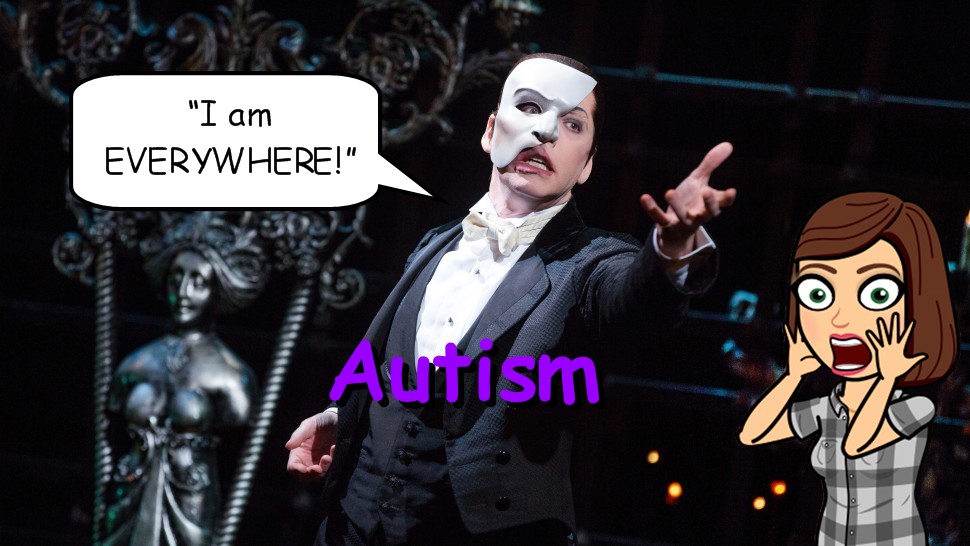
We’re everywhere, looking exactly the same as you do.

Phantom of the opera autism.jpg

^^^ Sorry couldn’t resist giving my favourite musical a shout out- 10 points if you get the song reference 😎

With autism, it’s very much a case of “don’t judge a book by it’s cover”.

With the increased generalization of the spectrum, from the outside, our books look alike, each with the same rainbow-coloured ‘autism’ cover on display. The stories inside however are very different. There may be similar themes, experiences and symptoms between books, but ultimately each is unique.

bitmoji-20190729090736.png

Contrary to popular belief, just like the child in the advice column, many high functioning autists have an active social life. In college I was at every party going and the last one on the dance floor- had you seen me, would you have said I was autistic? Appearances can be deceptive, you don’t know how hard some of us have to work on our social skills behind closed doors. Eye contact isn’t natural for me, but with practice and forcing myself out of my comfort zone, no one would be any the wiser when chatting to me now. I’m a social butterfly who doesn’t outwardly appear autistic, but I have a piece of paper and an autism spectrum quotient score that say otherwise

No, I do not “look” like the stereotypical image of autism, but it doesn’t mean that I’m not riding that spectrum.

This attitude towards autism’s outward appearance could in fact be quite detrimental. If we don’t recognize that a person is autistic when they don’t fit the preconceived mould; they may languish for years without adequate understanding and supports for their needs. This is especially true for females on the spectrum who have learned the art of social masking, often flying under the radar of male centered diagnostic criteria.

As I have discussed many times before, autism is a spectrum, everyone is different and therefore their traits will be different. Don’t judge us by the ‘autism’ cover adorning our story, delve deeper into the book and you may be surprised at what you’ll learn 🙂

Hope you enjoyed this post and have a lovely bank holiday weekend dear Earthlings! 😀

Aoife

The Problem with High Functioning Autism

Greetings Earthlings! 🙂

This week I’d like to discuss the term “high functioning autism”.

You may be surprised to hear that the term “high functioning” is quite controversial within the autistic community. In fact a recent study strongly supports discarding the term “high functioning autism” completely.

So why is the term controversial?

bitmoji-20190710074854

Firstly, let’s quickly remind ourselves of what constitutes high functioning autism:

High functioning autism (HFA) is a term used to describe autists with strong language skills and an IQ of over 70 ( i.e they do not have an intellectual disability). 

Herein lies the problem- the term uses IQ as a predictor of functionality and does not take into account the day to day struggles of the average autist. An autist deemed to be low functioning may not encounter challenges in their daily life, but may struggle academically.  Similarly, an autist may excel academically, but something so trivial as writing an email may prove challenging. In many of the films I’ve reviewed, the autistic character is described as high functioning, but yet they are incapable of living an independent life.

Moreover, functioning levels often fluctuate from year to year, improving or dis-improving depending on circumstances and levels of support- there’s even evidence to suggest that, as with many things, autism can get worse with age! Levels can even fluctuate day to day where something as simple as lack of sleep can impact upon functioning. As a result of this, many autists deemed “high functioning” do not get adequate support for their needs.

bitmoji-20190710075012

Researchers have found in a recent study that there is a serious gap between an autists cognitive functioning (IQ) and their adaptive behaviours (i.e. their ability to adapt to their environment). The average results show that autists with higher IQs scored 28 points lower than their IQ in adaptive behaviour scales, suggesting that IQ is a weak predictor of daily functioning.

You can read more about the study here:

Large study supports discarding the term ‘high-functioning autism’

Technically speaking, within the medical community the term “high functioning” is considered an informal term and is not in itself a definitive diagnosis, further fueling efforts to banish it.

However, I personally feel that removing the term could be problematic. In my case, both my IQ and functional abilities are high- I breezed through college, have an active social life, hold a job and live independently. To say that I am simply autistic to a person who doesn’t know me very well can skew their expectations and perceptions of me- especially in the workforce. Granted, public understanding of the spectrum is improving, but still the ‘a’ word can place you into a predefined box in people’s minds.

I worry that our move towards a more generalized view of the spectrum may effectively disable the truly high functioning. Recall how autism is divided into levels. Asperger’s syndrome has been swallowed up by level 1 autism, where autists have noticeable issues with socializing and communication skills. This level is characterized by:

  • decreased interest in social interactions or activities
  • capable of social engagement but may struggle with conversational give-and-take
  • difficulty with planning and organizing
  • struggles with initiating social interactions, such as talking to a person
  • obvious signs of communication difficulty
  • trouble adapting to changes in routine or behavior

where autists are vaguely classed as “requiring support”.

On paper, I fall under this definition, but it does not describe me as well as Asperger’s syndrome or the term ‘high functioning’. This definition paints an entirely different picture for people to that of my reality (for starters the only support I require consists mainly of a good bra, sugar, a hug and a box of tissues for unexpected meltdowns 😂). Were I to have been diagnosed earlier in life, this definition may well have held me back.

For many autists, indeed the term high functioning can be tricky, but I do not believe it should be abandoned completely. Yes, it is time to reevaluate our classification of autism to better define functionality levels across the entire spectrum, but perhaps there’s a better way to go about it.

bitmoji84905202

Hope you enjoyed this post dear Earthlings! 😀

Have a lovely weekend!

Aoife

Autism and Echopraxia

Greetings Earthlings! 🙂

Leading on from my previous post on echolalia, this week I’d like to briefly discuss the phenomenon echopraxia.

Image result for what the gif

Yes I know, it’s another mouthful, but what exactly is echopraxia?

Echopraxia (also known as echomotism or echokinesis) is a type of tic disorder characterized by involuntary imitation of another persons actions e.g. waving a hand, touching your nose, kicking something, even facial expressions. Echopraxia is one of the core features of Tourette’s syndrome, however it has also been found to occur in ASD’s. It is often paired with echolalia, but it has been known to occur independently in autists.

I know what you’re thinking- imitation of actions is critical to early development in childhood and perfectly “normal” behaviour, so it seems like echopraxia might be reading into things too much. However, when this behaviour persists and becomes reactionary rather than a learning tool, then it can be viewed from a pathophysiological  perspective. As such, it can be very difficult to diagnose this behaviour in children. 

So what does the science have to say about echopraxia and autism?

There’s very limited research in this area, however experts believe that echopraxia is related to damage or dysfunction within the frontal lobe known as the action cortex of the brain- an area that is often implicated in autistic behaviours. Other’s have theorized that abnormalities in the mirror neurons located here may be responsible.

Nope, I’m afraid mirror neurons are not quite this exiting- mirror neurons are in fact a particular type of nerve cell that fires when a person or an animal acts and witnesses another person complete the same action. This type of behaviour has been particularly observed in primates, giving new meaning to the phrase ‘monkey see, monkey do’.

echopraxia

In general, echopraxia is considered harmless, however if it starts to interfere with social functioning, then behavioural modifications, medications and psychotherapy are possible treatment options 🙂

Hope you enjoyed this post dear Earthlings! 😀

Have a lovely weekend!

Aoife


Autism and Eating Disorders

Greetings Earthlings! 🙂

This week I’d like to talk about a very common issue, particularly for women with autism- eating disorders.

bitmoji-20190618091926

As discussed previously, mental health issues are quite prevalent among the autistic population. Because of this, many autists can go un-diagnosed as co-morbid mental health issues often mask the root autism diagnosis. This is particularly true of eating disorders for female autists where doctors will diagnose an eating disorder, but due to social masking tendencies will often overlook their autistic traits.

In fact this should really be one of the first things that doctors should assess when patients present with eating disorders as numerous studies have shown that there is a higher prevalence rate of autism in patients diagnosed with eating disorders (up to 20%). Evidence indicates that patients presenting with anorexia nervosa, bulimia nervosa and binge eating disorder (BED) have greater numbers of autistic traits than the general population.

Autists will often not benefit from conventional treatment for disordered eating so it is critical that it is identified early.

salad

So why are eating disorders so prevalent for those on the spectrum?

The reasons are varied, but tend to be either psychological or sensory related:

Psychological:

Some people on the spectrum develop eating disorders as a means to fit in, to attain the kind of figures that they see in magazines and perceive to be “perfect” or “normal”. Others develop eating disorders as a means of control, where the routine and rigidity can be a source of comfort to an anxious mind running on overdrive (interestingly this may have a scientific basis as starvation decreases levels of serotonin, which is heavily involved in anxiety and is often elevated in autism). Moreover, if exercise or particular foods become specialist interests, an autist may obsess and inadvertently develop a disorder as a result.

In some cases an eating disorder may be a simple matter of mind blindness where an autist simply does not understand that their eating behaviours are abnormal or dangerous.

binge

Sensory:

Sensory issues are commonplace for autists both with and without an eating disorder. An autist may be sensitive to different tastes, textures and smells which can make for a very restrictive diet depending on the severity. In some cases, eating may be so stressful that they may not eat very much at all to avoid an unpleasant sensory event.

For further information about autism and eating disorders you can check out the link below for advice and support:

https://www.bodywhys.ie/understanding-eating-disorders/key-issues/autism-eating-disorders/

Hope you enjoyed this post dear Earthlings! 🙂

Enjoy the weekend!

Aoife

Autism on Screen- What’s Eating Gilbert Grape

Greetings Earthlings! 🙂

This week I’d like to discuss the portrayal of autism in the 1993 comedy-drama film ‘What’s Eating Gilbert Grape‘ starring Johnny Depp, a young Leonardo Dicaprio and Juliette Lewis (who ironically portrayed an autistic character in ‘The Other Sister‘ a few years later).

download (1).jpg

The story follows Gilbert Grape (Depp) a young man living in a rural town in Iowa as he takes care of his obese mother and autistic brother Arnie (Dicaprio). The film explores Gilbert’s life and struggles to take care of his family whilst trying to forge a life of his own.

If you haven’t seen this classic, here’s the trailer:

So how does the film fare in it’s depiction of autism?

Autism is not explicitly mentioned as such in this film, but most experts agree that Arnie’s traits align with those of autism. His repetitive movements, echolalia, self injurious behaviours, use of atypical speech, preference for routine, his childlike nature, mind-blindness and lack of danger perception (he has a fondness for climbing the town water tower) all indicate that Arnie is on the spectrum. This is also one of the few films where the autist is not portrayed as a savant so that’s a refreshing change!

Leonardo Dicaprio’s acting is, as always, sublime- he even received his first ever Academy Award nomination for his portrayal of Arnie in this role. In particular I felt that the depiction of meltdowns was quite good, however, the most striking aspect of the film, as in Atypical, was how it highlights the struggles that the wider family often experiences with autism, particularly where siblings are concerned. Gilbert loves Arnie dearly, but taking care of him and his entire family takes it’s toll.

The film also takes a more lighthearted approach at times to Arnie’s eccentricities. Arnie’s lack of filter delivers some of the more humorous moments in the film, which like Atypical, allows us to see the funnier side of autism- yes autism can be challenging, but it’s not all doom and gloom.

All in all ‘What’s Eating Gilbert Grape‘ gives a fairly decent representation of autism, but either way- the film is worth a watch just for Leonardo Dicaprio’s performance. This film really was a sign of things to come for him! 🙂

Image result for what's eating gilbert grape

Hope you enjoyed this post dear Earthlings! 😀

Enjoy the weekend!

Aoife

Autism- Breaking the Mould

Greetings Earthlings! 🙂

In the last couple of days an audition video from America’s Got Talent has gone viral featuring Kodi Lee- a blind, 22 year old autist with an amazing gift for music. If you haven’t seen the clip yet, check it out below (such an amazing voice!):

After watching this video, it’s got me thinking about our tendency to put people on the spectrum into boxes. We’re constantly talking about tolerance, acceptance and equality in the world today, but still we can be quite quick to write people off.

“You’re autistic”- this is you label, this your box, this is what we expect of you.

box

Having Asperger’s is just one aspect of me. It influences quite a lot of my quirks, but it is still only one piece of my jigsaw. This one word will not tell you about my talents, my interests, my active social life. It reveals a part of me, but not the whole.

My entire life I’ve never been one to conform, and autism is no exception. I refuse to fit into any particular mould- I’d much rather be an abstract painting, entirely unique.

Moulds are for bread and fondant 😛

mould.jpg

Something that really saddens me is that when a parent hear’s the word autism, there is a tendency to let go of the mental picture that they have for their child’s life. They mourn the loss of a “normal” life (whatever that is!). They worry that their child won’t make friends, will struggle in school, that they won’t achieve their dreams.

Life does not always run smoothly, and rarely fits the picture we first imagine. I never thought I would still be single in my late twenties, but that’s life. Some might think that I would scrap that picture of finding love from my mind after I got my diagnosis (as so often autists struggle romantically), but why would I? Sure it can make it difficult to read romantic situations, but it doesn’t mean I won’t find love one day. There’s no real reason that I can’t break the mould.

And sometimes in life, the picture has to completely change to give birth to something greater. For example, there is some evidence that there may be a hidden portrait underneath the Mona Lisa. Leonardo da Vinci had to let go of this original picture in order to create a masterpiece (one which he spent years editing I might add).

Our lives are like the creation of the Mona Lisa- the picture is always changing. An autism diagnosis may alter the projected picture, but it doesn’t mean that one day it won’t become a masterpiece.

The pictures we have in our heads for our lives/our children’s lives are not finite. We don’t have to let go of our dreams for the sake of one word. Look at how Kodi is breaking the mould- with one look you might think you know his story, but when he opens his mouth he paints you a brand new portrait. And let’s not forget Susan Boyle (a fellow aspie), one audition changed her life forever. Everyone laughed when she came on stage, but now she’s living her dream! (Side note- can’t believe this was 10 years ago…feeling old!👴).

And let’s not forget how non-verbal Carly Fleischmann has become a talk show host!

The world is full of stories of incredible autists breaking the mould, challenging our preconceptions of what we think autism is. As I am repeatedly saying, no two are the same, so why do we insist on these moulds?

Give us the freedom to be who we are, lend us a blank canvas and we’ll paint you a picture you could never have imagined 🙂

Hope you enjoyed this post dear Earthlings! 😀

Have a wonderful weekend! 🙂

bitmoji-20190529114602.png

Aoife


Autism and Gait

Greetings Earthlings! 😀

This week I’d like to discuss another lesser known aspect of the spectrum- autism and gait.

As I’ve discussed previously, coordination issues are part and parcel with autism, however, what you may not know is that these coordination issues tie in with an autists gait- particularly for those with Asperger’s syndrome. In fact one of the lesser known diagnostic criteria in the DSM-V is that of an odd or unusual gait.

New technologies are even using gait analysis as an early means of detecting autism:

I know it seems an unusual trait, (let’s face it, we rarely notice a person’s walk) but researchers have observed that autists can have greater or even reduced step and stride length, increased step width, have unusual posturing, tend to walk on their toes, and are lacking in “motor smoothness” when compared with their neurotypical peers.

So why is an autists gait so unusual? What does the science have to say?

Thus far only a few studies have investigated the underpinnings of gait and autism (although the association has been known for decades), but as usual, the evidence points back to the brain. There has been a lot of debate as to which region is responsible for gait differences, however there is evidence to suggest that neurological alterations in the cerebellum (regulates motor movement) and the basal ganglia (a group of nerves involved in voluntary control of motor movements) in autists are the likely culprits.

Furthermore, those autists who tend to toe walk can develop a leg length discrepancy which can also contribute to their odd gait. Gait issues such as this can have a negative impact on the body as this can shorten your Achilles tendon. Research shows that children with ASD’s tend to have a reduced range of motion in the knee and ankle when walking which may imply weakness around these joints.

It’s not all bad news however, as special orthotics can be used to help improve some of these issues.

bitmoji-20190521095540.png

Hope you enjoyed this post dear Earthlings! 🙂

Have a lovely weekend!

Aoife

Blog at WordPress.com.

Up ↑