Autism on Screen- Atypical (Season 2)

Greetings Earthlings! 🙂

Following on from last years discussion of the Netflix smash ‘Atypical‘, I wanted to see how the second season fared in it’s portrayal of autism 🙂

Image result for atypical season 2

In case you need a reminder, ‘Atypical‘ focuses on autistic teenager Sam as he navigates his senior year of high school. The show also focuses on Sam’s wider family and friends so that we are not given a mere one dimensional look at the reality of living with autism.

Picking up where the last season left off, ‘Atypical‘ follows Sam through the latter half of his senior year in high school, charting his girl trouble, struggles with change, and his fears and ambitions for life after school. The season in particular focuses a great deal on the difficulties Sam experiences with change as he comes to terms with the consequences of his mother’s affair, needing to find a new therapist, his sisters transfer to a private school along with an assortment of other changes associated with the end of his school days.

You can check out the trailer for season 2 here:

Just like last season, I highly enjoyed this refreshing and endearingly comedic portrayal of autism. The acting was again excellent and I believe that the show gave a well rounded view of the autistic experience.

What I liked in particular about this season was Sam’s support group. In order to prepare himself for “the abyss” or his future after graduation, Sam joins a group for high-school seniors with ASD’s. The good thing about this group meant that it allowed for other autistic characters and their traits to shine through in the series.

In addition to this, many of these group members were themselves on the spectrum (as the first series was criticized for not making greater use of spectrum actors) which meant that we actually saw a realistic portrayal of several spectrum characters! 😀 This was great for showcasing autistic women, especially as one of the characters was shown to have “super empathy” after stealing Sam’s art portfolio to keep him from going to college as he was afraid of becoming a starving artist! 😂 Additionally the struggles to regulate tone were also evident in this group- a common trait with limited awareness.

Furthermore the season highlighted a growing area of importance- first responder autism training. Sam get’s overwhelmed when he attempts to sleep over at his friend Zahid’s house and leaves for home in his PJs. He is subsequently arrested for his odd behaviour in his attempts to “stim” and calm down, even after Zahid tells the officer that he is autistic. Here in Ireland, autism charity AsIAm are particularly dedicated to offering training to a number of services in the public sector for encounters such as this one:

https://asiam.ie/our-work/asiam-public-sector-training/

Image result for atypical season 2

However, there was one major issue in this season, which we Irish found highly irksome- the mispronunciation (or absolute butchering) of Kilkea, Athy, Co. Kildare (https://www.independent.ie/entertainment/banter/trending/irish-netflix-viewers-bemused-by-atypical-characters-pronunciation-of-kildare-athy-and-kilkea-37308271.html). This town was pronounced as kill-kay-ah, ath-ee, county kill-daahr. For the record- it’s pronounced kill-key, a-thigh, county kill-dare (literally no reason to mispronounce the last one! 😛 ).

I didn’t even realize where they were talking about until they said Ireland at the end! Perhaps the scriptwriters would do well to double check their place names in future 😛

All in all I highly enjoyed the sophomore season of ‘Atypical‘ and would highly recommend this quirky comedy for a weekend binge watch 🙂

Aoife
Autism and Robots

Greetings Earthlings! 🙂

Today I’d like to briefly discuss a somewhat unusual topic- robots and autism.

Yes, I know what you’re all thinking, Aoife has finally lost it- but just before you call in the men in the white coats, let me tell you about the clinical benefits of using robots for children with autism! 🙂

Image result for ah gif

Recent technological advances in the field of robotics offer great possibilities in the treatment of autism. As interactive robots are increasingly becoming more human like, this technology can be used clinically to help teach social skills to children with autism.

Whilst the research into the therapeutic benefits of robots is in it’s infancy, several schools across the globe have begun to use social robots reporting very positive results 🙂

So how do these robots work?

The robots engage autists with a specially tailored curriculum. For example, the robot makes a sad face or starts laughing and the child has to say what the robot is feeling, or when interacting with the robot if they do something that could hurt a real person, the robot will cry out so that the child can learn that this  behaviour is not appropriate.

It’s really cool! 😀

You can check out Milo below- one of the many models of social robots helping kids with autism worldwide (try not to let  him creep you out though, Kaspar the robot is way freakier….might have further to go in making these robots more approachable in my opinion 😬).

The benefits of using this technology currently include improved:

  • Engagement
  • Eye contact
  • Vocabulary
  • Attention
  • Self-motivation and regulation
  • Emotional recognition and understanding, and
  • Improvements in appropriate social behaviour

And all of this within just 1-4 months of using a robot like Milo! 😲

All in all the technology looks really promising in the treatment of autism, even if a few tweaks may be needed to improve the appearance of these robots 🙂 😛

robots


Aoife


Autistic Burnout

Greetings Earthlings! 🙂

Leading on from previous posts about shutdowns and meltdowns, today I’d like to discuss the “autistic burnout”.

bitmoji-20180418083700.png

So what exactly is that when it’s at home?

Autistic burnout (also known as “autistic regression”) happens when an autist has maxed out their capacity to mask and to socially cope following a period of prolonged stress (such as major change, attempting to be “normal”, poor self care etc.). This triggers a shutdown like state where the autist can become “more autistic” and is often unable to utilize the skills they have learned to cope- the mind is so exhausted that the autist no longer has to energy to try to overcome their difficulties.

Some people have even reported that these skills did not come back at all after recovering from a severe burnout- hence the name autistic regression.

bitmoji1240954002

From a scientific perspective, the autistic burnout has not been explored as of yet on a medical level, however, there is much discussion of burnout within the autistic community.

Thankfully I have not really experienced such a full on burnout, but I have circled the drain a few times. When you’re particularly under pressure from doing too many things at once, sleep deprived, dehydrated, hungry etc., that’s when the mask starts to slip. In times like these I have felt much more symptomatic than normal, causing me to snap or say inappropriate things and act more eccentrically than I ordinarily would. It’s as if a part of your brain switches off to keep from overloading- and that part seems to be the one that controls our cloaking device.

So how can burnouts be avoided?

Much in the same way as meltdowns and shutdowns 🙂

As I have discussed in a number of previous posts, the key things to remember are:

  • Self Care– Stay hydrated, get plenty of snacks, get lot’s of sleep etc.
  • Utilize stress busters– Find respite in hobbies, in exercise, specialist interests or relieve stress through stimming
  • Take a break– If a situation is taking it’s toll, take a step back. Leave the room, take a holiday (if work related) or go outside for a walk; time in solitude to decompress and reset can be particularly helpful 🙂

Here’s a useful chart from the Autistic Women’s Network summarizing autistic burnout:

Click to access autistic-burnout.pdf

Hope you enjoyed this post dear Earthlings! 🙂

Remember to make time for you this weekend 😉

Aoife

Autism and Memory

Greetings Earthlings! 🙂

In today’s post we’re going to explore the concept of memory and autism.

When we think of autism and memory, we often picture the ‘Rain Man‘ stereotype- an individual with superb, photographic memory.

Whilst this is a stereotypical view of autism, stereotypes often are based on fact. It is indeed true that many autists possess impeccable and often eidetic memories (although the scientific jury is still out as to whether or not true eidetic memories really exist).

Just check out this autstic artists sketch drawn entirely from memory! 😲

https://www.youtube.com/watch?v=x3IMP0fwlCM

However, the opposite is also true in that many individuals with autism equally possess a number of memory deficits such as difficulties with short term and working memory (a part of the short term memory that temporarily stores information for processing-e.g decision making, reasoning and behavior). As a result of this, children with autism often have poorer memory for more complicated information.

My own memory has always been kind of strange- I fall somewhere between having a normal memory and an eidetic one (I definitely don’t have a full eidetic memory- school would have been a lot easier if I had! 😛 )

bitmoji792226925Whilst I can’t recite the entire works of JK Rowling word for word, my brain does however, tend to randomly churn out eidetic memories every now and again (known as sporadic eidetic memory). I sporadically come out with full eidetic memories recalling such minuscule details as clothes, smells, songs, haircuts etc. My memories are so detailed that I once when recounting the previous night’s episode of Desperate Housewives to my Physical Therapist went so far as to mention the likely flavour of smoothie that the ladies of Wisteria Lane were drinking as they gossiped! 😂😬

I’ve unwittingly been dubbed the “family historian” as a result 😛

But what has the science to say about memory and autism?

bitmoji-386840795

The research is conflicting. Scientists have had great difficulty in obtaining consistent results across memory studies- they are as diverse as the spectrum itself!

However, there are a couple of areas in which scientists seem to agree:

  • Visual memory is thought to be a particular strength in autists due to increased activity in visual areas of the autistic brain, resulting in enhanced perceptual processing (and eidetic memory formation)
  • Deficits in working memory may arise from alterations in the brain networks involved in working memory such as the amygdaloid complex and the medial temporal lobe (MTL) affecting their ability to encode and process information

Fun Fact: The regions of the brain involved in declarative memory (memory of facts and events) are thought to compensate for social deficits in autism, becoming activated in social situations to allow autists to mask (for example using formulaic speech i.e. learned phrases)

That’s all for this week dear Earthlings- I hope this post was ‘memorable’ 😉

Enjoy the weekend! 😀

Aoife

Ask an Aspie

Greetings Earthlings! 🙂

Have you ever had any burning questions about autism that you’d like answered?

Is there any aspect of autism that you’d like to know more about?

For the past 18 months, you’ve listened to my ramblings about life on the spectrum, but now I’d like to turn it over to you guys! 🙂

bitmoji1822789206

For some time now I’ve been meaning to start a series called “Ask an Aspie” to allow you the opportunity to ask me questions/address the spectrum topics that you want to know more about 🙂

So write me a comment or send me an email and let me know what YOU want to know most about! 😀

Enjoy the weekend Earthlings! 🙂

Aoife

Autism and Art

Greetings Earthlings! 🙂

This week I’d like to take a quick look at a more creative side of the spectrum- the benefits of art therapy 🙂

bitmoji-20180512031836.png

Too often we focus on the logic driven mathematical and scientific skills that autists often possess (*cough* ‘Rain Man‘), failing to see the array of creativity that exists within the spectrum. In fact, research suggests that there appears to be a link between milder/higher functioning forms of autism and artistic creativity- with many citing Andy Warhol (who as mentioned in a previous post (celebrities with autism) is thought by several experts to have had Asperger’s Syndrome) as a prime example. You can read about some of his bizzare traits here:  https://www.theguardian.com/uk/1999/mar/14/vanessathorpe.theobserver

Personally, I love all things creative- I  paint, I draw, I sculpt, I knit, decorate cakes and as you all know, I write. Many a weekend has been spent consumed by an art project over the years 🙂

bitmoji-20180514073006.png

In recent years, experts have begun to target creativity in autists by exploring the potential benefits of art therapy.

So what exactly is art therapy and how might it help?

With a key focus on sensory stimulation, art therapy is specifically designed with the aim of addressing deficits and problem behaviours, building life skills, promoting healthy self expression, communication and to help to instill calm.  As of yet, there is little research into art therapy, however, currently available evidence has shown that it promotes mental and emotional growth for autists through art making.

munch.png

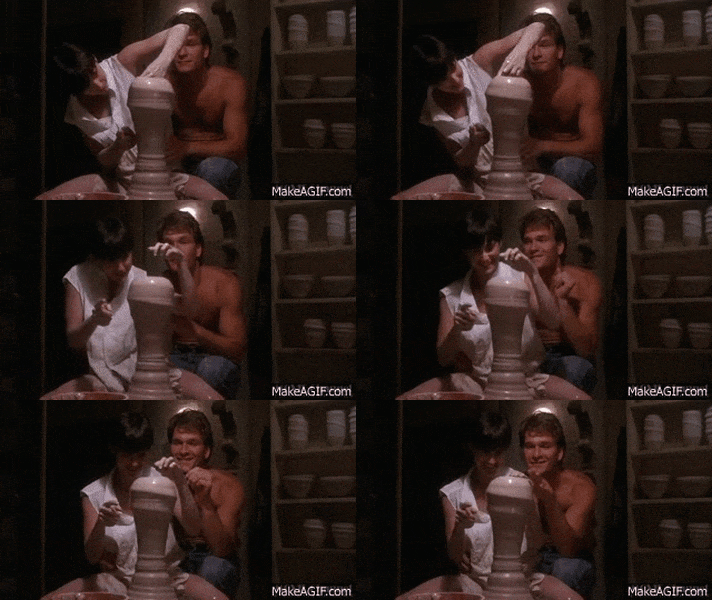
In my experience, the calming effect of art can be quite powerful. As I’ve previously discussed, I often find it hard to switch off my brain at times. However, I have found sculpture to be a powerful way to quieten my mind in the past. I once spent an hour at Art Society in college making a sculpture of dolphins, realizing at the end that I had not thought about anything other than the movement of my hands for the entire duration! 😲 The physical effort can take up a surprising amount of your thought capacity! Granted, the moisture of the clay and drying sensation against the skin may not be great for some autists on a sensory level- but in exposing yourself to new smells and textures through a fun activity, this can greatly help to reduce your tolerance for unpleasant stimuli! 😀

Image result for ghost pottery gif

Knitting can also be quite useful to calm the mind, however, I found that the more I improved, the more room I had in my mind for thought- but hey, it’s still fun, and not as boring as it sounds (my approach should be renamed “extreme” knitting, I have in fact injured myself from my exertions and needed physio in the past… 😛 😂)!

All in all, art therapy offers us a unique way to help improve autistic behaviours by channeling them into something constructive, creative and above all fun 🙂

Enjoy the weekend Earthlings! 🙂

Aoife

Non-Verbal Autism

Greetings Earthlings,

Leading on from my recent post about voice control and autism, this week I’d like to briefly talk about non-verbal autism.

bitmoji-39779843

Granted, I cannot provide any personal insight into the matter, (I could never be described as non verbal 😛 ), but I’ll do my best to explain it! 🙂

So first things first, what is non-verbal autism?

Affecting approximately 25-50% of autists, non-verbal autism is pretty self explanatory- the autist is unable to speak.

So what causes non-verbal autism?

Again, as with most aspects of the spectrum, the cause is unclear. Non-verbal autism is highly under-researched and therefore poorly understood. However, one particular study does indicate that there may be differences in the structure of the brains of verbal and non-verbal autists in areas associated with language. Brain imaging analysis of toddlers indicated that autists who grew up to be verbal showed similar signs of activity in these areas to their neurotypical peers. Toddlers who grew up nonverbal however displayed signs of reduced brain activity in the same areas which would likely explain their struggles to formulate speech.

With early intervention and improved techniques, many nonverbal children can now learn to speak, however, a minority of autists will remain silent. But don’t despair, technological advancements in speech generating devices are now helping to reveal the inner voice of nonverbal autists.

Take the inspirational Carly Fleischmann for example. As I have discussed previously (lesser known ASDs), Carly is a non-verbal autist…and talk show host! :O Carly never let her inability to speak to keep her from her dreams of being a talk show host 🙂

Here’s a video of Carly in action 🙂 :

That’s all for this week dear Earthlings! 🙂

Enjoy the bank holiday weekend!! 😀

Aoife

Autism and Voice Control

Greetings Earthlings! 🙂

Today we’re going to briefly talk about an aspect of the spectrum that many of you may not be familiar with- voice control.


bitmoji-20180418040243

We’re all aware that autism is often accompanied by difficulties with speech (non verbal autism, apraxia, speaking in monotones etc.) however, few are aware of the challenges to control the pitch and volume of our voices.

This is especially challenging for me as I often struggle to accurately gauge my volume. For example, I may think that I am singing along at an appropriate volume, buuuuuut those who are listening to me may have slightly different reactions…

Screenshot_20180420-193011_2

I’ve probably deafened several members of my friends and family at this stage! 😛

For years I could never understand how I was chastised for my mumbling in school, but a shouter at home- I just could never seem to get the balance right.

I naturally tried to rationalize my shouting with waxy ears and struggles to be heard over the din of the school- but is there any scientific explanation for my struggles to regulate tone?

Many acoustic studies have found that prosody (an area of linguistics that focuses on linguistic functions such as tone, intonation, stress and rhythm of speech) is impaired in autists. Prosody is used to reflect emotional states, sarcasm, stress, emphasis and other areas of language that are not conveyed through grammar and vocabulary- an area where many autists struggle.

MRI studies have shown that the areas of the brain involved in the perception and processing of prosody (the left supramarginal gyrus (SMG)) are abnormally activated in autists compared to their neurotypical peers. Neurons in the left precuneus, the left medial prefrontal cortex and the right anterior cingulate cortex should be deactivated when exposed to prosody, however these areas are active in the autistic brain.

As a result, we are often unable to discern the exact pitch, tone or emphasis we should use in conversation. This  abnormal activation also explains why autists often struggle to accurately interpret another persons meaning/intention through their use of prosody in their speech.

Impairments in auditory processing of sound in the brain may also feed into this issue- so try not to judge me too harshly the next time I blow your eardrums out 😬 😉

Have a good weekend Earthlings! 🙂

Aoife

Autism and Masking

Greetings Earthlings! 🙂

This week I’d like to discuss something I’ve briefly touched upon in previous posts (women and autism, ‘Please Stand By‘)- autism and masking.

So what is masking?

bitmoji-928950327

Masking is a common behavioural trait within the autistic community wherein social mimicry is used to “mask” other autistic behaviours in social settings.

Basically this means that autists consciously employ techniques from social observation (such as forced eye contact and rehearsed conversations) in order to better blend into the social landscape to prevent their autistic traits from sticking out. You may not see the autism, but it’s still there behind the mask. Some autists even carry multiple masks to be used for different audiences.

Masking mainly tends to happen among girls with autism rather than boys (boys have also shown signs of masking but not to the same extent). Studies have shown that autistic women are generally better at recognizing emotions than their male peers (almost as good in fact as neurotypicals) and show greater social attentiveness which feeds into our ability to mask.

For example, take a quick look at this video I shared in my previous post where a group of autistic women go speed dating with an oblivious group of neurotypical men:

For me personally, social masking kept me under the ASD radar for many years. Without realizing it, I had been giving an Oscar worthy performance for most of my life.

I figured out how I was “supposed” to act from observing those around me, reading books and watching films (though sadly the amount of rom coms/romance films/novels I consume led to some unfortunate learning curves! 😛 ). I forced myself to make eye contact and to watch my mouth more, I even devised a sort of mental go-to phrase card with acceptable answers to such tricky questions as ‘How are you?’ or how to appropriately answer the phone (which I still dread by the way 😛 )

In one of my more extreme forms of masking, I somehow developed the ability to cry only out of my right eye when I would experience mini meltdowns in school so that the tears would roll down unseen behind a curtain of hair! 😬

I became really good at being invisible….well, at least between meltdowns! 😛 😉

bitmoji56242099

Social masking in girls is thought to be one of the primary reasons that women with autism often go undetected into adulthood, if at all. Research suggests that the ability to mask may even prevent those who have been flagged for assessment from getting the formal diagnosis that they need. In addition to this, a recent survey of autistic adults reported universal exhaustion from their masking exertions which is why it is so important that we develop better diagnostic tools for women on the spectrum.

Have a good weekend everyone! 🙂

Aoife

Autism on Screen- Please Stand By

Greetings Earthlings! 🙂

In this weeks edition of ‘autism on screen’, we’re going to take a look at a brand new film about autism- the 2018 film ‘Please Stand By.

Image result for please stand by poster

What’s that I see in the poster? A young woman with autism?! 😲

FINALLY!

Nice to see Hollywood change things up a bit!

So what’s the story about?

Starring Dakota Fanning (was wondering what she was up to these days after Twlight!), ‘Please Stand By‘ tells the story of Wendy, a girl with Asperger’s syndrome living in a home for people with disabilities. When the opportunity arises to enter a screenwriting contest for ‘Star Trek‘ fan-fiction, Wendy must step outside her comfort zone and boldly cross the country alone (she ran away- a common trait in autistic women) in order to get her script to the studio on time.

You can check out the trailer for the film here:

So how did this film fare in it’s depiction of autism?

Well…as excited as I was to see this film…the reality did not live up to my expectations.

Indeed, Wendy showed the classic signs of autism- meltdowns, lack of eye contact, preference for routine, social awkwardness, literal thinking etc., but she did not stand out as a unique character. She was quirky, but there was nothing unique about her quirks, unlike Sigourney Weaver and her fondness for snow in ‘Snow Cake.

Surprisingly, Wendy didn’t appear to be a savant as in other films, however, she did have superb recall of the minutia of her specialist interestStar Trek‘!

bitmoji431833082.png

I am a little shocked seeing as her character was so derivative in other respects! 😛

What really bugs me about this film however were the missed opportunities. As Wendy spends much of this film by herself, ‘Please Stand By‘ had the perfect opportunity to focus in on the challenges of a high functioning female autist. To the outside world, most autistic women appear fine; we employ learned/observed techniques to blend in- known as ‘masking’. However, behind closed doors it’s a very different story.

Case in point-check out this clip from last week’s Channel 4 documentary ‘Are You Autistic‘:

You would never know that these women are on the spectrum, but you could pick Wendy out of a lineup!

The film uses a lot of narrative introspection to give us some insight (albeit minor) into the autistic psyche, but alas the full potential here was not harnessed. Wendy mainly spoke in ‘Star Trek‘ quotes which while poignant, this narrative could have been put to better use to give us true insight into the speed/and or disordered array of thought within the autistic mind. I often compare my thoughts to that of Marisa Tomei’s character in ‘What Women Want‘ (which by the way is just as funny 18 years on as it was when it was released… Man I feel old!😬).

To be quite frank, the film is kind of forgettable (I even had to look up Wendy’s name she left that little of an impression on me!)- it just didn’t draw me in and I found it incredibly tedious.

But as I say with all these films- if you think it’s your thing, why not check it out? One man’s trash is another man’s treasure after all! 🙂

Enjoy the weekend everyone! 😀

Aoife

Blog at WordPress.com.

Up ↑