Broad Autism Phenotype (BAP)

Greetings Earthlings! 🙂

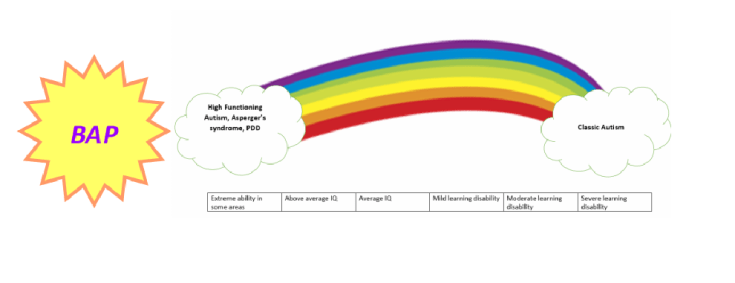
Today we’re going to discuss a type of autism that lies just outside the spectrum- the broad or broader autism phenotype (BAP).

Image result for what gif

What on earth is that when it’s at home?!

BAP is a term used to describe a wider range of individuals just beyond the spectrum who have difficulties with language, personality, and exhibit a number of social and behavioural traits at a higher level than the average neurotypical, but not so high as to be diagnosed with autism.

In other words, this means that you have “a touch of autism” or “not quite autism (NQA)”. The individual has a high number of mild traits, but not enough to interfere with daily life.

So what do we know about BAP?

bap.png

Relatively little- it doesn’t even have a Wikipedia page!

This intermediate description is most commonly associated with family members (parents, siblings, and other extended family members) of those with ASD diagnoses (14–23%), but it can also be found in the general population as well (5–9%).

Interestingly, evidence of an intermediate autism phenotype has existed since the late 1970’s (the term itself was coined in 1994), but it is only in recent years, with the expansion of the spectrum, that it has become a source of research interest for scientists seeking to understand the range of ASD’s that lie beneath the spectrum rainbow.

Broader autism phenotype

Much of the research in this area involves using the BAP to better understand autism- in particular it’s severity and genetics. By analyzing autism traits in families through the prism of BAP for example, researchers may be better able to identify the specific genes which underpin ASDs, paving the way for better therapies for autists.

Apologies for the shortness of this post dear Earthlings, but there is sadly very little information out there about BAP. Perhaps in the future there may be new research that will shed greater light on this subject 🙂

Have a good weekend everyone! 🙂

Aoife

Autism and Smell

Greetings Earthlings! 🙂

As I mentioned in last weeks post on taste sensitivity, this week we’re going to discuss sensitivity to smell in autism.

Image result for smell gif

As with other senses we have discussed, autists can be either hyposensitive or hypersensitive to odours. One autist may enter a malodorous environment without noticing anything amiss, another autist may wretch, or worse!

As a child, my nose was particularly sensitive to my environment (although judging by how I could taste the beer my friends were drinking yesterday evening from the fumes alone, this may still be the case on occasion 😛 ). Bad smells were especially trying- the smell of salads, fish, cigarette smoke, incense, even something so simple as a bag of popcorn could easily turn my stomach.

But it wasn’t all bad- this sensitivity comes with a heightened appreciation for pleasant smells too 🙂

Baking, chocolate, nice perfumes, the outdoors, the smell of metal (don’t ask me why I love this one so much- must be something to do with my taste in music! 😛 😉 )- in fact, such smells are not only a sensory sensation, but can also be used to help calm an autist.

As easily as an unpleasant smell could unsettle me, the right smell could calm me back down again as a child.  I always kept a teddy or a blanket near at hand that I could smell to help soothe and calm me and to lull me off to sleep- I couldn’t sleep without one particular teddy until I was 16!

teddy.png

^^^^My teddy was a lot more raggedy than this…😬

So why does smell affect autists so much?

Interestingly, some studies indicate that there are no differences in sensitivity to smell between autists and their neurotypical peers, however, much research points to the cortex of the brain. This region is heavily involved in smell processing, and yep, you guessed it- the autistic brain shows signs of dysfunction in this region. In fact, the pre-frontal cortex shows signs of overgrowth and excessive linkage in the neurons (just like an overloaded plug), so no wonder sensory perception is altered in autists! This region is also associated with the formation and retrieval of long term memories, which could also explain why smells are often tied to memory recall in autists (which I will explore in more detail at a later stage 🙂 ).

One study also shows that autists may not inhale smells in the same way to their neurotypical peers. Evidence suggests that autists inhale deeply and intensely for both pleasant and unpleasant smells, whereas neurotypicals will tentatively sniff in the presence of an offending odour, which could further explain differences in scent processing.

In addition to this, research suggests that alterations in smell can influence social behaviours. A recent study in fact suggest that autists cannot smell fear and that there is a reversal in their response to fear. In this study, a group of autists were calm when presented with a sample of sweat from a skydiver, whereas their neurotypical peers exhibited classic signs of fear. In contrast, their fear levels increased when presented with the sweat sample from a calm individual!

In other words, an autists social behaviour may be affected by an inability to interpret social cues carried in odours- the mind boggles!

So there we have it dear Earthlings- hope this post didn’t ‘stink’ too badly 😛 😉

bitmoji-2090425460.png

Enjoy the weekend everyone! 🙂

Aoife

Autism and Pain

Greetings Earthlings! 🙂

As I am currently recovering from the removal of my wisdom teeth (contrary to popular belief- my mouth is too small 😛 ), I’ve decided to write about pain and autism this week.

Image result for pain gif

One might imagine that autists have a higher response to physical pain owing to our sensory sensitivities, however, pain perception, as with all aspects of the spectrum, is entirely individual to the autist.

Some are hypersensitive (touching the skin or simply brushing your hair can cause pain), whereas others may in fact have very high pain thresholds. Yours truly unknowingly lived with a permanent ulcer in their mouth from an impacted wisdom tooth for a couple of years due this without batting an eyelid! I thought that was how it was supposed to look…😂😬!

oops.png

So why the polar responses to pain?

The evidence as to why this is is unclear. For many years, researchers believed that people with autism were insensitive to pain as they did not always respond to pain in the usual manner (crying, seeking comfort etc), in addition to the display of self injurious behaviours. However, more recent studies have challenged this notion indicating that people with autism show signs of hypersensitivity to pain in the brain, experiencing greater physiological responses to pain than neurotypical peers.

The autistic brain clearly demonstrates alterations in “normal” pain pathways, but is there a root explanation?

Some evidence points to genetic mutations in such genes as the Shank genes (which have  recently been implicated in a number of autistic behaviours), however, the explanation could be much simpler. As discussed in previous posts, numerous neurotransmitters are dysregulated in autism- neurotransmitters which play an important role in our perception of pain.

Evidence suggests that Dopamine in particular plays an important role in the modulation of pain perception and analgesia in the body. Many studies have linked dopamine dysregulation to autism, which could explain why pain responses vary among autists 🙂

There we have it now Earthlings! 🙂 Hope this post wasn’t too “painful” for you! 😉

Okaaaay, that was a bad one! Sorry 😛

We’ll blame that pun on my wisdom teeth! 😉

bitmoji-630449596

Enjoy the weekend everyone! 🙂

Aoife

Supporting a Child with Autism

Greetings Earthlings! 🙂

For a change today, I’d just like to write a quick post for all of the autism parents out there.

I recently received an email about special needs parenting and it got me thinking about ‘autism parents’. How they must be feeling, the difficulties they face, the struggle to understand, teach and support their child. They really should be called ‘awesome parents’- I certainly didn’t make life easy for mine! 😛

Autism is not the easiest of diagnoses for a parent to hear, but there are many simple ways that you can support your child. Granted, I’m not an autism parent, but as someone who has been on the other side of the fence, I’ll do my best to give you my top tips to support and encourage your child 🙂

bitmoji84905202.png

Educate yourself– Read, read read! Understanding is key to helping your child. A mechanic can’t help your engine if he doesn’t know how it works first.

Don’t believe everything you read–  You’ll quickly learn that one size does not fit all when it comes to autism. Each case of autism is different, every autist will have different needs and experiences to the next. The advice and experience of others can be useful, but remember to take everything with a pinch of salt.

Try to put yourself in their shoes– The world is often alien to us, we don’t always fit in or understand it’s ways. We don’t mean to act weird or meltdown and cause trouble, but oftentimes our brain has other ideas. Try to understand how we see the world before you judge us too harshly 🙂

Know their limits, but don’t limit them– This can be a challenging balance to strike. As I have discussed previously, we should endeavour to understand the capabilities of autistic children, but we must not use autism as an excuse– explanation yes, but never excuse. When we repeatedly excuse an autists behaviour, or tell them they “can’t” do something, we keep them from reaching their potential. For example, as a child, I could not seem to master the humble skip. Had my parents told me to give up due to my coordination difficulties, I would never have overcome this struggle- and would have looked pretty stupid in school shows where such simple choreography was the cornerstone of many a dance number! 😛 😉

Image result for skipping gif

Never underestimate the power of small victories– whether it’s getting your child to wear a bra, tie their shoelaces or a mastered skip, sometimes it’s the little steps that can have the greatest impact. Had I not overcome my seemingly left feet, I would not have discovered a love of dance, never danced on stage or gone out to clubs. Without this small victory I would never have gone on to help choreograph my school play or even teach dancing to kids as a teenager! The victories seem small, but they just may be the tip of the majestic iceberg lurking underneath 🙂

Accept the A-word– Acceptance is at the heart of supporting a child with autism. Without this, they can never truly fulfill their potential. There’s no use in burying your head in the sand. We won’t grow out of autism, we need to accept and grow around it.

Always remember:

Image result for autism end of the world beginning of a new one

So there you have it Earthlings- my top tips for supporting a child with autism. However, like I said, I can only speak from my experiences of autism, so here are some other helpful advice links on more specifc ways to support autistic children:

At the end of the day Earthlings, armed with a little bit of knowledge, understanding and most importantly love- there’s no better way to support your child 🙂

support

Aoife

Autism in the Workplace

Greetings Earthlings! 🙂

Did you know that between 75 and 85% of people with autism cannot find/maintain employment, despite many being highly educated?

Image result for shock gif

Shocking statistic isn’t it?

But why is it so?

Most of us have a strong desire to work and the qualifications to boot, but what we lack are the skills to navigate the workplace and or the interview process.

For many people with autism, the interview is perhaps the most difficult part of the employment process. Unexpected questions can throw us, social niceties can go over our heads, eye contact is a struggle and repetitive movements are often hard to control. We like structure and routine, things we can control and predict; interviews take us out of our structured comfort zones. All these difficulties coupled with the mere mention of the ‘a’ word sadly may see your CV dropped to the bottom of the pile.

Image result for paper in the bin gif

Of those lucky enough to get over the hurdle of the interview, further problems may lie in navigating the workplace itself.

The workplace can be overwhelming for the best of us, but for an autist, this can be even more so. Noise levels and repetitive sounds, the pressure to reach deadlines, the unappetizing smell of your co-workers lunches (whenever someone has fish at work it’s a real struggle for me to hold back my gag! 😛 )- it can be a sensory smorgasbord, not to mention the potential social issues! Some days it just takes all your strength to hold back a meltdown.

bitmoji1523297645.png

Most employers do not understand the needs of an autistic employee, and as such we may easily fall off the career ladder- and not just for reasons of poor coordination! 😛 😉

However, the tables are beginning to turn for the better in terms of making the workplace autism friendly- in fact many companies are now specifically seeking to employ autists to mine our oftentimes untapped skill sets.

But while we wait for the rest of the working world to catch up, here are a few things that you can do to better help you to thrive in the workplace:

work.png

  • Talk about your struggles– shoving it deep down isn’t going to do any good! Talk to someone when you’re feeling under pressure at work- trust me you’ll feel all the better for it
  • Know your limits– if you feel a task is getting on top of you, or you want to jump out of your seat with antsy frustration, take a break- have a snack, go to the bathroom, have an early lunch, or if the company allows it, a quick scroll on your phone. When you feel that overwhelming tidal wave approaching, get out of it’s way; don’t let it take you down
  • Take care of yourself– get enough sleep, stay fed and hydrated. In my experience the combination of exhaustion, hunger and or thirst with the added stress of a tough work task can run the risk of meltdown. Get to bed early, keep snacks and a drink nearby and work will be much easier to cope with
  • Get involved in the work social scene– now I know this one can be troublesome when social anxiety rears it’s ugly head, but making the effort to engage with your co-workers will really help. Many times I’ve forced myself to go to social work gatherings entirely out of my comfort zone and barely knowing the people that would be there, and you know what? It helped me make some brand new friends and put a fresh spring in my step 🙂

bitmoji1086201202.png

I’ll delve into more of my tips and tricks for finding and maintaining employment in a later post 🙂

Enjoy the weekend everyone, be sure to get that Christmas shopping done on time (I may or may not have finished mine a couple of weeks back…#organized! 😛 )

Aoife

Autism Management- Cognitive Behavioural Therapy (CBT)

Greetings Earthlings! 🙂

Today I’d like to briefly examine one of the most commonly recommended therapies for autism management- cognitive behavioural therapy or CBT.

So let’s all lean back in our chez long as we dive in! 🙂

dgdfd_Ink_LI.jpg

First off, what exactly is CBT?

Originally designed as a treatment for depression, CBT is a form of psycho-social intervention (i.e. counselling/psychotherapy) that is widely used to help improve mental health. Unlike other forms of therapy, CBT focuses on developing coping strategies to target our problems and to change unhelpful patterns in emotions, attitudes, negative behaviours,  and thought patterns.

In other words- CBT aims to change negative ways of thinking or cognitions in order to improve behaviour.

counselling

As a result, CBT is widely used to treat anxiety, depression, eating disorders, OCD and a range of other psychological issues- many of which are co-morbid with an ASD diagnosis. It’s thought that CBT can be a particularly useful tool to treat anxiety and to help develop emotional recognition in autists.

CBT was personally recommended to me following my initial diagnosis in order help me to better understand autism and to conquer my social anxiety.

So what did I make of it?

Well, being honest (as we aspies must be 😛 😉 ), my opinions are slightly mixed regarding CBT. Whilst initially I found it helpful as it taught me a lot about autism and the reasons behind my behaviours, after a time, I felt that I didn’t really need it- especially given that I was in my twenties and had already overcome many of the challenges associated with ASD’s. In many ways, simply knowing and understanding Asperger’s Syndrome was enough to assuage much of the mental anguish I had inflicted on myself for being different 🙂

Nevertheless, I did find it beneficial to have a neutral party to talk to in those first initial months post diagnosis. It’s quite a lot to take on board, so it was nice to have that outlet to help guide me through the fog.

All in all, I felt that perhaps CBT may be better suited for a younger person with autism in helping them to develop lifelong coping mechanisms that will enable them to thrive. Had I better understood myself earlier in life through CBT intervention, many things could have been so much simpler 🙂

So if you think CBT may help you or your child, why not give it a try- get out your phone, book an appointment and take a seat on that couch (it’s surprisingly comfy 😉 )

jgg.png

Enjoy the weekend everyone! 🙂

Aoife

Autism and Light Sensitivity

Greetings Earthlings! 🙂

As twinkling Christmas lights are rapidly being erected around me, I’ve been thinking a lot about autism and light sensitivity this week.

Light sensitivity, also known as photophobia (although the phobia part has never really made sense to me! 😛 ), is quite common for autists.

Image result for the light it burns gif

We are hypersensitive to other sensory stimuli such as sound, so naturally, light too can cause sensory issues for many autists. The wrong lighting environment can cause a whole host of problems that can exacerbate behavioural issues.

If lighting is too bright, this can distort vision, cause headaches and sleep disturbances, and of course, sensory overload and meltdowns. Equally, some autists can be hypo or under sensitive to light. This can cause issues with depth perception, coordination and clumsiness in addition to blurred vision.

In my experience, I have some minor sensitivities to light. Bright lights don’t bother me as such, but I find that I sometimes need to wear sunglasses to take the edge off of a sunny day- sometimes even on a grey one. There exists many photos of me climbing a mountain in the midst of a rain storm wearing my sunnies without a care in the world!😂

rain sun.png

Getting to sleep can also be a minor issue for me if the lighting is wrong- a past trip to Norway during 24 hours of light was an absolute nightmare! (it’s just not right!! 😛 )

So why are we more sensitive to light?

Well, as with many aspects of autism, there has been little research into this particular trait. One study has shown that the pupillary light reflex (the reflex that causes our pupils to either shrink or dilate in response to light) is noticeably different between autists and neurotypicals. Results from this study indicated that this reflex is delayed in autists, where the pupils constricted at a slower velocity and a smaller amplitude (i.e. the maximum size the pupil could constrict to) to neurotypicals. If our pupils are not regulating the entry of light into our eyes as efficiently as our neurotypical peers, this could explain why light can sometimes overwhelm us.

Optic nerve hypoplasia (a condition where the nerve connecting the eyes and the brain is underdeveloped) has also been indicated in a number of cases of autism, with photophobia being one of the main symptoms. So perhaps the development of the optic nerve may be impacted in the autistic brain.

So what can you do to help navigate this sensory issue?

  • Wear sunglasses– Ah, my best friends! I carry a pair in my handbag at all times as you never know when the sun might unexpectedly peep out- even in Ireland! 😛 For night time, why not try an eye mask (although if you’re as fidgety as I am at night, this could end up on the floor before dawn! 😂)!
  • Install a dimmer switch– A useful tool to help optimize light levels to suit the individual (and loads of fun to play with! 😉 )
  • Coloured Filters (overlays or lenses)– These are designed to block specific wavelengths of light which a person may be sensitive to in order to manage visual stress; however, there is no real research to support this claim. But as I always say- if it works for you, give it a try! 🙂

sun.png

Hope you enjoyed this post Earthlings! 🙂

Have a great weekend! 😀

Aoife


Should I Tell My Child They Have Autism?

Greetings Earthlings! 🙂

So today we’re going to discuss a very important question when it comes to growing up with autism- should autists be made aware of their diagnosis?bitmoji185739333

Now this question is a little bit tricky.

On one hand, we have the parents who do not want their child to know at all; they want their child to grow up as “normally” as possible so that they may never be held back by the autistic label.

In a sense, part of me would agree with this approach. In a lot of ways, growing up undiagnosed was a blessing in disguise. I was never treated differently (well, by teachers at least- children are another kettle of fish!) and I grew up to be a “normally” functioning adult with a job and friends, never held back by the autistic label.

Buuuuuuutttttttt…

Whilst I can appreciate a parents desire for their child to thrive, the decision not to tell a child about their diagnosis ultimately amounts to sticking your head in the sand.

bitmoji1733715277

We cannot ignore autism and pretend that it’s not happening. There needs to be interventions, strategies and most importantly, understanding.

We don’t just grow out of autism, we need to cultivate an environment so that we can grow around autism. Without self awareness, this will ultimately make life difficult for your child.

What if they found out some other way that they were autistic? If they overheard a teacher, accidentally caught sight of their notes or were taunted by another child? How would you feel if your parents kept something like this from you?

At the end of the day, your child needs to know about their diagnosis; maybe not today or tomorrow, but when the time is right, they will need to know.

Yes, there were some advantages to getting a later diagnosis, but ultimately, life would have been so much simpler for both my parents and I had we known that I was on the spectrum. We would have known how to manage meltdowns, my peers would have understood me better, I wouldn’t have tortured myself for being different- I would have understood and learned to better accept and love me all the sooner.

hugs.png

So don’t worry about holding your child back, or upsetting them; take a deep breath and find a way to tell them- they will thank you for it in the end 🙂

Aoife

Autism and “Stimming”

Greetings Earthlings! 🙂

Today I’d like to touch on one of the most commonly observed autistic behaviours- “stimming”.

So what exactly is “stimming?”

Self-stimulatory behaviour, (also known as stereotypy or “stimming”), refers to many of the repetitive behaviours often exhibited by autists. Examples of these behaviours include scratching or rubbing the skin, noise making, smelling objects and the classic examples of rocking and  hand flapping, although in my experience it’s a lot more like ‘Jazz hands’ than flapping!

jazz hands.gif

There are two psychological theories as to why autists stim:

  • As a response to overwhelming sensory stimuli
  • As a means of relieving stress and anxiety

From a physiological perspective, there are a number of possible biological reasons.

Some researchers believe that stimming provides the autist with sensory stimulation. Contrary to common belief, many people with autism have a reduced sensitivity to certain sensory stimuli. Dysfunctions in the circuitry of the brain mean that the body craves sensory stimulation, and so we adapt repetitive behaviours in order to stimulate and excite our nervous system.

Deficits in dopamine levels in the brain can also interfere with our reward pathways, leading autists to engage in behaviours, such as stimming, which will provide the extra hit of dopamine that the brain needs.

So that’s why I’m drawn to fluffy things! 😉

Image result for stroking fluffy gif

Aside from being drawn to stimulatory texures, I have a particular tendency to fidget with the silver chain around my neck. I just find something oddly soothing about the rough sensation of the metal against my skin! 😛

In my experience, I also find that stimming isn’t always a response to stress, but born from a need to keep my hands busy.

As I’ve discussed previously, research shows that autists have higher levels of excitatory neurotransmitters such as glutamate, and lower levels of calming neurotransmitters in the brain. As a result, we are often hyper-stimulated. Stimulation of the brain’s reward system, i.e.  dopamine release through “stimming” behaviour, causes a decrease in glutamate levels, effectively calming the brain!

This would explain why I’ve often found that stimming sometimes helps me to concentrate and clear my mind by channeling any excess energy into a physical action. I find this particularly helpful when I’m studying, or writing, and for some strange reason while I’m waiting for the microwave to ping! 😛 #excitedforfood

Image result for fidgeting gif

Stimming can also be considered a form of self injurious behaviour, but I’ll write a separate post on this topic at a later stage 🙂

So is there anything that can be done to control this type of behaviour?

bitmoji339468972

  • Try replacement behaviours– if the stim is not socially acceptable or harmful, as in the case of biting behaviours, attempt to replace the stim with another one such as a fidget toy or chewing rubber
  • Exercise– there is evidence to suggest that exercising can decrease the frequency of stimming behaviours, although the research is unclear why
  • Cognitive behavioural therapy (CBT)– is thought to be useful as self stimulatory behaviour operates in a similar way to OCD tendencies which are often managed through CBT techniques
  • Medication– Seems there’s a pill for everything these days! Medications can be used to help modify compulsive behaviours such as stimming, but I personally would not advocate this route

So there we have it Earthlings, a brief insight into stimming behaviours in autism! 🙂

Enjoy the weekend everyone! 🙂

Aoife

Autism Through The Ages

Greetings Earthlings! 🙂

In this week’s post I’m going to briefly explore the history of autism.

So gather round for storytime! 😀

fgghd

As autism rates increase, many people have come to believe that the condition is relatively new. Whilst the clinical term may be in it’s infancy, autism can in fact trace it’s genetic lineage back through millennia!

Genetic research has shown that some of the key genes involved in the development of autism came from our shared heritage with the apes, predating the evolution from monkey to man (somewhere in the region of 7 million years ago).

Image result for evolution

Other related autism genes are slightly more “recent” than this, having come into existence over 100,000-years ago.

Whilst a third of autistic genes may come about through spontaneous genetic mutation, from this evidence we can see that autistic genes were inserted into the genetic code of our ancestors for a reason.

Interestingly in ancient times, people that displayed autistic traits were in fact highly revered. Such autistic traits as exceptional memory skills, creative thinking, observational skills, heightened senses and extensive knowledge in important areas such as plants and animals (i.e specialist interests), would all have been greatly valued in an ancient community. The incorporation of these skills within the group would have been essential to their survival.

Experts also believe that autistic skills such as memory and attention to detail may have contributed to the creation of ancient cave paintings such as this one:

How often we focus on the negatives of autism that we fail to stop and consider the reasons these genes exist. If they were a hindrance to the human race, why have they not been eradicated through millennia of evolution?

I think Temple Grandin sums it up pretty well here:

Image result for autism genes memes

And she would be right! 😉 Experts believe that autistic genes have been conserved to advance our intelligence. Variants of autistic genes have been linked to improved cognitive performance and the formation of new brain cells.

Such talented historical figures as Michelangelo, Mozart, Beethoven and of course, Albert Einstein, are all believed to have shown signs of autism- but history remembers them for their esteemed achievements, not their genetic quirks.

Something that we would all do well to think of when we commit autistic people to the annals of history in future.

So there we have it Earthlings, I hope you find this information as interesting as I found it 🙂 I could go on further buuuuttt I think I’ll spare you the clinical history of autism for another day 😉

Have a good weekend everyone! 🙂

Aoife

Blog at WordPress.com.

Up ↑