Supporting a Child with Autism

Greetings Earthlings! 🙂

For a change today, I’d just like to write a quick post for all of the autism parents out there.

I recently received an email about special needs parenting and it got me thinking about ‘autism parents’. How they must be feeling, the difficulties they face, the struggle to understand, teach and support their child. They really should be called ‘awesome parents’- I certainly didn’t make life easy for mine! 😛

Autism is not the easiest of diagnoses for a parent to hear, but there are many simple ways that you can support your child. Granted, I’m not an autism parent, but as someone who has been on the other side of the fence, I’ll do my best to give you my top tips to support and encourage your child 🙂

bitmoji84905202.png

Educate yourself– Read, read read! Understanding is key to helping your child. A mechanic can’t help your engine if he doesn’t know how it works first.

Don’t believe everything you read–  You’ll quickly learn that one size does not fit all when it comes to autism. Each case of autism is different, every autist will have different needs and experiences to the next. The advice and experience of others can be useful, but remember to take everything with a pinch of salt.

Try to put yourself in their shoes– The world is often alien to us, we don’t always fit in or understand it’s ways. We don’t mean to act weird or meltdown and cause trouble, but oftentimes our brain has other ideas. Try to understand how we see the world before you judge us too harshly 🙂

Know their limits, but don’t limit them– This can be a challenging balance to strike. As I have discussed previously, we should endeavour to understand the capabilities of autistic children, but we must not use autism as an excuse– explanation yes, but never excuse. When we repeatedly excuse an autists behaviour, or tell them they “can’t” do something, we keep them from reaching their potential. For example, as a child, I could not seem to master the humble skip. Had my parents told me to give up due to my coordination difficulties, I would never have overcome this struggle- and would have looked pretty stupid in school shows where such simple choreography was the cornerstone of many a dance number! 😛 😉

Image result for skipping gif

Never underestimate the power of small victories– whether it’s getting your child to wear a bra, tie their shoelaces or a mastered skip, sometimes it’s the little steps that can have the greatest impact. Had I not overcome my seemingly left feet, I would not have discovered a love of dance, never danced on stage or gone out to clubs. Without this small victory I would never have gone on to help choreograph my school play or even teach dancing to kids as a teenager! The victories seem small, but they just may be the tip of the majestic iceberg lurking underneath 🙂

Accept the A-word– Acceptance is at the heart of supporting a child with autism. Without this, they can never truly fulfill their potential. There’s no use in burying your head in the sand. We won’t grow out of autism, we need to accept and grow around it.

Always remember:

Image result for autism end of the world beginning of a new one

So there you have it Earthlings- my top tips for supporting a child with autism. However, like I said, I can only speak from my experiences of autism, so here are some other helpful advice links on more specifc ways to support autistic children:

At the end of the day Earthlings, armed with a little bit of knowledge, understanding and most importantly love- there’s no better way to support your child 🙂
support

Aoife

Autism on Screen- Mercury Rising

Greetings Earthlings! 🙂

It’s been a while since I’ve done one of these, so today I would like to take a quick look at the 1998 political action film (not a genre one would immediately associate with autism)- ‘Mercury Rising‘.

Mercuryrisingposter.jpg

So how does this action film relate to autism?

In this film, the NSA has created a cryptographic super-code (Mercury) that was thought to be unbreakable by any computer in the world. However, following the release of the code in a childrens puzzle book in order to test it, autistic savant (not again!!! 😛 ) Simon easily cracks it. This simple act puts his life in danger as contract killers are sent to silence him as the NSA believe him to be a liability. FBI agent Art Jeffries, played by Bruce Willis, is assigned the difficult task of protecting Simon from these killers whilst also navigating the social and behavioural challenges associated with his autism.

You can check out a trailer for the film below:

Honestly, I found the film to be particularly tedious (not a desirable quality for an action film), and really struggled to make it through to the end. 2 hours is a loooong time for a boring film! 😛

As to the film’s portrayal of autism, you know what I’m going to say- we NEED to stop perpetuating the stereotype of the autistic savant! As I have discussed many times, this is a RARE characteristic (roughly 1 in 10 autists), and yet almost every film I’ve seen that features autism depicts this rare trait in some form or another! 😛

Give me strength!

Aside from this, whilst the film did touch on such important topics as ‘wandering’ and issues of trust (which are not always depicted where autism is considered), I just felt that this character was highly stereotyped and that autism was poorly portrayed overall and at times was a little insulting. In fact the original book that this film is based on was titled ‘Simple Simon!’😲😒

This may even perhaps be one of the worst depictions of autism on screen in my opinion.

So all in all, if you need a good sedative, or are a huge Bruce Willis fan, this film’s for you! 😛 😉

Enjoy the weekend everyone! 🙂

Aoife

Accepting your Autism Diagnosis

Greetings Earthlings! 🙂

To kick off the new year I’m going to expand a little bit on something I’ve touched on briefly in the past- coming to terms with your autism diagnosis.

As I’ve stated many times, getting my Asperger’s diagnosis was one of the best things that could have happened to me. Two little words clarified a lifetime of questioning, confusion and misunderstanding.

My entire life finally began to make sense.

bitmoji-1865562563.png

Whilst this diagnosis was indeed a welcome one (in spite of the way my diagnosis was sprung on me 😛 ), I struggled to come to terms with it for some time afterwards. As an adult, the diagnosis shouldn’t have changed anything- Asperger’s syndrome explains me, but it does not define me.

However, just because the shoe fits does not mean that you will break it in overnight.

Logically, there was no issue in being diagnosed; the emotional aspect on the other hand was much tougher.

Getting my diagnosis was like seeing myself for the first time in a mirror. It felt like I had made a revolutionary discovery, and yet  somehow, I was ill at ease. The more I read about Asperger’s, the more self conscious I became of my mannerisms and behaviours. I was hyper-aware of everything that I did.

I knew and accepted that Asperger’s didn’t define me, however, I felt compelled to define it. I talked about Asperger’s incessantly possessed by the niggling urge to explain every single thing I did for fear of being misunderstood. As a friend recently told me, she barely knew my name before I had filled her in about my diagnosis! 😂

There were times when I felt as though I were beginning to disappear behind the smokescreen of the diagnosis, constantly questioning what was me and what was just Asperger’s.

bitmoji-386840795.png

It took me over two years to learn to fully relax and embrace my diagnosis- somewhere along the way it just clicked. I no longer feel this need to go on about it. Indeed, there are times when I want to talk about it (for example in this blog), but I am also perfectly content to keep people guessing 😉

Asperger’s is a big part of my life, but it’s not the whole picture 🙂

Here’s just a couple of things that helped me on my journey towards acceptance:

  • Talk about it– Real original- I know, but if it ain’t broke don’t fix it!
  • Try CBT– Now I know that I’ve said CBT wasn’t particularly useful for me from a management perspective, buuuuuut cognitive behavioural therapy did help to increase my knowledge of autism and better understand who and why I am 🙂
  • Write it out– I know I’ve said it before, but writing can be so cathartic. It really helps to verbalize what you can’t describe, especially if you have alexithymia. My laptop is full of mini essays from deflating my overly full skull at 3am! 😛
  • Read – Whilst this may have partially fueled my hyper-analysis, it also allowed me to better understand and accept myself. The more I learned, the easier it was to accept and embrace my quirks. Just maybe steer away from some of the novelizations of autism- these don’t always paint the most realistic of pictures 😛

Learning to accept an autism diagnosis (as cheesy as it sounds) is a journey. There may be twists and turns and many a speed bump along the way, but you will one day reach your destination 🙂

distance.png

Aoife


Should I tell my Employer I Have Autism?

Greetings Earthlings! 🙂

In continuation from my previous post, I’d like to discuss a very important question for autists in the workplace: should you tell your employer that you are on the spectrum?

bitmoji148542879.png

This is a tricky one to tackle.

On the one hand, your employer can better support you and help to adjust aspects of your role to suit your needs; on the other, many employers are poorly informed about autism. As a result of this, you may be misjudged and your true potential overshadowed by the big bad ‘A’ word.

In my career, I have had both positive and negative experiences when informing my employer. One employer was highly supportive- my diagnosis was openly discussed and viewed as an asset. In another position, my abilities were overshadowed by my diagnosis. Having Asperger’s was seen as a problem, and my career was reluctantly diverted down an entirely new road (which thankfully was fruitful). As a result of this, I chose not to reveal my diagnosis to my current employer in order to allow my work to speak for itself without an autism filter.

So what should you do?

Image result for hmm

There is no right or wrong answer to this question; the answer is entirely individual. In my case, thankfully my needs are minimal (a bottle of water and some snacks go a long way towards managing my more eccentric behaviours, and the occasional cake will help distract from foot-in-mouth tendencies 😛 😉 ). I am in the lucky position where I can pass for neurotypical, however, there are many autists out there that may struggle in the workplace if not adequately supported by their employer.

Ultimately the “right” answer is what is right for you.

Assess the situation- Do you need the extra support? Would you feel more comfortable/uncomfortable if your co-workers were aware? Is this the kind of company that will support you if you choose to tell them?

At the end of the day, it’s up to you.  You are under no obligation to reveal this information if you are no comfortable doing so.

And remember- whatever your decision, it will all come right in the end. If an employer doesn’t want you, then you don’t want them.

There are much better opportunities waiting out there for you 🙂

bitmoji1293571427.png

Aoife

Bullying and Autism

Greetings Earthlings 🙂

Bullying- neurotypical and neurodiverse alike, we’ve  all been there at some point, but did you know that autistic people are bullied nearly five times as often as their neurotypical peers?

Studies have estimated that as many as 46% of people with autism have been bullied at some point in their life versus 10% of the general population.

bitmoji-1835291873

Our issues with social awkwardness and interpretation, hypersensitivity, literal thinking, poor motor skills and trusting nature can make autists quite vulnerable to bullies. Sometimes we aren’t even aware that we are being targeting and so the bullying goes unreported.

Navigating school as an un-diagnosed teenager was particularly challenging. My literal thinking meant that I was often unaware that I was being made fun of, simple things said in attempts to fit in were turned into taunts, my expressions of individualism were ridiculed- and I just couldn’t understand why.

When I finally started to realize what was going on, it was devastating. I felt like such a fool that I shoved my emotions down and tried to pretend that I was fine.

Buuuuuttttt there’s only so long you can continue to ignore a full septic tank for before chaos erupts…

Once your peers have seen you have a meltdown, some people will do anything to trigger another one.

So I trudged along quietly everyday blaming myself for the teasing I endured:

Why was I so naiive?

Why did I say that?

Why did I lose it? 

Why can’t I be normal?

I sat back and allowed the storm clouds to gather overhead every time I reached the school doors.

bitmoji-1234681477

It wasn’t until I burned out and hit breaking point that I realized I had to find a better way through, began to talk and learned, not just to cope, but to thrive 🙂

So what advice would I give to someone on the spectrum who find themselves in the midst of a bullying situation?

Well, as the bullying game has intensified with the spread of social media since my schooldays (rural Ireland had quite limited access to high speed internet in the noughties), this is a tough one to advise, but here are some of my top tips:

  • Ignore the bullies– An obvious one that’s easier said than done, I know (I pretended to ignore for years- it can take quite a bit of practice to truly let words glide off your back), but when you react or meltdown- that’s what fuels them. My reactions made bullies push my buttons all the harder. If you feel a meltdown coming on, take a moment to go somewhere quiet, get some fresh air and take a deep breath.  Bathroom stalls were a personal favourite of mine to give me some time to regroup (unless someone had been smoking in there… this added further sensory fuel to the fire! 😛 )
  • Find an outlet for your emotions- We autists experience and process our emotions in very different ways. If you shove things down, the end result will not be pleasant. So run, dance, go on a four hour killing spree on your PlayStation (something that I wouldn’t know anything about… 😛 )- do whatever works for you to deal with your frustrations. I know it’s hard, but finding an outlet will help to quell the dragon inside.
  • Try to think before you act/speak– Again this is quite challenging when you don’t have a filter or struggle with impulsivity, but sometimes what may seem like the most simple of sentiments to you can be twisted and misconstrued by bullies. An innocent comment I once passed about the family dog led to years of jeering and implied bestiality…! I still put my foot in it every now and again, but I’ve gradually learned to pause more to assess if my comments will sink or float.
  • Be careful what you post on social media- The online world can be a dangerous, unregulated one. We live so much of our lives online we forget that our peers are always watching. As with your thoughts, take a moment to think through your posts. Something as simple as a picture or throwaway comment could land you in bother both on and offline (a simple lack of an appropriate emoji once caused a rift with a friend). Remember- it’s also perfectly ok to abstain or take some time away from social media. It may seem like social suicide, but we all need time away from our screens- people disable their accounts every day for lots of reasons so don’t worry about what they’ll think at school. Your sanity is far more important 🙂
  • Talk to someone– If you’re being targeted, tell a teacher, confide in a friend or talk to your parents so something can be done. But bear in mind, they can’t always  intervene. Teasing is a natural part of life as much as it may hurt (something that the autistic mind really struggles to comprehend), and not everything can be prevented. What may seem a devastating comment to your mind may mean nothing to an outsider. Intervention aside, by simply talking to someone about how you’re feeling, this will make the load so much easier to bear. Don’t let the quicksand claim you- ask for help!bitmoji2141702869

At the end of it all, just remember what my Biology teacher once taught me- “Whoever said that your school days are the best days of your life lied- college days are the best days of your life!”

So don’t get disheartened Earthlings! It may be hard to see it through the swirling fog in the crystal ball, but life does get so much better (…once you get past the bills, taxes and work-day traffic jams! 😛 😉 ).

Aoife

Autism on Screen- Atypical

Greetings Earthlings! 🙂

So today I’m going to place Netflix’s latest original offering ‘Atypical‘ under the microscope.

Image result for atypical

The series has been widely discussed within the autistic community this week, but in case you haven’t heard about it- ‘Atypical‘ is a coming of age series which follows Sam, an eighteen year old boy with high functioning autism as he sets out to find a girlfriend.

You can watch a trailer for the series here:

The series has received mainly positive reviews from critics (Forbes claim it to be the greatest series Netflix has ever made- uh, ‘Daredevil‘ anyone? 😛 ), but some have critiqued the stereotypical nature of the character of Sam.

So what did I make of it?

fgsdtr

Show creator Robia Rashid, who herself has experience of autism in her personal life, conducted a lot of background research and hired autism consultant Michelle Dean to review all scripts and cuts- and in my opinion, it shows!

I found ‘Atypical’ to be a quite enjoyable and endearing series. I particularly enjoyed the coming of age angle, taking us away from the typical child/awkward adult portrayals that we see all too often on screen. It’s refreshing to see autism from the perspective of a teenager on the spectrum, a particularly turbulent time in the life of a change resistant autist (even more turbulent if navigated undiagnosed as in my case).

And guess what- the creators didn’t resort to savant stereotypes! 😀

Granted, Sam is highly intelligent with an excellent memory, but these traits are subtly infused within the fabric of his personality. I particularly found the acting from lead Keir Gilchrist, who based his portrayal on his experiences with autistic friends, to be quite excellent, especially for an actor of his age.

Image result for atypical

However, as excellent an actor as Gilchrist may be, many have criticized the show for casting a neurotypical actor in the main role. On the other hand, show creators did feature actor Anthony Jacques (seen on the right below), who is himself autistic. Alas, while described as a “supporting” character in many reviews of the show, he briefly appears in only two episodes.

Capture.PNG

Nevertheless Jacques’ character of Christopher forms a refreshing addition to the cast with his quirky enthusiasm, representing a higher functioning bracket of the spectrum.

Perhaps the thing I enjoyed most about the show was how it focused not just on how autism impacts Sam’s life, but it also gave equal screen time to the impacts of autism within his wider social circle. We see the toll that autism has placed on Sam’s parents and their marriage, the responsibility that Sam’s younger sister burdens herself with and the reactions of friends and others in the community towards Sam.

As much as I personally enjoyed the show however, there were times where Netflix veered towards the stereotypical. For example, I felt that Sam was a little too literal in his thinking/responses:

Zahid (Sam’s friend): “I’m taking you to Poon-city!”

Sam: “That’s not a real place”

We have our moments yes, but not everything is quite that literal.

Related imageRelated image

I also found issue with how Sam always speaks in measured monotones- a common autistic stereotype. Whilst, yes, this is characteristic of some within the autistic community, it is not for all. My tone of voice for example can be anywhere from high pitched to a deep drawl depending on the mood I’m in (or an opportunistic head cold 😉 ). This stereotype crops up time and time again in on screen portrayals and it is really starting to bug me! 😛

Once again as I watched this show, I felt as though I were seeing yet another carbon copy autistic person dance across my screen. The show talks about neurodiversity, but the character of Sam is, to my eye, far from diverse.

Perhaps Netflix would do well to feature an autistic female lead if the show is renewed for a second season.

All in all, ‘Atypical‘ is a mostly enjoyable affair so check it out if you have a spare 4-5 hours for a weekend binge watch 🙂

Aoife

Autism Management- Sound

Greetings Earthlings 🙂

So leading on from my recent post about sound sensitivity and autism, today I’m going to expand a little bit more on the subject.

Fun Fact: Did you know that an estimated 65% of autists are sensitive to sound?

Being sensitive to sound can be quite challenging for those on the spectrum, but that doesn’t mean that it can’t be managed.

So here are some of my top tips for managing sound sensitivity:

  • Earplugs/Noise Cancelling Headphones- I know, it’s the obvious one, but it has to be said! Using these can really help to take the edge off for many autists in noisy environments. These can be especially helpful if you are a fan of live music, but find gigs too loud- I have genuinely seen people wear noise canceling headphones, earplugs and cotton wool to gigs, you will not be alone! 😀 Added Bonus– it can also discourage unwanted conversations 😉 Image result for headphone memesIf you’re in the market for a pair, the nice folks at reviews.com have a really good article comparing the best on the market:  https://www.reviews.com/noise-canceling-headphones/
  • Listen to music– if you don’t appreciate the sound of silence like Simon and Garfunkel, then hooking a set of headphones up to a music player is another great way to manage sound sensitivity. You can control what sounds you will hear, drown out potential triggers and have some fun while doing so! 🙂 This is particularly useful in the workplace to help focus your mind on your work whilst keeping distracting sounds out.

download (3)

Top tip– headphones for leisure (comfier for long journeys, seal in the sound better, and will stop your parents complaining about the volume 😉 ); earbuds for the workplace (drown out sound whilst still allowing you to hear if you’re needed by colleagues).


  • Try a silent disco- If sound sensitivity is keeping you from partying the night away in the club, why not go to a silent disco (as seen in the final episode of Atypical)? These are quiet, but loads of fun- and they enable you to control both the volume and choice of music. As an added bonus, you can take off your headphones at any time and have a conversation without the need for shouting 😀


  • Move away from the offending stimulus– I know it sounds a little silly, but sometimes you just need to take a step away from offending sounds.

Image result for step away gif

We can’t always walk around wearing noise cancelling headphones -they can really irritate your ears if you wear them for too long, especially if you happen to be wearing earrings at the time! 😛

Top Tip- If you’re feeling overwhelmed by an irritating sound, especially on a night out, take a few minutes to go outside or to the bathroom, or try stepping out to the quiet of the smoking area (although this may result in a different kind of sensory assault…)


  • Ask if an offensive sound can be stopped– Naturally, we can’t go around demanding that someone chew less loudly or ask the DJ to turn the music down (can’t commit social suicide!), but it doesn’t hurt to ask a friend/family member to turn down the car radio volume, not to pop balloons around you or to stop playing with that sonic app that makes your ears bleed (remember people playing with those in school as the teachers could never hear the frequency?)!


  • Magnesium supplements– Now this one is a little weird. Some people believe that magnesium deficiency attributes to our sensitivity to sound…this smells a bit like pseudoscience to me… but hey- if it works for you, who am I to question it!

So there we have it Earthlings, my top tips for managing sound sensitivity on the spectrum 😀

Have a good weekend everyone (unless you’re back to school next week- in that case, my condolences! 😛 😉 )

Aoife

Autism Management- Concerts

Greetings Earthlings! 🙂

Ah, live music! There’s nothing I love more than a decent rock concert!

“But wait- wutt?! 

You’re autistic! Surely you can’t enjoy a loud, flashy, crowded rock concert?!”

Image result for wrongo gif

Plleeeeeeeeeeeeeeease! 😛

What do I always say? No two autists are alike!!!!

Sure, sudden noises can make me jump, but in actual fact I love the noise! I relish the chaos of alternative rock! The vibration of the music through your body, the bright lights, the pyrotechnics, the showmanship- it’s really hard to beat a decent concert.

That being said, my love for gigs has not come without it’s challenges.

At my very first gig (Paramore’s Brand New Eyes tour, 2009), I suffered both a meltdown AND a shutdown! The crowd made me very unsettled and uncomfortable moshing during Paramore’s opening number, so I spent the remainder of the concert on the sidelines crying and alone! 😛 We subsequently almost missed our bus home, the stress from which brought on a shutdown.

Certainly a memorable and eventful night! 😛

Indeed, concerts can be overwhelming for both neurotypical and neurodiverse alike, but that does not mean that a concert can’t be an enjoyable experience. It’s all about finding what works for you 🙂

Here are my tips for finding comfort at a concert:

bitmoji-1572203057

  • Outdoor vs indoor venues: This is one that I’m learning the hard way. Outdoor gigs, whilst a little easier on the ears than indoor venues, can be a real mixed bag in terms of enjoyment. Crowds are bigger, snagging a good vantage point can be tricky and security have far less control over crowd behaviour. I spent much of my last gig being kicked in the back by a girl sitting on her boyfriends shoulders. Take my advice- choose indoor gigs for your favourite artists.
  • Choose seating– After my first “pit” experience, I have made a point of always choosing to pay a few euros more for a decent seat in large arenas. This way you avoid strangers touching you, claustrophobia, tall people, reduce exposure to potentially unpleasant odours (outdoor gigs are a real pain if you hate smoking as I do) and prevent being unexpectedly hit by stray “balloons”, flying glasses of beer and, on one random occasion, black nail varnish! Don’t you just miss the emo kids of the mid noughties? 😛

 emo ryan higa nigahiga how to be emo GIF

Alternatively, if you’d rather be closer to the action, smaller venues (< 2000 capacity) generally offer more comfortable standing experiences. Crowds are spaced out more and are better behaved with security always close at hand 🙂

  • Sunglasses-Not as crazy as it sounds I promise! Sunglasses are my best friend as they really help to take the edge off bright lights. I’ve even been known to wear them on a night out in the club on occasion! Don’t worry about what other people think- it’ll be dark and everyone will be too focused on the stage to notice 🙂
  • Earplugs– This one may seem a little bit counter productive, but lot’s of people do it. Loud music is part and parcel when it comes to gigs, but sometimes the noise can be a little excessive. Take my most recent concert just last week. I was standing in front of a girl who insisted upon screaming every 5 seconds for 2 and a half hours- not like your average fangirl, but a murder victim (the kind of piercing scream that makes you jump every time you hear it)! Quite frankly, she’s lucky she wasn’t my murder victim! 😜😂 I was rather envious of a nearby concertgoer for having had the sense to bring a pair!

So there we have it, my top tips for managing autism at a gig!

As I always say, you should never allow an autism diagnosis to hold you back- if you can’t climb the mountain, there’s always a way around it 🙂

So rock on dear Earthlings! 😉

bitmoji-725899322.png

Aoife

Autism on Screen: Forrest Gump

Greetings Earthlings! 🙂

Today we’re going to have a look at the portrayal of autism in the multi-award winning 1994 classic ‘Forrest Gump‘.

I know, it’s not a film that specifically mentions autism, but it’s on a list of films featuring autism by the Autism Research Institute so we’ll have a look anyway! 🙂

In actual fact, ‘Forrest Gump‘ was based on a book of the same name by Winston Groom (1986) in which the title character is an autistic savant with great mathematical ability! I’ll have a read of this at some stage and discuss it in the future 🙂

Forrest Gump Cover.jpg

So what’s ‘Forrest Gump‘ about?

In short, the film details the life and adventures of one Forrest Gump native of Greenbow, Alabama. Slow witted, but kind hearted, Forrest find’s himself in the midst of some of the most pivotal events in modern American history, showing everyone that mental disability does not preclude you from living a most extraordinary life.

For anyone who has yet to see the film- here’s a little trailer:

So how does ‘Forrest Gump‘ fare in it’s portrayal of autism?

Whilst ‘Forrest Gump‘ may not intentionally portray autism as in the book, nevertheless Forrest displays many autistic characteristics consistent with a diagnosis of Asperger’s syndrome. He does not always display socially appropriate behavior, as demonstrated by the memorable scene in the White House where he tells JFK that he has to pee! Forrest doesn’t always make eye contact, has some specialist interests (such as Jenny and Ping Pong) and can often ramble on, speaking in monotones as is often associated with AS. Forrest also demonstrates that he is a literal thinker in the film, often leading to some of the more humorous moments.

Image result for have you ever been with a girl forrest gump

Interestingly, the film depicts Forrest in a more realistic light than in the book. Whilst he is described in both as having a low IQ in the 70’s, Forest is not portrayed as a stereotyped mathematical savant in the film.

FINALLY! A bit of realism! 😛 😉

Although entirely fictional, this film delivers the audience an encouraging message of hope. In spite of his mental limitations, Forrest goes on to lead not just a “normal”, but an extraordinary life.

Forrest’s tale truly shows us how, as I’ve often remarked in this blog, you should never allow autism to hold you back. An autism diagnosis can be a challenge yes, but it does not mean that you can’t live a “normal”, happy and fulfilling life 🙂

To quote Sally Field in this film:

Image result for forrest gump gifs

Enjoy the weekend everyone! 🙂

Aoife

Autism on Screen- Sesame Street: Meet Julia

Greetings Earthlings! 🙂

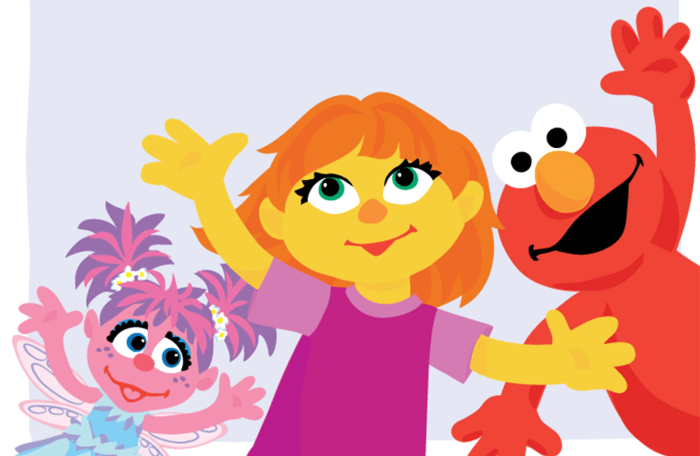
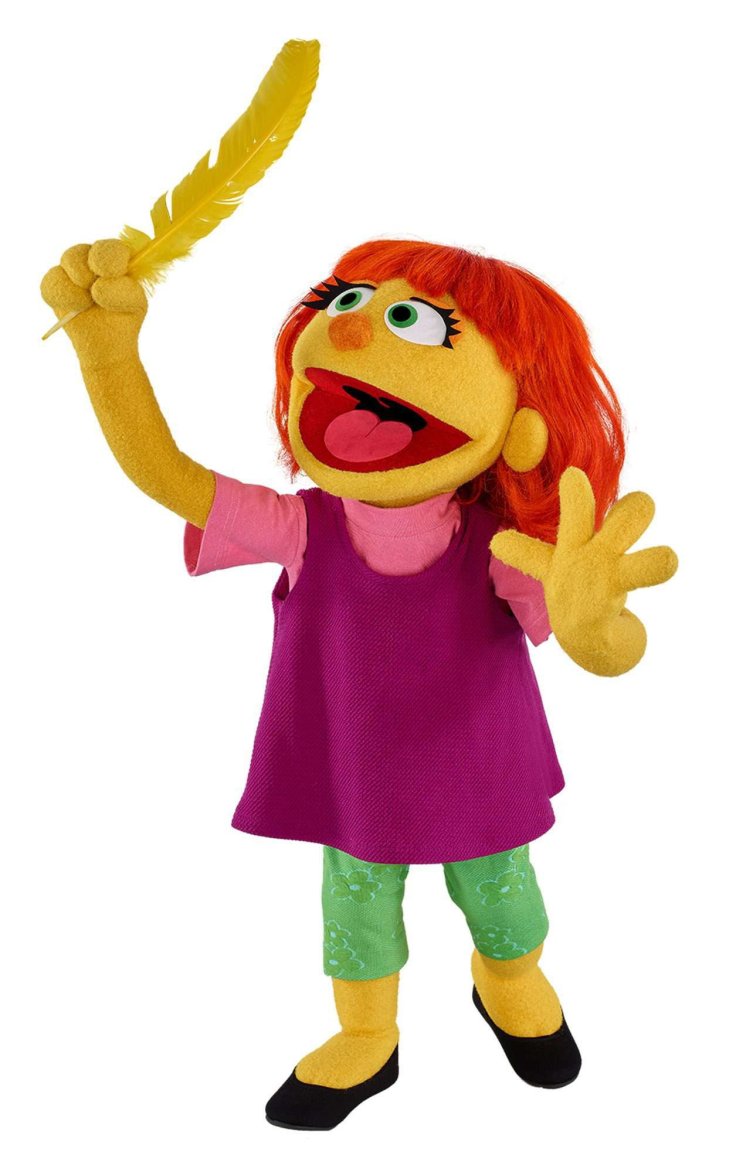
Earlier this week, popular children’s TV show Sesame Street officially debuted a new puppet with a twist- a puppet with autism! 😀 The character of Julia was introduced as part of Sesame Street’s autism initiative, first appearing on Monday to rave reviews from fans, experts and parents everywhere.

Image result for julia sesame street

Whilst only making the news in recent months, Julia has in actual fact been around since 2015, having first appeared in an online storybook about autism as part of ‘Sesame Street’s’ autism initiative- ‘Sesame Street and Autism: See Amazing in All Children’.

The creators of Sesame Street established this initiative in 2015 in order to promote better understanding of the condition after a study revealed that children with autism are more than five times more likely to be bullied than their peers!! This initiative was developed in partnership with autism workers, advocates, parents and autists themselves in order to ensure that the topic is handled in the best possible way.

You can find out more about the initiative here:

http://autism.sesamestreet.org/

It’s a nifty little website providing videos for kids, videos for parents, daily routine cards and loads of other useful materials for children and adults alike 🙂

So what is Julia actually like?

Image result for julia sesame street

Julia first appears onscreen quietly painting with her friends Elmo, the fairy Abby Cadabby and Alan. When Big Bird comes on the scene, Julia largely ignores him, completely engrossed in her painting. The other puppets are engaging in finger painting, but Julia makes noises of disgust and uses a paintbrush instead, with Abby remarking that Julia hates the feeling of paint on her fingers.

With their paintings finished, Abby gives Julia’s painting huge praise (it was easily better than Abby and Elmo’s efforts), remarking that she is very creative- casually demonstrating the talents that autists possess without veering into savant stereotypes. Big Bird tries to hive five Julia for her efforts, but still she ignores him, making no eye contact. When Julia hops off to play tag with the other puppets, Big Bird questions whether Julia likes him or not. This leads Alan to explain autism to Big Bird so that he understands that Julia does things a little differently, “in a Julia sort of way“- but she’s also lots of fun! 🙂

Later in the episode, Julia hears nearby sirens and covers her ears in response to the noise, needing to go somewhere quiet for a bit, subtly demonstrating how an autist can struggle with sensory sensitivity. Julia also carries around Fluster, a rabbit toy which she strokes to help her calm down, showing the audience ‘stimming’ in action.

The primary focus of this segment is to demonstrate that although Julia has autism, she can play and be your friend just like everyone else. After Big Bird remarks that Julia is not like any friend he’s ever had before, Elmo and Abby point out that none of them are exactly the same, bird, monster, fairy- they are all different, but are friends regardless. Julia talks a little differently, repeats sentences, flaps her arms when she gets excited- but she’s just another playmate, however different, at the end of the day 🙂

You can watch Julia’s debut in full in the video below 🙂 :

My school life would have been so much easier had other children been better able to understand and accept me as the other puppets accept Julia, but with initiatives like this at work I have great hope for the next generation 🙂

This episode was handled both sensitively and intelligently to provide children everywhere with an insight into autism. All behaviours are explained, little is left for the audience to guess at. Julia is different to the other puppets yes, but the episode normalizes her differences so that when children encounter real people like Julia, they will be treated with acceptance and understanding 🙂

Here’s a behind the scenes look at how the character was brought to life:

Fun Fact: Julia’s puppeteer (who can be seen in this video thumbnail) is a mother to an autistic son in reality!

This was a pleasure to watch and I look forward to seeing all of Julia’s future adventures in the show! 🙂

Aoife

Blog at WordPress.com.

Up ↑