Autism and Relaxed Performances

Greetings Earthlings! 🙂

Happy new year! Hope you all had an enjoyable Christmas holiday! 🙂

This week I’d like to talk about relaxed performances in the theatre and how they can be beneficial to autists.

So what exactly is a relaxed performance?

A relaxed performance is pretty self explanatory- it is a performance in the theatre where the normal rules and etiquette are “relaxed” and the ambiance is adjusted to be more sensory friendly for the audience. Oftentimes the theatre can overwhelm the senses with loud music, strobe lighting and sudden noises (I jumped so high when a prop gun went off during Phantom of the Opera!), which can make it problematic for autists.

But how is it tailored?

Different theatres will offer different experiences, but in general, a relaxed performance focuses on sensory elements such as removing strobe lighting, turning down the stage volume, and brighter house lights. The normal rules of the theatre are relaxed, meaning that the doors are not locked, you can get up and move around if you are getting overwhelmed, and many theatres even provide a designated, quiet chill out space.

As an avid lover of musical theatre, I was naturally eager to attend one, and was delighted to see that the Watergate theatre in nearby Kilkenny was putting on a relaxed performance for their pantomime performance of Aladdin. The theatre had a very detailed plan on their website for the performance to make the show inclusive for all:

  • The auditorium doors were opened 45 minutes ahead of the performance (way earlier than a standard show) to allow the audience extra time to come in and settle down and familiarize themselves with the room
  • Strobe lighting and loud/sudden sound effects were removed, and the overall lighting and sound was adjusted for a more comfortable sensory experience
  • The house lights remained on and low over the audience, who were free to move around as needed
  • Sensory tools and service dogs were also welcome
  • They even provided a detailed preparation journey document outlining the theatre facilities, with multiple pictures to help orient visitors with the theatre to fully prepare an autist for their theatrical experience

So what did I make of it?

For me personally as a high functioning, seasoned theatre goer, it was a bit of a mixed bag. In theory, the concept is amazing, but in practice it’s a lot more difficult. The lighting and sound adjustments were great, the experience was far more relaxed without the likelihood of jumping out of my seat unexpectedly, buuuuutttt these adjustments created another sensory quandary.

So the theatre has it’s rules and etiquette for a reason- to allow everyone to hear the performance un-distracted. But, without these rules, the audience is naturally much louder than a regular performance… In a room full of uninhibited, talkative/echolalic, snacking neurodivergents with lowered stage sounds, the performance becomes difficult to hear. I often missed jokes and lines due to the sound adjustments- and this was with me sitting in the front row beside a speaker. This created a greater sensory issue for me as I was surrounded by distracting noises everywhere, with constant chatter and rustling of snacks. While this was primarily irritating for me, a more sensitive autist could have had a meltdown in this scenario. As the stage sounds were reduced, normal sound reducing earpieces would not have improved the situation.

Granted, in my experience, audiences that have large numbers of children in attendance are much louder, but the stage volumes usually counteract the increased noise threshold. As such if sound is your primary sensory sensitivity, you would be better off attending a regular performance with ear defenders or noise reducing earplugs (I highly recommend these- I tested them out at Rocky Horror Picture Show and I lost no sound quality with the volume reduction).

All in all, while the concept of a relaxed performance is good in theory, it may not be suitable for all autists.

Hope you enjoyed this post dear Earthlings! 😀

Have a lovely weekend!

Aoife

Autism and Sensory Rooms

Greetings Earthlings! 🙂

Continuing on from my last post, this week I’d like to discuss sensory rooms and how they can benefit autists.

As I mentioned in my last post, while trying out the sensory pod on the Carlow campus of South East Technological University (SETU), I also had the pleasure of trying out the campus sensory room for students on the spectrum.

But first things first, what exactly is a sensory room and how can it help autists?

Sensory rooms are designated safe, calming spaces where an autist can retreat when overstimulated. Here they can relax and stim in a room designed to stimulate the senses and regulate emotions. As with sensory pods, sensory rooms are all different, but they may have dimmed LED lighting, water features, light projections, soft furnishings, swings, textured pads, sensory toys, punch bags etc. The concept is surprisingly not a new one, dating back to the 1970’s in the Netherlands where Dutch psychologists wanted to awaken sensory perception in individuals with disabilities through sensory stimulation.

Fun fact– they were originally called ‘snoezelen’, a portmanteau of the dutch word to sniff (snuffelen) and to snooze (doezelen).

Here’s a video discussing how sensory rooms can help neurodivergents in their education:

So how did I find the sensory room?

I booked in for half an hour into the sensory room and found that like the sensory pod, it was incredibly soothing. It was so nice to be able to take some time out on the beanbag in this soundproofed room away from the hustle and bustle of the busy student centre. I wasn’t a big fan of the whirring sound from the water pipe in the room, however, one of the great things about the sensory room was that I had the power to customize my experience. I was handed 2 remotes when I walked in which allowed me to control the lighting, water features, projections etc. so I could tailor the room to my needs- an essential feature given the level of diversity in sensory needs. Like the pod, this facility would have been great to have during my third level education to take time out when assignments and exams were frying my brain.

You can check out a quick Tik Tok of the sensory room I visited here:

While facilities like this are great in an educational setting, you can also create your own sensory room at home to allow yourself or your kids some needed respite during an overload. There is no one size fits all model for sensory rooms. Different autists have different sensory needs, so being able to create your own room with sensory stimuli that specifically calm you is a game changer. Here’s a handy article that gives some tips on how to build your own room https://www.irishtimes.com/life-style/2022/10/15/a-quiet-place-how-to-build-a-sensory-room/.

Hope you enjoyed this post dear Earthlings!

Have a lovely weekend! 🙂

Aoife

Autism and Sensory Pods

Greetings Earthlings! 🙂

This week I’d like to talk about sensory pods and how they can be beneficial for autists!

So first things first, what is a sensory pod?

A sensory pod is an enclosed space designed to be calming and relaxing for autists. Each pod can be different but they are generally soundproofed to reduce outside noise, dimly lit with LED lighting (which has been scientifically linked to behavioural improvements) and may have cushions or a comfortable mat to sit on. Pods may also allow you to adjust the temperature, play white noise, project visuals on the wall, and you can further add in sensory toys, weighted blankets, vests, plushies etc. As autists can struggle with sensory processing and overload, sensory pods are an ideal way to help manage an overwhelming situation. You can see a video about sensory pods here:

I recently booked into the sensory pod on the Carlow campus of South East Technological University (SETU) to give it a try. The university has two sensory pods in the library that neurodivergent students can avail of for time out, or even just a quiet place to study.

So what was my experience like?

I can highly recommend the sensory pod. While it was a bit awkward climbing into it as a fully grown adult in her thirties, once I was lying down in the pod it was so soothing. The room was kitted out with an interactive screen on the wall where you could avail of streaming services like Netflix to take some chill time out from your studies. There was a mirror on the wall with a panel of dials to adjust the lighting to your liking- blue, green, red, white and even no lights. The college even provided a USB mouse and keyboard that students could avail of if using the pod to study. Lying there on the squishy mat, I could easily have fallen asleep with the sounds of the library dulled around me. You would forget that you were in the middle of a busy college campus on a Friday evening!

It’s great to see a sensory facility like this for neurodivergents in an academic institution, I would love to have had something like this to study in back when I was in university (then again, I was only diagnosed as I was leaving third level education 🙃).

I also had the opportunity to try out the sensory room on campus which I will talk about in my next post.

Hope you enjoyed this post dear Earthlings!

Have a lovely weekend! 🙂

Aoife

Autism and Auditory Processing Disorder (APD)

Greetings Earthlings! 🙂

Leading on from my previous post about autism and sound sensitivity, this week I’d like to take a look at auditory processing disorder or APD.

So what exactly is APD?

APD, also known as central auditory processing disorder (CAPD), is a condition where a person doesn’t fully process the sounds they are hearing. There is generally nothing wrong with your hearing ability, but a neurological issue in interpreting the meaning of that sound. People with APD often struggle to understand spoken instructions, sentences where they’ve missed words, thick accents, words that sound similar, and understanding conversations that place in noisy environments. For example, if someone said the word ‘dog’, you would hear the word perfectly, but might struggle to retrieve the meaning of the word.

So how is APD linked to autism?

APD’s are very common in autists, but the link is unclear. One of the leading theories however is that the hippocampus is immature and underdeveloped in the autistic brain. This part of the brain is responsible for processing auditory and other sensory information, so if the region is not properly developed, autists will struggle to process sensory input like sound. Other research suggests that autists are hearing and processing sound properly, however, they are processing this information at a slower level than their peers due to delayed development of the auditory cortex in the brain.

An interesting behavioural study proposed that autists are actually processing sounds correctly, however, they are choosing to not pay attention to certain sounds or speech due to variations in their attention span.

Some researchers have also linked difficulties in auditory processing to impairment and delays in language development in autism as the ability to process sound efficiently is critical to language formation.

To help autists struggling with APD to better process sound, it’s recommended that you:

  • Try to talk face to face
  • Avoid covering your face when speaking
  • Repeat or rephrase words if they are struggling
  • Reduce background noise in the environment
  • Avoid long and complicated sentences
  • Try not to speak too fast or too slow
  • Use pictures and text for younger autists

Hope you enjoyed this post dear Earthlings!

Have a lovely weekend! 🙂

Aoife

Autism and Sensory Socks

Greetings Earthlings! 🙂

This week I’d like to discuss a rather unusual item that can be used for management of autism- the sensory sock! Here’s a picture of what it looks like:

So what exactly is it?

The sensory sock (also known as the body sock) is a stretchy Lycra suit of sorts that is designed to provide a unique, fun and intense sensory experience for autists. Once inside, the suit provides tactile and deep pressure stimulation to the wearer while increasing spatial awareness and improving balance. These sensory inputs can be quite calming for autists which can help us to regulate sensory issues. This can also be used for neurotypical kids to explore their environment and encourage creative movement.

But how exactly does it work?

The stretchy Lycra provides resistance to the wearer as they move around applying deep pressure to the joints which, as previously explained in my post about weighted blankets, causes the release of calming neurotransmitters in the brain, reducing the levels of excitatory neurotransmitters which are elevated in the autistic brain. The enclosed space can help the wearer feel calm and safe, allowing them to regulate their emotions- many autists find enclosed spaces to be particularly therapeutic, so having a portable space like this can be really handy!

I came across the video below of someone trying out a sensory sock online, so naturally I had to get one to try it out!

So how did I get on?

Well…it was…an experience! 😛 While I won’t terrify you with the images of me waddling around my kitchen like a deformed bright green T-Rex, the sock was certainly worth the laugh! My first impressions however, were not the most positive from a sensory perspective. I didn’t really like the smell or the feeling of my arms being so constricted, and found the velcro opening at the front quite distracting as it was reluctant to stay shut (sensory socks don’t seem to be designed for adult women of a certain chest size 🙈). I did try the sock again a week later, but this time I chose to lie down while wearing it which proved to be a much more positive experience. This time I felt the relaxing deep pressure around my limbs that was reminiscent of my weighted blanket. Despite my best efforts, I wasn’t able to bring myself to spend more than a couple of seconds with my head inside the suit. It either wouldn’t stay closed or the smell and claustrophobia got to me so I wasn’t really able to assess that feature.

All in all, I can certainly see the benefits this sensory sock might have for younger autists, but personally I think I’ll stick with my weighted blanket for now.

Hope you enjoyed this post dear Earthlings!

Have a lovely weekend! 🙂

Aoife

Autism and Dyscalculia

Greetings Earthlings! 🙂

Leading on from my previous post on dyslexia, this week I’d like to discuss another lesser known learning disability that can be co-morbid with autism- dyscalculia.

So what exactly is dyscalculia?

Dyscalculia is a specific type of learning disability characterized by a difficulty with numbers and arithmetic i.e, understanding how to do maths and manipulate numbers (that’s right- not all autists are good with numbers Hollywood 😛 ) . There are varying levels of dyscalculia but signs may include difficulties with numbers and mathematical symbols, pattern recognition, sequence issues, handling money, managing and telling time, visual processing, and memory issues.

So what causes dyscalculia?

Again as with most aspects of the spectrum, the exact mechanism is unclear. Thought to be related to ADHD, dyslexia and dyspraxia, dyscalculia seems to result from dysfunction in the intraparietal sulcus (an area thought to be involved in processing symbolic and numerical information) and the frontal lobe of the brain. The frontal lobe in particular contains most of the dopamine neurons of the brain which are involved in attention, planning and short term memory- all of which are important functions in comprehending numbers. As discussed in many previous posts, dopamine levels are dysregulated in the autistic brain which could explain why autists may be more prone to these types of learning disabilities.

Is there anything that can be done to help manage it?

As with most disabilities, early detection and intervention are key to helping those with dyscalculia cope with their struggles. There have been very few targeted programs specific to dyscalculia but in recent years a number of digital programs have been created to help improve basic numerical abilities. The gold standard one to one tutoring is also a useful option to help improve these skills through repetition and targeting areas of particular difficulty. Interestingly, there was a study conducted in 2014 where electrical stimulation of the left side of the posterior parietal lobe of the brain (an area involved in spatial reasoning and planned movements) improved numerical abilities in patients. As many as 43% of autists may have abnormalities in their parietal lobe, so further research into this region could provide us with new ways to manage dyscalculia in the future.

Hope you enjoyed this post dear Earthlings!

Have a lovely weekend! 🙂

Aoife

Autism and Irlen Syndrome

Greetings Earthlings! 🙂

This week I’d like to talk about a condition that impacts approximately half of autists- Irlen syndrome.

So what exactly is Irlen syndrome?

First defined in the 1980’s, Irlen syndrome (also known as scotopic sensitivity syndrome (SSS) or Meares–Irlen syndrome) is described as a difficulty in the brain’s ability to process images/visual information. It is not exclusive to autists as it also impacts roughly 15% of the neurotypical population. As 70% of the information we process is visual, the inability to process this information can have a serious knock on effect on our brains ability to function effectively, causing issues with reading, coordination, sensory processing, spatial awareness, and ADHD– all co-morbid issues associated with autism.

But what causes it?

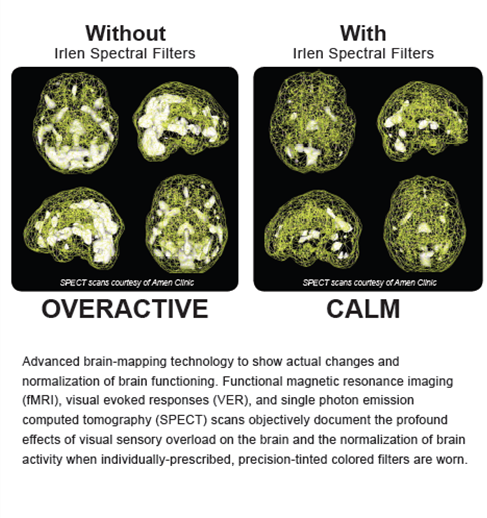
Irlen syndrome is caused by hypersensitivity to certain wave lengths of light which can cause the brain to process visual information incorrectly. The exact mechanism is poorly understood, but the brain seemingly becomes overactive in response to light causing dysfunction. Interestingly, Irlen syndrome is classified as a pseudo-medical diagnosis as there is skepticism over it’s existence as a stand alone condition with a distinct pathology. Experts are skeptical of Irlen syndrome as there is a lot of overlap in symptoms from other conditions and they may be lumped in under one convenient heading.

But is there anything we can do to manage symptoms?

The Irlen method is the main treatment approach for the condition. Pioneered by Helen Irlen, the Irlen method is a non-invasive approach using coloured lenses to filter light and to improve the brains ability to process visual information. The lenses can be either worn as glasses or in contact form.

You can see the impact that Irlen lenses have on the brain here:

However, the efficacy of this method has been difficult to prove. In particular there seems to be little evidence to support their use to improve reading issues and dyslexia. That being said, many people have found great relief from using Irlen lenses, such as actor Paddy Considine who has both Asperger’s syndrome and Irlen syndrome.

As with all pseudoscience/pseudomedicine, take everything with a pinch of salt, but if you think Irlen lenses may help your issues with light sensitivity it’s worth a try!

Hope you enjoyed this post dear Earthlings! 🙂

Have a lovely weekend!

Aoife

Autism and Silent Discos

Greetings Earthlings!

This week I’d like to discuss my previous experiences with silent discos during my college days and how this phenomenon can benefit autists.

So what exactly is a silent disco?

A silent disco is pretty much what it sounds like- it’s a disco where no music is played through the speakers, but everyone is however provided with a set of wireless headphones to listen and dance to music. Each set of headphones has it’s own volume controls and allows you to pick from up to 3 different channels from different DJs to choose which music genre you would like to listen to- so while everyone else might be raving to EDM, you can rock out in peace. The idea originated in the UK in the early 2000’s and has since taken the world by storm, proving particularly popular with students and leading to more inclusive club nights.

So how can silent discos benefit autists?

One of the major drawbacks of the club scene for autists is the obscenely loud music blaring from the speakers. Sound sensitivity can be a serious issue for autists and will often deter us from dipping our toes into the night time social scene. Silent discos remove this barrier as there are no speakers, you can control the volume of the music (even turn if off if you wish to dance with no music- no one else will know!), control the channel, and if you want to chat to your friends you can simply slip them off and talk at a normal decibel without the need for shouting (bonus- no morning after voice loss!). Silent discos were highlighted in particular in the first season of Atypical to allow Sam to attend a school dance with his classmates in comfort. Light sensitivity from strobe lights can still be an issue, but I’ve always found that sunglasses in clubs can be quite beneficial (some may think you’re a bit odd, but most will think it’s awesome!).

I tried out silent discos in Dublin while I was studying for my masters several years back and found the experience quite refreshing. Over the years I have conditioned myself to the cacophony of club nights (I’ve always had more issues with sudden volume increases rather than general high volume levels- I am quite partial to rock concerts!), but being able to attend a silent disco where I could slip my headphones down and have an actual conversation with my friends between dances was a dream! I was in total control of my headphones and we could all dance together just like any other club night with our eardrums still intact!

Silent discos are a great way for autists to get out and experience college nightlife with a fraction of the stress, so I would highly recommend them for young adult autists trying to settle into the college social scene. Many colleges run silent discos so just watch out for an event near you and give it a try! 🙂

Hope you enjoyed this post dear Earthlings!

Have a lovely weekend! 🙂

Aoife

Autism and Rapid Prompting Method (RPM)

Greetings Earthlings! 🙂

Leading on from a previous post about non-verbal autism, this week I’d like to discuss a popular communication method for non-verbal autists- the rapid prompting method or RPM for short.

So what exactly is RPM?

RPM, also known as ‘spelling to communicate’ is a communication technique that allows non-verbal autists to communicate through a system of writing, typing, or pointing at a letter board.

You can see a video of RPM in practice here:

But is it effective?

Now this is where things get interesting. As far as the scientific community is concerned, RPM is pseudoscience- they can’t generate evidence to prove that it really works. There are concerns that the facilitator of the method may unconsciously prompt and influence an autists answers in the way they move the communication device, and as such, many in the community discourage the practice of RPM until the efficacy and safety can be established.

That being said however, there are so many positive stories out there about how life changing RPM has been for non-verbal autists.

Here in Ireland there was a recent documentary on RTÉ called ‘Speechless‘ about how RPM has completely changed life for non-verbal autist Fiacre Ryan. The documentary followed Fiacre and his family over an eight year period, showing his journey with RPM and how it has enabled him to communicate with his family and give them an insight into his world- as his sister described it, it was like getting to know a completely new person. After discovering RPM, Fiacre went from having only basic playschool level knowledge to a wealth of vocabulary and an aptitude for calculus. With the help of an aide to facilitate RPM, he was able to attend mainstream school. Fiacre went on to be the first non-verbal student to sit the Leaving Certificate exam using RPM (passing with flying colours!), and is currently working with a publisher to create a book of his poetry! 😀 Before RPM, Fiacre says that his mind was very cloudy and dark, but communication has given him a new lease of life.

If you’re in Ireland (or have a really good VPN blocker) you can check out the documentary here: https://www.rte.ie/player/movie/speechless/264381992324

So while RPM may officially be considered pseudoscience, the stories speak for themselves. As with most autism interventions, take it with a pinch of salt.

Hope you enjoyed this post dear Earthlings! 🙂

Have a lovely weekend!

Aoife

Travelling on the Autistic Spectrum- When Things Go Wrong

Greetings Earthlings! 🙂

Leading on from my previous post about managing autism while travelling, after a recent mishap with a suitcase in the airport on my way to Italy, this week I’d like to talk about when things go wrong.

Ordinarily, travelling on my own through an airport is no great hassle for me. I’ve done it loads of times before with no issue, however, with all the disruptions to travel since the start of the pandemic, flying has become a little bit more stressful. Due to reduced capacities on public transport, I started out my journey on the wrong foot by driving the 2 hours to Dublin up a very busy motorway on a Friday afternoon- not the most calming of scenarios given some of the issues autists can have driving. Arriving in the terminal after a lengthy search for a free parking space (despite pre-booking), I made my way directly to bag drop off to relieve myself of the ginormous suitcase I was carrying, laden with goodies from home for an overseas relative.

That’s when things started to go awry…

The suitcase wobbled and rolled off of the self service scales as it was recording the weight, so the label the machine printed off displayed an incorrect value. I proceeded to put the bag on the drop off conveyor… buuuttt it wouldn’t take my suitcase! Now as we are in Covid times, there were crowds of people round me travelling, but not a lot of staff to ask for help from at these desks in order to reduce interactions. So I tried to re-weigh and reprint my tag a second time to find that my bag was 0.8 kg over the limit, leading me to frantically kneel down in the middle of the floor, pulling out shoes and baked goods to shove them in my carry on. I was enduring this stress while still wearing my coat and a face mask, so the heat from the situation was rising, not to mention I was still coming down from the stressful drive, was tired, hungry, and in need of the bathroom- so my sanity was hanging on by a thread! Once I had reduced my weight sufficiently, the machine then refused to print another label for my luggage, and tried to charge me €60 for the pleasure! 🙈

Sooo I frantically searched for a an attendant to advise me, who did not have a solution only that I join the massive queue at the ticket desk…aannnnd then the meltdown hit! Thankfully it wasn’t more than a few tears, and once I communicated that I was autistic to the attendant, she was very nice and supportive 🙂

But the saga wasn’t quite over yet! As I proceeded towards the ticket desk for assistance, another attendant saw me and asked where I was going with my suitcase (as the desk was in the opposite direction to the drop off). I communicated my issue and this no-nonsense lady firmly told me to stop crying! Believe me, I wouldn’t be crying in my thirties over something so stupid as an overweight suitcase if I had the choice 😛 She eventually steered me direct to the drop off and fired the suitcase on the conveyor with a final parting order to stop crying. Five minutes later, I was sitting calmly in McDonald’s, my crisis was over and the mortification set in 😳

Granted, this experience was resolved quickly and could have been a lot worse (I’ve had a 24 hour delay on a previous family holiday), but it was still an extremely stressful few minutes!

Based on this mortifying experience, here are some modified tips for dealing with autism while travelling when it’s too late for prevention:

Take a moment to collect yourself– if you feel like a meltdown could be coming on, take a step back. My stress over increased airport traffic with international travel opening up pushed me to keep going, but I should have paused to take off my coat, grab a snack from my bag, and try the suitcase again.

Take a break in a sensory friendly room (if available)– Irish airports have pioneered sensory friendly rooms for travelling autists to enable you to take some chill time to come down from stressful scenarios. If a space like this is available, take some time out.

Approach a member of staff for help– if you feel that you are struggling and are in a position to communicate your struggles, reach out to a member of airport staff and they should be able to help make your journey a little easier. Dublin Airport, among others, has a special lanyard that you can get to alert staff that you are autistic if you are in need of assistance, so the training is there for staff to help you in your time of need.

Take a break from your face maskface masks can be quite problematic for a lot of autists, but are a requirement for travel at present. If you’re getting overwhelmed from wearing the mask for too long, go to the bathroom for a few minutes to pull down your mask and take some deep breaths privately. Pro tip– spend as long as you can in the food court as you will not be required to wear your mask in this area.

Bonus tip– If you’re using a self service scale, place your bag on it’s side, not on it’s wheels- learn from my mistakes 😛 😉

Perhaps the best tip I can offer is to make use of autism assistance programs where available. I have not previously used this service as I have not needed it, and also because other airports like Shannon Airport advocate the use of bright orange hats to quickly identify an autist, which as an adult, this concept would make me feel like a bit of a sore thumb 😛 Check out if the airport you are going to has an assistance program for autists that you can avail of so that in the event that something does go wrong, you will be taken care of. Once I was able to communicate that I was autistic, the staff were happy to help, but other autists may not be able to communicate this mid-meltdown, so make sure to check out assistance programs ahead of time to ensure that the help is available to you in the event that things go wrong 🙂

Hope you enjoyed this post dear Earthlings!

Have a lovely weekend!

Aoife

Blog at WordPress.com.

Up ↑