Autism and T-Rex Arms

Greetings Earthlings! 🙂

This week I’d like to talk about a somewhat unusual aspect of the spectrum that has been brought to my attention in recent months- T-Rex arms.

Yes- you read that correctly, and no I have not joined the spectrum dinosaur brigade (I don’t think I’ll ever understand the fascination 🙈).

So what on earth are T-Rex arms?🦖

Well, it’s pretty much what it says on the tin. T-Rex arms are when an autist holds their arms in a position reminiscent of the mighty T-Rex- arms shortened and tucked into chest, hands bent forward and curled in like claws.

Ok… but how does this behaviour relate to autism?

This unique posture is commonly observed in autism (and in some overlapping ADHD cases) with many autistic and ADHD content creators poking fun at the behaviour. Since I’ve been made aware of this phenomenon, I keep catching myself holding my hands in this position at random times- most notably when I’m in the middle of a busy task like baking or cleaning.

So why do we do it?

The reasons are quite varied. Some autists say it’s because it feels natural and comforting, some say it’s because they don’t know what to do with their hands. Others, like myself, see it as more of an accessibility issue, where you keep your hands close to your chest ready for action mid-task, or a spatial issue where you have greater control of your hands by clutching them close rather than at your sides.

But is there a scientific reason?

Here’s where things get interesting. Scientists think that T-Rex arms are a form of stimming, so it’s likely to be a sensory related behaviour. They believe that autists keep their arms close to their chest as a natural coping mechanism to comfort and calm when experiencing sensory overload. In some cases T-Rex arms can be viewed as a sign of impending sensory overload, a form of non-verbal communication that experts advise parents to look out for so that they can anticipate a meltdown and take action as needed.

T-Rex arms have been particularly linked to sleep, with many autists adopting this position when they lay down at night. Experts believe that this helps neurodivergents to relax and sleep better, kind of like how weighted blankets work on the nervous system by applying deep pressure to release calming neurotransmitters. Maybe this explains why I often wake up with numb arms in the morning 🙈😂🦖.

Hope you enjoyed this post dear Earthlings! 🙂

Have a lovely weekend!

Aoife

Autism and Sensory Rooms

Greetings Earthlings! 🙂

Continuing on from my last post, this week I’d like to discuss sensory rooms and how they can benefit autists.

As I mentioned in my last post, while trying out the sensory pod on the Carlow campus of South East Technological University (SETU), I also had the pleasure of trying out the campus sensory room for students on the spectrum.

But first things first, what exactly is a sensory room and how can it help autists?

Sensory rooms are designated safe, calming spaces where an autist can retreat when overstimulated. Here they can relax and stim in a room designed to stimulate the senses and regulate emotions. As with sensory pods, sensory rooms are all different, but they may have dimmed LED lighting, water features, light projections, soft furnishings, swings, textured pads, sensory toys, punch bags etc. The concept is surprisingly not a new one, dating back to the 1970’s in the Netherlands where Dutch psychologists wanted to awaken sensory perception in individuals with disabilities through sensory stimulation.

Fun fact– they were originally called ‘snoezelen’, a portmanteau of the dutch word to sniff (snuffelen) and to snooze (doezelen).

Here’s a video discussing how sensory rooms can help neurodivergents in their education:

So how did I find the sensory room?

I booked in for half an hour into the sensory room and found that like the sensory pod, it was incredibly soothing. It was so nice to be able to take some time out on the beanbag in this soundproofed room away from the hustle and bustle of the busy student centre. I wasn’t a big fan of the whirring sound from the water pipe in the room, however, one of the great things about the sensory room was that I had the power to customize my experience. I was handed 2 remotes when I walked in which allowed me to control the lighting, water features, projections etc. so I could tailor the room to my needs- an essential feature given the level of diversity in sensory needs. Like the pod, this facility would have been great to have during my third level education to take time out when assignments and exams were frying my brain.

You can check out a quick Tik Tok of the sensory room I visited here:

While facilities like this are great in an educational setting, you can also create your own sensory room at home to allow yourself or your kids some needed respite during an overload. There is no one size fits all model for sensory rooms. Different autists have different sensory needs, so being able to create your own room with sensory stimuli that specifically calm you is a game changer. Here’s a handy article that gives some tips on how to build your own room https://www.irishtimes.com/life-style/2022/10/15/a-quiet-place-how-to-build-a-sensory-room/.

Hope you enjoyed this post dear Earthlings!

Have a lovely weekend! 🙂

Aoife

Autism and Sensory Pods

Greetings Earthlings! 🙂

This week I’d like to talk about sensory pods and how they can be beneficial for autists!

So first things first, what is a sensory pod?

A sensory pod is an enclosed space designed to be calming and relaxing for autists. Each pod can be different but they are generally soundproofed to reduce outside noise, dimly lit with LED lighting (which has been scientifically linked to behavioural improvements) and may have cushions or a comfortable mat to sit on. Pods may also allow you to adjust the temperature, play white noise, project visuals on the wall, and you can further add in sensory toys, weighted blankets, vests, plushies etc. As autists can struggle with sensory processing and overload, sensory pods are an ideal way to help manage an overwhelming situation. You can see a video about sensory pods here:

I recently booked into the sensory pod on the Carlow campus of South East Technological University (SETU) to give it a try. The university has two sensory pods in the library that neurodivergent students can avail of for time out, or even just a quiet place to study.

So what was my experience like?

I can highly recommend the sensory pod. While it was a bit awkward climbing into it as a fully grown adult in her thirties, once I was lying down in the pod it was so soothing. The room was kitted out with an interactive screen on the wall where you could avail of streaming services like Netflix to take some chill time out from your studies. There was a mirror on the wall with a panel of dials to adjust the lighting to your liking- blue, green, red, white and even no lights. The college even provided a USB mouse and keyboard that students could avail of if using the pod to study. Lying there on the squishy mat, I could easily have fallen asleep with the sounds of the library dulled around me. You would forget that you were in the middle of a busy college campus on a Friday evening!

It’s great to see a sensory facility like this for neurodivergents in an academic institution, I would love to have had something like this to study in back when I was in university (then again, I was only diagnosed as I was leaving third level education 🙃).

I also had the opportunity to try out the sensory room on campus which I will talk about in my next post.

Hope you enjoyed this post dear Earthlings!

Have a lovely weekend! 🙂

Aoife

Autism and Sensory Socks

Greetings Earthlings! 🙂

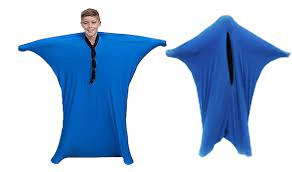
This week I’d like to discuss a rather unusual item that can be used for management of autism- the sensory sock! Here’s a picture of what it looks like:

So what exactly is it?

The sensory sock (also known as the body sock) is a stretchy Lycra suit of sorts that is designed to provide a unique, fun and intense sensory experience for autists. Once inside, the suit provides tactile and deep pressure stimulation to the wearer while increasing spatial awareness and improving balance. These sensory inputs can be quite calming for autists which can help us to regulate sensory issues. This can also be used for neurotypical kids to explore their environment and encourage creative movement.

But how exactly does it work?

The stretchy Lycra provides resistance to the wearer as they move around applying deep pressure to the joints which, as previously explained in my post about weighted blankets, causes the release of calming neurotransmitters in the brain, reducing the levels of excitatory neurotransmitters which are elevated in the autistic brain. The enclosed space can help the wearer feel calm and safe, allowing them to regulate their emotions- many autists find enclosed spaces to be particularly therapeutic, so having a portable space like this can be really handy!

I came across the video below of someone trying out a sensory sock online, so naturally I had to get one to try it out!

So how did I get on?

Well…it was…an experience! 😛 While I won’t terrify you with the images of me waddling around my kitchen like a deformed bright green T-Rex, the sock was certainly worth the laugh! My first impressions however, were not the most positive from a sensory perspective. I didn’t really like the smell or the feeling of my arms being so constricted, and found the velcro opening at the front quite distracting as it was reluctant to stay shut (sensory socks don’t seem to be designed for adult women of a certain chest size 🙈). I did try the sock again a week later, but this time I chose to lie down while wearing it which proved to be a much more positive experience. This time I felt the relaxing deep pressure around my limbs that was reminiscent of my weighted blanket. Despite my best efforts, I wasn’t able to bring myself to spend more than a couple of seconds with my head inside the suit. It either wouldn’t stay closed or the smell and claustrophobia got to me so I wasn’t really able to assess that feature.

All in all, I can certainly see the benefits this sensory sock might have for younger autists, but personally I think I’ll stick with my weighted blanket for now.

Hope you enjoyed this post dear Earthlings!

Have a lovely weekend! 🙂

Aoife

Autism and Emergency Services

Greetings Earthlings! 🙂

Following the recent violent shooting of an unarmed, 13 year old autist by police in America during a meltdown (thankfully he is recovering in hospital), this week I’d like to discuss the importance of adequately educating our emergency services and first responders about autism.

emergency services

In this situation, Linden Cameron’s mother called 911 for assistance as Linden was experiencing a bad meltdown due to separation anxiety, and needed help to de-escalate the situation with the minimal amount of force. Shortly after arrival however, the police shot Linden multiple times instead of using lesser means of force (they claimed that he was armed, but this was not the case).

While the issue of police brutality in the States is an entirely separate debate, this incident really highlights the need to properly educate the emergency services about autistic behaviours.

Autists can’t always regulate their behaviours and emotions, especially when they are in distress. Loud noises and flashing lights from emergency vehicles can further impact this stress from a sensory perspective and make situations worse. Autists are also quite sensitive to touch, and as such, physical interactions could cause an autist to attack a responder. 

bitmoji-35911512

Here are some tips to keep in mind when interacting with a distressed autist/suspected autist:

Patience- always be patient when dealing with an autist and give them some space. Try to void making quick movements or loud noises that may distress them further. They may have difficulty communicating with you, so give them plenty of time to process and respond.

Try to use clear, concise language– avoid confusing sentences or turns of phrase that they might interpret literally (e.g it’s raining cats and dogs). They may already be struggling to process their situation, and too many words could be even more overwhelming.

Avoid touching an autist– unless absolutely necessary. Touch sensitivities could escalate the situation and an autist may react violently in defense.

Watch out for potential triggers that may escalate the situation– be conscious of potential sources of distress such as sensory sensitivities which could further agitate an autist. 

fire

Listen- take advice from caregivers (if present) or the autist themselves (as some autists may be able to communicate during a meltdown on some level). They will have a better understanding of their individual needs than you do. 

At the end of the day however, there is no substitute for a proper training program for emergency responders/law enforcement. Many autism charities run these programs such as AsIAm here in Ireland.

You can read more advice for the emergency services here:

http://asiam.ie/wp-content/uploads/2015/04/emergency_servicesFinal.pdf 

Hope you found this post helpful dear Earthlings! 🙂

Enjoy the weekend!

Aoife

Autism Friendly Shopping

Greetings Earthlings! 😀

Shopping can be quite an overwhelming experience for an autist- the hustle and bustle, bright lighting, loud noises, strong smells etc.

As autism friendly events are all the rage at the moment, I decided to take some time to check out Lidl’s weekly autism friendly shopping hours.

bitmoji-20200108115640

So what’s so special about Lidl’s autism friendly shopping experience?

Every Tuesday from 6-8pm across all Irish stores, Lidl takes the following autism friendly measures:

  • Reduced lighting
  • No music or announcements
  • Lower till scan sounds
  • Priority queuing
  • Offers additional help if requested
  • Assistance dogs are welcome (sadly none of these cuties were around during my visit 😦 )

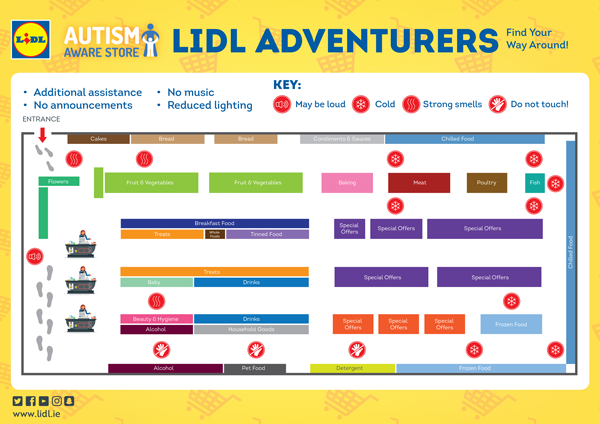
They also include a sensory map for kids which can be downloaded from their website to show you the layout of the store to familiarize yourself with it, even providing a key to indicate where there may be strong smells, cold areas, and items that you shouldn’t touch:

Image result for lidl sensory map

This map would also be of benefit for anxious adults on the spectrum, albeit the ‘do not touch’ symbols on the alcohol, pet food and cleaning products is a bit insulting. These symbols could be challenging for literal, rule-abiding adult autists- who says we don’t like to drink/cook with alcohol, have pets to feed or need to clean a toilet 😛

So how was my shopping experience?

I’ve lived and shopped on my own since college, so I’m perfectly at ease with the hustle and bustle of a busy shop (except for Lush in Dublin- so narrow, crowded and impossible to find what you’re looking for that I have to say a prayer before I enter 😛 ). Nevertheless, I found the whole experience quite soothing.

bitmoji-20200108115447

My eyes didn’t recoil from the harsh transition from the darkness of the carpark to dazzling supermarket lighting, but rather gently adjusted to the dimmed lights. Even the freezer lights were turned off to reduce the sensory impact. The quietness of the store was similarly soothing. I could slowly walk around the store at ease, my mind clear to focus on the items in front of me.

I was really enjoying my experience, however, it was cut short abruptly without any warning.

Lidl’s autism friendly hours are 6-8pm on a Tuesday. At 7.45 I looked up from my phone to be blinded by the store lighting which had been turned on early. Granted, shops aren’t a sensory problem for me, however, had another autist been in the shop at this time it could have been a whole other story.

What if someone had started their shop at 7.30 under the assumption that they had a solid 30 minutes to get a few bits?

This begs the question as to why the hour ended early? Autists are very literal and  would assume that when something is advertised to last until 8pm that that is when it ends- not 15 minutes earlier with no advanced warning. At this point in the evening, there were no children in the shop, so was it assumed that there were no more autists doing their shopping? My presence meant that there was one confirmed autist still shopping, who’s to say there were not others?

If the decision to end the hour early was based on the number of children in the store, it is highly insulting to adults on the spectrum. People still consider autism to be a childhood disorder, but it is lifelong. We keep forgetting that the child with autism will one day grow up. These autism friendly evenings appear to be mainly geared at children, but adults with autism may choose to shop during these hours too and this must be considered.

Aside from their disregard for accurate timekeeping, Lidl is nevertheless the perfect spot to go for an autism friendly grocery spree! 😀 If arriving later in the hour though, especially for adult autists, perhaps it would be worthwhile flagging it to a member of staff or carry a sign or something to avoid getting caught out like I did 😛 😂

bitmoji-20200108115511Hope you enjoyed this post dear Earthlings! 😀

Enjoy the weekend!

Aoife

Autism and Food

Greetings Earthlings! 😀

Following a recent report about a teenager who has been left blind from a restrictive diet of roughly 4 nutritionally lacking food items, this week I’d like to discuss the topic of food and autism.

bitmoji-20190517071624.png

Did you know that feeding difficulties are estimated to occur in as many as 70 to 90% of children with autism?

It’s a shocking statistic!

People with autism are often described as selective or picky eaters, often favouring carbohydrates and highly processed foods while rejecting fruits and vegetables- but why is that?

Research has found that food issues in autism overlap with sensory sensitivities to taste, texture, colour  and smell. As such, autists will often actively avoid these foods to avoid adverse sensory reactions. In the animal kingdom, many species develop conditioned aversions to certain unpleasant tastes, associating them with danger and illness. As the autistic tongue is so sensitive, it’s thought that autists can also develop aversions to foods in this manner.

In my case, although my autistic traits are extremely mild, food continues to be an issue for me. Certain smells, tastes and textures in particular will make me want to throw up. Fruit and veg in particular have been troublesome on a sensory level- for example I love the taste of strawberry, but I can’t tolerate physically eating one due to the texture.

bleh

It’s made things quite difficult at times when I’ve been out eating with friends to try to maintain a neutral expression when a foodstuff disagrees with my brain to avoid hurting someone’s feeling. A lot of the time it’s just easier to pretend that I’m not hungry to avoid an awkward social/sensory situation- pro tip, always keep snacks in your car/handbag.

Selective eating habits are commonplace for autists, however, serious food aversions can can be diagnosed clinically as avoidant/restrictive food intake disorder (ARFID), previously known as selective eating disorder (SED).

But is there any getting around these sensory issues?

CBT as with many other aspects of autism, cognitive behavioural therapy can help to change behaviours surrounding food over time.

Persistence- keep trying to build up your tolerance to certain textures/tastes. When I was younger, I could not stand to drink a glass of water as it felt so weird compared with other soft drinks. It was not easy to adjust to this texture at first  (I even had to swap shots of water for shots of orange juice to get it down! 😂), but I stuck with it, and now I drink several litres a day willingly 🙂

Prepare food in different ways- this has perhaps been the most helpful for me. Changing the way some foodstuffs are prepared/cooked can really impact the textural outcome. Smoothies have been particularly useful to help me achieve my 5 a day. I may not be able to eat the fruit itself, but throw it in a blender and bye-bye textural issues. Similarly, with apple tart, if the apples are too chewy, I find it extremely difficult to stomach, but if you bake the tart until the apples are soft and mushy I can’t get enough of it!

tart

Hope you enjoyed this post dear Earthlings! 😀

Have a good weekend!

Aoife


Autism and Clothing

Greetings Earthlings! 🙂

This week I’d like to briefly expand on something that I touched on in my previous post about skin sensitivity, -the importance of clothing and autism.

bitmoji-20190401080206

No, I’m not going to talk about fashion, but function!

For many autists, it can be quite difficult to pick out clothes. A stray fiber, an itchy label or a prickly seam can unleash a storm of sensory discomfort. Gene mutations cause the nerves in our skin to be extra sensitive to certain stimuli. This coupled with hyperactivity in the cortex and the amygdala (both regions involved in sensory processing) don’t make for the happiest of bedfellows.

But what if the clothes that irritate us could in fact be used to manage autistic symptoms?

bitmoji431833082

Clothes are now being designed and adapted to cater for the different needs of autists. Companies are now producing  seamless socks and underwear, looser fitting clothes made from softer materials, and most interestingly, weighted and compression clothing.

Based on the research of the great Temple Grandin and her hugging machine, both weighted and compression clothing provide calming, deep pressure stimulation much like a soothing hug. The pressure switches off the sympathetic nervous system (fight or flight) to the parasympathetic nervous system (rest and digest), promoting the release of “feel good” neurotransmitters. Based on this, it’s thought that autists are better able to cope with sensory issues, hyperactivity, motor skills and sleeplessness when wearing sensory clothing.

It’s a really interesting premise- there’s even been an inflatable sensory scarf produced that’s designed to provide soothing pressure in addition to emitting calming aromas! Check it out:

https://www.wired.com/2015/08/odd-looking-clothing-designed-help-autistic-kids/

In reality however, the results are mixed. Scientific studies indicate that weighted and inflatable vests do not appear to be effective and are not clinically recommended, yet the personal testimonials of families across the globe beg to differ. One testimonial claimed that a child’s meltdowns went from 12 a day to having none in 3 years!

Either way, nothing ventured nothing gained, so if you think that sensory wear may be of benefit to you or a loved one with autism, why not give it a shot? 🙂

With the variety of sensory wear available, you’ll at the very least look fabulous! 😉

bitmoji216715141


Enjoy the weekend everyone! 😀

Aoife

Autism and Climate Change

Greetings Earthlings! 🙂

I know what you’re all thinking, she’s lost it- what on earth has autism got to do with climate change?!

bitmoji-20190130083606.png

Well, nothing really, but what I’m referring to is the impact of the recent Lancet report about the need to change our eating habits to stave off climate change and it’s potential impacts for the autistic community. If you’ve been living under a rock and haven’t heard about the report you can check out the paper here:

https://linkinghub.elsevier.com/retrieve/pii/S0140673618331799

or alternatively here’s a handy little summary news report:

https://www.irishtimes.com/business/agribusiness-and-food/meat-consumption-must-drop-by-90-to-avert-climate-crisis-report-warns-1.3760363

The bottom line of the report- we need to reduce our meat consumption by 90% and significantly increase our consumption of fruits, vegetables, nuts and beans to achieve our daily recommended caloric intake (18 times as much dry beans, soy and nuts in fact! 😲)

bitmoji-20180320082114

As a scientist, I’m all for finding ways to reverse the impact of climate change,  however, I have found this report quite infuriating!

I haven’t really talked about food too much as an issue on this blog (mainly because it’s a subject that’s going to take some time to write about!), but food issues are perhaps my biggest struggle. Troubles with textures, tastes, smells- it can be a nightmare sometimes; but if the Lancet report is to be taken seriously, my nightmare has only just begun!

I’m a real meat lover, and vegetables for me mainly consists of baked beans and the old Irish favourite potatoes (some stereotypes are based in fact after all! 😛 😉 ). If this report is to be seriously considered, this would restrict my daily intake of chicken (my staple) to 29g or the equivalent of one and a half chicken nuggets. Worse still for my beloved potato the Lancet recommends 50g or 39 calories of potatoes per day- roughly a quarter of a medium-sized potato!

So basically if we start to crack down on these foodstuffs, I’ll be living on fresh air and sugar- I’ll have a killer figure for sure, albeit with a side of diabetes 😛

What I am most concerned about is the larger autistic community. My food issues are mild in comparison to other autists-what about the poor struggling parents who’s child will only eat the same meal day in day out, or will only eat McDonalds or foods of a particular colour? Has no one stopped to consider the struggles that these recommendations will bring?

Don’t even get me started on the implications for those with food and nut allergies, of which a high percentage of the autistic community suffer from!

The agricultural industry in Europe is responsible for a mere 10% of our carbon footprint whereas our energy consumption stands over a whopping 80%! Why must our food habits change when our energy consumption is so staggeringly high?

It beggars belief that the medical community would think that such a radical overhaul of our eating habits is our best option in the fight against climate change.

What we really need are cleaner fuel alternatives, better range of and services for hybrid cars, and better public transport systems for rural communities (a huge issue here in Ireland- if you don’t have a car, rural life is extremely isolating. Where I live one would have to walk for 45 minutes to get a bus to the nearest town!) to cut down our carbon footprint.

Hope you enjoyed this post dear Earthlings! 🙂

Have a wonderful weekend!

Aoife

Autism and the Dentist

Greetings Earthlings! 🙂

This week I’m going to discuss an important issue for many people on the spectrum- going to the dentist.

fdd.png

I know- no one ever really enjoys going to the dentist (except maybe Bill Murray in ‘Little Shop of Horrors‘! 😛 ), but for autists in particular, visits to the dentist can be quite traumatic. For many, the invasion of space can be an issue, for others, a trip to the dentist can aggravate sensory sensitivities (the sensation of brushing, the taste of toothpaste, the smell of latex gloves etc).

Thankfully I have never had any major issues with going to the dentist (aside from one unpleasant incident where the anesthetic didn’t take and I felt the drill hit a nerve…), nevertheless it wouldn’t be one of my favourite activities. The high pitched squeal of the tools, the scraping sensation against my teeth, the needles (shudder!)- it’s not the most pleasant of experiences inside my head! There’s a lot of fist clenching! 😛

Image result for shudder gif

So how might we navigate an autists difficulties at the dentist?

Here are just a few tips and tricks that might benefit parents, dentists and autists alike:

  • Inquire if your dentist is autism friendly– Have they had autistic patients before? Do they have any special tools or techniques to make the visit more comfortable? Do they take any sensory interventions such as dimming the lights, providing sunglasses or minimizing any loud noises that may startle the child?
  • Prepare for a dental visit– Help to desensitize an autist to the experience by story-boarding a trip to the dentist with them so that they know what to expect. When it comes to anxiety, the fear of the unknown is often greater than the reality of the experience. Why not inquire if your dentist will allow you to visit the surgery/send pictures to desensitize your child to the environment and meet the staff before coming in for the real thing? 🙂
  • Wear noise cancelling headphones– whilst this may not be as effective as in other situations given that the tools are operating so close to the ears, nevertheless this may help to take the edge off any noise related issues.
  • Weighted blanket– A weighted blanket sitting on your lap could be quite beneficial in calming an autist. As I’ve discussed previously, the deep pressure stimulation can calm the mind and put the autist at ease. X-ray jackets can also be used to substitute for a weighted blanket. Comforters such as soft toys or other sensory items that autists use to ‘stim‘ can also be useful to help put them at ease.
  • Communication is key– as I’ve said above, the unknown is often one of the more unsettling aspects of a dental visit for an autist. Talk them through each step, show them what you are planning to do to their teeth, allow them to see and feel the tools- testing a motion on the hand can be useful to desensitize an autist prior to the oral exam.
  • Rewards and Bribery– what child doesn’t love a good bribe to motivate them to get through their dental appointment?! There’s a lot to be said for the power and promise of a treat (I may have even bribed myself with a trip to the cinema to motivate me to get this post finished on time! 😂)
  • Sedation– though not the best of options, this can sometimes be the only way for particularly anxious autists or those with gagging issues to get through a visit to the dentist.

I’ve also found this useful video about visiting the dentist if you want to check it out:

You can also find more information in the following link:

Click to access dentalguide.pdf

So there we have it Earthlings! I hope you’ve found this post useful 🙂

Dental care isn’t always the easiest for an autist, but remember, prevention is always best- so get try to find a toothpaste that you like, pick the right toothbrush (soft bristles can be helpful) and take care of those pearly whites! 🙂

bitmoji-20180311030645.png

Aoife

Blog at WordPress.com.

Up ↑