So a little bit different today- I know the title is unusual! 😛
But the prospect of talking on the phone is something that fills many an autist with dread!
But why does this seemingly innocuous device strike fear into our hearts?
My relationship with phones is complicated.
On the one hand, I enjoy chatting to my family and friends on the phone; on the other, talking on the phone feels soooo AWKWARD to me!
As if reading a person isn’t hard enough, but when you can’t see them? It really adds to your social anxiety. You can’t tell if they’re bored or if you’re cutting across them, not to mention dealing with heavy accents, bad signal and awkward silences- the stress is a killer!
Worse still when someone asks you to answer their phone!
I don’t mind answering too much if it’s someone I already know, but when it’s a stranger….
“What do I say?
What if the person on the other end thinks I’m them?
How long will I have to talk until they can take the phone away from me??”
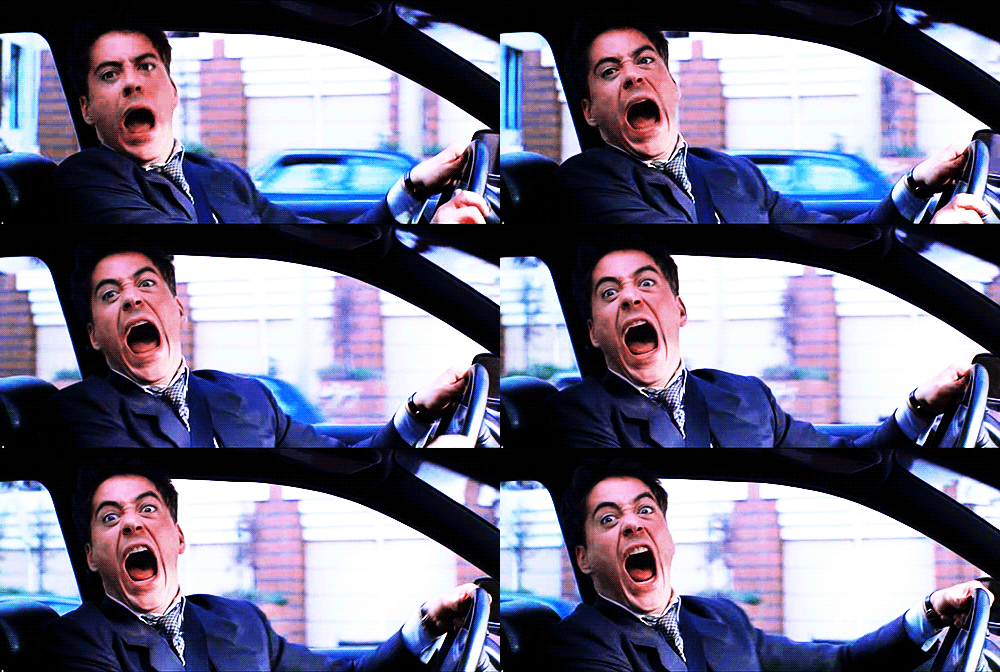
AAAAGGGHHHHH!!!!!
It makes me feel beyond awkward answering someone elses phone!
Not to mention the awkwardness of dealing with telemarketers and scammers…I try to brush them off and don’t want to be rude… but then when they keep pushing their product on you, I feel too awkward not to listen! I just sit there burning up, waiting for an appropriate opportunity to tell them ‘no’ and run! 😛
Sometimes I just want nothing more than to throw my phone at the wall! 😛
I will do everything that I can to avoid calling someone, if at all possible. I will email, text, Whats App, Facebook etc. before I will ever go near my phone. If the phone rings in the house and I’m closest to it, I have been known to get up and leave the room for the bathroom to force someone else to pick up the receiver! 😛
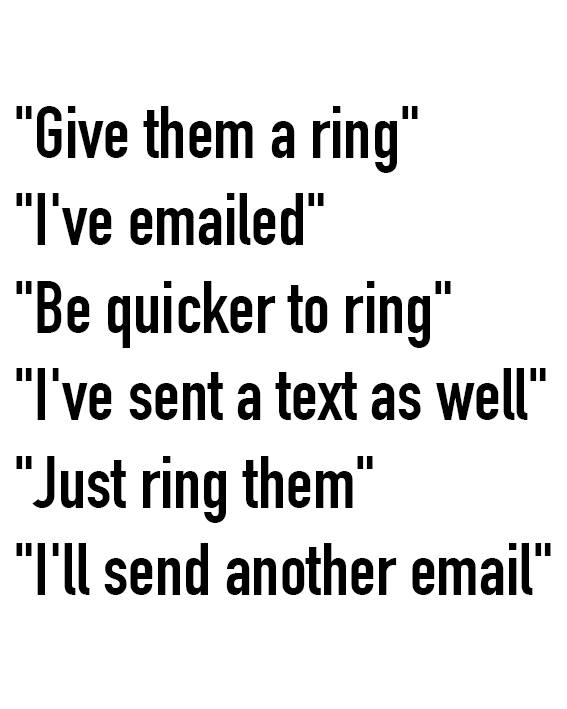
This meme is a pretty accurate transcription of actual conversations I’ve had with my mother 😛
Over the years however, I have gotten more comfortable with the phone. When I was younger, I never really knew how to act appropriately on the phone. When someone asked to speak to another member of the house, I would freeze up and throw the phone at that person while the caller was still talking! 😛
Since then, I’ve gradually developed my phone etiquette and learned to relax a little more when answering the phone. Practice makes perfect I suppose 🙂
Making calls can still be a little tricky.
A lot of it is tied up in the anxiety of not being able to see the person on the other end. When you initiate a conversation in real life, you know if the person is amenable to talking. If I call them however, my brain starts worrying about disturbing them if they’re busy or whether they really want to talk to me or not.
And then there’s the added stress of “I’ll call you back,” and the panic that ensues when they don’t.
“Did they forget?
Did they not want to talk to me?
Oh God, do I need to call them back???!!”
But as you grow older, these worries begin to fade. You just have to take a deep breath, press call and go for it! 🙂
An email is not going to fix your internet (for obvious reasons 😛 ) or secure your hair cut! 😉
Top Tip: It helps to remind yourself when calling strangers that they can’t see you, they don’t know you so they can’t judge you if you say something stupid 😉
So today I’m going to be talking a little bit about-
Haha! Sorry about that! 😛 Although fun story- genuinely stopped mid conversation to cry “SQUIRREL” when out with a friend recently! 😉
Yes that’s right, today we’ll be talking about ADHD in autism- also known as attention deficit hyperactivity disorder.
ADHD is commonly diagnosed in autists (in the region of 29-83%), causing such difficulties as impulsiveness, over-activity and poor attention.
There are 3 main types of ADHD:
Inattentive ADHD (formerly known as ADD (attention deficit disorder))- This can manifest in a number of ways such as a lack of attention to detail, losing things, organizational problems, making careless mistakes, having trouble completing tasks and struggling to sustain attention.
Hyperactive-Impulsive ADHD- Signs of hyperactivity and impulsivity include restlessness, excessive talking (Guilty!) fidgeting, interupting others, impulsive descisions and activities etc.
Combined Inattentive and Hyperactive-Impulsive ADHD
Personally, I would have really mild combined ADHD tendencies. In addition to my sometimes impulsive nature, I have a habit of zoning out of lessons and conversations, sometimes even films, books and TV shows for brief moments, completely lost in my own thoughts.
I can be pretty easily bored and distracted!
Half the time I’m not even aware of it happening. I could be reading a page in a book one minute, and suddenly find myself halfway down the next page, without any idea of what I was supposed to have taken in! Other times I find myself in a room in the house unsure as to why I came in as I hopped onto another train of thought mid action! I often have to repeat tasks over and over in my mind to ensure I don’t forget them.
My mind just completely wanders off…
But somehow I’ve always managed to hide my inattention. It never really posed a problem at school. Teachers knew I was away with the fairies, but could never seem to catch me out when pressed! 😛 I suppose my deductive skills must have learned to compensate for my temporary lapses in concentration! 😉
Top Tip: Studies have suggested that playing video games may be beneficial to improving concentration in ADHD.
Just because concentration can be a struggle however, does not mean that you can’t concentrate.
Interestingly, there occurs a concentration paradox in ADHD and autism known as hyperfocus- an intense form of concentration where you are completely absorbed by a task, something that I like to call “The Zone”. I’ll write a separate post on hyperfocus at a later stage 🙂
Aoife’s Top Tip: Applying specialist interests to tasks can encourage concentration. Last year I was struggling to write an essay for college, I found an angle that allowed me to write about Eurovision and suddenly I couldn’t stop writing! 🙂
In addition to my lapses in focus, I can also be a little bit hyperactive. Now, hyperactive doesn’t necessarily mean bouncing off the walls like a child high on sweets, it can also mean abnormally active.
I am quite a restless individual. On the outside, I may look like I’m staring at a wall, in my mind I could be designing a cake, a knitting project, writing a story or drafting a hypothesis. I once spent a train ride visualizing, staging and arranging a musical based on the music of My Chemical Romance!😂
I always have this need to be productive, even if it’s as simple as building my trophy collection on the Playstation or binge watching a TV series.
My brain never turns off!
If I’m excited enough, I do bounce around the place on occasion too 😉
But what’s going on in the brain that interrupts our concentration?
Most current models point to low levels of the neurotransmitters Dopamine and Noradrenaline. Pathways involving these chemical messengers project to the striatum and prefontal cortex of the brain- areas which are responsible for executive function (i.e. memory, planning, organization, behaviour control etc.). If these neurotransmitters are out of sync, this will have an effect on these functions. As neurotransmitters are also dysregulated in the autistic brain, this would explain why ADHD so commonly occurs in autism.
ADHD, like autism, can’t be cured, but it can be treated with cognitive behavioural therapy (CBT) and medication in severe cases, however, the side effects of medical treatment for ADHD have been controversial, and long term usage studies have yet to be completed.
However, like autism, ADHD need not hold you back in life. Some of the most successful people in the world have ADHD, such as Sir Richard Branson, Justin Timberlake, Simone Biles, will.i.am, Russell Brand, Ryan Higa, Jamie Oliver, Jim Carrey and Solange Knowles 🙂
Wouldn’t be high on my list of favourite activities I’ll admit! 😛 Stressful roundabouts, merging onto busy roads, idiot drivers, getting lost, the noise of hitting a pothole- it can be a lot for an aspie to handle!
My coordination issues did not make it the easiest of tasks to get the hang of, that’s for sure!
Coordinating pedal movements and gear changes, difficulties with spatial awareness, not to mention the stress and anxiety of learning to drive on country roads (Irish country roads tend to be narrow, winding, and full of potholes! 😛 ) made this a highly frustrating experience!
I never could understand why I found it so hard to get the hang of driving when my sisters took to it so easily, but after I got my diagnosis, my struggles began to make a world of sense!
Driving would not be the first thing to come to mind when someone pictures the struggles an autist faces. In fact it’s a requirement in some countries that your ASD diagnosis be listed on your drivers licence if it impacts your ability to drive safely– you can even be fined in the event of an accident if it’s not stated on your licence!
Studies among autists actually report more traffic violations than in neurotypical groups, however, this may relate to our tendency to be more honest than our neurotypical peers 😛 😉
This doesn’t mean that autists shouldn’t drive, but it’s something to be aware of.
So how exactly does autism impact our driving?
Impulsivity– Autist’s are naturally more impulsive than neurotypicals. This can impact our driving by causing us to make poor driving decisions on impulse. It has also been reported that this impulsivity may influence speeding behaviours
Sensory integration/processing issues– Driving involves a huge amount of sensory input. Listening to the engine, watching the road, spatial awareness, not to mention unexpected road noises and unpleasant smells from the outside- it can be a lot for the autistic brain to process when moving a vehicle
ADD & ADHD- Autists can get distracted quite easily…on busy roads where lot’s of things are happening, your focus can sometimes waver. If there’s a cute dog nearby, I have been known to take my eyes off the road…
Spatial Awareness & Coordination– Autists often have issues with these which can make it difficult in positioning the car on the road, parking and navigating gear changes. Spatial awareness was one of my greatest obstacles when first learning to drive. I always seemed to be veering towards the nearest hedge…When I first got my car, I was practicing driving around the house with no problems, aaannd then I decided to change direction- BIG mistake! My poor spatial judgement caused me to nicely scratch the car on the edge of the dog house…before getting it stuck on some cement blocks at the oil tank! Caused a mini shutdown which made my sister think I had run the dog over I was so incoherent!! 😛
Top tip for parents and instructors: PATIENCE!!!! Learning to drive is much more difficult for autists so don’t be too hard on us for when we don’t get it straight away. We’re already beating ourselves up for our slow progression; getting frustrated or annoyed with us will only make it worse.
Here are some useful links with driving tips for autists:
Aoife’s Top Tip- Get a Sat Nav. They really help to take the edge off when stressed about driving to new and unfamiliar locations. If you mess up, it will recalculate and send you right in the end 🙂
Having autism may initially make learning to drive difficult, however, you will get there in the end 🙂 After two years of stressful practice, I passed my test first time and drive everywhere now.
The freedom you gain from this skill is worth the fight 🙂
Many of you may have come across articles or ads online claiming to have “cured” or found a “cure” for autism.
Notice my use of air quotes? 😏
According to both the medical and scientific community- there is no cure for autism; fact!
Autism can be managed; but it cannot be cured.
In truth, these purported “cures” are unproven, and in some cases, quite dangerous. Here are the facts about some of these products/techniques:
Raw Camel Milk (whhhhyyyy!!!) & Essential Oils are just some of the many products retailed as a “cure” for autism. Neither have been proven safe or effective by the FDA
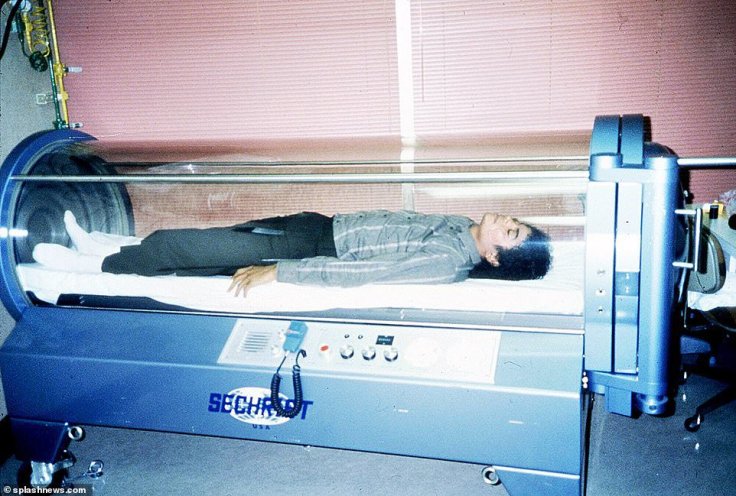
Hyperbaric oxygen therapy: Remember those stories about Michael Jackson sleeping in an oxygen tent? Some have claimed that breathing oxygen in a hyperbaric chamber can “cure” autism, but this is completely unproven
Detoxifying clay baths: These are mixed in with bathwater to supposedly draw out toxins, pollutants and heavy metals in order to “dramatically” improve autism; but again, these are entirely false claims
Diet Change: Some articles report that following a specific diet can “cure” autism. As I’ve previously discussed, many people report improvements in autistic symptoms following gluten (a protein found in grains like wheat), casein (a protein found in dairy) and sugar free diets, but there is insufficient scientific evidence to support this. Many doctors have recently spoken out against these fad diets as they can be very bad for your health if you unnecessarily remove these foodstuffs. Gluten free diets for example can increase your risk of cardiac problems through decreased intake of essential wholegrains
Chelation therapies: This is a medical procedure where chelating agents are administered to bind and remove heavy metals and toxins from the body, such as in the case of mercury and lead poisoning. These are often marketed as “cures” for autism, coming in the form of suppositories, sprays, drops, capsules, and clay baths. These are NOT approved for the treatment of autism, and should only be used under medical supervision, as they can remove important minerals from the body which can cause serious life-threatening issues such as deadly kidney damage!
Miracle Mineral Solution (MMS): This is perhaps one of the most dangerous “cures” for autism. A solution that claims to cure HIV, cancer and malaria in addition to autism, MMS contains 28% sodium chlorite solution- equivalent to industrial strength bleach! People have reported vomiting, diarrhea and symptoms of severe dehydration after taking this, but the labels claim that this means that the product is working!! This can also cause life threatening low blood pressure and death in severe cases. Naturally, this has not been proven to cure autism.
The bottom line, these so called “cures” are nothing but
For those struggling parents out there, I know it’s difficult. I wreaked havoc as a child and did not make life easy for my family; but seeking a cure is not the answer. Love and acceptance are the best way forward 🙂
This stuff is dangerous and can make your child very sick indeed.
Always be wary of what you read/buy on the internet dear Earthlings!
To mark the end of autism awareness month, today I’d like to tell you about a film that in my opinion, is probably the most realistic representation of autism on screen- the 2005 romantic-comedy-drama film ‘Mozart and the Whale.‘
(This film is also called ‘Crazy in Love‘ in some parts of the world)
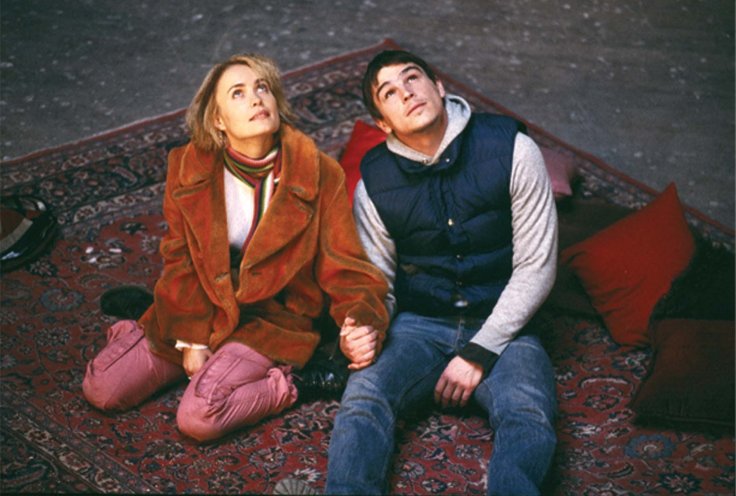
The film follows the turbulent relationship between Donald (Josh Hartnett) and Isabelle (Radha Mitchell)- two adults with Asperger’s syndrome who meet at an autism support group.
Check out the trailer below:
What makes this film stand out from the crowd is that the film illustrates two very different pictures of AS and two different levels of functionality.
Donald, contrary to the OCD stereotype, lives in a hoarders paradise surrounded by birds (and their droppings…), and works as a taxi driver as he is unable to navigate job interviews to make use of his university degree. Isabelle in contrast lives in a highly organized environment, hairdressing by day and painting by night; maintaining a relatively normal social life and appearing to outsiders as merely eccentric.
In watching their interactions, a clear difference emerges in their expression of AS. In addition to this, the background support groups also provide us with different pictures of autism with no two characters appearing the same.
Autism is unique, and this film remains true to that.
Another key element to this film is that of gender and autism. Other films such as ‘Snow Cake‘, have a tendency to portray women using the male experience of the condition, however, in this film we can see that there is a clear difference between autistic men and women.
Unlike Donald, Isabelle appears relatively normal to an outsider, albeit eccentric. She performs better socially and in the workplace, and largely appears to be in control. The film also hints at Isabelle’s developed social coping skills when she says:
“I can’t keep from shocking people so I make it work for me.”
As someone who made great efforts in college to turn qualities that were once perceived as weird into (hopefully) endearing eccentricities, this remark completely resonated with me.
However, like many women with autism, Isabelle struggles with issues of mental health and she is seeing a therapist. This film gives us a true insight into the realities faced by many women living with AS.
This film has divided some critics as to it’s accuracy in it’s portrayal of autism. On the one hand, it has been praised by many critics as one of the truest cinematic representations of autism, however, others have criticized the film for portraying the leads as having savant skills (Donald is mathematical; Isabelle has artistic and musical savant skills).
I know, I sound like a hypocrite as I often give out about this over-representation,
BUT
the characters in ‘Mozart and the Whale‘ are based on a true story!! 😀
The film is loosely based on the love story of Jerry and Mary Newport, two people with AS who are savants!
You can read a bit more on their story over on Goodreads:
Fun Fact about the Film: The screenplay for ‘Mozart and the Whale‘ was written by Ron Bass- the same screenwriter for ‘Rain Man‘!
This fact is made even more interesting by the fact that ‘Rain Man‘ is often considered inaccurate, while ‘Mozart and the Whale‘ is perceived as the most accurate.
In comparing both films, we can really see a clear change in attitudes towards autism in the intervening 17 years. We move from a dramatic and stereotyped vision of autism to a friendlier, more accurate portrayal of the autistic condition.
If you want to watch a film about autism, this is the one to see.
This film definitely get’s Aoife’s ‘A’ of approval 😉
Leading on from the previous post, I’d like to talk to you about shutdowns and autism.
So what exactly is a shutdown?
A shutdown is basically an episode where the brain briefly stops processing and making sense of information in response to stress or sensory overload.
The lights are on, but nobody’s home.
These episodes are much more discrete than meltdowns, and can often go unnoticed by the outside world. Sometimes meltdowns can turn into shutdowns and vice versa.
So what does a shutdown feel like?
Like meltdowns, shutdowns can manifest differently among autists. Some people go completely limp and unresponsive, some withdraw completely from those around them, some even become really sleepy and nod off.
For me personally, a shutdown is like entering a state of shock. You might struggle to move (as discussed in my diagnosis story), formulate sentences, or even think. It can be a completely overwhelming experience. When I first started to become aware of them as a teenager, I had no idea what was going on; I just knew that I felt, for lack of a better word, “wrong”.
Like meltdowns, in my experience, shutdowns can be either mild or severe:
Mild shutdowns tend to happen in social situations, especially in confrontation. Someone throws me off or says something that I hadn’t anticipated…aaaannnd my mind freezes up. I go limp and say nothing, whilst the other person talks on oblivious. To an outsider it looks like I’m just listening or defeated by an argument; in reality, my brain can’t formulate the words to respond.
The minute the conversation ends my brain reboots and suddenly all that I could or should have said comes rushing back- great timing! 😛
Severe shutdowns, like meltdowns, are brought on by serious stress, or a shock. Think of your brain like a computer that’s been attacked by a virus. The system get’s overwhelmed by the attack and needs to shuts down to recover. When this happens, it feels as though I’ve been locked out of my own brain.
However, unlike a meltdown situation, I’m locked out yes, but the brain hasn’t been hijacked. I’m not in a state of total control, but I’m not out of control either- a little bit purgatorial in nature.
It’s a very odd sensation.
I find myself in an overwhelming situation and fail to react. I know that I don’t feel right about the situation, so I try to break down what happened and process. However, when I go to think about the event, it’s as if a firewall has gone up and all of the files in my brain have been encrypted. You keep trying to access your files so you can run a scan to diagnose the problem, but your brain keeps locking you out.
It feels sooo weird, like my mind is flashing this giant ‘NOPE’ sign at me every time I try to think! 😛
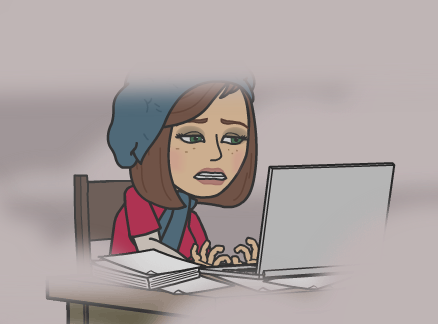
^^^accurate representation of my “access denied” face 😛 😉
During a particularly bad shutdown, I once spent about 5 minutes of going “um…ah… what it is… er…you see…uh” down the phone to my mother before I could coherently form a sentence to tell her what had happened. My mind simply refused to let me go there!
But why do shutdowns happen?
There’s not a lot of information out there as to the biological cause of shutdowns, but experts seem to think that it is the result of an abnormal stress response like the meltdown, possibly linked to the high and persistent levels of stress hormones in autism. Some have theorized that the shutdown is almost a preventative form of meltdown wherein the autist shuts down to prevent further sensory input and injury- like playing dead to avoid a fight.
Shutdowns can be difficult, but you just have to give them time to pass 🙂
Top Tip: Like a meltdown, you can sometimes speed up a shut down through music. Animals are also particularly good to release the hold of a shut down. My dogs always seem to sense when something’s wrong with me- a concerned look from them will often get the waterworks flowing 🙂
Remember- your brain needs time to recover after a stressful incident- there’s a reason you need to leave your computer a few minutes rest after a reboot 🙂 😉
Leading on from Friday’s post, I’d like to place the autistic meltdown under the microscope today.
So what exactly is a meltdown?
To an outsider, meltdowns appear like temper tantrums. You see a petulant, naughty child that didn’t get their way. Screaming, throwing things, violent behaviour- it seems like a tantrum, but the reality is very different.
Meltdowns are described as a temporary loss of behavioural control in response to an overwhelming situation or stimulus. This can manifest physically (lashing out, kicking, biting etc.), verbally (shouting, crying, screaming) or both.
So what’s happening in the brain that causes these outbursts?
The human body increases secretion of what are known as stress hormones (e.g. adrenaline, cortisol) in response to a stressful situation. Studies have shown that autists have higher levels of these stress hormones than their neurotypical peers.
When a stressful situation passes, stress hormones should return to normal levels. In the case of autism however, these hormones persist in the body for some time afterwards. The autist is left with residual levels of biological stress which make us more susceptible to stress related outbursts.
Release of stress hormones is controlled by the hypothalamic–pituitary–adrenal axis or HPA axis, a complex interconnecting network that comprises the hypothalamus, the pituitary gland andthe adrenal gland (i.e. HPA). This system controls how the body reacts to stress. Research suggests that this system is hyper-reactive to stress in the case of autism.
In particularly stressful or harmful situations, our bodies enter a heightened state of physiological stress which triggers the “fight or flight” response. High levels of stress hormones such as cortisol and adrenaline increase the release of glucose (to give a burst of energy) and increase blood pressure (to divert blood to the muscles) in order to prepare you to either fight the danger or run away from it.
This response is triggered in the case of a meltdown.
Excessive stress hormone release pushes the brain over the edge. The brain thinks it’s under attack and instructs the body to protect itself at all costs. The autist is in instinctual fight or flight mode at the mercy of their stress hormones.
Meltdowns manifest differently from person to person. When I would meltdown, it appeared as though I were throwing temper tantrums as I stood and fought my corner; other times I would run away from my trigger somewhere quiet. Sometimes I fought and then ran away.
My parents tried everything to get me to control my “tantrums”. Taking away toys, sending me to my room, bribery, guilt, you name it!
Bribery was perhaps one of the more successful tactics they used. My meltdowns were at their worst around the age of 6, so my mother implemented a sticker reward system. If I behaved myself, I got a sticker for the day on the calendar. At the end of the month if I had a full set of stickers I would get a present.
It didn’t really work though…I only managed maybe two months without incident, and I doubt that they were consecutive. I still think fondly of that hard earned Monkees greatest hits tape (such a Hipster child! 😛 ) and Hula Hair Barbie! 😉
Anyone else remember her?
One year, I was even asked to give up losing my temper for lent!!! 😛 I lasted about 4 weeks, had a meltdown and subsequently felt like the worst person in the world for letting Jesus down!
It seemed biology had a different plan- how naive we were! 😛
So what does a meltdown look like for me?
I like to classify the severity of a meltdown on a scale from 1 to 3:
Stage 1: These are very mild and normally pass within a few minutes. Usually these entail getting a little bit overwhelmed and starting to cry unexpectedly- often mid sentence! Think of these moments as opening the steam valve to cool the system 🙂 Maths classes for example triggered many of these mini meltdowns- I wouldn’t understand a concept or problem, get frustrated, aaaannnnd suddenly find myself choking back tears while my exasperated maths teacher attempted to break things down for me (or if this happened mid-homework I’ve been known to throw my book at the wall 😛 ).
Stage 2: This type of meltdown is a little more intense spreading out over several minutes, hours, and if particularly overwhelmed, on and off again over days. A situation, rumination or accumulation of stress tends to set these guys off. If wound particularly tightly, something very simple may tip the scales in this case- “You don’t want to play with me? FINE!” **Core meltdown activated**! Tears flow, your chest gets tighter and breathing can be difficult. This tends for me to be a “feeling” or cathartic stage. You’re in overload and need to feel, think and process the triggers until the storm passes.
TIP: I find that reasoning and music (songs that relate to the emotion or trigger) often work well to calm you and speed up the process. Hugs are also greatly appreciated as deep pressure calms and eases stress 🙂
In this stage I find that shutdowns can also happen, wherein I struggle to speak, think and even act (an experience I’ll delve into further on Friday 🙂 )
Stage 3: Enter the dragon! These are full scale, out of control meltdowns. Fight or flight is triggered and you are working on autopilot. The brain has been pushed too far and launches all out war. These tend to be brief, (gradually abating to a stage 2 meltdown when the adrenaline wears off), but are highly destructive. You can literally say or do anything in this heightened adrenal state. Your mind believes it’s at war and will act accordingly to protect itself. Reason is useless; scolds are futile. The real Aoife is locked outside her brain, banging on the door desperately trying to re-enter the cockpit. I’m aware that I’m out of control and want it all to stop, but am powerless to do so. Nothing can be done but wait until the door is unlocked once more.
TIP: Anger and attempts at restraint are useless in this situation, it only fuels the fire. Remaining as calm as possible until the mist passes is key.
I know these can sound a little scary, but they do decrease in frequency with time and stress management. It takes a significant stressor to trigger a stage 3 for me anymore 🙂 Happy stage 1 meltdown’s, like hearing the Phantom of the Opera overture, can even be quite amusing! 😛 😉
Meltdowns are tricky, but easily managed when you understand them for what they are. In the years leading to my diagnosis, without knowing it, I developed methods to help ease these passing hurricanes. Deep breathing, writing out my emotions, hugging a pillow or giant teddy, talking, and praying, but most importantly music. Music is key for me personally. The melodies, the riffs, but especially the lyrics; they soothe my soul. They verbalize the emotions I’m struggling to identify and process, guiding me safely past the storm 🙂
A meltdown is not a tantrum; it is not attention seeking behaviour; believe me- no one wants it to stop more than I do.
It is a biological response to excessive stress. We have no control over it. Punishments and judgments will only make things worse. Growing up would have been so much easier had my friends, family and (most importantly) I understood this.
Love, support and understanding are critical to meltdown management.
So try not to judge that kid crying hysterically in the corner at a party- there may be far more to it than you realize 🙂
So today I’m going to share with you something that I’ve been musing on a lot lately:
“Does autism make me a bad person?”
When it comes to autism, there is a very fine line between bad behaviour and autistic behaviour.
To an outsider, meltdowns appear like temper tantrums. Inappropriate statements and behaviours seem to hint at a naughty child.
It can be very hard to discern the difference.
As a child, I spent much of my time being branded as naughty. Growing up in an Irish household, I was no stranger to the dreaded wooden spoon…
I was notorious for my “temper tantrums”, I always seemed to say and do the wrong things, and I consistently found myself fighting with those around me. In short, I was a nightmare!
Worse still was the nightmare I lived on the inside.
I never could understand why I said or did bad things back then. My sisters never seemed to find themselves in the trouble that I always did. Something simple would just set me off like a rocket and there would be no turning back. After the smoke had cleared, sitting in a pool of tears surrounded by the wreckage of a meltdown, I felt like the worst person in the world.
“Why did I say that?”
“Why did I throw lego at my parents?”
“Why was I so violent?”
I was always left shocked and appalled my behaviour, crying for hours afterwards at the consequences I faced.
Oftentimes I felt as though I were little more than a criminal. My parents even threatened my bad behaviour with the police on a number of occasions- once going so far as to put my PJs in a plastic bag after telling me that they were coming to take me away! 😛
I tried so hard to behave, but I never could seem to keep it up for more than a few weeks. As I’ve told you before, I even tried running away because I couldn’t be good and felt obliged to leave.
But none of this behaviour was ever intentional.
Autists have no control over meltdowns; the brain is completely overwhelmed. In this state, literally anything can happen. Like Elvis, any trace of rationality has left the building. I’ll explore meltdowns next week in greater detail.
My tendency towards mimicry and my twisted sense of logic also impacted my bad behaviour.
I graffiti-ed a desk in school after perceiving previous samples around me to be the norm, I practiced swearing like a sailor and flipping the bird (I struggled with the dexterity of it) before secondary school to blend in – I even forced the habit of chewing pens as I thought that I needed a “bad” or “cool” habit when I went there!!!! Don’t ask me how I rationalized that one! 😛
Not good for your teeth kids!
Over the years I’ve better learned to control and prevent public meltdowns and restrict my social faux pas’, but on occasion I will wind up in a spot of bother just like everybody else.
Autism has huge influence over my behaviour, but do my actions make me a bad person?
This is a tricky one.
I’m not perfect. I often say or do things that can rub people up the wrong way, but for the most part, I don’t intend to do people wrong. Having been wronged many times in my own life, the thought of hurting another person greatly upsets me. When I unintentionally put my foot in it, I’ll torture myself for hours, weeks, even years afterwards for my missteps.
But I’ll always try my hardest to make amends and be better.
Even before I received my diagnosis I made serious efforts to try to modify my negative social behaviours. I oftentimes find that I overcompensate with my friends for fear of being perceived as bad like my childhood all over again. I’ll proofread your project at 2 in the morning, I’m always baking and making gifts, I even overcompensate with emojis for fear of the wrong sentiments coming across. I forever spend my days worrying how others may take me up wrong.
I’m constantly in a state of high alert that I’ll do something bad. In many ways I’ve spent much of my adult life trying to be the sort of person that I couldn’t seem to be as a child, as if by being good now somehow undoes the wrongs, or acts as a safety net in case I meltdown or lodge my foot in my mouth.
Yes, there are times in my life when I can be bad, say or do the wrong things or lose control; but that doesn’t make me bad. Autism can make me act badly sometimes, but it doesn’t mean that the person is bad.
I’m by no means Mother Teresa, but I’d like to think that I’m a good person 🙂
That being said, just because a person is autistic, does not mean that they are entirely blameless if they act badly. Indeed, much of my poor behaviour as a child can be attributed to autism, but there were also times where I knowingly chose to be bad, just like any other child.
Autism can’t always be used as an excuse for my actions.
Some psychologists for example, have theorized that Hitler likely had Asperger’s syndrome, but we couldn’t give him a free pass now could we?
Autism is a spectrum– there are both good and bad among us. We are human, we make mistakes- we just tend to make a few more of them than others 😉
Having autism doesn’t make a person bad, it merely makes us human 🙂
Today I’m going to talk to you about coordination difficulties and the spectrum.
Did you know: Roughly 80% of autists have issues with motor coordination?
And I am no exception! 😛
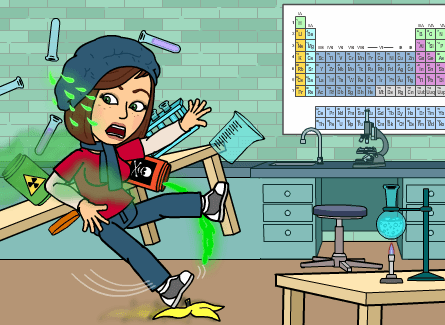
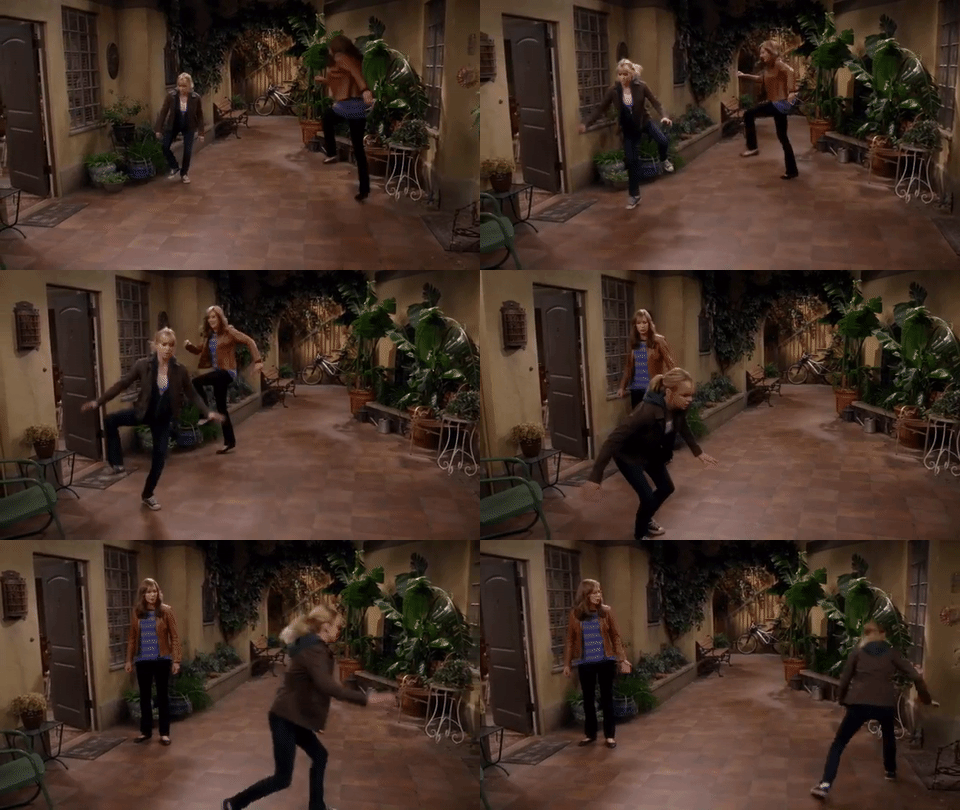
To be honest, I needn’t even write anything for this post- a host of gifs would fairly accurately sum up my experiences of coordination! 😛
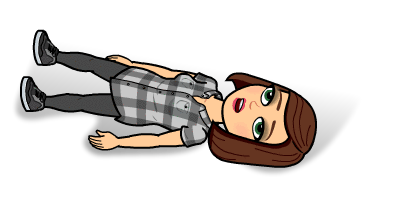
I drop things more easily, I fall over a LOT, bump into things, walk sideways into people I’m walking alongside, fumble a little longer with buttons, laces, hair clips etc. People have often thought I’ve been drunk on nights out (although I don’t drink) when coordination trouble presents itself- giddiness has a habit of rendering me less coordinated for some reason! 😛
These incidents happen so often it becomes another part of daily life- you trip over your feet for no reason, laugh and keep walking! 😛
You might think I’m exaggerating but it happens all the time! Even my dogs have noticed- I once fell flat on my face on a walk and my normally attentive German Shepherd just stood and laughed, waiting for me to get back up! 😛
I’ve always been a little slower than my peers when it comes to mastering my finer motor skills. From my very first skip I’ve struggled with my coordination issues.
My mother often reminds me of how I used to screw my face up in concentration after dance classes in my attempts to master the skill. I would try and try and try to skip around the room, but kept falling over my own two feet!
Don’t get me started on the struggle to add in a skipping rope! 😛
But nevertheless, each time I fell, I got back up again and persisted until I mastered it- and then you couldn’t keep me from skipping!
This has always been my experience of coordination. I struggle a little bit longer than my peers to develop my motor skills, but with persistence, master them I will. Tying my shoelaces, riding a bike, learning to drive, knitting- all these skills took time to master, but I got there in the end 🙂
Now if I could just master walking in heels, I’d be flying! 😛 😉
Top tip– Keeping on top of sleep, thirst and hunger can really help to keep your coordination in check. In addition to acting loopy if I fall victim to these, I find that my equilibrium can also be affected.
But what do scientists have to say about these coordination issues?
The underlying cause of these issues is poorly understood, however, recent studies suggest that motor coordination issues in autism are likely linked to abnormal neural connections in the brain. Remember the synapse (or connecting junction point between two neurons) which we discussed last week? Autist’s have an overabundance of these bad boys compared with normally developing peers.
So how does the synapse affect motor coordination?
Motor learning and control is influenced by a specific group of neurons known as purkinje cells. Purkinje cells, (located in the cerebellum- an area heavily involved in motor control), receive signals from climbing fibers- a type of neuron which carries information from the body to the brain. These climbing fibers detect changes or disturbances in our environment, such as changes in space or the position of nearby objects, and relay this information to the purkinje cells. Purkinje cells then emit inhibitory signals at synapses so to modify motor movements accordingly.
In autism however, the efficacy of purkinje cells to influence motor change is greatly reduced.
Normally, each purkinje cell receives input from a single climbing fiber. Autists have too many synapses connecting the brain, and so the purkinje cell receives signals from multiple climbing fibers. This confuses the purkinje cell, which in turn alters the efficacy of corrective signals. Like a game of Chinese Whispers, the more people involved (i.e. synapses and climbing fibers), the more the message get’s lost in translation.
To give an example, if you were walking along and someone threw a ball at you, climbing fibers will alert the purkinje cells to tell the body to move out of the way. In autism….well, the signal to do this get’s scrambled on route to the brain, aaaaand… you’ll likely get hit in the face! 😛
^^^^Story of my life right here! 😛
At the end of the day, whilst coordination problems can be incredibly frustrating, persist and you will get there 🙂
Never give up- ride that bike, drive that car, skip like there’s no tomorrow!! Autism only limits us if we allow ourselves to be limited 🙂
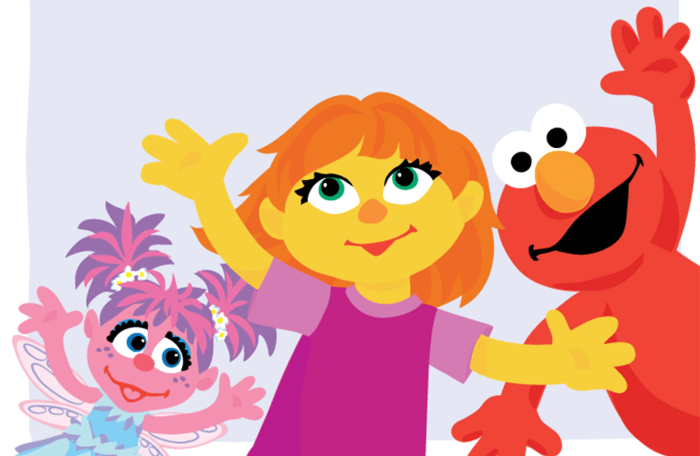
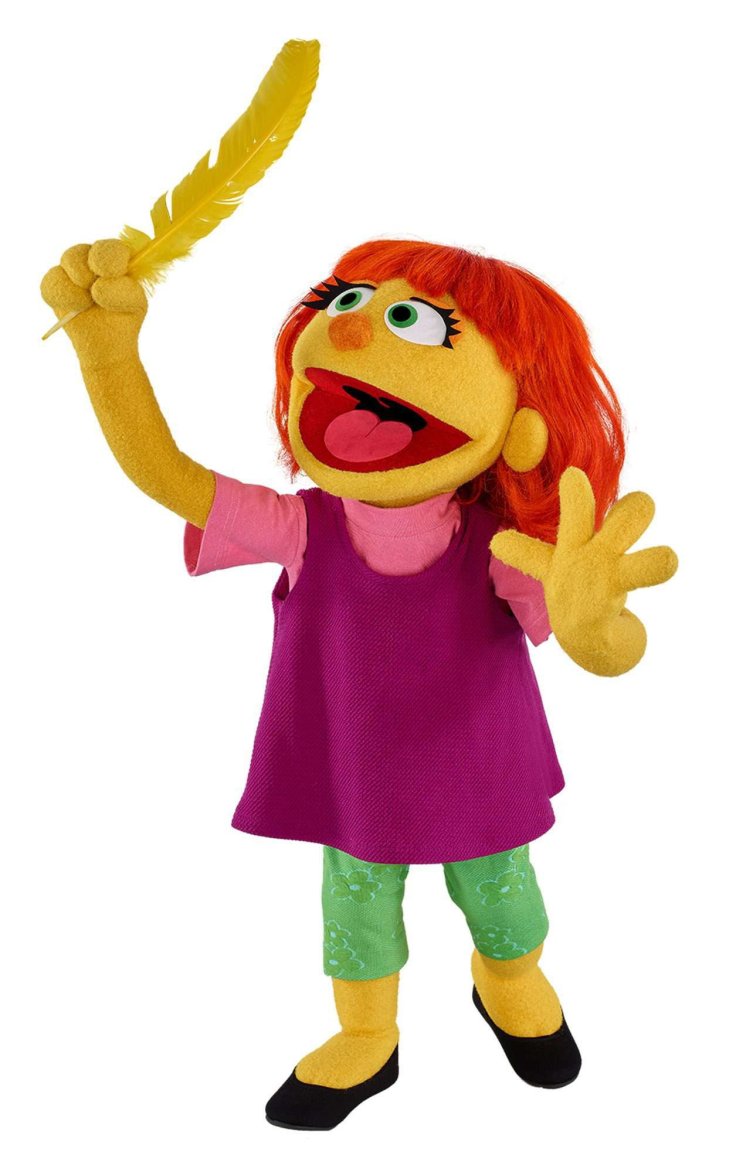
Earlier this week, popular children’s TV show Sesame Street officiallydebuted a new puppet with a twist- a puppet with autism! 😀 The character of Julia was introduced as part of Sesame Street’s autism initiative, first appearing on Monday to rave reviews from fans, experts and parents everywhere.
Whilst only making the news in recent months, Julia has in actual fact been around since 2015, having first appeared in an online storybook about autism as part of ‘Sesame Street’s’ autism initiative- ‘Sesame Street and Autism: See Amazing in All Children’.
The creators of Sesame Street established this initiative in 2015 in order to promote better understanding of the condition after a study revealed that children with autism are more than five times more likely to be bullied than their peers!! This initiative was developed in partnership with autism workers, advocates, parents and autists themselves in order to ensure that the topic is handled in the best possible way.
It’s a nifty little website providing videos for kids, videos for parents, daily routine cards and loads of other useful materials for children and adults alike 🙂
So what is Julia actually like?
Julia first appears onscreen quietly painting with her friends Elmo, the fairy Abby Cadabby and Alan. When Big Bird comes on the scene, Julia largely ignores him, completely engrossed in her painting. The other puppets are engaging in finger painting, but Julia makes noises of disgust and uses a paintbrush instead, with Abby remarking that Julia hates the feeling of paint on her fingers.
With their paintings finished, Abby gives Julia’s painting huge praise (it was easily better than Abby and Elmo’s efforts), remarking that she is very creative- casually demonstrating the talents that autists possess without veering into savant stereotypes. Big Bird tries to hive five Julia for her efforts, but still she ignores him, making no eye contact. When Julia hops off to play tag with the other puppets, Big Bird questions whether Julia likes him or not. This leads Alan to explain autism to Big Bird so that he understands that Julia does things a little differently, “in a Julia sort of way“- but she’s also lots of fun! 🙂
Later in the episode, Julia hears nearby sirens and covers her ears in response to the noise, needing to go somewhere quiet for a bit, subtly demonstrating how an autist can struggle with sensory sensitivity. Julia also carries around Fluster, a rabbit toy which she strokes to help her calm down, showing the audience ‘stimming’ in action.
The primary focus of this segment is to demonstrate that although Julia has autism, she can play and be your friend just like everyone else. After Big Bird remarks that Julia is not like any friend he’s ever had before, Elmo and Abby point out that none of them are exactly the same, bird, monster, fairy- they are all different, but are friends regardless. Julia talks a little differently, repeats sentences, flaps her arms when she gets excited- but she’s just another playmate, however different, at the end of the day 🙂
You can watch Julia’s debut in full in the video below 🙂 :
My school life would have been so much easier had other children been better able to understand and accept me as the other puppets accept Julia, but with initiatives like this at work I have great hope for the next generation 🙂
This episode was handled both sensitively and intelligently to provide children everywhere with an insight into autism. All behaviours are explained, little is left for the audience to guess at. Julia is different to the other puppets yes, but the episode normalizes her differences so that when children encounter real people like Julia, they will be treated with acceptance and understanding 🙂
Here’s a behind the scenes look at how the character was brought to life:
Fun Fact: Julia’s puppeteer (who can be seen in this video thumbnail) is a mother to an autistic son in reality!
This was a pleasure to watch and I look forward to seeing all of Julia’s future adventures in the show! 🙂



































 A Is For Aoife Not Autism