Autism and “Stimming”

Greetings Earthlings! 🙂

Today I’d like to touch on one of the most commonly observed autistic behaviours- “stimming”.

So what exactly is “stimming?”

Self-stimulatory behaviour, (also known as stereotypy or “stimming”), refers to many of the repetitive behaviours often exhibited by autists. Examples of these behaviours include scratching or rubbing the skin, noise making, smelling objects and the classic examples of rocking and  hand flapping, although in my experience it’s a lot more like ‘Jazz hands’ than flapping!

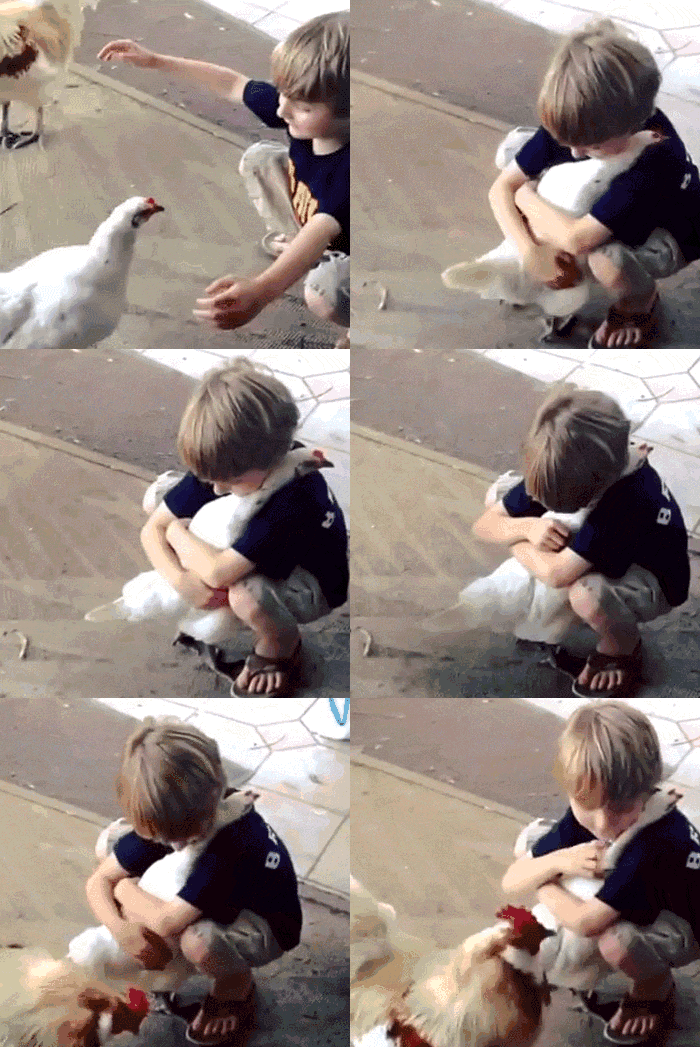
jazz hands.gif

There are two psychological theories as to why autists stim:

  • As a response to overwhelming sensory stimuli
  • As a means of relieving stress and anxiety

From a physiological perspective, there are a number of possible biological reasons.

Some researchers believe that stimming provides the autist with sensory stimulation. Contrary to common belief, many people with autism have a reduced sensitivity to certain sensory stimuli. Dysfunctions in the circuitry of the brain mean that the body craves sensory stimulation, and so we adapt repetitive behaviours in order to stimulate and excite our nervous system.

Deficits in dopamine levels in the brain can also interfere with our reward pathways, leading autists to engage in behaviours, such as stimming, which will provide the extra hit of dopamine that the brain needs.

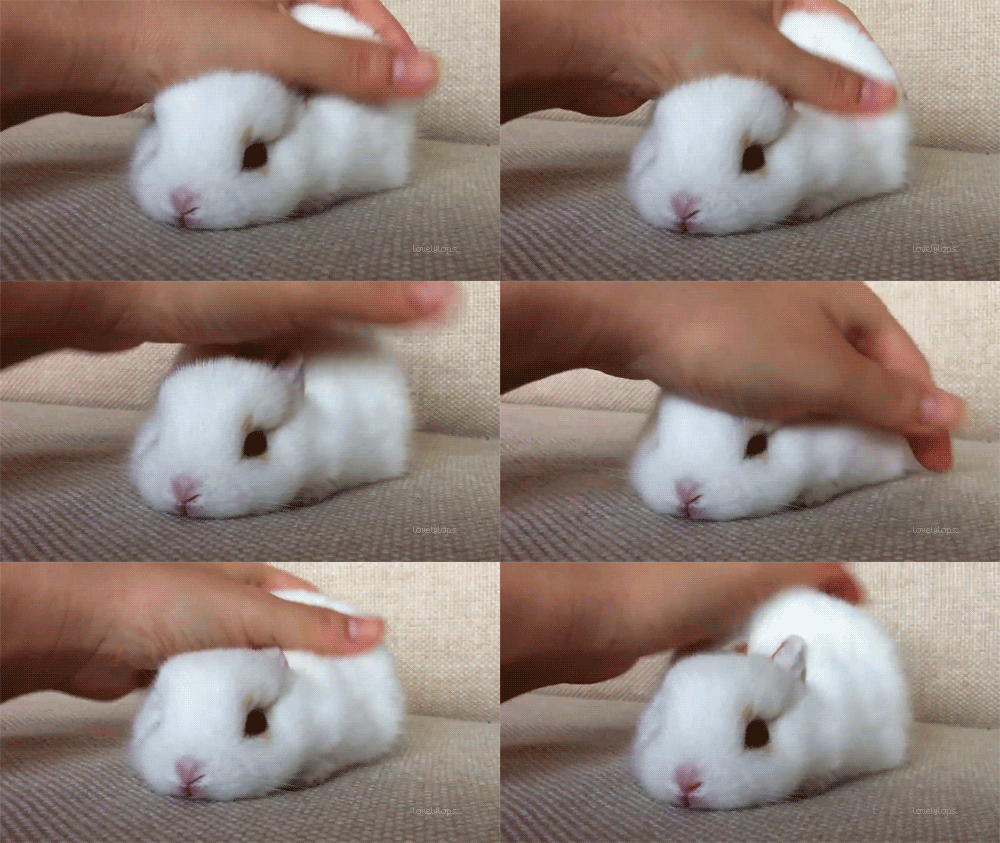
So that’s why I’m drawn to fluffy things! 😉

Image result for stroking fluffy gif

Aside from being drawn to stimulatory texures, I have a particular tendency to fidget with the silver chain around my neck. I just find something oddly soothing about the rough sensation of the metal against my skin! 😛

In my experience, I also find that stimming isn’t always a response to stress, but born from a need to keep my hands busy.

As I’ve discussed previously, research shows that autists have higher levels of excitatory neurotransmitters such as glutamate, and lower levels of calming neurotransmitters in the brain. As a result, we are often hyper-stimulated. Stimulation of the brain’s reward system, i.e.  dopamine release through “stimming” behaviour, causes a decrease in glutamate levels, effectively calming the brain!

This would explain why I’ve often found that stimming sometimes helps me to concentrate and clear my mind by channeling any excess energy into a physical action. I find this particularly helpful when I’m studying, or writing, and for some strange reason while I’m waiting for the microwave to ping! 😛 #excitedforfood

Image result for fidgeting gif

Stimming can also be considered a form of self injurious behaviour, but I’ll write a separate post on this topic at a later stage 🙂

So is there anything that can be done to control this type of behaviour?

bitmoji339468972

  • Try replacement behaviours– if the stim is not socially acceptable or harmful, as in the case of biting behaviours, attempt to replace the stim with another one such as a fidget toy or chewing rubber
  • Exercise– there is evidence to suggest that exercising can decrease the frequency of stimming behaviours, although the research is unclear why
  • Cognitive behavioural therapy (CBT)– is thought to be useful as self stimulatory behaviour operates in a similar way to OCD tendencies which are often managed through CBT techniques
  • Medication– Seems there’s a pill for everything these days! Medications can be used to help modify compulsive behaviours such as stimming, but I personally would not advocate this route

So there we have it Earthlings, a brief insight into stimming behaviours in autism! 🙂

Enjoy the weekend everyone! 🙂

Aoife
Autism and Illness

Greetings Earthlings! 🙂

As we head into flu season, I thought I’d explore some of the challenges that face autists when it comes to feeling unwell.

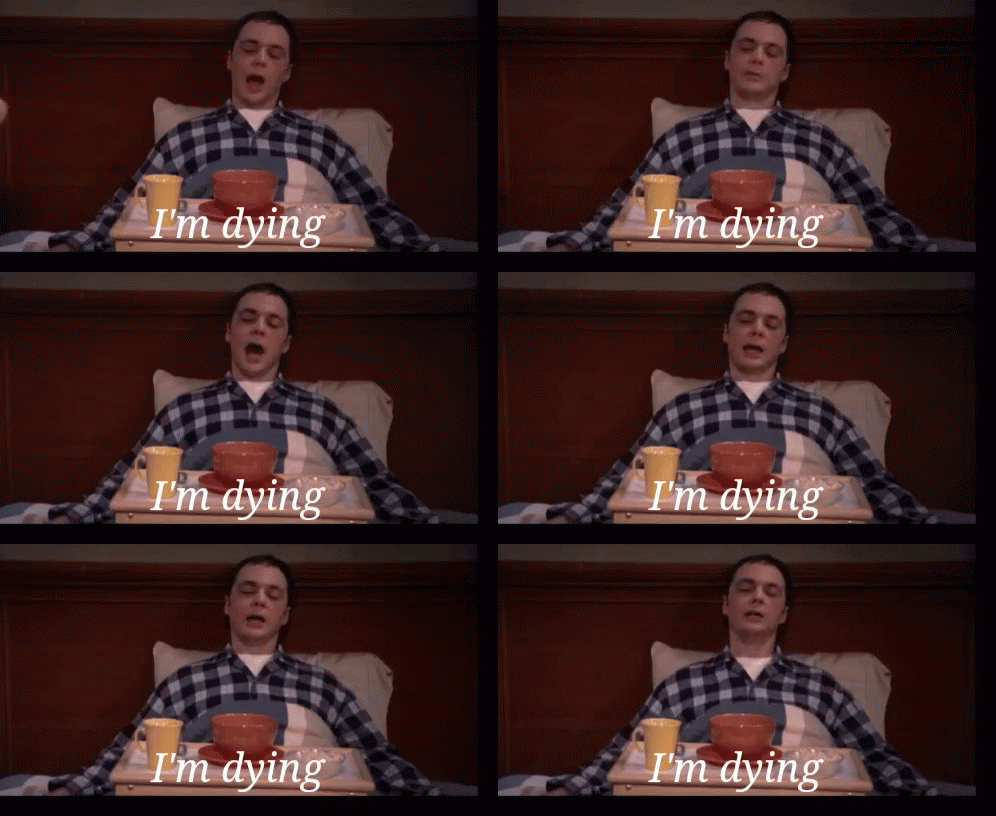
We all know the glorious sensations that accompany common illnesses, the coughing, the vomiting, aches and pains and that delightful swollen head feeling that makes it hard to remember what breathing feels like! 😛

Image result for i'm dying sheldon gif

Now imagine you have autism- you are hypersensitive to stimuli such as temperature changes, struggle with change, and do not cope well with discomfort. On top of this, your struggles to communicate might make it difficult to convey that something is wrong. Most children will tell their mother that their tummy hurts; an autist may struggle to identify or describe a medical problem to a parent or doctor, especially in nonverbal cases.

It might just be a simple cold or bug to a neurotypical, but to an autist, it may be an entirely overwhelming experience.

One of the biggest challenges that I faced growing up was not so much coping with illness, (I have been known to go out clubbing whilst suffering from a bug or the flu!) but treating it.

I HATED taking medication!

Taste aversion was a big issue, mostly because medication came in foul tasting liquid form! Here’s a fairly accurate representation of my face after swallowing medicine:

bitmoji586634746.png

Every year my mother and I would go to war to get me to take my cough bottle or antibiotics. I would try it once, discover it tasted rancid, aaaaannnd then do everything my twisted sense of logic would come up with to avoid taking it. I would often pour out the medication when she wasn’t looking, or pretend I was old enough to dose myself so I could get away with not taking it! 😂

Didn’t work out so well though when things got worse… 😛

I know! I should have know better- but don’t  judge me too harshly, seven year olds are not well versed in the concept of antibiotic resistance! 😛 😉

Tablets were a little easier, but tricky to get used to the sensation of swallowing them at first. Once I discovered that antibiotics came in tablet form as an adolescent however, I became far more amenable to knocking them back! As the guys from Pringles say- “Once you pop, you can’t stop!” 😉 Although I may still recoil as the tablet slips down on occasion, especially if it has an unfortunate taste, or even worse, a powdery texture…!😬

Image result for swallowing tablet gif

Getting an autist to take medication can indeed be quite a daunting task, but here are some of my top tips for parents struggling with this problem:

  • Mix liquid medications into another drink or yoghurt– Ok, I know this feels a little bit like wrapping tablets in meat to get your pet to take them, but there is method in the madness! My mother used to mix antibiotics or antihistamine in with my juice or flat coke when I would refuse to take them. For the most part this worked, but sometimes I found the combination tasted just as bad- so trial and error! Just make sure that they consume the whole thing to get their full dose.
  • Ask for tablets not liquids– Granted, you can’t get tablets before the age of 12, but if given the choice- take the tablets. There is far less chance of taste related rejection!
  • Bribery- My mother was always particularly fond of this approach. To first encourage me to take propolis tablets, I was promised a fun-size bag of Malteasers if I swallowed them without complaint! Needless to say- it worked! 😉
  • Make a game of it- Why not try and use a specialist interest to encourage them to take their medicine? ‘It’s a magic potion to make you feel better!’, ‘This is what makes the Hulk strong!’ ‘See- it’s pink like Barbie; her favourite drink!’ My mother tried something like this by writing a note on a box of meringues to say that she had cast an engorgement spell on them to keep me from eating them! I was a bit older at the time, so I mostly ignored it, but I got a chuckle out of it at least! 😛 😉 Had I been a stubborn 6 year old however, I definitely would have fallen for it.

Failing all that- try to stay healthy folks! Wear your warm jumpers, take your multivitamins (although the scientific jury is out on whether or not these are actually useful!) and your apple a day and hopefully you will keep the doctor away 😉

bitmoji562267823.png

Enjoy the weekend everyone! :)`

Aoife

Autism- Are We Making Excuses?

Greetings Earthlings,

So today, my title is a little bit different, but I’ve been musing on this question a lot of late- are we making excuses for autists?

hmm

Don’t get me wrong, I’m the first person to advocate the need for understanding and acceptance for those of us on the spectrum- but there is a fine line between making exceptions and making excuses.

I have seen people that were given all of the support and understanding that I grew up without, and yet they do not seem to function as well as I do. Granted there are varying levels of need and functionality within the community, but one has to wonder if excuses have been made. Certainly teachers have told me about spectrum kids where parents have insisted that their child is “not able” for various school activities.

If raised in a protective autism friendly bubble, what happens when your supports go away in adulthood? How can you cope in the real world if people have spent your whole life excusing your behaviour?

Tells a stranger they look like a troll- “He has Asperger’s!”

Struggles with a maths problem- “She’s not able, she’s autistic!”

Throws a plate in a restaurant- “I can’t help it, I’m on the spectrum!”

If you tried anything like that last one as an adult you would be arrested not excused!

police.png

Yes being autistic is a challenge, yes we can’t always control impulses, meltdowns or our tongues, but it doesn’t mean that we can’t improve. If we are never called out on our behaviour, we will continue to think that it’s ok to tell people that they look like a troll for example, and one day we will say it to the wrong person- bye bye friend, or job opportunity; maybe even hello fist!

I know it’s not easy to scold an autistic child, we don’t understand how or why we’re in trouble, or even what we did wrong sometimes- which often triggered meltdowns for me growing up; but here are some tips on how to approach this situation:

  • Reassure them that they are not in trouble- This can be critical. As you know, we autists are black and white thinkers. We see the world in good and bad. If something we do is bad, then we perceive our whole selves to be bad. Our brains struggle to handle anything less than perfection- and we all know what happens when our brains can’t handle something! #meltdownalert

Image result for there there gif

  • Explain why the behaviour was bad- The key here is to not excuse the behaviour, but to explain it to us. If we understand why, then we are far less likely to be overwhelmed. “You’re not in trouble Aoife, but it’s not nice to….because… So try to remember that next time ok?
  • Create Rules– Rules are essential to modifying our behaviours. We live our lives by them, and yet when it comes to social rules we just don’t have a clue! If you create some for us however, we will be all the better for it 🙂  penny big bang theory sheldon autism aspergers GIF
  • Use reward systems to encourage positive behaviours- As I’ve discussed previously, my mother found it particularly effective to use rewards to encourage me towards better habits such as studying and holding my temper

I’m not saying that we autists need to conform and be “normal” (as I always say- it’s overrated!), but for our own sakes, we cannot make excuses for every single autistic behaviour. So try new things, fall off that bike a dozen times or tackle that equation.  If we automatically say that we “can’t”- then we will never reach our potential.

We may get it wrong, but oh, what if we succeed? 🙂

Aoife

Autism on Screen-The Good Doctor

Greetings Earthlings 🙂

Today I’m going to explore the most recent portrayal of autism on screen- the pilot episode for the new ABC drama ‘The Good Doctor‘.

A Review of the Good Doctor | The Art of Autism

So what’s it all about?

Well the name is fairly self explanatory- the series follows Dr. Shaun Murphy (played by Freddie Highmore- can’t believe he’s all grown up!), a surgical resident with autism and savant syndrome (Really?Again! 😛 ) as he sets out to save lives.

You can watch a trailer for the show here- but word of warning, it’s a bit spoilery for the first episode so if you’d really like to watch it- maybe skip the trailer 🙂

But how does it’s depiction of autism fare?

Granted, this was merely the pilot, but so far the show has portrayed some of the classic symptoms very well- repetitive movements, truthfulness, literal thinking, awkward gait, eye contact issues etc. Like ‘Atypical, the show strives for subtly in Shaun’s idiosyncrasies rather than highlighting the obvious differences to his surgical peers. For example, Shaun struggles to open a ribbon, a simple, subtle struggle that few would associate with autism. Why just this evening I had to ask my housemate to open some freezer bags for me as I just couldn’t seem to crack it!

Unlike other portrayals of autism, I felt that the acting was far more natural, as if I were encountering a real person and not another hyperbolic autist.

For the first time, I felt like I could identify with Shaun as he awkwardly went about- I particularly identified with his descriptions of smells and how he uses different scents for recall (I’m notorious for using unusual identifiers to recall memories!).

However, as the title character is a savant, once again we are seeing an over-representation of a rare autistic trait. Nevertheless in the context of this series, it makes sense that Shaun has a brilliant mind and excellent recall- skills which are essential in the medical field.

Good Doctor' star Freddie Highmore on playing an autistic character,  breaking down stereotypes - ABC News

The pilot also touched on a very important issue- the struggle for autists to gain employment. Following the decision to hire Shaun, the hospital held a meeting to debate the validity of his candidacy as a surgical resident given that he is autistic. This meeting largely focused on all the areas where Shaun may fail, with little attention given to how he might succeed.

Given my own struggles to break into the world of employment this past year, one has to wonder if similar debates were held when I left the interview.

Why is it automatically assumed that we will not be capable, or that we will struggle in a job? Would such a meeting have been held for any other equally capable doctor in Shaun’s workplace?

Thousands of undiagnosed autists have successful careers, and yet the mention of the a-word could see them doomed to failure.

Companies are not allowed to discriminate on the basis of gender, age, educational background etc., so why does it have to be different for autism? How will you know if we are capable if you never give us the chance?

All in all, I really enjoyed the pilot and will be very interested to see how this show progresses 🙂 I would highly recommend it- but be warned it may not be for the squeamish (I’m not particularly, but there was one moment during that episode where I physically recoiled! 😛 )

Have a good weekend everyone! 🙂

Aoife

Autism- A History

Greetings Earthlings! 🙂

Today, in continuation from my post exploring autism through the ages, I’d like to give you a brief intro into how we came to know of  autism.

So how about a bedtime story then Earthlings? 🙂

bitmoji485231286.png

A long time ago in the land of Austria, two researchers were born that would go on to make medical history- Leo Kanner and Hans Asperger. Whilst these men interestingly did not collaborate, together their respective research laid the groundwork for our current understanding of ASD’s.

So how did it all begin?

Whilst some of the earliest documented cases of autism dates back to the 1700’s, the new Latin term autismus (“isolated self”) was first coined by Swiss psychiatrist Eugen Bleuler (who also coined the term schizophrenia) in 1910. Derived from the Greek word “autós” (meaning ‘self’), Bleuler used the term to describe a sub group of people with schizophrenia that were removed from social interaction.

Image result for eugen bleuler

The term autism first began to take it’s modern form in 1938 when Hans Asperger adopted the term ‘autistic psychopaths’ in a German lecture on child psychology. During this period, Asperger was investigating the ASD which would later bear his name, examining a group of four boys of normal intelligence who struggled with social integration and empathy. Asperger dubbed these boys “little professors” due to their ability to lecture at length on their favourite subjects!

Fun Fact: Asperger himself is widely thought to have displayed many of the symptoms of his discovery himself!

Image result for hans asperger

In 1944 Asperger published an article in German titled ‘Autistic psychopathy’ in childhood, a publication which largely went unnoticed within the English speaking medical community until the 1980s when child psychiatrist Lorna Wing brought his work into the limelight.

This obscurity was also due in part to the work of his contemporary Leo Kanner at the prestigious John Hopkins University in the USA, who pipped Asperger to the post with his paper Autistic Disturbance of Affective Contact in 1943.

Image result for leo kanner

In this work, Kanner described a group of 11 (8 boys, 3 girls) socially isolated children with a “need for sameness” and a “resistance to (unexpected) change.” Kanner claimed to have discovered a new medical condition which he named “infantile autism”, garnering much attention and praise within the medical community.

But was it coincidence that these men happened to work in tandem on such similar projects 4000 miles apart?

In his lifetime, Kanner claimed that he had never heard of Asperger’s work, however, it would appear that this was not the truth.

Author Steve Silberman has since discovered that Kanner likely heard of Asperger’s work through George Frankl- a work colleague from Vienna, and former chief diagnostician at Asperger’s clinic in 1938. Driven by an ambition to make his mark on medical history, it would appear that Kanner sought to recreate Asperger’s work in America, repacked it and claimed it as his own!!

Image result for fainting gifPoor Asperger- but at least his name lives on in Asperger’s syndrome! 🙂


So what did these early researchers believe to be the root of autism?

Difficult as it may be to imagine, Kanner firmly believed in something called the “refrigerator mother hypothesis“- a since (rightly) discarded theory which claimed that autism is caused by a lack of maternal warmth or love!!!

Image result for outraged gif

I know!!!!!

Madness!

In addition to this, Kanner’s reuse of Bleuler’s term autism resulted in decades of confused terminology where autism and schizophrenia were one and the same.

Thankfully, the research caught up to give us a clearer insight into the physiological roots of autism (although it took about 20 years for the experts to catch on! 😛 ), leading to the establishment of autism (and later Aspergers syndrome in 1994) as a separate diagnosis in it’s own right in 1980.

And that is the history of autism dear Earthlings, I hope you enjoyed your bedtime story! 😉

Enjoy the weekend everyone! 😀

Aoife

Autism Through The Ages

Greetings Earthlings! 🙂

In this week’s post I’m going to briefly explore the history of autism.

So gather round for storytime! 😀

fgghd

As autism rates increase, many people have come to believe that the condition is relatively new. Whilst the clinical term may be in it’s infancy, autism can in fact trace it’s genetic lineage back through millennia!

Genetic research has shown that some of the key genes involved in the development of autism came from our shared heritage with the apes, predating the evolution from monkey to man (somewhere in the region of 7 million years ago).

Image result for evolution

Other related autism genes are slightly more “recent” than this, having come into existence over 100,000-years ago.

Whilst a third of autistic genes may come about through spontaneous genetic mutation, from this evidence we can see that autistic genes were inserted into the genetic code of our ancestors for a reason.

Interestingly in ancient times, people that displayed autistic traits were in fact highly revered. Such autistic traits as exceptional memory skills, creative thinking, observational skills, heightened senses and extensive knowledge in important areas such as plants and animals (i.e specialist interests), would all have been greatly valued in an ancient community. The incorporation of these skills within the group would have been essential to their survival.

Experts also believe that autistic skills such as memory and attention to detail may have contributed to the creation of ancient cave paintings such as this one:

How often we focus on the negatives of autism that we fail to stop and consider the reasons these genes exist. If they were a hindrance to the human race, why have they not been eradicated through millennia of evolution?

I think Temple Grandin sums it up pretty well here:

Image result for autism genes memes

And she would be right! 😉 Experts believe that autistic genes have been conserved to advance our intelligence. Variants of autistic genes have been linked to improved cognitive performance and the formation of new brain cells.

Such talented historical figures as Michelangelo, Mozart, Beethoven and of course, Albert Einstein, are all believed to have shown signs of autism- but history remembers them for their esteemed achievements, not their genetic quirks.

Something that we would all do well to think of when we commit autistic people to the annals of history in future.

So there we have it Earthlings, I hope you find this information as interesting as I found it 🙂 I could go on further buuuuttt I think I’ll spare you the clinical history of autism for another day 😉

Have a good weekend everyone! 🙂

Aoife

Autism on Screen- Atypical

Greetings Earthlings! 🙂

So today I’m going to place Netflix’s latest original offering ‘Atypical‘ under the microscope.

Image result for atypical

The series has been widely discussed within the autistic community this week, but in case you haven’t heard about it- ‘Atypical‘ is a coming of age series which follows Sam, an eighteen year old boy with high functioning autism as he sets out to find a girlfriend.

You can watch a trailer for the series here:

The series has received mainly positive reviews from critics (Forbes claim it to be the greatest series Netflix has ever made- uh, ‘Daredevil‘ anyone? 😛 ), but some have critiqued the stereotypical nature of the character of Sam.

So what did I make of it?

fgsdtr

Show creator Robia Rashid, who herself has experience of autism in her personal life, conducted a lot of background research and hired autism consultant Michelle Dean to review all scripts and cuts- and in my opinion, it shows!

I found ‘Atypical’ to be a quite enjoyable and endearing series. I particularly enjoyed the coming of age angle, taking us away from the typical child/awkward adult portrayals that we see all too often on screen. It’s refreshing to see autism from the perspective of a teenager on the spectrum, a particularly turbulent time in the life of a change resistant autist (even more turbulent if navigated undiagnosed as in my case).

And guess what- the creators didn’t resort to savant stereotypes! 😀

Granted, Sam is highly intelligent with an excellent memory, but these traits are subtly infused within the fabric of his personality. I particularly found the acting from lead Keir Gilchrist, who based his portrayal on his experiences with autistic friends, to be quite excellent, especially for an actor of his age.

Image result for atypical

However, as excellent an actor as Gilchrist may be, many have criticized the show for casting a neurotypical actor in the main role. On the other hand, show creators did feature actor Anthony Jacques (seen on the right below), who is himself autistic. Alas, while described as a “supporting” character in many reviews of the show, he briefly appears in only two episodes.

Capture.PNG

Nevertheless Jacques’ character of Christopher forms a refreshing addition to the cast with his quirky enthusiasm, representing a higher functioning bracket of the spectrum.

Perhaps the thing I enjoyed most about the show was how it focused not just on how autism impacts Sam’s life, but it also gave equal screen time to the impacts of autism within his wider social circle. We see the toll that autism has placed on Sam’s parents and their marriage, the responsibility that Sam’s younger sister burdens herself with and the reactions of friends and others in the community towards Sam.

As much as I personally enjoyed the show however, there were times where Netflix veered towards the stereotypical. For example, I felt that Sam was a little too literal in his thinking/responses:

Zahid (Sam’s friend): “I’m taking you to Poon-city!”

Sam: “That’s not a real place”

We have our moments yes, but not everything is quite that literal.

Related imageRelated image

I also found issue with how Sam always speaks in measured monotones- a common autistic stereotype. Whilst, yes, this is characteristic of some within the autistic community, it is not for all. My tone of voice for example can be anywhere from high pitched to a deep drawl depending on the mood I’m in (or an opportunistic head cold 😉 ). This stereotype crops up time and time again in on screen portrayals and it is really starting to bug me! 😛

Once again as I watched this show, I felt as though I were seeing yet another carbon copy autistic person dance across my screen. The show talks about neurodiversity, but the character of Sam is, to my eye, far from diverse.

Perhaps Netflix would do well to feature an autistic female lead if the show is renewed for a second season.

All in all, ‘Atypical‘ is a mostly enjoyable affair so check it out if you have a spare 4-5 hours for a weekend binge watch 🙂

Aoife

Autism Management- Sound

Greetings Earthlings 🙂

So leading on from my recent post about sound sensitivity and autism, today I’m going to expand a little bit more on the subject.

Fun Fact: Did you know that an estimated 65% of autists are sensitive to sound?

Being sensitive to sound can be quite challenging for those on the spectrum, but that doesn’t mean that it can’t be managed.

So here are some of my top tips for managing sound sensitivity:

  • Earplugs/Noise Cancelling Headphones- I know, it’s the obvious one, but it has to be said! Using these can really help to take the edge off for many autists in noisy environments. These can be especially helpful if you are a fan of live music, but find gigs too loud- I have genuinely seen people wear noise canceling headphones, earplugs and cotton wool to gigs, you will not be alone! 😀 Added Bonus– it can also discourage unwanted conversations 😉 Image result for headphone memesIf you’re in the market for a pair, the nice folks at reviews.com have a really good article comparing the best on the market:  https://www.reviews.com/noise-canceling-headphones/
  • Listen to music– if you don’t appreciate the sound of silence like Simon and Garfunkel, then hooking a set of headphones up to a music player is another great way to manage sound sensitivity. You can control what sounds you will hear, drown out potential triggers and have some fun while doing so! 🙂 This is particularly useful in the workplace to help focus your mind on your work whilst keeping distracting sounds out.

download (3)

Top tip– headphones for leisure (comfier for long journeys, seal in the sound better, and will stop your parents complaining about the volume 😉 ); earbuds for the workplace (drown out sound whilst still allowing you to hear if you’re needed by colleagues).


  • Try a silent disco- If sound sensitivity is keeping you from partying the night away in the club, why not go to a silent disco (as seen in the final episode of Atypical)? These are quiet, but loads of fun- and they enable you to control both the volume and choice of music. As an added bonus, you can take off your headphones at any time and have a conversation without the need for shouting 😀


  • Move away from the offending stimulus– I know it sounds a little silly, but sometimes you just need to take a step away from offending sounds.

Image result for step away gif

We can’t always walk around wearing noise cancelling headphones -they can really irritate your ears if you wear them for too long, especially if you happen to be wearing earrings at the time! 😛

Top Tip- If you’re feeling overwhelmed by an irritating sound, especially on a night out, take a few minutes to go outside or to the bathroom, or try stepping out to the quiet of the smoking area (although this may result in a different kind of sensory assault…)


  • Ask if an offensive sound can be stopped– Naturally, we can’t go around demanding that someone chew less loudly or ask the DJ to turn the music down (can’t commit social suicide!), but it doesn’t hurt to ask a friend/family member to turn down the car radio volume, not to pop balloons around you or to stop playing with that sonic app that makes your ears bleed (remember people playing with those in school as the teachers could never hear the frequency?)!


  • Magnesium supplements– Now this one is a little weird. Some people believe that magnesium deficiency attributes to our sensitivity to sound…this smells a bit like pseudoscience to me… but hey- if it works for you, who am I to question it!

So there we have it Earthlings, my top tips for managing sound sensitivity on the spectrum 😀

Have a good weekend everyone (unless you’re back to school next week- in that case, my condolences! 😛 😉 )

Aoife

Autism on Screen- Cube

Greetings Earthlings! 🙂

Today I’m going to talk to you about the portrayal of autism in the 1997 Canadian sci-fi horror film ‘Cube‘ (not the fun TV show! 😛 ).

Cube The Movie Poster Art.jpg

I came across this (apparently) cult film last year when I was researching films featuring autism for a college assignment and decided to check it out.

The film focuses on a group of strangers who wake up in (surprise surprise) a giant cube comprised of a series of interconnecting rooms, each rigged with booby traps with the potential to kill the occupants of the cube. For example, there is a room that upon triggering a motion sensor will cause a wire grille to close in on the unwitting victim and slice them to pieces…

It’s a pretty grim film…

In order to leave, the group must work together to figure out how to escape their deadly prison and crack the puzzle that is the cube.

This film was definitely not my cup of tea (if I were a tea drinker! 😛 ), but hey if you’re into the sci-fi horror genre then check out the trailer and see what you think!

But what has this film got to do with autism?

Well, wouldn’t you know it, the invisible puppeteers who control the cube hand selected their prisoners so that they could combine their skills to navigate the maze, and who did they select? None other than an autistic savant…!

Why?!

bitmoji110263557.png

This character is key to the prisoners escape as his mathematical skills enable them to calculate how the cube moves so that they can navigate their way to the exit in relative safety…or so they thought!

Buuut I won’t spoil it for you in case you want to see it! 🙂

Sooo aside from yet another stereotypical mathematical savant, how is this films portrayal of autism?

The actor is actually pretty good showing lack of eye contact, stimming and repetitive movements, colour sensitivity etc.; however, once again I felt as though I was watching the same stereotypical character I’ve seen in dozens of films before.

Autism is a spectrum, each character we see on screen should be unique; but I guess Hollywood has yet to get the memo!

These scriptwriters seem to be stuck in a repetitive cube of their own! 😛 😉

Until next week Earthlings! 🙂

Aoife

Autism and Making Friends

Greetings Earthlings! 🙂

Today we’re going to talk about something that many autists find difficult-making friends.

When it comes to making friends there is no exact science, something which can trip up many a logically thinking autist.

It’s not that we don’t want to make friends, but we often struggle to navigate the social playing field, sometimes choosing our own company to avoid the various trials and tribulations of social interaction.

There are no set rules when it comes to friendship, and we just can’t seem to wrap our brains around it.

Image result for how not to make friends

In my own experience, I found that connecting with my peers was a real barrier to formulating friendships in school. We had different tastes in music and film, were interested in different hobbies, wanted different things, held opposing beliefs etc. I found it really challenging to find common ground to converse on.

Making friends isn’t the easiest of tasks, but there are some things that I’ve learned over the years to make the process a little less challenging :

  • Take classes- I found that dance classes were a great social outlet as a child. I partnered up with different children, got invited to a lot of birthday parties (although I have many memories of wandering off to be by myself! 😛 ) and it helped with my coordination. Speech and drama classes can also be very useful in helping to build your confidence and social skills.
  • Try to find common ground with your peers. When in conversation, ask the other person about TV shows, bands, films, sports etc. you may be surprised at what you have in common.
  • Don’t be discouraged if you’re struggling to connect with your peers- I was 11 before I truly made a lasting friendship, and it wasn’t until college that I finally felt that I belonged socially. The average school-goer can often be small minded when it comes to befriending people who dare to be different. While some amazing efforts are being made to de-stigmatize and embrace autism in the younger generation, there will always be some who rebel against difference. Forget the haters- there are so much better people out there who are worthy of your friendship 🙂

5284_583670671643597_310296445_n.jpg

  • Try not to compare yourself to your neurotypical peers- We all make friends in different ways, prefer different types and sizes of social groups. What seems to work for others may not work for you. Social mimicry may seem logical, buuuutt, it doesn’t always work.
  • Be yourself- As cheesy as it sounds, it’s true! 😛 I have spent many a year feigning interest in matters that I thought my peers would respond to, but when I stayed true to myself, that’s when I discovered true friendship. True friends love you for you 🙂

Image result for best friends know how weird you are

  • And if that all fails, you can always do what I do- bake to make friends! Nothing like a plate of home made sugary goodness to create a lasting impression 😉 Even if you burn it, you’ll still get a funny story out of it! As I’ve grown into adulthood, the stories of my many mishaps have become quite the conversation starter 😛 😉

If things don’t work out, don’t be so hard on yourself about it. Not all friendships are built to last. One of the biggest mistakes that I make is to hyper-analyse why a friendship breaks down in my efforts to understand where I went wrong to avoid future problems. Whilst yes, social lessons can be taken from past experiences, there’s no use in torturing yourself about it- you may not even have made a misstep.

Sometimes, these things just happen.

But that does not mean that you should not try again. The social complexities of formulating friendship can be overwhelming, but the reward is great 🙂

I have been so blessed in the friends that I have made in my lifetime, people who love and accept me as I am- even embracing my quirks.

Sometimes people are not always the most accepting of those who dare to be themselves, but that doesn’t mean that you do not belong socially. It took me years to find my pack, but in the end, I found my place 🙂

Image result for friendship memes

Have a great week everyone! 😀

Aoife

Blog at WordPress.com.

Up ↑