Autism 10 years on

Greetings Earthlings! 🙂

This week marks a bit of a milestone in my autism journey- the 10 year anniversary of my diagnosis. It’s mind boggling how fast these years have flown by, not to mention how much my life has changed in that time.

In September 2014, I was a complete wreck. I was suffering with social anxiety, my mental health was a mess, and I was struggling with work and the social dynamics of my workplace. I had never been so stressed in my entire life (which is saying something given that I was bullied in school) and was at breaking point. Out of nowhere, I found myself tricked into an autism assessment (kudos to my parents for that 😛 ) and my entire world flipped- but in the best possible way.

Admittedly, things were rough for the first year as I learned to adjust to this newfound knowledge, and it took an additional year to relax enough to not mention the diagnosis every 5 minutes, but my life has ultimately changed for the better. I spent my first 24 years on this earth feeling like I didn’t belong, like a wonky puzzle piece that couldn’t slot into society. Everyone misunderstood me, but I guess when I didn’t even understand myself, how could the rest of the world? Most twenty somethings will have a quarter life crisis on their journey of self discovery, but I had the ultimate one. One little word held the key that allowed me to fully embrace the person I was always meant to be.

10 years later, I barely recognize myself. I’m in a job that I enjoy, I have amazing, supportive friends, and a (very) busy social life. Looking back on my past through the lens of autism, I have become a lot kinder to my younger self, learning to laugh and channel my experiences to help others like me. I feel less self conscious of my differences, know my triggers and how to sidestep them. This has enabled me to grow in confidence to a point where I have never felt more comfortable in my own skin.

Before my diagnosis, I was always shy and introverted, but by fully understanding myself, I’ve been able to unleash my inner extrovert, comfortably smiling and chatting with strangers wherever I go. Having a name for my differences normalized my feelings and gave me ownership, allowing me to overcome my anxieties and manage my sensory issues. I have autism, but autism does not have me.

If you had told me ten years ago what this one little word would do to my life, I don’t think I would have believed you.

I find it quite hard to imagine what my life would look like now had I not received my diagnosis. I have previously discussed if parents should tell their child about their diagnosis, and while the decision depends on the individual, based on my experience I would highly recommend divulging. It was initially a tough pill to swallow, but my life is better for it.

There’s so many things I wished I knew about autism before I was diagnosed, even now I’m still learning every day, but I suppose the biggest thing was to know that I would still be me at the end of it all- just a shiny, happier model. As I’ve discussed on many occasions, while an autism diagnosis shouldn’t change anything in theory, knowledge changes everything for the autist. It’s a lot to process, and it can be hard to see beyond the label, but you will emerge from the chrysalis a fully fledged butterfly. Initially it seemed like autism weighed me down, but that was just my wings poking through ready for flight 🦋

So for those of you working through your diagnosis right now, cringey cliché that it is to say, it does get better. To quote ‘The Middle‘ by Jimmy Eat World:

“It just takes some time
Little girl, you’re in the middle of the ride
Everything, everything’ll be just fine
Everything, everything’ll be alright, alright.”
❤️

Hope you enjoyed this post dear Earthlings! 🙂

Have a lovely weekend!

Aoife

Autism and AuDHD

Greetings Earthlings! 🙂

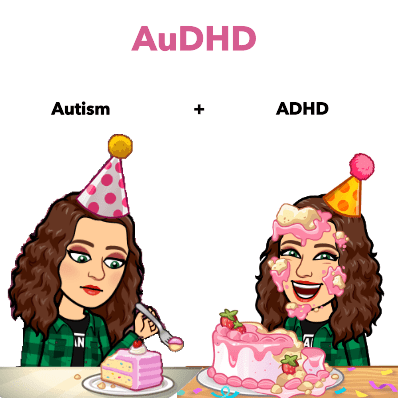
Leading on from my previous post about autism and ADHD, this week I’d like to expand on the topic by discussing the concept of AuDHD- aka autism + ADHD.

ADHD has been getting a lot of online attention in the last couple of years with many adults getting late life diagnoses as knowledge of the condition has advanced. Up to 10 years ago, it was thought that both autism and ADHD were completely separate diagnoses with no overlap. Now, it’s thought that 30-80% of autists also have ADHD, with many discovering they had autism during an ADHD diagnosis and vice versa.

When I previously wrote about this topic, I estimated that I was mildly ADHD, but the more stories I have been hearing about the experiences of female ADHDers, I exhibit a lot more traits than I originally thought. Because I wasn’t fitting the classic impulsive/hyperactive model of ADHD, I never thought to dig much deeper, buuutttttt, just like autism, it turns out that there are differences in symptoms between men and women. The original research observed more men than women (there’s a whole history of women being under researched in medicine) and so it was believed to impact more males than females, but, as with autism, sex differences and masking behaviours have made it very difficult to diagnose ADHD in women. ADHD also operates on a severity spectrum which can make it difficult to pick up on.

With all this overlap, enter the concept of AuDHD.

One of the most fascinating aspects of AuDHD is it’s paradoxical nature:

  • Autists like routine, but ADHD makes it difficult to maintain
  • ADHDers crave stimulation, but autists get easily overstimulated
  • Autists are rigid with rules, timekeeping and planning, but ADHDers suffer from time-blindness, impulsivity and hyperactivity making it difficult to follow plans and rules
  • ADHDers can be messy and chaotic, but autists like order and systemising

Effectively in AuDHD, the paradoxes can camouflage each other, making it much harder to diagnose either disorder. It’s like having 2 different brains fighting for control, but only one or the other will win out at any given time. For example, today you might do a weeks worth of work, tomorrow you might struggle to find the dopamine to do anything.

At other times, the symptoms are symbiotic. For example in my case, I can have complete time-blindness when I’m in the middle of something, but if I need to keep an appointment, the social rules governing lateness force me to be on time. AuDHD is a constant seesaw between the two conditions, a separate presentation in itself.

While it’s not a separate diagnosis yet, given the prevalence of comorbidity, who knows what the future will hold as neurodivergent research increases.

Hope you liked this post dear Earthlings! 🙂

Have a lovely weekend!

Aoife

Autism and AI

Greetings Earthlings,

This week I’d like to discuss a bit of a hot button topic at the moment- Artificial intelligence (AI).

Once upon a time, AI used to mean that atrocious Steven Spielberg film, but now AI is creeping into our every day lives. Chat-bots, deepfakes, AI research models, advanced searches and content recommendations- we can’t escape it. The applications are seemingly limitless, with great potential for people with autism.

But first things first, what exactly is AI?

AI is the technology that enables computers and other digital devices to do the things that humans do like read, write, learn, talk, analyze etc. While not human, the combination of human-like abilities and machine thinking can make it a powerful tool to be reckoned with.

So how can we leverage AI when it comes to autism?

Now here’s where things get cool. Robots are being used to help manage autism! Researchers are training robots how to interact with children with autism so that autists can get practice identifying facial expressions and social cues and help them to learn how to respond appropriately. Robots are the ideal companions as they have limitless patience and allow autists to practice their skills in a safe, non-judgmental environment. There are also a number of new AI apps that similarly work to help autists to practice their social skills, with AI technology being used to help move and learn what works best for the autist and help suggest the right kind of calming exercises depending on their mood.

In addition, AI models can be used to study the MRI’s of autists to help us better understand the condition, particularly how neurological changes and autistic traits vary between neurodivergents.

Most recently new AI systems has been developed that can quickly and accurately diagnose autism- one system by measuring how water travels in the brain by analyzing MRI images; and another that detects autism by measuring responses to a flash of light in the eye. This could revolutionize how we diagnose autism, allowing autists to get access to services sooner for better overall outcomes. Other cool AI apps allow parents to upload videos of their child’s behaviours to be analyzed by clinicians for remote diagnosis using AI to help categorize and assess them.

On the other hand, AI is a force that we must be careful with. It has great potential for use, but we need to be careful where we tow the line. This is especially true of Elon Musk’s Neuralink- a computer chip that can be implanted in the human brain, allowing us to control mobile devices through the power of thought. This week saw the first reported successful (though the evidence remains to be seen) implant where the patient has recovered well and is able to control a mouse on a screen with their brain. What was once the stuff of science fiction is rapidly becoming a reality. Aside from these tech applications, Musk claimed in 2019 that Neuralink has untapped medical potential to help “solve” neurological diseases like Parkinson’s, Alzheimer’s, Schizophrenia and…. autism.

Now… this was naturally met with a lot of backlash from autism charities- especially given that Musk has openly discussed how his autism has contributed to his success. Autism is a different way of thinking, it is not something that the majority of autists would like to “solve”. New approaches to help autists navigate life in a neurotypical world yes, but most would not wish to get rid of their autism if given the choice. Would modifying autistic traits through AI really help autists, or could it make things worse by taking away our unique way of thinking?

It’s a very fine line we tread, so we must proceed optimistically with caution when applying AI to autism.

Hope you enjoyed (or were horrified by) this post dear Earthlings!

Have a lovely weekend!

Aoife

Autism and Early Intervention

Greetings Earthlings! 🙂

This week I’d like to talk about a recent landmark study showing the importance of early intervention for long term outcomes for autists.

For many years, studies have reported great benefits for autists when early interventions are taken. The research suggests that the earlier interventions are put in place, the better the outcomes for autists. Putting the right behavioural therapies in place as early as 18 months, such as applied behavioural analysis (APA), can be effective in improving language ability, social interactions and IQ for autists. Other programs advocate practical social interventions, peer intervention programs and active family involvement.

Recently, a new type of early intervention has been in the news showing really interesting results. An Australian clinical trial was conducted on a group of autists that showed early behavioural signs of autism to assess the impact of preemptive interventions long before any autism diagnosis (the group were all between 9-14 months old). The intervention used in this study is called iBASIS-VIPP (Intervention within the British Autism Study of Infant Siblings- Video Interaction to Promote Positive Parenting. Talk about a mouthful!). This intervention is a parent led, video aided therapy which is used to improve social communication and development in infants by helping parents to understand their child’s communication style and to learn how to adapt to it. Parent-child interactions were filmed during 12, 2 hour sessions over a period of 5 months and discussions were held focusing on both child and parent behaviours and how to address them to improve social interaction.

So what did the study find?

Results showed significant reductions in the severity of autistic behaviours throughout early childhood. The most interesting finding however, was that this preemptive intervention had greatly reduced the odds for meeting the diagnostic criteria for autism than those who received normal care from 21% down to 7%- that’s 2/3 reduction! 😲 In other words, use of iBASIS-VIPP in early childhood greatly reduces the severity of autism symptoms, and the odds of receiving an autism diagnosis.

Although given how many of us pass through the radar undetected, implementing a program like iBASIS-VIPP on a wider scale is easier said than done. Some early signs may be too subtle to detect, so later bloomers may not reap the same benefits. Nevertheless, early intervention, where possible can have serious lifelong benefits for autists.

Hope you enjoyed this post dear Earthlings!

Have a lovely weekend! 🙂

Aoife

What I Wished I Knew About Autism

Greetings Earthlings! 🙂

This week I’d like talk about some of the things I wished I had known about autism when I was first diagnosed. There’s so much to learn about the autistic spectrum, but here are just a selection of things I personally wish I had known:

2367c11bfeb8a8da66e7e817805c757b97d5a0e51583f811aa45cef767aff9a7.0

Autism is neurological not psychological– This is something that really stems from a lack of proper education about autism in the world. Because autism is so behaviour orientated, there is often a lot of onus on the psychology of the condition, and as such, people can be very dismissive of it. “If you just did this..”, “if you just tried to fit in…”- it’s not that simple. The autistic brain is wired completely differently to the neurotypical brain. There are chemical differences, differences in multiple structures in the brain, even differences in the number of brain connections. Behavioural changes can be made and coping strategies developed, but we need to be aware of the biological aspect- you can’t just swap out your brain for another. I wish I had understood that my own brain was hardwired to drop me into unfortunate situations growing up!

3ff4ecab47c14c9731380d8666b9a12a0fa143f6fca474294d069d13d17b94fa.0

Autism is a different way of thinking– The autistic brain is built differently, so therefore it thinks differently. It doesn’t mean that autistic thinking is not “normal”, just different. 

Autism is a spectrum- I know this one may seem silly as we’ve all heard of the autistic spectrum, but I wished I had known what being on the spectrum really meant. I had often heard the phrase “oh so-and-so is on the spectrum”, but took it to be a catch all term for people who were a bit odd, didn’t quite learn like everyone else, didn’t quite act like everyone else- basically people who weren’t quite “normal”. I never understood the minutia of the spectrum, that there were high functioning and lower functioning forms of autism. I wish I had known that traits were highly variable, that not everyone with autism is the same and that every case is unique. Perhaps if I had known this, I would have been far more understanding and less dismissive of my fellow autists growing up.

360caa9d0ff28163fb1a7597ec015198bed20c910faa8c89c01802c1027bab2d.0

Autists do experience empathy– We just may not be the best at expressing it. In fact as I’ve previously discussed, research suggests that we feel emotions on an even greater scale than neurotypicals. 

Autists want love– Asexuality is often thought to go hand in hand with autism. As I’ve previously discussed, most autists want to be loved, we’re just not sure how to communicate that or navigate the complexities of romantic relationships. Yes, there are a number of asexual individuals on the spectrum (as there equally are in the neurotypical population), but as with the spectrum of autistic traits, there is also a spectrum of sexuality

abbb6623d14fd35d3271de90deb1ab3d14aedcc9e318b85b1a4d57b2cc768b85.0

That I wasn’t alone– For much of my life I felt like I didn’t fit in, like the world just didn’t understand me. I was always saying or doing the wrong thing, regularly subjected to looks of disappointment and dismay followed by lectures about my behaviour. When I would meltdown, I was ridiculed or punished as I sat there baffled by my own reactions, unable to explain to myself or others what had happened. Everything changed once I got my diagnosis; suddenly my behaviour was not so abnormal after all. There were articles, books and blogs filled with thousands of similar stories to mine. There was a name, an explanation, a community- I never have to feel alone again.

That I was “normal” (whatever that means) – As a result of being undiagnosed and misunderstood, I was constantly berating myself for not conforming to the accepted “norm”. The world told me that I was weird, that I was “wrong”, where nothing I ever seemed to do outside of academics seemed to be “right”. Had I truly known and understood that there is no such thing as “normal”, had I, and the world, known that being autistic is “normal” for millions of people, my life could have been so much simpler.

bitmoji314050179

Hope you liked this post dear Earthlings! 🙂 

Enjoy the weekend! 

Aoife

Late Autism Diagnosis

Greetings Earthlings! 😀

This week after reading that British comedian Johnathan Ross’s daughter received an autism diagnosis late in life, I thought I’d write about my own experience of receiving an autism diagnosis as an adult.

diagnosis

As you may know from my blog intro, I was diagnosed with Asperger’s Syndrome a few weeks shy of my 24th birthday. With autism diagnoses on the rise in recent years, it seems hard to imagine that a person would not be diagnosed until their twenties, but this was my reality. As it turns out, I was far from alone in my predicament with such notable autists as Susan Boyle, Anne Hegerty, Dan Aykroyd and Gary Numan all receiving adult diagnoses.

So why are so many autists only being diagnosed as adults?

e73ef8047d469e08e14eadd9922c4ec3dbc98d5d31133708657f3ee55a373b83.0

Leading autism experts have described a “lost generation” of autists who grew up during a time where autism was poorly researched and understood. Many high functioning autists did not fit the criteria for classic autism, and as such slipped through the diagnostic radar. It is only in recent years following the introduction of the spectrum concept that many previously undiagnosed autists are finally getting the diagnosis they should have received decades previously. 

In my case, I was both academic and social in school, so no one really batted an eyelid or questioned that something was amiss. My meltdowns were put down to stress (you would not believe the amount of school reports to my parents that said I needed to chill!😂) or temper tantrums, or just plain being a drama queen- oh if my teachers/friends only knew that I wanted none of the attention that my meltdowns brought! 😛 It was only after I failed to grow out of my quirks in college and worsening social anxiety that my family sought to diagnose me (you can read the full story here).

In fact, statistically speaking, the vast majority of women with autism do not get their diagnosis until they are adults, often going unnoticed due to our ability to socially mask, or in some cases, misdiagnosed with conditions co-morbid with autism. Moreover, as I have discussed in numerous posts, women often present with completely different autistic traits to men, but these differences went unnoticed by the medical community for decades as the original descriptions of autism were based on a largely male cohort of patients.

So you’ve got your autism diagnosis, what happens now?

For many, the diagnosis comes as a relief. It feels as though you’ve got the final missing piece of a jigsaw puzzle, like you’re just seeing the full picture of yourself for the first time. However, it equally takes a while to get your head around it all, and the experience often leaves you with more questions than answers. You’re handed this life changing diagnosis, but realistically there are little to no supports available for autists over the age of 18 in most countries. So where does that leave you?

e61154a27280f6d8a7d8e4ae7e9ffa867c791ea3a84ca5028f1d1b3a10eec150.0

Here are some tips that I found helpful for dealing with a late autism diagnosis:

Educate yourself- I’ve always had a thirst for knowledge, so whenever I don’t understand something I hit the books. Learning about autism was one of the cornerstones to helping me to better understand and embrace my diagnosis, allowing me to be a little kinder to myself in my symptomatic moments.

Check out some autism blogs/diagnosis stories- I found that reading the stories of other autists was quite comforting as I was coming to terms with my diagnosis. You’re not alone in this 🤗

Link up with local autism support groups/charities– there’s no better source of information and available supports than those who’ve gone through an autism diagnosis in your area. They will all have been through the same thing as you, whether as a recently diagnosed adult or as a parent to autistic child, and will be able to provide you with the best resources available in your locale.

Try CBT– as I’ve discussed in a previous post, CBT wasn’t really my thing for helping me manage my symptoms, but it was highly beneficial in those early few months after my diagnosis to have a professional there who knew about autism to talk things through and to help me to understand my behaviours better.

Talk about it with your friends and family– in many ways, an autism diagnosis is not a journey we walk alone; our friends and family walk it with us. They are on a journey to better understand you too and will want to be there to support you in every way you need.

At the end of the day, while it was not ideal receiving an adult diagnosis, the personal and mental benefits that I have attained in recent years have been completely worth it. I finally understand myself and feel comfortable in my own skin. At long last, I’m able to fully be me in all the weird and wonderful ways God made me to be 🙂

360caa9d0ff28163fb1a7597ec015198bed20c910faa8c89c01802c1027bab2d.0

Hope you enjoyed this post dear Earthlings! 🙂

Stay safe!

Aoife

Greta Thunberg and Autism

Greetings Earthlings! 😀

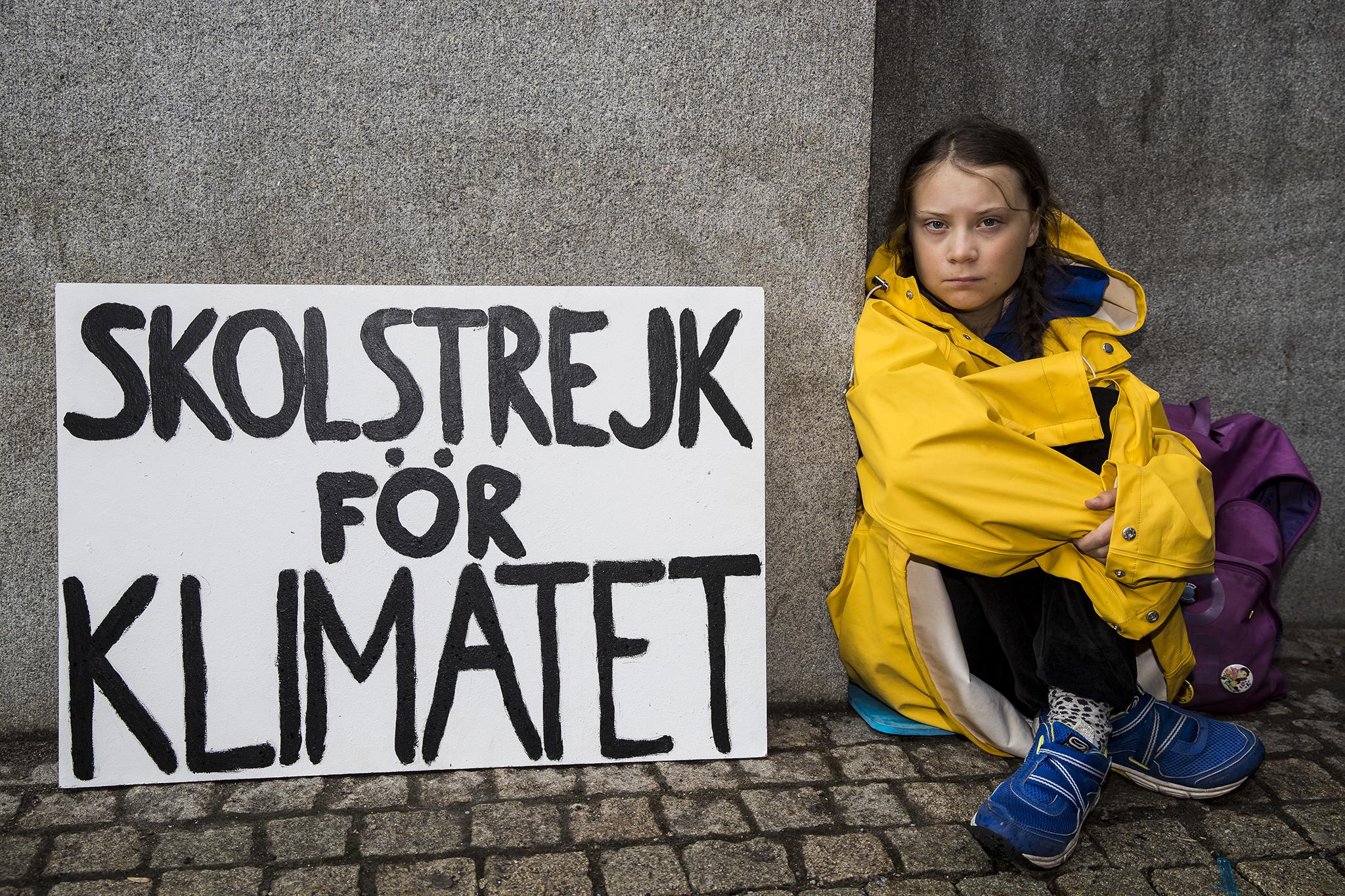
So this week I’d like to discuss an inspirational young autist that I’ve been meaning to write about for some time- climate activist Greta Thunberg.

Image result for greta thunberg"

For those of you who’ve been living under a rock (and I mean, seriously living under a rock, this girl has been all over the news 😛 ), Greta is a Swedish teenager who began striking from school on Fridays outside the houses of parliament in Stockholm for action against climate change in 2018 at just 15 years of age. Greta rationalized that the impending climate crisis means no future for her generation, so why should she go to school to prepare for a future that would not exist?

Since she began striking, Greta’s actions have spawned an international movement known as ‘Fridays For Future‘ where students the world over are striking from school for climate change action. She was even nominated for the Nobel Peace Prize for 2019.

What a girl!

Image result for fridays for future"

In recent months however, attention has focused on the fact that Greta has Asperger’s syndrome (I’m in good company!). In her viral Ted Talk, Greta speaks of how learning about the climate crisis at 8 years old led to her diagnosis. Unable to process the inaction of the world, Greta became withdrawn, depressed and stopped eating, which led her to be diagnosed with OCD, selective mutism and Asperger’s Syndrome. As Greta so eloquently explained in her talk, this means that she only speaks when necessary. Now, in the midst of the climate crisis, is one of those moments.

You can see her viral TEDx Talk here:


Like me, Greta does not see Asperger’s as a disability, but as a gift, calling it her “superpower”. She recently discussed this on the Ellen DeGeneres show where she talked about how autists are important in a crisis such as global warming as we are different, and we need to think differently to find solutions. Her tenacity, her passion and her black and white, no nonsense speeches (all autistic traits), truly are superpowers in her fight to save the planet.


Greta Fun Fact- her mother represented Sweden in the 2009 Eurovision Song Contest 😀

However, the media have recently begun to turn on Greta because she is neurodivergent. A guest on Fox News recently described her as “mentally ill” sparking much discussion about the state of her mental health. As is often the case, once people hear the ‘a’ word, they automatically assign you a box…

Just a reminder– autism is NOT a mental illness; it’s a neurodevelopmental disorder. We may be greater disposed to having issues with our mental health due to higher stress levels, but an autism diagnosis is not synonymous with mental illness.

Whilst I would echo some journalists concerns about the strain of her current international exposure (fellow aspie Susan Boyle had to check into rehab for exhaustion after her viral appearance in Britain’s’ Got Talent), ultimately what Greta needs is action. Saving the planet is her specialist interest, and as I’ve discussed previously, we are consumed by our passions. She will stop at nothing or for no one to save the world.

Without a doubt, Greta is an extraordinary girl, and really shows that you should not allow yourself to be limited by your diagnosis. Indeed, there are people out there vehemently trying to write her off, but the rest of the world is listening.

Hope you enjoyed this post dear Earthlings! 😀

Have a lovely weekend!

Aoife

“You Don’t Look Autistic!”

Greetings Earthlings! 🙂

After reading a write in to an advice column in the newspaper this morning, the parent of a recently diagnosed child rationalized that the diagnosis didn’t make sense as their child was doing well in school, popular and “good socially.”

I found this particularly annoying as this type of attitude is something that we high functioning autists encounter all the time.

“You don’t look autistic?!”

“You’re normal!”

“You can’t be autistic!”

bitmoji110263557

These are some of the most common phrases I hear when I talk to people about my diagnosis, as do many high functioning autists. Whilst this is a great compliment to my upbringing and acting skills, this kind of reaction can be quite damaging for autists.

First things first- no one looks autistic 😛

It’s a neurodevelopmental disorder, how are we supposed to look? Unless you have eyes like an MRI or some type of X-ray vision, you won’t physically see our neurological differences! Roughly 1 in 68 people are autistic- that’s 1 person per double decker bus, 1 person per carriage on the average train, and 3 people on the average international flight. Would you say that you’ve seen someone that “looked” autistic every time you’ve used these transport services? 🤨

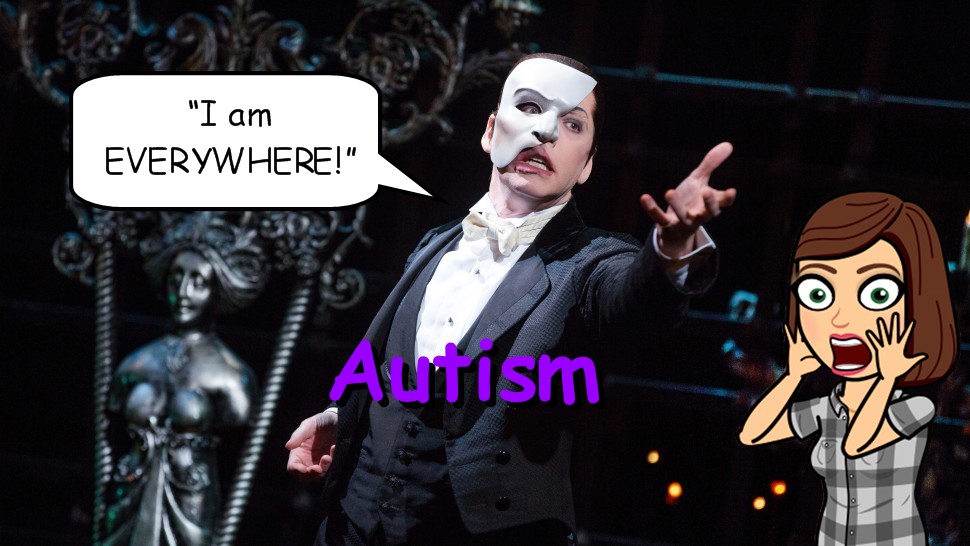
We’re everywhere, looking exactly the same as you do.

Phantom of the opera autism.jpg

^^^ Sorry couldn’t resist giving my favourite musical a shout out- 10 points if you get the song reference 😎

With autism, it’s very much a case of “don’t judge a book by it’s cover”.

With the increased generalization of the spectrum, from the outside, our books look alike, each with the same rainbow-coloured ‘autism’ cover on display. The stories inside however are very different. There may be similar themes, experiences and symptoms between books, but ultimately each is unique.

bitmoji-20190729090736.png

Contrary to popular belief, just like the child in the advice column, many high functioning autists have an active social life. In college I was at every party going and the last one on the dance floor- had you seen me, would you have said I was autistic? Appearances can be deceptive, you don’t know how hard some of us have to work on our social skills behind closed doors. Eye contact isn’t natural for me, but with practice and forcing myself out of my comfort zone, no one would be any the wiser when chatting to me now. I’m a social butterfly who doesn’t outwardly appear autistic, but I have a piece of paper and an autism spectrum quotient score that say otherwise

No, I do not “look” like the stereotypical image of autism, but it doesn’t mean that I’m not riding that spectrum.

This attitude towards autism’s outward appearance could in fact be quite detrimental. If we don’t recognize that a person is autistic when they don’t fit the preconceived mould; they may languish for years without adequate understanding and supports for their needs. This is especially true for females on the spectrum who have learned the art of social masking, often flying under the radar of male centered diagnostic criteria.

As I have discussed many times before, autism is a spectrum, everyone is different and therefore their traits will be different. Don’t judge us by the ‘autism’ cover adorning our story, delve deeper into the book and you may be surprised at what you’ll learn 🙂

Hope you enjoyed this post and have a lovely bank holiday weekend dear Earthlings! 😀

Aoife

Autism and Eating Disorders

Greetings Earthlings! 🙂

This week I’d like to talk about a very common issue, particularly for women with autism- eating disorders.

bitmoji-20190618091926

As discussed previously, mental health issues are quite prevalent among the autistic population. Because of this, many autists can go un-diagnosed as co-morbid mental health issues often mask the root autism diagnosis. This is particularly true of eating disorders for female autists where doctors will diagnose an eating disorder, but due to social masking tendencies will often overlook their autistic traits.

In fact this should really be one of the first things that doctors should assess when patients present with eating disorders as numerous studies have shown that there is a higher prevalence rate of autism in patients diagnosed with eating disorders (up to 20%). Evidence indicates that patients presenting with anorexia nervosa, bulimia nervosa and binge eating disorder (BED) have greater numbers of autistic traits than the general population.

Autists will often not benefit from conventional treatment for disordered eating so it is critical that it is identified early.

salad

So why are eating disorders so prevalent for those on the spectrum?

The reasons are varied, but tend to be either psychological or sensory related:

Psychological:

Some people on the spectrum develop eating disorders as a means to fit in, to attain the kind of figures that they see in magazines and perceive to be “perfect” or “normal”. Others develop eating disorders as a means of control, where the routine and rigidity can be a source of comfort to an anxious mind running on overdrive (interestingly this may have a scientific basis as starvation decreases levels of serotonin, which is heavily involved in anxiety and is often elevated in autism). Moreover, if exercise or particular foods become specialist interests, an autist may obsess and inadvertently develop a disorder as a result.

In some cases an eating disorder may be a simple matter of mind blindness where an autist simply does not understand that their eating behaviours are abnormal or dangerous.

binge

Sensory:

Sensory issues are commonplace for autists both with and without an eating disorder. An autist may be sensitive to different tastes, textures and smells which can make for a very restrictive diet depending on the severity. In some cases, eating may be so stressful that they may not eat very much at all to avoid an unpleasant sensory event.

For further information about autism and eating disorders you can check out the link below for advice and support:

https://www.bodywhys.ie/understanding-eating-disorders/key-issues/autism-eating-disorders/

Hope you enjoyed this post dear Earthlings! 🙂

Enjoy the weekend!

Aoife

Autism and Gait

Greetings Earthlings! 😀

This week I’d like to discuss another lesser known aspect of the spectrum- autism and gait.

As I’ve discussed previously, coordination issues are part and parcel with autism, however, what you may not know is that these coordination issues tie in with an autists gait- particularly for those with Asperger’s syndrome. In fact one of the lesser known diagnostic criteria in the DSM-V is that of an odd or unusual gait.

New technologies are even using gait analysis as an early means of detecting autism:

I know it seems an unusual trait, (let’s face it, we rarely notice a person’s walk) but researchers have observed that autists can have greater or even reduced step and stride length, increased step width, have unusual posturing, tend to walk on their toes, and are lacking in “motor smoothness” when compared with their neurotypical peers.

So why is an autists gait so unusual? What does the science have to say?

Thus far only a few studies have investigated the underpinnings of gait and autism (although the association has been known for decades), but as usual, the evidence points back to the brain. There has been a lot of debate as to which region is responsible for gait differences, however there is evidence to suggest that neurological alterations in the cerebellum (regulates motor movement) and the basal ganglia (a group of nerves involved in voluntary control of motor movements) in autists are the likely culprits.

Furthermore, those autists who tend to toe walk can develop a leg length discrepancy which can also contribute to their odd gait. Gait issues such as this can have a negative impact on the body as this can shorten your Achilles tendon. Research shows that children with ASD’s tend to have a reduced range of motion in the knee and ankle when walking which may imply weakness around these joints.

It’s not all bad news however, as special orthotics can be used to help improve some of these issues.

bitmoji-20190521095540.png

Hope you enjoyed this post dear Earthlings! 🙂

Have a lovely weekend!

Aoife

Blog at WordPress.com.

Up ↑