This week I’d like to discuss a topic that many autists struggle with- boredom. We all know the feeling, that mental itch that makes you want to jump out of your skin, but for autists boredom can be so much worse.
Many autists, especially those with co-morbid ADHD, crave constant stimulation. As a result, boredom occurs more easily than neurotypicals. A simple lack of interest in a topic, if a task is too easy, or feeling overwhelmed can trigger boredom and autists will tune out fast. When this happens, it can lead to negative behaviours where an autist will act out and be destructive and disruptive, it might even trigger a meltdown in chronic scenarios (I have had this happen in work following months of tedious tasks🙈).
Boredom has always been a challenge for me. I constantly need to be working on something. In school I often got in trouble for reading/drawing/writing during class as I would get ahead of my work and need to keep my hands busy while waiting for the lesson to move forward. If anything they should have encouraged my habit for productivity in my downtime! 🤷♀️
But what does the science have to say?
As I’ve discussed previously, autists have higher levels of stimulating neurotransmitters and lower levels of calming neurotransmitters, so their neurons are firing excessively in the brain. When they aren’t able to channel this excess stimulation into something, boredom takes over which can lead to negative behaviours that cause problems. Autists also have dysregulated levels of the neurotransmitter dopamine- the chemical involved in motivation, pleasure and reward systems. When dopamine levels are low, motivation is low, so when an activity is not enjoyable, autists won’t have the brain power to engage and boredom will set in.
On another level, there have been reports from doctors claiming that FMRI scans of ADHD brains show that areas of the brain associated with pain light up when they experience boredom, suggesting that boredom might actually be a painful experience for neurodivergents. However, other neuroscientists have refuted this claim as the human pain response largely remains a mystery, so making this assumption from the data is a bit of a stretch.
This week I’d like to discuss autism in one of my favourite teenage book series ‘The Princess Diaries‘ (we won’t go into the films- they deviated too much from the books and Anne Hathaway comes across more adorably awkward than autistic).
So what are the books about?
The books focus on American teenager Mia Thermopolis and her discovery that she is secretly a princess to the small European principality of Genovia. Mia keeps a diary to help process her feelings in the wake of this massive revelation, whilst also navigating the ups and downs of school life, teenage crushes, bullies, self image and self-discovery. Two later books geared at the adults who grew up with Mia document her royal wedding and experiences of quarantine life during the Covid-19 pandemic.
But what about autism?
Now here’s where things get interesting. Reading these books was probably the first time that I had ever heard of Asperger’s syndrome (the original series was written pre-2013 when Asperger’s was still a separate diagnosis). Mia is assigned to do a report on the condition in psychology class in book 5 ‘Princess in Pink‘ (or ‘Give Me Five ‘ as I knew it), quickly identifying with many traits, and subsequently diagnosing herself and everyone in her social circle. However, her mother reminds her that she thought she had Tourette’s syndrome during her previous assignment, brushing away her fears and never mentioning autism again. Her mom does suggest that Mia’s best friend Lily might have Aspergers- which is likely, but in my opinion Lily tends to veer more towards narcissism than spectrum.
Princess Diaries author Meg Cabot
So is Mia really autistic?
Despite being brushed off by her family, I (and many other autistic readers) believe that ironically Mia is quite likely on the spectrum. I always identified with Mia and saw a lot of myself in her. Tomboyish and nerdy, she always marched to her own beat (in spite of her bullies), but struggled to fit in outside her close knit friend group. She’s a highly sensitive over-thinker with a tendency to catastrophize and create scenarios in her head out of nothing. She obsesses over the minutia of how the world perceives her and the social pressures and expectations of society (she spends several books overthinking about her readiness for physical intimacy and what is expected of her), often describing herself as a ‘freak’ who wants to be normal. An avid writer, Mia journals everything in detail, her thoughts often resonating with ADHD thinking. Moreover, she is quite drawn to smells like her brothers head and her boyfriend’s neck, feeling calmer after she has sniffed these- something that many autists can relate to. She also tends to look to romantic comedies and romance novels for how relationships should play out- something that many experts have noted autistic women do.
One moment in particular stands out to me with the hindsight of my diagnosis. In the 6th book Princess in Training (Sixsational in the UK/Ireland), Mia completely cracks under the pressure of her princess duties, running for student council, her first ever B in English, and her paranoia that her boyfriend will break up with her as she’s not ready for sex. After seeing her grandmother handing out pens in school for her presidential campaign, she freaks out, starts throwing the pens and completely breaks down crying and is hauled off to the nurses office, an incident the nurse described as “a crying jag”. This seems far more like a classic meltdown to me. Moreover, there are many more instances of things like this where when things go wrong, Mia goes into flight mode running off with her diary to her fire escape, the school roof, abandoned stairwells and spends an awful lot of time in bathroom stalls mirroring my own responses to upsetting situations as a teenager.
Some readers however were not happy about Mia’s assumption that everyone she knows has Asperger’s. Meg Cabot has apologised on her blog for any pain caused by this as she was trying to portray how Asperger’s can be so diverse in it’s symptoms and how we all have traits, but was mainly trying to show the phenomenon of thinking you have the disease you’re reading about. On another level, I think this is really interesting how Mia keeps seeing it in her friend group as quite often neurodivergents tend to gravitate towards each other (a number of my friends have sought autism/ADHD diagnoses as adults), so it’s fair to say her friends likely do have many autistic traits.
Not much was widely known about the female experience of autism back when these books were written, but it’s a pretty accurate depiction, however unintentional.
This week I’d like to talk about a somewhat unusual aspect of the spectrum that has been brought to my attention in recent months- T-Rex arms.
Yes- you read that correctly, and no I have not joined the spectrum dinosaur brigade (I don’t think I’ll ever understand the fascination 🙈).
So what on earth are T-Rex arms?🦖
Well, it’s pretty much what it says on the tin. T-Rex arms are when an autist holds their arms in a position reminiscent of the mighty T-Rex- arms shortened and tucked into chest, hands bent forward and curled in like claws.
Ok… but how does this behaviour relate to autism?
This unique posture is commonly observed in autism (and in some overlappingADHD cases) with many autistic and ADHD content creators poking fun at the behaviour. Since I’ve been made aware of this phenomenon, I keep catching myself holding my hands in this position at random times- most notably when I’m in the middle of a busy task like baking or cleaning.
So why do we do it?
The reasons are quite varied. Some autists say it’s because it feels natural and comforting, some say it’s because they don’t know what to do with their hands. Others, like myself, see it as more of an accessibility issue, where you keep your hands close to your chest ready for action mid-task, or a spatial issue where you have greater control of your hands by clutching them close rather than at your sides.
Here’s where things get interesting. Scientists think that T-Rex arms are a form of stimming, so it’s likely to be a sensory related behaviour. They believe that autists keep their arms close to their chest as a natural coping mechanism to comfort and calm when experiencing sensory overload. In some cases T-Rex arms can be viewed as a sign of impending sensory overload, a form of non-verbal communication that experts advise parents to look out for so that they can anticipate a meltdown and take action as needed.
T-Rex arms have been particularly linked to sleep, with many autists adopting this position when they lay down at night. Experts believe that this helps neurodivergents to relax and sleep better, kind of like how weighted blankets work on the nervous system by applying deep pressure to release calming neurotransmitters. Maybe this explains why I often wake up with numb arms in the morning 🙈😂🦖.
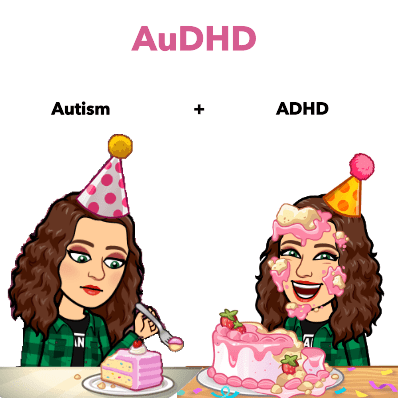
Leading on from my previous post about autism and ADHD, this week I’d like to expand on the topic by discussing the concept of AuDHD- aka autism + ADHD.
ADHD has been getting a lot of online attention in the last couple of years with many adults getting late life diagnoses as knowledge of the condition has advanced. Up to 10 years ago, it was thought that both autism and ADHD were completely separate diagnoses with no overlap. Now, it’s thought that 30-80% of autists also have ADHD, with many discovering they had autism during an ADHD diagnosis and vice versa.
When I previously wrote about this topic, I estimated that I was mildly ADHD, but the more stories I have been hearing about the experiences of female ADHDers, I exhibit a lot more traits than I originally thought. Because I wasn’t fitting the classic impulsive/hyperactive model of ADHD, I never thought to dig much deeper, buuutttttt, just like autism, it turns out that there are differences in symptoms between men and women. The original research observed more men than women (there’s a whole history of women being under researched in medicine) and so it was believed to impact more males than females, but, as with autism, sex differences and masking behaviours have made it very difficult to diagnose ADHD in women. ADHD also operates on a severity spectrum which can make it difficult to pick up on.
With all this overlap, enter the concept of AuDHD.
One of the most fascinating aspects of AuDHD is it’s paradoxical nature:
Autists like routine, but ADHD makes it difficult to maintain
ADHDers crave stimulation, but autists get easily overstimulated
Autists are rigid with rules, timekeeping and planning, but ADHDers suffer from time-blindness, impulsivity and hyperactivity making it difficult to follow plans and rules
ADHDers can be messy and chaotic, but autists like order and systemising
Effectively in AuDHD, the paradoxes can camouflage each other, making it much harder to diagnose either disorder. It’s like having 2 different brains fighting for control, but only one or the other will win out at any given time. For example, today you might do a weeks worth of work, tomorrow you might struggle to find the dopamine to do anything.
At other times, the symptoms are symbiotic. For example in my case, I can have complete time-blindness when I’m in the middle of something, but if I need to keep an appointment, the social rules governing lateness force me to be on time. AuDHD is a constant seesaw between the two conditions, a separate presentation in itself.
While it’s not a separate diagnosis yet, given the prevalence of comorbidity, who knows what the future will hold as neurodivergent research increases.
This week I’d like to take a quick look at some likely spectrum characters in the beloved TV sitcom Friends. Now I know what you’re thinking, autism was never mentioned during the 10 season run (likely due to a lack of general awareness of the condition during the 1990s), but many people have retrospectively noticed some autistic traits in the gang.
For those of you who have been living under a rock (or are so young you have yet to see the show), the TV series follows 6 friends in their 20’s/30’s living in New York, charting their friendship and the hilarious antics they get up to. Here’s a compilation video of the iconic intro across the seasons to give you a flavour of the show:
So let’s get to autism. First up- let’s take a look at Ross Geller (David Schwimmer).
Ross displays many traits of a high functioning autist. He’s a quirky, highly strung palaeontologist (do I smell a stereotype?) who is intensely passionate about science.
He is often socially awkward, misses out on social cues and sarcasm, moves with an unusual gait, and shows signs of sensory issues (he thinks that ice-cream is too cold). Ross is also prone to impulsive decisions, obsessive tendencies, and outbursts of rage that border on meltdown-like behaviour as you can see in the clip below.
Ross’s sister Monica (played by Courtney Cox) on the other hand, while not as overtly quirky as Ross, also displays some traits. Her OCD and control issues are often centre stage in the show with many comedic moments drawing from this. She can be an obsessive overthinker and fiercely competitive, often fixating on certain topics in her pursuit of perfectionism.
Her compulsive overeating in her teen years could also be considered an autistic trait. She may not be quite as neurodivergent as her brother, but she could fall under broader autism phenotype as do many siblings of autists. The iconic dance scene between the brother-sister duo really highlights their quirkiness and possible neurodiversity in their complete blindness at how ridiculous they look.
Finally, let’s take a look at the iconic Phoebe Buffay. Portrayed by Lisa Kudrow, Phoebe is the quintessential outsider displaying many autistic and ADHD traits. Brutally honest and hyperactive, she unashamedly marches to her own beat, completely oblivious to how others perceive her (or her terrible singing). She also flaps her hands an awful lot in the show and has been known to chew her hair in earlier seasons which are signs of stimming behaviour.
Interestingly, neurodivergent individuals tend to stick together in real life (I’ve spoken to many spectrum friends and you tend to subconsciously attract each other 🤣), which could explain why 3 out of the group of 6 display autistic traits. This is perhaps the most realistic aspect of autism that the show unconsciously portrays.
Now obviously we will never know if these characters are on the spectrum, but it’s still nice to see clearly neurodivergent characters marching to the beat of their own drum for us to identify with 🙂
Leading on from my previous posts about autism and memory, IQ, and studying, this week I’d like to talk about the topic of autism and academic learning.
First things first, autism is NOT a learning disability. It’s a neurodevelopmental disorder which impacts how our brain develops and the rate at which it develops having an impact on motor learning, social learning, language learning etc. That being said, ASD‘s can be co-morbid with learning disabilities such as dyslexia, ADHD and dysgraphia.
Everyone’s academic learning journey is unique, especially among autists. Autists can have problems concentrating in classrooms due to sensory sensitivities, issues with social skills can make it harder to interpret teaching cues, and difficulties with executive functioning and information processing can make it hard to process new information.
I’ve always had a passion for academic learning, but even I’ve had my struggles. I struggled hugely with maths in my teenage years. Once letters came into equations I regularly had meltdowns and got overwhelmed when I couldn’t immediately make sense of the topic. One of my most enduring memories of school is throwing my maths book at the wall mid meltdown while doing my homework 🙈
Buuuuuttttt I would usually be able to make sense of the exercises once the meltdown had passed. My teachers unfortunately didn’t understand this (the joys of being undiagnosed) which often made my learning journey challenging. Had I been given the opportunity to work slowly 1:1 with maths, I would have picked topics up a lot quicker.
Everyone’s learning style is different, especially when considering the challenges of autism. There are several different learning styles:
Visual learning– where learners take in information better visually through pictures, graphs and mind maps to help make connections
Auditory learning– where learners listen to information for optimal processing
Verbal learning– using verbal approaches like reading out loud and mnemonic devices
Reading/writing learning– classical learning approach by reading and writing
Kinesthetic learning– physical learning by doing tasks or needing to move while learning
Logical learning– where logic and pattern recognition skills are used to connect concepts
Social/Interpersonal learning– where you learn best by observing others, and talking and communicating with a social group
Solitary/Intrapersonal learning– where you just need to be by yourself to learn on your own with no distractions
Sometimes a mix of learning styles can be the best approach- I have employed all of these styles at different points in my life, but I would largely fall into the visual and kinesthetic learner categories. Seeing things drawn out and or doing tasks is often the best way for me to process information. For example, I tend to take notes using coloured pens as the visual stimulation from the colours makes it easier to process and retain the information.
There are so many different ways to learn, it’s just a matter of sitting down and figuring out what kind of learning style works for you, or working out a plan to limit classroom issues like sensory challenges that can derail your learning process. Lot’s of apps and supports are available for autists these days that can help make learning a lot easier.
The key thing is to not get discouraged. No two autists are the same and it can take a while to find what learning style works for you. When I took maths and biostatistics in college, the lectures were overwhelming, but once I sat down to a tutorial session where we worked hands on with the sums in an intimate environment, I flew through the work and got excellent marks in my exams. It takes time, but once you find the right approach, learning can be a breeze 😊
This week I’d like to talk about another co-morbid condition with autism and ADHD– rejection sensitive dysphoria (RSD).
So what exactly is RSD?
RSD is an intense or overwhelming emotional sensitivity to rejection and criticism (both perceived and real). This can cause intense emotional pain that can be difficult to bear.
Looking back over my childhood, I really struggled with RSD. Whilst I am well versed in the art of rejection now that I’m in my thirties, growing up as an undiagnosed autist did not make for an easy ride. Even the slightest rejections could trigger meltdowns as my brain struggled to process the situation. Something as simple as someone not immediately having time for me, a passing comment in a raised tone, even constructive criticism could set me off. Once at a family event in a hotel I had a bad meltdown because my uncle was short with me for requesting a different flavour of ice-cream to the one that I had been given. Cue me hiding out in the toilets followed by 3 hours doodling in the back of the car instead of joining the party from my RSD over-reaction (I was 13 by the way! 🙈). I can’t even blame sensory issues for that over-reaction, I just didn’t feel like eating raspberry ripple that day! 😂
So is there any scientific reason for RSD?
RSD, like maladaptive daydreaming, is not a clinical diagnosis so it’s hard to underpin how it works. There isn’t exactly a scientific way to measure rejection. However, as it has been observed in patients with autism and ADHD, psychologists believe that it is caused by alterations in brain structure in the regions that regulate and process emotions such as the frontal lobe and the amygdala- both regions where structural changes have been linked to autistic symptoms.
As discussed previously, autists often have a warped sense of perception and logic so it can be very easy to misconstrue and over-react to rejection. The tendency towards perfectionism and black and white thinking in particular can make us far more susceptible to such negative reactions. For example, if someone told me that they didn’t like my shoes, even though it’s only one component of my outfit and just a passing comment, my younger self would have spiraled.
Life is often all or nothing for an autist, so if someone rejects one small thing, it may skew our entire perception of ourselves.
You don’t like my shoes = you don’t like me.
The shoes are wrong, I chose the shoes, the shoes are on my body, therefore, I’m wrong. The world is black and white so if I’m wearing the wrong shoes, everything else about me has to be wrong by extension- you’re either wrong or right, you can’t be both.
RSV can be pretty exhausting for an autist, so understanding of our responses to rejection is vital to supporting us. If you’re struggling with RSV, cognitive behavioural therapy (CBT) can help you learn how to better process feelings of rejection, but medication such as ADHD drugs and anti-depressants can be useful for more severe cases.
Leading on from my previous post about Netflix’s film ‘I Used to be Famous‘, this week I’d like to talk about another new Netflix series that has an autistic character- the reboot of the Australian comedy-drama series ‘Heartbreak High’.
So what’s the show about?
The show centres on a group of teenagers in the fictional Hartley High School in Australia after a graffitied “sex map” has been discovered on a wall detailing all of the sordid details of the students sex-capades. Following its discovery, the principal puts the students in a mandatory sex education class called ‘Sexual Literacy Tutorials – or “SLTs” (which inadvertently sounds like ‘sluts’) in an attempt to guide the students and calm the PR storm brewing outside.
You can see a trailer for the show here:
Now one of the great things about this show is that it prominently features an autistic character called Quinni, played by autistic actor and activist Chloe Hayden. Quinni is an emotionally intelligent, vivacious and bubbly teenager with ADHD, who loves bright colours, art, stickers, crocs and fantasy novels (one of her specialist interests). Quinni is also a lesbian, which marks one of the first times I’ve seen an LGBT autist in a fictional show, which is quite surprising given that many on the spectrum identify as LGBT+. It was refreshing to not have the classic asexual wallflower that is often depicted on screen. The real twist is that there is actually an asexual character in the show but he wasn’t autistic!
The writers worked very closely with Chloe to create a genuine picture of autism for the audience (she pretty much got to write all of her character). To the untrained eye it is not immediately obvious that Quinni is on the spectrum, she just seems like a chatty, quirky teenage girl. We don’t find out she is autistic until she blurts it out to her annoyed date after seemingly ignoring her attempts at conversation all evening as she was struggling to concentrate due to noise sensitivity in the crowded restaurant. The response she gets is one that all high functioning autists can relate to- questioning, doubtful, comparing us to stereotypes/media portrayals from neurotypical actors etc. This scene was added as the writer’s asked Chloe what happens when she tells people about her diagnosis which you can see below:
As the series progresses we get to see her navigate the rollercoaster of her first relationship. While it starts out sweet with Sasha being considerate of her needs, a typical selfish teenager, Sasha starts coddling her and feeling responsible for Quinni rather than understanding her needs:
The relationship ends in tears when Sasha becomes dismissive of her need for routine and ruins a much planned and anticipated meeting with Quinni’s favourite author for her, triggering a meltdown and shutdown, with Quinni retreating into herself, not speaking for days on end- a sad reality that autists may face.
Personally, I wasn’t the biggest fan of the show (in my opinion it was a little bit too “woke” and the broad diversity of the characters seemed a bit forced), but it is a genuine portrayal of the reality that teenage autistic women face every day and is one of the first times that I’ve seen something of myself in an autistic character on screen in a long time. We need to see more Quinni’s on our screen to properly educate people about the realities of living with autism, and to give the next generation of autists someone to relate to, something that so many of us were lacking in our developmental years.
Following the recent release of Netflix sensation ‘Stranger Things‘ Season 4 Vol., this week I’d like to discuss a possible autistic character that many fans have been discussing online since the season dropped (don’t worry- I’ll keep this spoiler free!).
So before I get into discussing this character, what’s Stranger Things about?
For those of you who may not have heard of Netflix’s all time most streamed TV show, Stranger Things is an 80’s nostalgia sci-fi/horror/drama series set in the fictional town of Hawkins Indiana. Secret government cold war experiments exploring psychokinesis have ripped a portal to an alternate dimension filled with monsters called the ‘Upside Down’, leading to a series of mysterious events in Hawkins which a young group of pre-teens set out to investigate after their friend Will disappears.
Now back to autism.
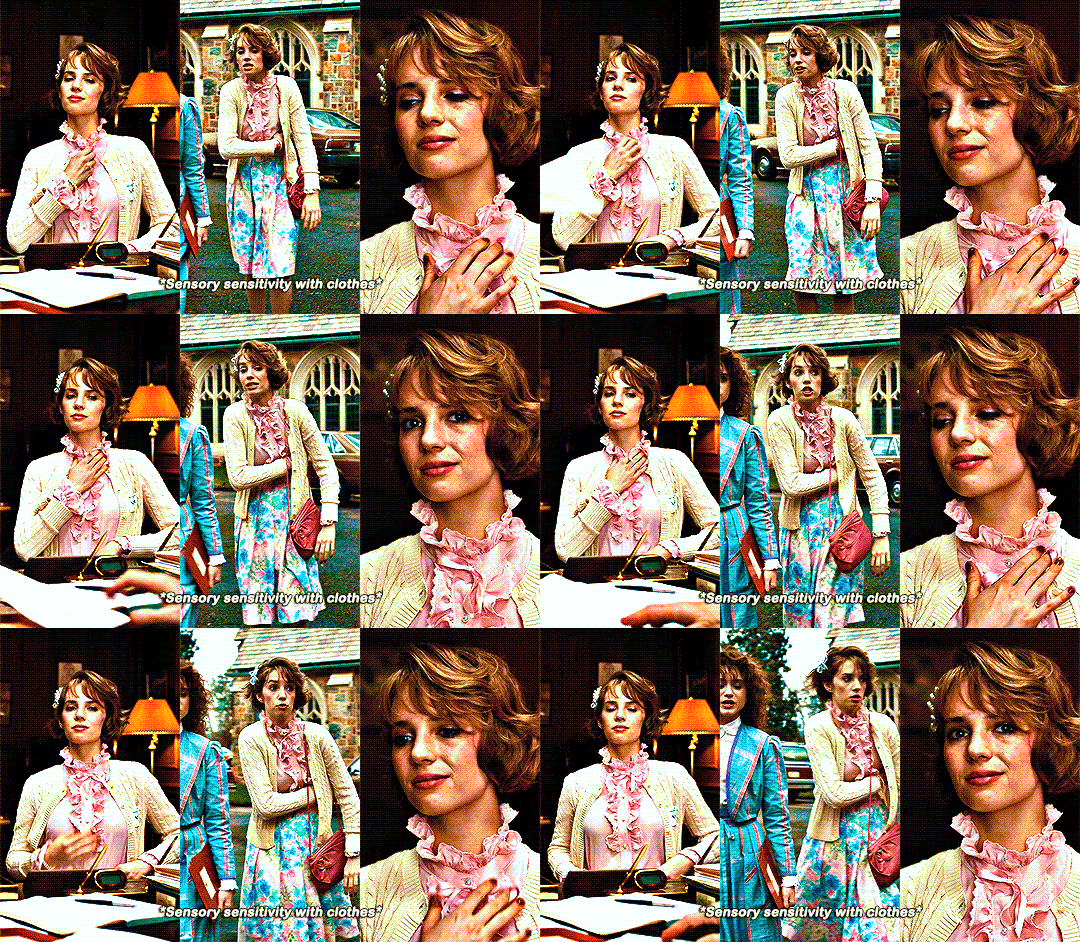
In the most recent series, one of the new characters introduced in the last season, now appears to be showing a lot of neurodivergent traits- Robin Buckley, played by Maya Hawke (daughter of Hollywood legends Uma Thurman and Ethan Hawke).
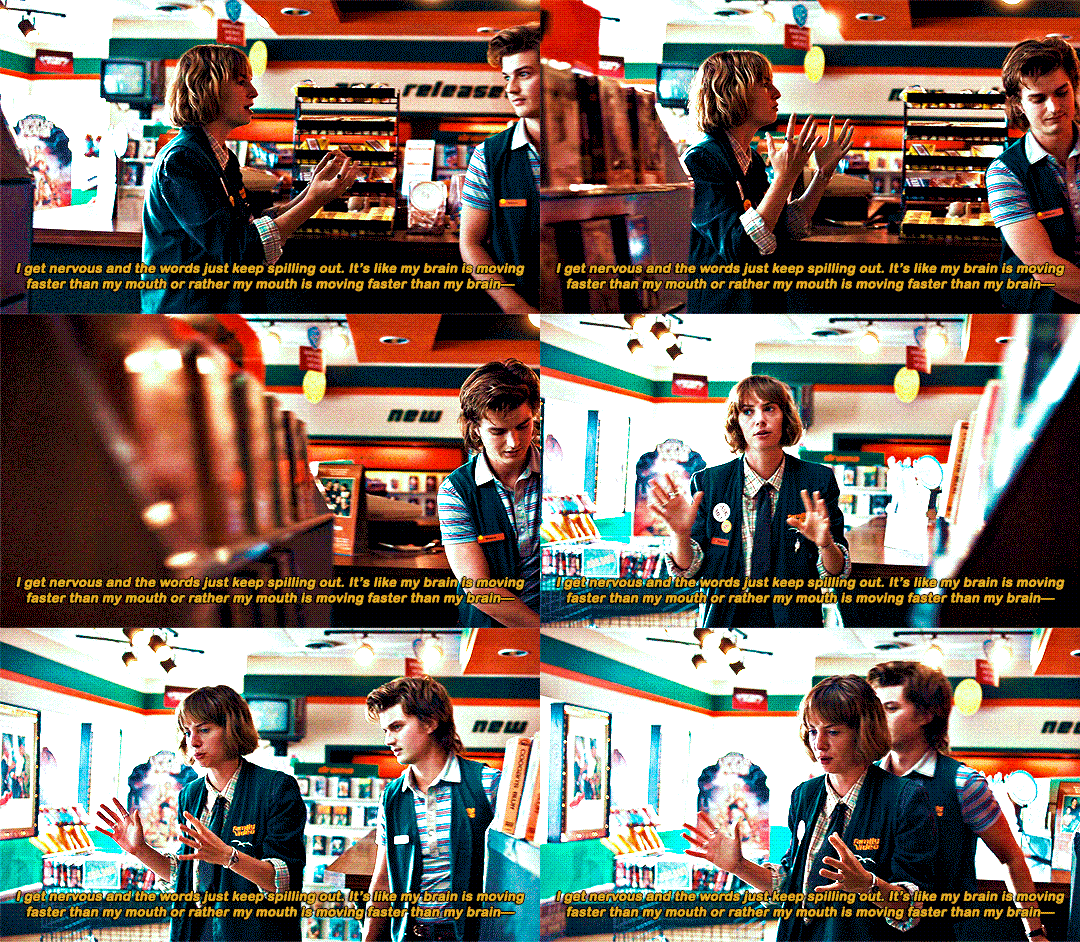
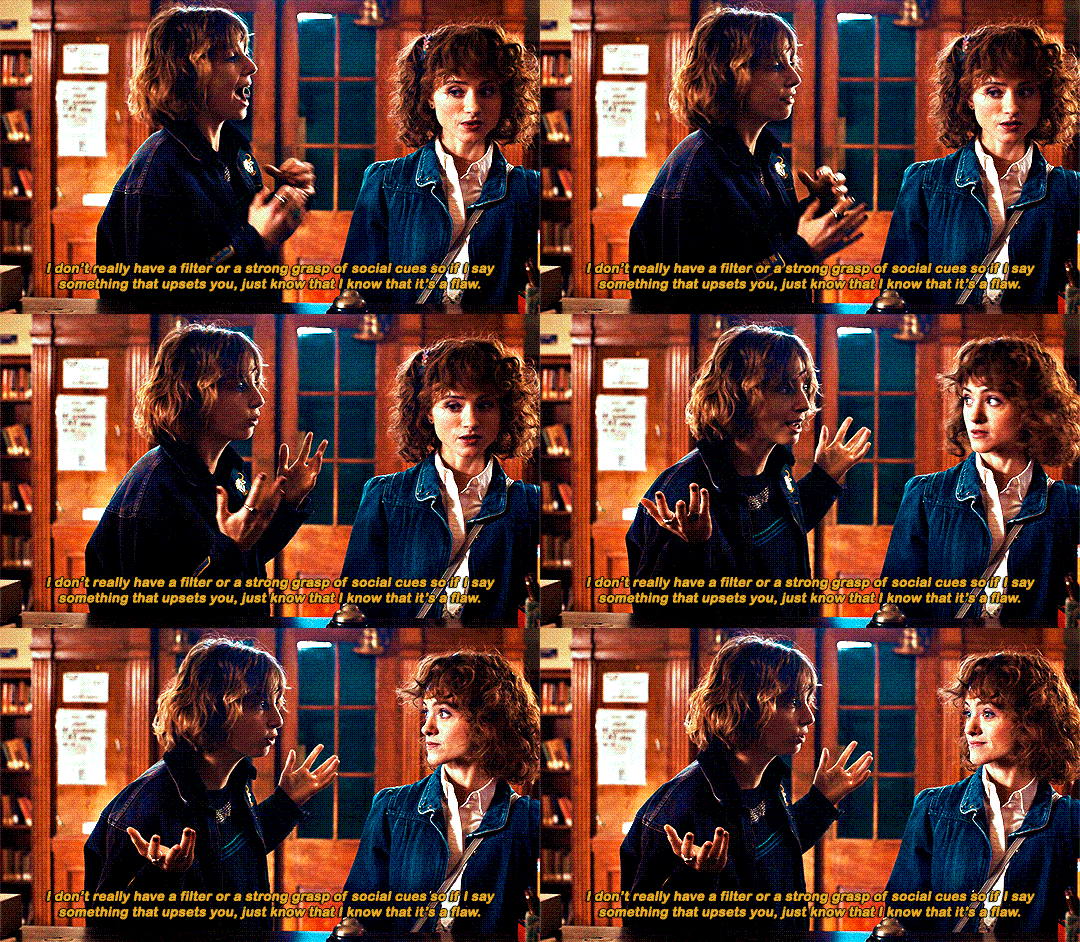
Robin is a highly intelligent high school student that befriends the main Stranger Things gang in season 3 when Russian scientists build a portal to the Upside Down in a secret lab beneath the mall that she works at. Described as “an alternative girl” when her casting was first announced, Robin has certainly captured the attention of autistic viewers as her character has developed in season 4. Throughout the season, Robin has been very quirky, exhibiting no filter and rambling constantly about random topics, but can also be quite easily distracted, suggesting that like many autists she has ADHD.
She mentions that she has no grasp of social cues and has awful coordination, claiming that she took 6 months longer to walk than the other babies which she says was not normal. Robin also claims to be a terrible liar and regularly addresses her weirdness and tendency to inadvertently come across as mean or condescending, constantly asking her friends if she is being annoying.
During one particularly memorable scene, Robin, a notorious tomboy, is dressed up in tight frilly clothing which she constantly complains about, arguing that the borrowed outfit is itchy, the bra is pinching her, and the blouse is strangling her, which could suggest that sensory sensitivities could be driving her penchant for baggy clothing.
Most autistic fans did not notice much in the line of neurodiversity in season 3, but other keen eyed viewers have noted traits prior to season 4 citing her ability to hyperfocus, her memory, her ability to connect dots the others can’t, her blunt truth bombs and that she is a member of the LGBTQ+ community (which a large proportion of autists are). Robin also remarked in season 3 “I feel like my whole life has been one big error“, a sentiment that many an autist can relate to. It could be argued that perhaps now that Robin is part of the gang, she is far more relaxed and doesn’t feel the need to mask as much as she did in season 3.
Whilst it is highly unlikely that Robin will have an autism story-line given how poorly understood autism was in women during the 1980’s, nevertheless it’s always nice for autistic fans to feel seen when watching our favourite shows. It will be interesting to see how her character develops in season 4 vol 2 and beyond!
This week I’d just like to write a quick post about studying and autism.
Knuckling down and studying can be hard at the best of times, but even more so for an autist. There are often learning challenges such as dyslexia, dysgraphia and concentration issues with ADHD which can make studying quite tricky. Frustrated meltdowns when things aren’t clicking can also be tough to navigate (can’t tell you how many times I chucked my maths book at the wall trying to study!😂).
So here are some of my top tips for studying on the spectrum:
Stimming-Self stimulatory behaviours can be a useful way of channeling excess brain activity. By having a stress ball, a pen to chew or something to fidget with can help to free up your mind and allow you to better concentrate on the topic you’re studying.
Make it Visual- Autists are often very visual and highly creative, many operating between both the logical left and creative right hemispheres of the brain at the same time (due to the absence of a connecting bundle of nerves that splits the brain in two). Making things visual using graphs, videos and images can help to improve concentration by stimulating the creative right hemisphere of the brain instead of the usual logical left.
Aoife’s top tip: Use coloured pens for note taking. This was one of the best pieces of advice that my art teacher gave me as it really helped my concentration and retention levels by manipulating neuroscience! However, be careful with the colour choices as some autists can be hypersensitive to certain colours like yellow. Find the colours your child likes and buy lots of pens in those colours for them to write out their notes. My friends in college often told them how happy my notes made them as a rainbow of colour waved back at them every time I opened my notebook 😂
Bribery– I know this is one of my more common tips for managing numerous autistic traits, buuuut bribery is one of the best motivators! Concentration wasn’t always an issue for me when studying, but motivation was. When it came to boring subjects I just tuned out, so my mother traded me gaming hours for hours spent studying- 2 hours study meant 2 hours on the Playstation! It proved highly effective! 😂
Set small goals and take frequent breaks– This can be tricky for the all or nothing autistic mind, as once you get going, you tend to want to get it all done at once, which can often lead to frustration when you’ve pushed your brain past it’s limits. Setting small goals and taking regular breaks can be one of the best ways to study, especially where concentration levels can be an issue. Focusing on one small task at a time can build up a sense of achievement and encourage you to keep going without getting overwhelmed and frustrated. To this day I still do this at home or in work when I get overwhelmed by the volume of tasks that need to be completed.
Focus on what you can do before tackling more challenging subjects– One of the most commonly advised exam strategies is to complete the questions you do know first before going back to the harder ones to avoid getting overwhelmed and to build up your confidence. The same goes for studying- I’ve used this mantra several times of late when I’m writing to get me started on a task and keep from getting overwhelmed and it never fails! It’s not the easiest habit to form for an autist (as logic dictates everything should be done in exact order), but once you get in on it everything becomes so much easier 🙂
Take advantage of all available aids– when it comes to exam time, accept the help of a scribe or a reader (if you’ve dysgraphia or dyslexia) and take any extra time offered to you. Educational departments understand that autists often need a little extra time and help during exams, so if you need it take it- there’s no shame in asking for it. I was past my schooling by the time I got my diagnosis, but it would have been nice to have had a little extra time for exams when awkward questions threw me, or at least the comfort of knowing it was there if needed.
If you follow these tips you’ll be studying like a pro before long!
And always remember- it’s just temporary! We all have to study at some point (unless you’re one of the lucky few with an eidetic memory) to get to where we need to go, but it’s not forever, just keep focusing on the finish line and you won’t go wrong 🙂


















 A Is For Aoife Not Autism