Autism and T-Rex Arms

Greetings Earthlings! 🙂

This week I’d like to talk about a somewhat unusual aspect of the spectrum that has been brought to my attention in recent months- T-Rex arms.

Yes- you read that correctly, and no I have not joined the spectrum dinosaur brigade (I don’t think I’ll ever understand the fascination 🙈).

So what on earth are T-Rex arms?🦖

Well, it’s pretty much what it says on the tin. T-Rex arms are when an autist holds their arms in a position reminiscent of the mighty T-Rex- arms shortened and tucked into chest, hands bent forward and curled in like claws.
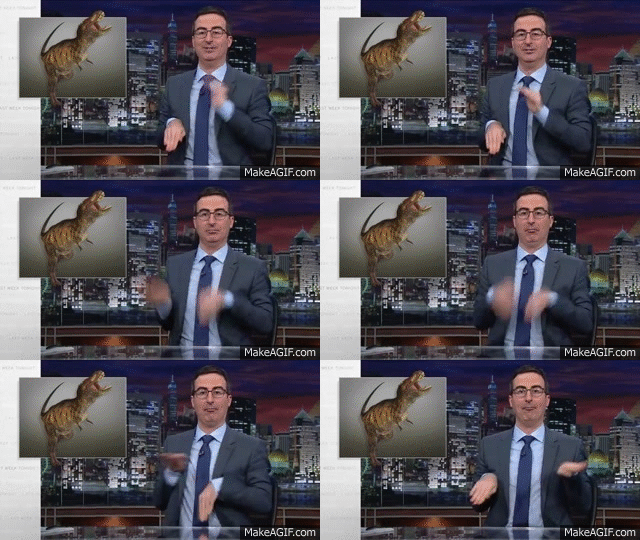
Ok… but how does this behaviour relate to autism?

This unique posture is commonly observed in autism (and in some overlapping ADHD cases) with many autistic and ADHD content creators poking fun at the behaviour. Since I’ve been made aware of this phenomenon, I keep catching myself holding my hands in this position at random times- most notably when I’m in the middle of a busy task like baking or cleaning.

So why do we do it?

The reasons are quite varied. Some autists say it’s because it feels natural and comforting, some say it’s because they don’t know what to do with their hands. Others, like myself, see it as more of an accessibility issue, where you keep your hands close to your chest ready for action mid-task, or a spatial issue where you have greater control of your hands by clutching them close rather than at your sides.

But is there a scientific reason?

Here’s where things get interesting. Scientists think that T-Rex arms are a form of stimming, so it’s likely to be a sensory related behaviour. They believe that autists keep their arms close to their chest as a natural coping mechanism to comfort and calm when experiencing sensory overload. In some cases T-Rex arms can be viewed as a sign of impending sensory overload, a form of non-verbal communication that experts advise parents to look out for so that they can anticipate a meltdown and take action as needed.

T-Rex arms have been particularly linked to sleep, with many autists adopting this position when they lay down at night. Experts believe that this helps neurodivergents to relax and sleep better, kind of like how weighted blankets work on the nervous system by applying deep pressure to release calming neurotransmitters. Maybe this explains why I often wake up with numb arms in the morning 🙈😂🦖.

Hope you enjoyed this post dear Earthlings! 🙂

Have a lovely weekend!

Aoife

Autism friendly festivals

Greetings Earthlings! 🙂

This week I’d like to talk about the subject of autism friendly festivals.

Yes- you heard me correctly! 😀

Festivals and autism are not really two words that tend to go together, what with the crowds, noises, smells and flashing lights, but recent years have seen large music festivals such as Electric Picnic and Glastonbury set up specific sensory friendly tents for neurodivergent attendees. In addition to this, there are now a number of specific autism friendly festivals.

Autism charity ASIAM recently launched the Sensoria festival in Dublin as part of a 3 year plan to make Dublin the world’s first autism friendly city. A free ticketed event, the festival took place at two different times in the day to keep crowds to a minimum, offering sensory domes, pods and gardens, a messy play tactile zone, neurodiversity information tents and therapy dogs. In addition to these sensory friendly modifications, a number of sensory activities and performances were arranged including non verbal street theatre, sensory movement workshops, sensory silent films, and a unique show titled ‘Squish, Stomp, Spin – The Magic of Stim’ by ADHD artist Moss Russell.

Similarly in the UK, the Spectrum Autism Friendly Festival has been running since 2017. The festival is run by staff that are fully trained about autism, and offers attendees an enriching experience with sensory areas and quiet spaces in addition to fun activities such as cooking classes, arts and crafts, bouncy castles, treasure hunts, pedal carts, and even light saber training!

Whilst these autism friendly festivals are a great incentive, they are largely geared at children, which is a little disheartening for autistic adults with sensory issues. In Reading in the UK however, the A Different World Festival has been established to cater to older autists. Inspired by their teenage son who could not access the Reading Festival as an autist, the organizers set up A Different World to allow young people and adults with additional needs to experience a real rock festival. This festival follows normal festival formats, but limits numbers to reduce crowding and ensure space, allows no strobe lighting or pyrotechnics, has a sensory village, a service dog tent, and a wellness tent to cater for everyone’s needs.

Hope you enjoyed this post dear Earthlings!

Have a lovely weekend 🙂

Aoife

Autism and AI

Greetings Earthlings,

This week I’d like to discuss a bit of a hot button topic at the moment- Artificial intelligence (AI).

Once upon a time, AI used to mean that atrocious Steven Spielberg film, but now AI is creeping into our every day lives. Chat-bots, deepfakes, AI research models, advanced searches and content recommendations- we can’t escape it. The applications are seemingly limitless, with great potential for people with autism.

But first things first, what exactly is AI?

AI is the technology that enables computers and other digital devices to do the things that humans do like read, write, learn, talk, analyze etc. While not human, the combination of human-like abilities and machine thinking can make it a powerful tool to be reckoned with.

So how can we leverage AI when it comes to autism?

Now here’s where things get cool. Robots are being used to help manage autism! Researchers are training robots how to interact with children with autism so that autists can get practice identifying facial expressions and social cues and help them to learn how to respond appropriately. Robots are the ideal companions as they have limitless patience and allow autists to practice their skills in a safe, non-judgmental environment. There are also a number of new AI apps that similarly work to help autists to practice their social skills, with AI technology being used to help move and learn what works best for the autist and help suggest the right kind of calming exercises depending on their mood.

In addition, AI models can be used to study the MRI’s of autists to help us better understand the condition, particularly how neurological changes and autistic traits vary between neurodivergents.

Most recently new AI systems has been developed that can quickly and accurately diagnose autism- one system by measuring how water travels in the brain by analyzing MRI images; and another that detects autism by measuring responses to a flash of light in the eye. This could revolutionize how we diagnose autism, allowing autists to get access to services sooner for better overall outcomes. Other cool AI apps allow parents to upload videos of their child’s behaviours to be analyzed by clinicians for remote diagnosis using AI to help categorize and assess them.

On the other hand, AI is a force that we must be careful with. It has great potential for use, but we need to be careful where we tow the line. This is especially true of Elon Musk’s Neuralink- a computer chip that can be implanted in the human brain, allowing us to control mobile devices through the power of thought. This week saw the first reported successful (though the evidence remains to be seen) implant where the patient has recovered well and is able to control a mouse on a screen with their brain. What was once the stuff of science fiction is rapidly becoming a reality. Aside from these tech applications, Musk claimed in 2019 that Neuralink has untapped medical potential to help “solve” neurological diseases like Parkinson’s, Alzheimer’s, Schizophrenia and…. autism.

Now… this was naturally met with a lot of backlash from autism charities- especially given that Musk has openly discussed how his autism has contributed to his success. Autism is a different way of thinking, it is not something that the majority of autists would like to “solve”. New approaches to help autists navigate life in a neurotypical world yes, but most would not wish to get rid of their autism if given the choice. Would modifying autistic traits through AI really help autists, or could it make things worse by taking away our unique way of thinking?

It’s a very fine line we tread, so we must proceed optimistically with caution when applying AI to autism.

Hope you enjoyed (or were horrified by) this post dear Earthlings!

Have a lovely weekend!

Aoife

Autism and Diabetes

Greetings Earthlings! 🙂

This week I’d like to discuss the topic of diabetes and how it can be linked to autism.

But before we get into that, what is diabetes?

In the body, the hormone insulin is produced by our friend the pancreas (in the image above) to control the absorption of sugar into our cells. Diabetes mellitus is a condition where blood sugar levels are uncontrolled due to insufficient insulin production. Elevated blood sugar levels (hyperglycemia) can cause a range of health issues such as nerve damage in the hands and feet (peripheral neuropathy), permanent damage to eyesight (diabetic retinopathy) and life threatening ketoacidosis (where substances called ketones build up in the body making blood more acidic).

There are a few different types of diabetes:

  • Type 1 or insulin dependent diabetes– this occurs when the pancreas ceases to produce insulin (caused by the immune system attacking insulin producing β cells) leading to high blood sugar levels. Replacement insulin must be injected to keep blood sugar levels stable.
  • Type 2 diabetes– occurs when the body develops insulin resistance so insulin is no longer able to control blood sugar levels. It usually occurs in adulthood as a result of poor diet, obesity and lack of physical exercise
  • Gestational diabetes– this type of diabetes occurs during pregnancy in women who have never previously had diabetes. It usually goes away following birth of the baby, but does increase your risk for type 2 diabetes in later life

That’s great Aoife, but what has all this got to do with autism?

Research suggests that idividuals with autism may have a 57% higher risk of developing diabetes compared with their neurotypical peers; specifically the risk is roughly 64% higher for type 1 diabetes, and a whopping 146% higher for type 2 diabetes!

So why are autists more susceptible?

In the case of type 1 diabetes, as I’ve previously discussed, autists tend to have an overactive immune system (likely due to genetic mutation) which could be damaging the pancreas preventing insulin production. Research has also found that type 1 diabetic mothers are at a higher risk for giving birth to an autistic child as it’s thought that autoimmune diseases like type 1 diabetes produce antibodies that can attack the developing brain in the womb. Similarly, gestational diabetes has been linked to a slightly increased risk in the development of autism and ADHD due to exposure to high blood glucose levels in utero.

The massive type 2 link on the other hand has a lot more to do with lifestyle. Sensory processing issues relating to food can lead to quite a restrictive diet. This diet is often high in sugar which may lead to type 2 diabetes in adulthood. Some autists with ADHD also have impulsive issues with over-eating for sensory stimulation, while others struggle with insatiable hunger (polyphagia), especially those with co-morbid Prader–Willi syndrome. Physical limitations due to co-morbid issues like of dyspraxia can also reduce and limit physical activity increasing the risk for diabetes. In addition, some studies have found genetic links to autism and weight gain which further compound this risk.

As with all things in life, just because there is an increased risk does not mean that the disease will manifest, but it’s useful to be aware of the risk nonetheless.

Hope you enjoyed this post!

Have a lovely weekend!

Aoife

Autism in ‘Freya Harte is not a Puzzle’

Greetings Earthlings! 🙂

This week I’d like to talk to you about an exciting new book for autistic teenagers- ‘Freya Harte is not a Puzzle‘ by up and coming Irish author Méabh Collins. The book centres on 14 year old Freya Harte who has just received an autism diagnosis and details her experiences as she comes to terms with it.

Having read an article about this book and it’s author Méabh (she and I are the same age and interestingly also diagnosed at the same age!) I was very excited to read it. Finally- a book about a teenage girl with autism written by a fellow autist! Best of all, Freya is coming up through the Irish education system- just the kind of book my teenage self could have related to.

So what did I make of it?

Author Méabh Collins

Quite frankly, I couldn’t put the book down! Freya’s experiences of autism were so similar to my own (apart from the timeline on the diagnosis), I really connected with her. Her literal thinking, the constant battle to fit in with her peers, the struggles to keep the tears at bay, the solace of the confined bathroom stall- it all hit very close to home. One of the things I most liked about the book was how Méabh gave us a genuine insight into the workings of the autistic mind and the issues we can have with twisted logic. For example, Freya struggles with an eating disorder because she read an article about foods for a healthy brain and thought that if she changed her diet drastically, maybe her brain would be more normal. She also gets up really early on a Saturday and takes the Luas into Dublin city to buy a Disney magazine far away from where anyone she may know might catch her buying it so that her peers don’t judge her for her specialist interest. It seems a bit daft when you read it, but these are the kind of logical decisions/conclusions the autistic mind makes- there’s method in the perceived madness!

This book gives great insight into how we work and I would highly recommend it for any teachers, parents or friends who are trying to support a woman through an autism diagnosis. No two autists are the same, but it’s a very good starting point to help you to understand what our minds go through on a day to day basis, how we see the world and rationalize every aspect of our day. Méabh deliberately took the approach of focusing on autism from the inside out. No stereotypical savants, no tricks or exaggerations for dramatic/comedic effect; just a nuanced exploration of the female autistic experience so that the reader can begin to understand how and why we think the way we do.

Understanding goes a long way to helping an autist, so this book is a must read for anyone who knows a woman with autism and would like an insight into the autistic mind.

Hope you enjoyed this post dear Earthlings! 🙂

Have a lovely weekend!

Aoife

Autism and closure

Greetings Earthlings! 🙂

This week I’d like to talk about a topic that’s often been an issue for me- closure. Autists crave closure and resolution in all situations, that black and white mindset where a beginning must have an ending. When we can’t get that closure, it’s like an itch you can’t scratch in your brain, always niggling away, sometimes for years.

I can’t keep track of the amount of incomplete tasks and unanswered questions that have haunted me over the years. For example, I could never just lose a game of solitaire, I would feel compelled to keep playing until I finished on a win. Similarly, I could never seem to abandon a TV series that was starting to go south, I would need to stick with it until it got the closure I needed (I stuck with Glee right til the end🙈)! The frustrated niggling can even go on for years.

As a teenager, I nearly drove myself demented trying to achieve 100% completion on Harry Potter and the Philosopher’s Stone on PS2. I tried every single possible thing I could, played the game in different ways, doubled up on collectibles, tried cheat discs, had several meltdowns in frustration, but nothing could ever move the needle beyond 88%. Nine years later, a post on an EA thread revealed there was a bug in the software and that there was a glitch you had to manipulate to get around it and my brain could finally rest 😌.

Luckily, it’s gotten a lot easier to let these things go as I’ve gotten older, but many autists struggle will be much greater. So is there any scientific reason why we crave closure?

I haven’t been able to find that much information on the subject (as shutdowns keeps coming up when I try to investigate for some reason🤷‍♀️), but one study has correlated the need for closure to cognitive flexibility, something that autists have great difficulty with.

Cognitive what now?

Cognitive flexibility is the ability to adjust your thinking and adapt to change in unexpected challenges and situations. Imaging studies of the brain have shown that people who have a strong need for closure tend to be cognitively inflexible caused by reduced connectivity between the brain regions involved in adaptation to behavioural conflict during tasks that need cognitive flexibility. In other words- we’re hard wired to need closure! 🧠

Hope you enjoyed this post dear Earthlings!

Have a lovely weekend! 🙂

Aoife

Blog at WordPress.com.

Up ↑