Should I Tell My Child They Have Autism?

Greetings Earthlings! 🙂

So today we’re going to discuss a very important question when it comes to growing up with autism- should autists be made aware of their diagnosis?bitmoji185739333

Now this question is a little bit tricky.

On one hand, we have the parents who do not want their child to know at all; they want their child to grow up as “normally” as possible so that they may never be held back by the autistic label.

In a sense, part of me would agree with this approach. In a lot of ways, growing up undiagnosed was a blessing in disguise. I was never treated differently (well, by teachers at least- children are another kettle of fish!) and I grew up to be a “normally” functioning adult with a job and friends, never held back by the autistic label.

Buuuuuuutttttttt…

Whilst I can appreciate a parents desire for their child to thrive, the decision not to tell a child about their diagnosis ultimately amounts to sticking your head in the sand.

bitmoji1733715277

We cannot ignore autism and pretend that it’s not happening. There needs to be interventions, strategies and most importantly, understanding.

We don’t just grow out of autism, we need to cultivate an environment so that we can grow around autism. Without self awareness, this will ultimately make life difficult for your child.

What if they found out some other way that they were autistic? If they overheard a teacher, accidentally caught sight of their notes or were taunted by another child? How would you feel if your parents kept something like this from you?

At the end of the day, your child needs to know about their diagnosis; maybe not today or tomorrow, but when the time is right, they will need to know.

Yes, there were some advantages to getting a later diagnosis, but ultimately, life would have been so much simpler for both my parents and I had we known that I was on the spectrum. We would have known how to manage meltdowns, my peers would have understood me better, I wouldn’t have tortured myself for being different- I would have understood and learned to better accept and love me all the sooner.

hugs.png

So don’t worry about holding your child back, or upsetting them; take a deep breath and find a way to tell them- they will thank you for it in the end 🙂

Aoife

Autism and the Benefits of Animals

Greetings Earthlings! 🙂

We all love our furry and feathered friends dearly don’t we? Seems hard to imagine the internet without funny animal videos these days!

Image result for funny animal gifs

Animals are so important to us that they are not just friends, but an integral part of the family.

For autists, an animal in the home can be this and so much more (#specialistinterest 😉 )!

Research suggests that animals can play a very important role in the social, emotional and cognitive development of children and can also aid the development of empathy. Animals such as assistance dogs (which I hope to write a post on at a later stage), cats, horses, guinea pigs, and interestingly keeping chickens is the latest trend to help improve these skills in the autistic community!

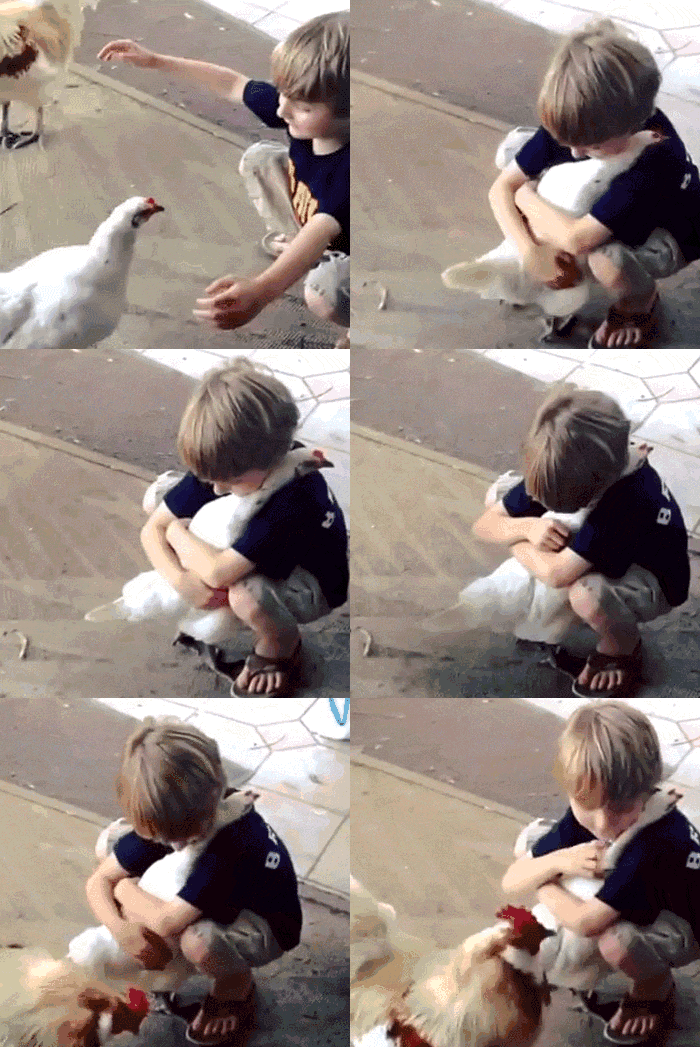
Image result for hugging animal gif

Studies have shown that the social skills of autists who live with an animal are much greater than those who do not have a pet. Pets are often considered “social lubricants” wherein they provide autists with a source of conversation which can encourage better engagement.

Sometimes we find it a lot easier to relate to animals. I’ve often remarked growing up that life would be so much easier if we were all dogs for example. With a dog, life is black and white (fun fact– they aren’t colour blind!). You take care of them, they love you forever-simple. There are no games or tricks (well, unless like my dog yours spins round in circles when you try to brush him to make you dizzy in the hope that you will go away 😛 ), you never have to wonder where you stand with a dog, they’ll make it very clear if they love or hate you!

dfgerhrtsghs

Studies have also shown that animals in fact can have a measurable biological effect on people with autism! A recent study measured “excitement” levels in children with autism when performing such tasks as reading out loud and playing with a group. The results showed that in these situations, the excitement levels were higher in the brain indicating stress. However, when these levels were measured whilst playing with an animal they  plummeted as stroking the animal induced biological calm.

Finally!

Scientific proof that I should spend more time cuddling my dogs!!! 😉


However, as beneficial as animals can be, experts advise that the individual needs and sensitivities of the child are taken into consideration when choosing a pet. A dog might seem like a good idea, but whilst many autists may gravitate towards the soft and furry, others may be repulsed by the texture of their hair, the smell or may even be overwhelmed by their energetic nature.

Aoife’s Top Tip– Try to expose your child to different animals to gauge their reactions before making any firm decisions on a pet- they are a big commitment! The research shows that any pet, even a spider, can be beneficial 🙂

There we have it dear Earthlings- another, scientifically proven reason to love animals all the more! 😀

What better way is there to spend the bank holiday weekend than relaxing with your pet? 😉

bitmoji1415319073

Aoife

Autism and “Stimming”

Greetings Earthlings! 🙂

Today I’d like to touch on one of the most commonly observed autistic behaviours- “stimming”.

So what exactly is “stimming?”

Self-stimulatory behaviour, (also known as stereotypy or “stimming”), refers to many of the repetitive behaviours often exhibited by autists. Examples of these behaviours include scratching or rubbing the skin, noise making, smelling objects and the classic examples of rocking and  hand flapping, although in my experience it’s a lot more like ‘Jazz hands’ than flapping!

jazz hands.gif

There are two psychological theories as to why autists stim:

  • As a response to overwhelming sensory stimuli
  • As a means of relieving stress and anxiety

From a physiological perspective, there are a number of possible biological reasons.

Some researchers believe that stimming provides the autist with sensory stimulation. Contrary to common belief, many people with autism have a reduced sensitivity to certain sensory stimuli. Dysfunctions in the circuitry of the brain mean that the body craves sensory stimulation, and so we adapt repetitive behaviours in order to stimulate and excite our nervous system.

Deficits in dopamine levels in the brain can also interfere with our reward pathways, leading autists to engage in behaviours, such as stimming, which will provide the extra hit of dopamine that the brain needs.

So that’s why I’m drawn to fluffy things! 😉

Image result for stroking fluffy gif

Aside from being drawn to stimulatory texures, I have a particular tendency to fidget with the silver chain around my neck. I just find something oddly soothing about the rough sensation of the metal against my skin! 😛

In my experience, I also find that stimming isn’t always a response to stress, but born from a need to keep my hands busy.

As I’ve discussed previously, research shows that autists have higher levels of excitatory neurotransmitters such as glutamate, and lower levels of calming neurotransmitters in the brain. As a result, we are often hyper-stimulated. Stimulation of the brain’s reward system, i.e.  dopamine release through “stimming” behaviour, causes a decrease in glutamate levels, effectively calming the brain!

This would explain why I’ve often found that stimming sometimes helps me to concentrate and clear my mind by channeling any excess energy into a physical action. I find this particularly helpful when I’m studying, or writing, and for some strange reason while I’m waiting for the microwave to ping! 😛 #excitedforfood

Image result for fidgeting gif

Stimming can also be considered a form of self injurious behaviour, but I’ll write a separate post on this topic at a later stage 🙂

So is there anything that can be done to control this type of behaviour?

bitmoji339468972

  • Try replacement behaviours– if the stim is not socially acceptable or harmful, as in the case of biting behaviours, attempt to replace the stim with another one such as a fidget toy or chewing rubber
  • Exercise– there is evidence to suggest that exercising can decrease the frequency of stimming behaviours, although the research is unclear why
  • Cognitive behavioural therapy (CBT)– is thought to be useful as self stimulatory behaviour operates in a similar way to OCD tendencies which are often managed through CBT techniques
  • Medication– Seems there’s a pill for everything these days! Medications can be used to help modify compulsive behaviours such as stimming, but I personally would not advocate this route

So there we have it Earthlings, a brief insight into stimming behaviours in autism! 🙂

Enjoy the weekend everyone! 🙂

Aoife

Autism and Illness

Greetings Earthlings! 🙂

As we head into flu season, I thought I’d explore some of the challenges that face autists when it comes to feeling unwell.

We all know the glorious sensations that accompany common illnesses, the coughing, the vomiting, aches and pains and that delightful swollen head feeling that makes it hard to remember what breathing feels like! 😛

Image result for i'm dying sheldon gif

Now imagine you have autism- you are hypersensitive to stimuli such as temperature changes, struggle with change, and do not cope well with discomfort. On top of this, your struggles to communicate might make it difficult to convey that something is wrong. Most children will tell their mother that their tummy hurts; an autist may struggle to identify or describe a medical problem to a parent or doctor, especially in nonverbal cases.

It might just be a simple cold or bug to a neurotypical, but to an autist, it may be an entirely overwhelming experience.

One of the biggest challenges that I faced growing up was not so much coping with illness, (I have been known to go out clubbing whilst suffering from a bug or the flu!) but treating it.

I HATED taking medication!

Taste aversion was a big issue, mostly because medication came in foul tasting liquid form! Here’s a fairly accurate representation of my face after swallowing medicine:

bitmoji586634746.png

Every year my mother and I would go to war to get me to take my cough bottle or antibiotics. I would try it once, discover it tasted rancid, aaaaannnd then do everything my twisted sense of logic would come up with to avoid taking it. I would often pour out the medication when she wasn’t looking, or pretend I was old enough to dose myself so I could get away with not taking it! 😂

Didn’t work out so well though when things got worse… 😛

I know! I should have know better- but don’t  judge me too harshly, seven year olds are not well versed in the concept of antibiotic resistance! 😛 😉

Tablets were a little easier, but tricky to get used to the sensation of swallowing them at first. Once I discovered that antibiotics came in tablet form as an adolescent however, I became far more amenable to knocking them back! As the guys from Pringles say- “Once you pop, you can’t stop!” 😉 Although I may still recoil as the tablet slips down on occasion, especially if it has an unfortunate taste, or even worse, a powdery texture…!😬

Image result for swallowing tablet gif

Getting an autist to take medication can indeed be quite a daunting task, but here are some of my top tips for parents struggling with this problem:

  • Mix liquid medications into another drink or yoghurt– Ok, I know this feels a little bit like wrapping tablets in meat to get your pet to take them, but there is method in the madness! My mother used to mix antibiotics or antihistamine in with my juice or flat coke when I would refuse to take them. For the most part this worked, but sometimes I found the combination tasted just as bad- so trial and error! Just make sure that they consume the whole thing to get their full dose.
  • Ask for tablets not liquids– Granted, you can’t get tablets before the age of 12, but if given the choice- take the tablets. There is far less chance of taste related rejection!
  • Bribery- My mother was always particularly fond of this approach. To first encourage me to take propolis tablets, I was promised a fun-size bag of Malteasers if I swallowed them without complaint! Needless to say- it worked! 😉
  • Make a game of it- Why not try and use a specialist interest to encourage them to take their medicine? ‘It’s a magic potion to make you feel better!’, ‘This is what makes the Hulk strong!’ ‘See- it’s pink like Barbie; her favourite drink!’ My mother tried something like this by writing a note on a box of meringues to say that she had cast an engorgement spell on them to keep me from eating them! I was a bit older at the time, so I mostly ignored it, but I got a chuckle out of it at least! 😛 😉 Had I been a stubborn 6 year old however, I definitely would have fallen for it.

Failing all that- try to stay healthy folks! Wear your warm jumpers, take your multivitamins (although the scientific jury is out on whether or not these are actually useful!) and your apple a day and hopefully you will keep the doctor away 😉

bitmoji562267823.png

Enjoy the weekend everyone! :)`

Aoife

Autism- Are We Making Excuses?

Greetings Earthlings,

So today, my title is a little bit different, but I’ve been musing on this question a lot of late- are we making excuses for autists?

hmm

Don’t get me wrong, I’m the first person to advocate the need for understanding and acceptance for those of us on the spectrum- but there is a fine line between making exceptions and making excuses.

I have seen people that were given all of the support and understanding that I grew up without, and yet they do not seem to function as well as I do. Granted there are varying levels of need and functionality within the community, but one has to wonder if excuses have been made. Certainly teachers have told me about spectrum kids where parents have insisted that their child is “not able” for various school activities.

If raised in a protective autism friendly bubble, what happens when your supports go away in adulthood? How can you cope in the real world if people have spent your whole life excusing your behaviour?

Tells a stranger they look like a troll- “He has Asperger’s!”

Struggles with a maths problem- “She’s not able, she’s autistic!”

Throws a plate in a restaurant- “I can’t help it, I’m on the spectrum!”

If you tried anything like that last one as an adult you would be arrested not excused!

police.png

Yes being autistic is a challenge, yes we can’t always control impulses, meltdowns or our tongues, but it doesn’t mean that we can’t improve. If we are never called out on our behaviour, we will continue to think that it’s ok to tell people that they look like a troll for example, and one day we will say it to the wrong person- bye bye friend, or job opportunity; maybe even hello fist!

I know it’s not easy to scold an autistic child, we don’t understand how or why we’re in trouble, or even what we did wrong sometimes- which often triggered meltdowns for me growing up; but here are some tips on how to approach this situation:

  • Reassure them that they are not in trouble- This can be critical. As you know, we autists are black and white thinkers. We see the world in good and bad. If something we do is bad, then we perceive our whole selves to be bad. Our brains struggle to handle anything less than perfection- and we all know what happens when our brains can’t handle something! #meltdownalert

Image result for there there gif

  • Explain why the behaviour was bad- The key here is to not excuse the behaviour, but to explain it to us. If we understand why, then we are far less likely to be overwhelmed. “You’re not in trouble Aoife, but it’s not nice to….because… So try to remember that next time ok?
  • Create Rules– Rules are essential to modifying our behaviours. We live our lives by them, and yet when it comes to social rules we just don’t have a clue! If you create some for us however, we will be all the better for it 🙂  penny big bang theory sheldon autism aspergers GIF
  • Use reward systems to encourage positive behaviours- As I’ve discussed previously, my mother found it particularly effective to use rewards to encourage me towards better habits such as studying and holding my temper

I’m not saying that we autists need to conform and be “normal” (as I always say- it’s overrated!), but for our own sakes, we cannot make excuses for every single autistic behaviour. So try new things, fall off that bike a dozen times or tackle that equation.  If we automatically say that we “can’t”- then we will never reach our potential.

We may get it wrong, but oh, what if we succeed? 🙂

Aoife

Autism on Screen-The Good Doctor

Greetings Earthlings 🙂

Today I’m going to explore the most recent portrayal of autism on screen- the pilot episode for the new ABC drama ‘The Good Doctor‘.

A Review of the Good Doctor | The Art of Autism

So what’s it all about?

Well the name is fairly self explanatory- the series follows Dr. Shaun Murphy (played by Freddie Highmore- can’t believe he’s all grown up!), a surgical resident with autism and savant syndrome (Really?Again! 😛 ) as he sets out to save lives.

You can watch a trailer for the show here- but word of warning, it’s a bit spoilery for the first episode so if you’d really like to watch it- maybe skip the trailer 🙂

But how does it’s depiction of autism fare?

Granted, this was merely the pilot, but so far the show has portrayed some of the classic symptoms very well- repetitive movements, truthfulness, literal thinking, awkward gait, eye contact issues etc. Like ‘Atypical, the show strives for subtly in Shaun’s idiosyncrasies rather than highlighting the obvious differences to his surgical peers. For example, Shaun struggles to open a ribbon, a simple, subtle struggle that few would associate with autism. Why just this evening I had to ask my housemate to open some freezer bags for me as I just couldn’t seem to crack it!

Unlike other portrayals of autism, I felt that the acting was far more natural, as if I were encountering a real person and not another hyperbolic autist.

For the first time, I felt like I could identify with Shaun as he awkwardly went about- I particularly identified with his descriptions of smells and how he uses different scents for recall (I’m notorious for using unusual identifiers to recall memories!).

However, as the title character is a savant, once again we are seeing an over-representation of a rare autistic trait. Nevertheless in the context of this series, it makes sense that Shaun has a brilliant mind and excellent recall- skills which are essential in the medical field.

Good Doctor' star Freddie Highmore on playing an autistic character,  breaking down stereotypes - ABC News

The pilot also touched on a very important issue- the struggle for autists to gain employment. Following the decision to hire Shaun, the hospital held a meeting to debate the validity of his candidacy as a surgical resident given that he is autistic. This meeting largely focused on all the areas where Shaun may fail, with little attention given to how he might succeed.

Given my own struggles to break into the world of employment this past year, one has to wonder if similar debates were held when I left the interview.

Why is it automatically assumed that we will not be capable, or that we will struggle in a job? Would such a meeting have been held for any other equally capable doctor in Shaun’s workplace?

Thousands of undiagnosed autists have successful careers, and yet the mention of the a-word could see them doomed to failure.

Companies are not allowed to discriminate on the basis of gender, age, educational background etc., so why does it have to be different for autism? How will you know if we are capable if you never give us the chance?

All in all, I really enjoyed the pilot and will be very interested to see how this show progresses 🙂 I would highly recommend it- but be warned it may not be for the squeamish (I’m not particularly, but there was one moment during that episode where I physically recoiled! 😛 )

Have a good weekend everyone! 🙂

Aoife

Bullying and Autism

Greetings Earthlings 🙂

Bullying- neurotypical and neurodiverse alike, we’ve  all been there at some point, but did you know that autistic people are bullied nearly five times as often as their neurotypical peers?

Studies have estimated that as many as 46% of people with autism have been bullied at some point in their life versus 10% of the general population.

bitmoji-1835291873

Our issues with social awkwardness and interpretation, hypersensitivity, literal thinking, poor motor skills and trusting nature can make autists quite vulnerable to bullies. Sometimes we aren’t even aware that we are being targeting and so the bullying goes unreported.

Navigating school as an un-diagnosed teenager was particularly challenging. My literal thinking meant that I was often unaware that I was being made fun of, simple things said in attempts to fit in were turned into taunts, my expressions of individualism were ridiculed- and I just couldn’t understand why.

When I finally started to realize what was going on, it was devastating. I felt like such a fool that I shoved my emotions down and tried to pretend that I was fine.

Buuuuuttttt there’s only so long you can continue to ignore a full septic tank for before chaos erupts…

Once your peers have seen you have a meltdown, some people will do anything to trigger another one.

So I trudged along quietly everyday blaming myself for the teasing I endured:

Why was I so naiive?

Why did I say that?

Why did I lose it? 

Why can’t I be normal?

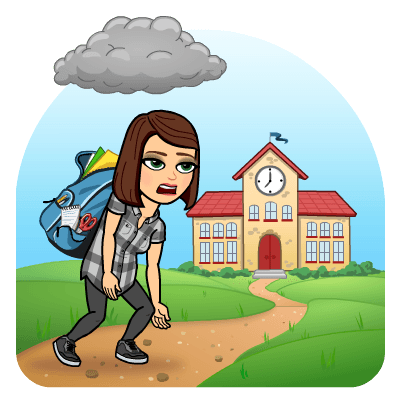
I sat back and allowed the storm clouds to gather overhead every time I reached the school doors.

bitmoji-1234681477

It wasn’t until I burned out and hit breaking point that I realized I had to find a better way through, began to talk and learned, not just to cope, but to thrive 🙂

So what advice would I give to someone on the spectrum who find themselves in the midst of a bullying situation?

Well, as the bullying game has intensified with the spread of social media since my schooldays (rural Ireland had quite limited access to high speed internet in the noughties), this is a tough one to advise, but here are some of my top tips:

  • Ignore the bullies– An obvious one that’s easier said than done, I know (I pretended to ignore for years- it can take quite a bit of practice to truly let words glide off your back), but when you react or meltdown- that’s what fuels them. My reactions made bullies push my buttons all the harder. If you feel a meltdown coming on, take a moment to go somewhere quiet, get some fresh air and take a deep breath.  Bathroom stalls were a personal favourite of mine to give me some time to regroup (unless someone had been smoking in there… this added further sensory fuel to the fire! 😛 )
  • Find an outlet for your emotions- We autists experience and process our emotions in very different ways. If you shove things down, the end result will not be pleasant. So run, dance, go on a four hour killing spree on your PlayStation (something that I wouldn’t know anything about… 😛 )- do whatever works for you to deal with your frustrations. I know it’s hard, but finding an outlet will help to quell the dragon inside.
  • Try to think before you act/speak– Again this is quite challenging when you don’t have a filter or struggle with impulsivity, but sometimes what may seem like the most simple of sentiments to you can be twisted and misconstrued by bullies. An innocent comment I once passed about the family dog led to years of jeering and implied bestiality…! I still put my foot in it every now and again, but I’ve gradually learned to pause more to assess if my comments will sink or float.
  • Be careful what you post on social media- The online world can be a dangerous, unregulated one. We live so much of our lives online we forget that our peers are always watching. As with your thoughts, take a moment to think through your posts. Something as simple as a picture or throwaway comment could land you in bother both on and offline (a simple lack of an appropriate emoji once caused a rift with a friend). Remember- it’s also perfectly ok to abstain or take some time away from social media. It may seem like social suicide, but we all need time away from our screens- people disable their accounts every day for lots of reasons so don’t worry about what they’ll think at school. Your sanity is far more important 🙂
  • Talk to someone– If you’re being targeted, tell a teacher, confide in a friend or talk to your parents so something can be done. But bear in mind, they can’t always  intervene. Teasing is a natural part of life as much as it may hurt (something that the autistic mind really struggles to comprehend), and not everything can be prevented. What may seem a devastating comment to your mind may mean nothing to an outsider. Intervention aside, by simply talking to someone about how you’re feeling, this will make the load so much easier to bear. Don’t let the quicksand claim you- ask for help!bitmoji2141702869

At the end of it all, just remember what my Biology teacher once taught me- “Whoever said that your school days are the best days of your life lied- college days are the best days of your life!”

So don’t get disheartened Earthlings! It may be hard to see it through the swirling fog in the crystal ball, but life does get so much better (…once you get past the bills, taxes and work-day traffic jams! 😛 😉 ).

Aoife

Autism- A History

Greetings Earthlings! 🙂

Today, in continuation from my post exploring autism through the ages, I’d like to give you a brief intro into how we came to know of  autism.

So how about a bedtime story then Earthlings? 🙂

bitmoji485231286.png

A long time ago in the land of Austria, two researchers were born that would go on to make medical history- Leo Kanner and Hans Asperger. Whilst these men interestingly did not collaborate, together their respective research laid the groundwork for our current understanding of ASD’s.

So how did it all begin?

Whilst some of the earliest documented cases of autism dates back to the 1700’s, the new Latin term autismus (“isolated self”) was first coined by Swiss psychiatrist Eugen Bleuler (who also coined the term schizophrenia) in 1910. Derived from the Greek word “autós” (meaning ‘self’), Bleuler used the term to describe a sub group of people with schizophrenia that were removed from social interaction.

Image result for eugen bleuler

The term autism first began to take it’s modern form in 1938 when Hans Asperger adopted the term ‘autistic psychopaths’ in a German lecture on child psychology. During this period, Asperger was investigating the ASD which would later bear his name, examining a group of four boys of normal intelligence who struggled with social integration and empathy. Asperger dubbed these boys “little professors” due to their ability to lecture at length on their favourite subjects!

Fun Fact: Asperger himself is widely thought to have displayed many of the symptoms of his discovery himself!

Image result for hans asperger

In 1944 Asperger published an article in German titled ‘Autistic psychopathy’ in childhood, a publication which largely went unnoticed within the English speaking medical community until the 1980s when child psychiatrist Lorna Wing brought his work into the limelight.

This obscurity was also due in part to the work of his contemporary Leo Kanner at the prestigious John Hopkins University in the USA, who pipped Asperger to the post with his paper Autistic Disturbance of Affective Contact in 1943.

Image result for leo kanner

In this work, Kanner described a group of 11 (8 boys, 3 girls) socially isolated children with a “need for sameness” and a “resistance to (unexpected) change.” Kanner claimed to have discovered a new medical condition which he named “infantile autism”, garnering much attention and praise within the medical community.

But was it coincidence that these men happened to work in tandem on such similar projects 4000 miles apart?

In his lifetime, Kanner claimed that he had never heard of Asperger’s work, however, it would appear that this was not the truth.

Author Steve Silberman has since discovered that Kanner likely heard of Asperger’s work through George Frankl- a work colleague from Vienna, and former chief diagnostician at Asperger’s clinic in 1938. Driven by an ambition to make his mark on medical history, it would appear that Kanner sought to recreate Asperger’s work in America, repacked it and claimed it as his own!!

Image result for fainting gifPoor Asperger- but at least his name lives on in Asperger’s syndrome! 🙂


So what did these early researchers believe to be the root of autism?

Difficult as it may be to imagine, Kanner firmly believed in something called the “refrigerator mother hypothesis“- a since (rightly) discarded theory which claimed that autism is caused by a lack of maternal warmth or love!!!

Image result for outraged gif

I know!!!!!

Madness!

In addition to this, Kanner’s reuse of Bleuler’s term autism resulted in decades of confused terminology where autism and schizophrenia were one and the same.

Thankfully, the research caught up to give us a clearer insight into the physiological roots of autism (although it took about 20 years for the experts to catch on! 😛 ), leading to the establishment of autism (and later Aspergers syndrome in 1994) as a separate diagnosis in it’s own right in 1980.

And that is the history of autism dear Earthlings, I hope you enjoyed your bedtime story! 😉

Enjoy the weekend everyone! 😀

Aoife

Autism and Anxiety

Greetings Earthlings! 🙂

Did you know: People with autism are five times more likely to suffer from an anxiety disorder?

bitmoji551804739

Autists are highly strung individuals. Our brains move faster than 10 speeding trains as we process the world around us; so naturally, we have a greater capacity for worrying. Imagine you are in the car approaching a straight road- you would just drive straight on without much further thought right?

In the autistic mind, you’re thinking about future bends that may (or may never) pop up, the condition of the road, idiot drivers you may encounter, stray animals or pedestrians, road works and diversions. What if I get lost? What will I do about parking? What if I get caught behind a tractor (a legitimate reason for being late for anything in Ireland! 😛 )?

What if this, what if that!

We over-analyse every single aspect of the most routine of ventures, twisting ourselves into anxious knots about an array of ‘what ifs‘ that may never come to pass.

621415c6C9yjMW

In my experience, social anxiety can be quite an issue. Most of the time, everything is hunky dory when I’m socializing- I listen, I engage, I laugh, no problem at all.

Buuuttt sometimes, if I’m in a particular group or struggling to get to grips with the topic of conversation, I feel so awkward that I start to get anxious.

“Am I talking enough? Am I saying the right things? Oh no that came out wrong! Aggggghhh!!!”

Annnnnd then I sort of slip back into my shell… 😛

giphy (6)

Most of the time, it won’t get much worse than this, but other times…I start to burn up, I can feel the sweats, my mind starts going into overdrive “Oh God everyone is staring!! They think I’m a saddo! What is wrong with me?”

My chest tightens up and it can be difficult to breathe.

Taking deep breaths usually helps to calm me down long enough to snap out of it…but sometimes it all starts to crumble in on top of you an then….

6ab77aef8ef6c487bda48f077d9d3aae.gif

MELTDOWN!!!! (^^^usually the flight instinct kicks in for me!)

Other times, anxiety has been known to wreak havoc with my digestive system. I once threw up on my own shoes from the stress of minding a drunken friend (who ironically did not get sick! 😛 )

Image result for mean girls throwing up gif

But I did get some new shoes following my gastric excursions, and some entertaining stories out of it! 😛 Oftentimes my anxiety incubates into productivity to force me to get things done so every anxious cloud has a silver lining! 😉

So what does the scientific community make of our anxious antics?

Remember how I’ve discussed Alexithymia in previous posts (Discussion-Emotions and EmpathyAutism and Music)? Researchers believe that our struggles to correctly identify and understand our emotions (and those of others) to be one of the driving forces behind anxiety disorders in the autistic community. A desire for emotional acceptance and an intolerance for uncertainty are also considered key players in the anxiety debate.

In addition to this, a number of biological factors have been identified in the development of anxiety. Some people are thought to have a higher biological response to stress for example- something that is quite likely in the case of autism, as we are known to have higher levels of stress hormones.

Dysregulation of levels of certain neurotransmitters in the brain are also thought to contribute to anxiety such as GABA, dopamine, serotonin and adrenaline. As I’ve discussed in numerous posts- many of these bad boys are indeed dysregulated in the autistic brain. Changes in activity levels within the amygdala or “fear centre” of the brain may also contribute to anxiety- and yes, you’ve guessed it! Similar changes in the amygdala have been linked to a number of autistic issues (skin sensitivity, sound sensitivity). 

So it all links back to a few simple physiological changes in our brain! 🙂

Image result for awkward yeti brain anxiety

Hope you enjoyed this weeks post Earthlings! 🙂

Have a wonderful weekend! 😀

Aoife


Autism Through The Ages

Greetings Earthlings! 🙂

In this week’s post I’m going to briefly explore the history of autism.

So gather round for storytime! 😀

fgghd

As autism rates increase, many people have come to believe that the condition is relatively new. Whilst the clinical term may be in it’s infancy, autism can in fact trace it’s genetic lineage back through millennia!

Genetic research has shown that some of the key genes involved in the development of autism came from our shared heritage with the apes, predating the evolution from monkey to man (somewhere in the region of 7 million years ago).

Image result for evolution

Other related autism genes are slightly more “recent” than this, having come into existence over 100,000-years ago.

Whilst a third of autistic genes may come about through spontaneous genetic mutation, from this evidence we can see that autistic genes were inserted into the genetic code of our ancestors for a reason.

Interestingly in ancient times, people that displayed autistic traits were in fact highly revered. Such autistic traits as exceptional memory skills, creative thinking, observational skills, heightened senses and extensive knowledge in important areas such as plants and animals (i.e specialist interests), would all have been greatly valued in an ancient community. The incorporation of these skills within the group would have been essential to their survival.

Experts also believe that autistic skills such as memory and attention to detail may have contributed to the creation of ancient cave paintings such as this one:

How often we focus on the negatives of autism that we fail to stop and consider the reasons these genes exist. If they were a hindrance to the human race, why have they not been eradicated through millennia of evolution?

I think Temple Grandin sums it up pretty well here:

Image result for autism genes memes

And she would be right! 😉 Experts believe that autistic genes have been conserved to advance our intelligence. Variants of autistic genes have been linked to improved cognitive performance and the formation of new brain cells.

Such talented historical figures as Michelangelo, Mozart, Beethoven and of course, Albert Einstein, are all believed to have shown signs of autism- but history remembers them for their esteemed achievements, not their genetic quirks.

Something that we would all do well to think of when we commit autistic people to the annals of history in future.

So there we have it Earthlings, I hope you find this information as interesting as I found it 🙂 I could go on further buuuuttt I think I’ll spare you the clinical history of autism for another day 😉

Have a good weekend everyone! 🙂

Aoife

Blog at WordPress.com.

Up ↑