Google Accessibility Discovery Centre (ADC)

Greetings Earthlings! 🙂

This week I’d like to talk about a recent trip I took to Google’s Accessibility Discovery Centre (ADC) in Dublin- the first of it’s kind in the EU. Now I know you might be wondering what a trip to Google has to do with autism- but bear with me!

So the ADC is a dedicated space where researchers and engineers develop new technologies that can help people with disabilities including those with autism. Not only do they develop new technologies, Google also uses this space to engage more effectively with disability communities to better understand our needs. The space is specifically designed to facilitate different disabilities- it’s wheelchair accessible, the colour scheme was designed to suit different disabilities with muted tones, and the lighting can be easily adjusted for sensitivities.

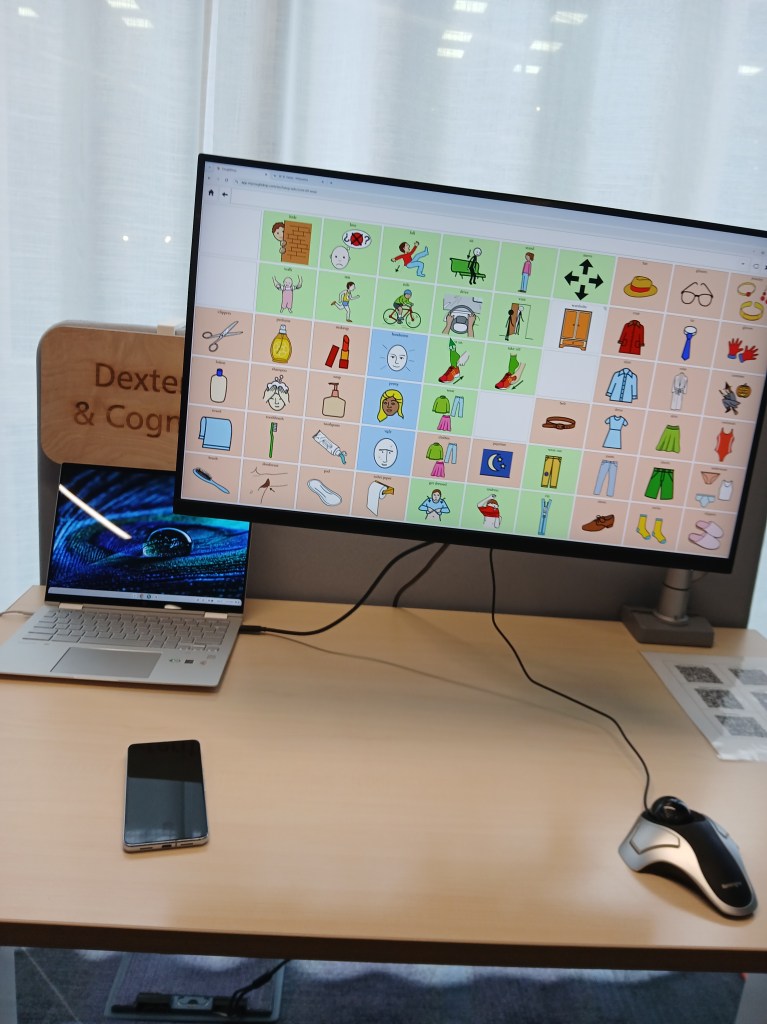
There were a number of really cool, innovative technologies that will really help the quality of life for people with physical disabilities including games that can be controlled with a chin joystick and ones that track eye movements- you can literally drive a car on the screen using your eyes! They are also working on some amazing tools for those with nonverbal autism such as a picture based program where you can click on images to make sentences (kind of like the rapid prompting method). You can see this in the image below:

They also showed us around their suite of accessibility tools and extensions available when using Google Chrome, including dyslexic font to help make reading easier- who knew such things could exist?🤯 One of my favourite parts of the tour was the neurodivergent corner where they had a range of nifty sensory toys you could play with which were great for stimming. They also had some glasses for light sensitivity issues, loop earplugs and a sliding social battery pin- which I could really do with getting my hands on 🤣.

It is a really cool facility and it’s great to see new dedicated spaces like these that are working on making life easier for neurodivergents and others with disabilities. If you’d like to tour the ADC, you can email Google at adc-dublin@google.com to set it up- I highly recommend the experience! 😀

Hope you enjoyed this post dear Earthlings!

Have a lovely weekend!

Aoife

Autism and Revenge bedtime procrastination (RBP)

Greetings Earthlings!

This week I’d like to discuss something that I have a very bad habit of engaging in- revenge bedtime procrastination.

And what pray tell is that when it’s at home?

You may never have heard of the expression, but it’s something that most 0f us have likely done at some point in our lives, especially for autists. Revenge bedtime procrastination (or RBP) is the deliberate act of putting off sleep in order to reclaim leisure time that was lost during the day, often after a busy and stressful one. The term was first coined on Chinese social media in 2014, where ‘revenge’ comes from taking back time for yourself, however, this behaviour is often self sabotaging resulting in poor sleep quality and deprivation.

For autists in particular, this behaviour is seen as a means of taking back control in a world where we often feel out of it. It’s a coping mechanism of sorts where we engage in this intentional sleep deprivation after an overwhelming day of sensory overload and social obligations. Taking back this time, while self sabotaging, is needed for self soothing, allowing autists to recover from the demands of living in a neurotypical world. Many autists struggle with executive dysfunction and ADHD, so organization and planning can be difficult, often leading to an out of balance day where routine can be difficult to maintain. RBP allows an autist to use their limited time at night for specialist interests and relaxation, where the cost of sleep is considered a worthy investment (or at least perceived as such til the next morning 😴).

I’m especially prone to this type of behaviour- I just wasn’t aware there was a word for it until recently. My schedule can be pretty hectic at times, often rolling home late at night, but despite my tiredness, I have to pull out my phone or a book for a while when I get to bed to veg out and decompress after the day. Other times, I tear into a few rows of knitting late at night, or tell myself I need just an episode or two of whatever show I’m currently binging before I can go to bed. I may be falling down from the tiredness, but there’s just something in me that pushes me to do these things before I turn out the light. Sometimes it’s this need to feel productive in my projects, other times its to zone out. It doesn’t matter how tired I’m going to be in the morning, my brain just needs those extra few minutes of me time.

It may not be the most sensible autistic behaviour, but with all the sleep issues autists experience at night, do whatever you need to do to reset your brain before bed 😌

Hope you enjoyed this post!

Have a lovely weekend!

Aoife

Autism and Displaced Anger

Greetings Earthlings! 🙂

Leading on from my previous posts about meltdowns, emotions and alexithymia (the inability to identify emotions in the self and others), this week I’d like to take a close look at the specific issue of displaced anger.

As I’ve discussed multiple times, autists process emotions differently to their neurotypical peers, often because they aren’t able to properly recognise what they’re feeling. In my experience, anger is one of the worst offenders. I have often had issues with displaced anger, misdirecting my wrath at everyone and anyone around me because I hadn’t been dealing with the source. Just walking around for weeks lashing out at the slightest annoyances because I hadn’t twigged that I was bothered by something else entirely.

Interestingly, I have also resorted to anger as a cloak in the past. I often found when on the verge of a meltdown being angry and rude were much easier emotions to project than what I was truly feeling. Anger was much easier to control, with less likelihood of dissolving into tears (not to mention the repellant effect). I just knew that were I to make eye contact or speak without anger in those scenarios, the floodgates would open, and it was too overwhelming to have to explain them.

There is also a cognitive emotional processing condition which can contribute to displaced anger outbursts known as anger rumination. This happens when an autist has a tendency to dwell on past experiences of anger and frustration. By focusing on these experiences, autists develop difficulties in properly processing and responding to anger. Persistent rumination on past stressors depletes your ability to self regulate resulting in behavioural inhibition, which makes you more hostile and prone to displaced anger outbursts.

While it’s never nice to be on the receiving end of these anger outbursts, try to bear in mind that you’re unlikely the cause. You might have triggered a reaction, but usually the issue runs deeper. Try to give an autist some space in these scenarios to give them time to calm down. Talking after the red mist has passed can be very helpful in allowing an autist to process their emotions in a healthy way in a safe, nonjudgmental environment.

Hope you enjoyed this post dear Earthlings!

Have a lovely weekend!

Aoife
Autism and Overthinking

Greetings Earthlings! 🙂

You can imagine my surprise this week to discover that I have never written a post about overthinking and autism!

Before I was diagnosed, overthinking was probably one of my strongest autistic traits. My brain was often compared to a washing machine set on high spin going round and round and out of control. I analyzed every single detail of my life, rehearsed potential conversations and social scenarios (usually catastrophizing them), and mentally abused myself daily with self critique. I would spend hours on the pillow staring into space unable to sleep as my mind raced out of control. My brain would be going so fast my head would be on fire on the pillow with all the heat generated from my neural activity!

Granted, I still have a tendency to rehearse and think through scenarios from multiple angles, but I find it much easier to rein in the horses before they start to race. Knowing why my mind works the way it does was a huge help, enabling me to be much kinder to myself, but also firmly stop the thoughts when needed.

But are there any scientific explanations for why we overthink?

There are a number of potential reasons why autists overthink. Sensory sensitivities and social anxiety may trigger overactive thoughts as an autist tries to process overwhelming stimuli and social interactions. As autists can be quite detail oriented and rigid in their thinking, it can also be hard to pivot from certain thoughts leading to overthinking. On another level, overthinking could have a physical cause in the way our brains are wired. As I’ve discussed previously, autists have too many synapses (connections between neurons where information is exchanged) so the brain is over-connected. With so many extra connections and ways information can travel, perhaps over-connectivity could be contributing to the issue of over-thinking.

So is there anything that can be done to manage it?

Here are some of my top tips for reining in your racing thoughts:

  • Weighted blanket or a weighted plushie– weighted blankets have been a game changer in helping me to sleep at night. They are scientifically designed to dampen the chemicals that stimulate your brain so less stimulation means less racing thoughts
  • Keep your hands busy– diverting all your nervous energy from your brain to your hands is great to slow your thoughts. I took knitting back up in college to try to slow my mind and found it immensely therapeutic. I was so busy concentrating on what my hands were doing that my brain didn’t have any capacity to think about anything else. Similarly, I’ve found sculpture and cake decorating have the same effect, so get your hands stuck into a project!
  • Exercise– is there anything a good walk can’t cure? Exercise can be great to help manage overthinking. I find that spin classes are great to switch off as you have to concentrate so completely on the task you don’t have any space in your head for anything else
  • Talk it out– discuss some of your thoughts with a friend or family member. A problem shared is a problem halved. I buried so many negative thoughts for so long my mental health suffered greatly, but things got so much easier once I started to talk through my problems. You don’t need to shoulder your struggles alone
  • Write it out– similarly, writing out your thoughts can be very therapeutic. I’ve often found that the simple act of getting my thoughts on paper was enough to get them to leave my head

Hope you enjoyed this post dear Earthlings!

Have a lovely weekend! 🙂

Aoife

Autism and Constructive Criticism

Greetings Earthlings! 🙂

Leading on from my previous posts about rejection sensitive dysphoria (RSD) and teaching students with autism, this week I’d like to focus in on the topic of constructive criticism.

Naturally, no one likes to be criticized, but with autists criticism can be quite devastating. As I’ve discussed many times, autists are black and white thinkers so when criticized, even constructively, we don’t tend to see the positives. Things are wrong and right, so if a mistake is made or an error pointed out, then it’s not just this one tiny thing that’s wrong, we perceive everything about us to be wrong. This can be particularly problematic in an educational setting where constructive criticism is essential to the learning process.

I found criticism particularly difficult in school. As a high achiever, it was a very bitter pill to swallow when I made a mistake. To this day I still cringe about the time I confused Lee Harvey Oswald and Mark David Chapman (I mean they were both high profile assassinations after all, it’s an easy mistake!) and had to embarrassingly hang my head after eagerly waving my hand around like an eejit to answer 🙈😂

In particular I struggled with constructive criticism when it came to art. It was one of my favourite subjects at school, but I was always butting heads with the teacher every time she tried to provide me with constructive feedback to the point that she felt she couldn’t give me any feedback at all based on my reactions. My parents had words with me, but while I adjusted my attitude as best I could, my teacher and I were at odds right up ’til the end of school as neither of us could seem to see the other’s perspective.

When it comes to education, this sort of relationship doesn’t help anyone. The teacher was frustrated with me, I was upset and frustrated with her, and my creative education was suffering as a result. While it is difficult for an autist to deal with constructive criticism, there are some ways to manage the situation.

  • Time and place– Be conscious of the situation and environment. Autists are often hyperaware of their differences, so you don’t want to make a scene in front of their peers that will only add to their distress. Moreover, you need to consider the timing and state the student might be in to avoid conflict. In one particularly memorable moment during my leaving cert (Irish state exams to get into university), my teacher attempted to question my approach and design for my piece DURING MY FINAL EXAM. Naturally in my stressed state, I had a moment and quite loudly gave out to her for disturbing me during my exam! Pick your moments carefully- and try not give feedback in a test setting 😛
  • Be specific– Don’t give vague feedback on areas for improvement. We need specific, concrete advice, otherwise we will catastrophize and drive ourselves demented wondering ‘What did they mean by X?’, or we may invest time working on the completely wrong thing. Don’t say ‘Your essay needs improvement’. Tell them they need to make it longer, include quotes, better spelling and punctuation, make a plan etc. When I worked in a lab and my experiments kept failing, each day for several weeks I was told ‘Not good enough‘, but no one took the time to sit with me and find out that I was missing one step every time (a step that they had failed to include in my instructions). All I knew was that I had failed and had to try and blindly figure it out on my own, which didn’t help anyone. I kept failing, they kept getting angry and my education suffered. Like any construction project, constructive criticism requires clear instructions
  • Focus on solutions, not problems– Similar to the previous point, focus on problem solving when giving constructive criticism. If the focus of feedback is all negative, this will likely overwhelm the student and trigger a meltdown (especially if they suffer from RSD) and they will learn nothing
  • Compliment sandwich– Lead with praise, deliver negative feedback, and close with praise. This can help to soften the blow for an autist making it clear that they didn’t exactly go wrong, but improvements can be made. This piece of advice is not just for those teaching an autist, but can also be useful for an autist who has to deliver constructive criticism to avoid complete bluntness and seeming lack of empathy . The TV show The Good Doctor used this technique to help autistic doctor Shaun Murphy educate his new autistic intern

Hope you enjoyed this post dear Earthlings!

Have a lovely weekend! 🙂

Aoife

Teaching a Student with Autism

Greetings Earthlings! 😀

This past week it’s been brought to my attention that I’ve written very little about autism and education/schooling (don’t know how I missed that 🫢), so for the next couple of posts I’d like to dive into this important topic. I’ve previously discussed the topic of learning and autism, so today I’m going to focus in on some pointers for teaching students with autism.

There are so many different pieces of advice for teaching an autist, but here are a couple of the stand out items based on my schooldays:

  • Find positive ways to keep them stimulated– I have a tendency to get bored pretty easily, which would happen a lot in school once I had completed my work. I’d often take out non-school books from my bag to read, or scraps of paper to write and doodle on to keep my mind and hands busy. Buuuuut some of my teachers didn’t like it, and confiscated my stuff 🙈. I understand it feels like an insult to the teacher and the lesson plan, but many autists have ADHD and need stimulation in these moments of downtime. If you notice that your student has a tendency to race ahead of the class, keep extra worksheets or puzzles around, encourage them to read a book (you could recommend a book on the class subject), do their homework or revise something for a test. If they’re already being productive as I used to be, leave them be- check in if you feel they’re not working, but if they aren’t causing trouble let sleeping dogs lie
  • Avoid routine disruption (if possible)- I know this can’t always be helped as schedules change from day to day, but try not to rock the boat where possible. In my experience, I was generally fine with changes to timetables, as long as I had advanced notice. Fire drill during Maths? Fine. A talk from a guest speaker during PE? Super. But drag me out of class when I was already settled in the middle of something… During my final year of secondary school, I had just settled down to my painting in double Art when a teacher pulled me out for a meeting about an upcoming debate (which I was already doing under duress). Well…I threw my paintbrushes down in frustration, I stormed into the meeting with my sleeves up and my apron on and I maaaaayyy have given out to him for interrupting me🙈 I get it, teachers have to try and organize extra curriculars around their free periods, but plucking an autist out of class without warning is best to be avoided (unless it’s something they hate, like if I’d been taken out of Business class😜). Try to catch them between classes and give advanced warning if you can
  • Try to understand their behaviours and perspectives- growing up undiagnosed, I was very lucky with the school that I was in. As a rule follower I didn’t generally have behavioural issues in class, buuuut as any autist will tell you, you’re not in a rational state during a meltdown. I had moments where I acted in ways that would have garnered a note home or detention for other students, but thankfully as I was a good student that was frequently bullied, my teachers put it down to stress and looked the other way. Now I know that we can’t look the other way for everything, autists have to be held accountable like everyone else, but take the time to try and understand the situation and assess why something might have happened. If they didn’t get homework done for example, it could be that they didn’t understand it, or were too overwhelmed. Giving out for non-completion won’t help anyone, but if you take a moment to talk to the student, the issue could be resolved calmly, and may help you to better support them in the future
  • Avoid sarcasm- autists can be so literal, it’s best not to use sarcasm to avoid any issues on clarity. When I was a teenager, we were discussing entering a drama competition in class. I can never remember the exact sequence of events and context, but my teacher seemingly asked me to write the play. I was so excited when I went home feeling privileged to have been asked. In the end however, I got busy, the teacher never circled back and so I never wrote anything. After years with this teacher I eventually realized that she was quite sarcastic. To this day, I still don’t know if the request was genuine or if it was a sarcastic comment to something stupid I said (and with my lack of filter that’s highly likely 😛 ). There were many other incidents with sarcasm and teachers which left their mark, so if you know/suspect that you have a spectrum student, just avoid it
  • Keep your cool, be kind, and don’t let them see you frustrated– this one’s a biggie. I know for a fact that I was difficult to teach at times, and you know how I knew? My teachers didn’t always hide their feelings. It made me feel awful, especially when I would be put down for being myself, never really understanding why they were mad. In one particular incident, I was struggling with a mathematical concept as a young teenager. I didn’t get it immediately and I had a crying meltdown. The teacher went over the concept a second time on the board, and when I still didn’t get it, she was annoyed and frustrated, and angrily moved on implying I was stupid for not getting it. Naturally I understood it perfectly after I had calmed down and my friend went over it slowly with kindness and patience. That incident stayed with me for many years. In Freya Harte is not a Puzzle by autistic author Méabh Collins, this book is full of similar moments like this, moments that can be devastating for a vulnerable student. I know how hard it can be to teach a ‘Me’, I have found myself equally irritated by autists like myself, but you can’t let them know. Patience and kindness are the biggest tools in your arsenal

This list of tips for teaching autists is also a really helpful resource, especially for teachers at the primary level: http://capacity-resource.middletownautism.com/wp-content/uploads/sites/6/2017/04/21-Tips-for-Teaching-Students-with-Autism-Spectrum-Disorders.pdf

As I am high functioning who was largely educated undiagnosed, I can only speak to my own experience. No two autists are the same, what would have helped me may not work for someone else, but I hope you find this post helpful nonetheless 🙂

Hope you enjoyed this post dear Earthlings!

Have a lovely weekend! 🙂

Aoife

Autism Friendly Parking

Greetings Earthlings! 🙂

Following on from my post about autism and driving, this week I’d like to talk about autism friendly parking facilities!

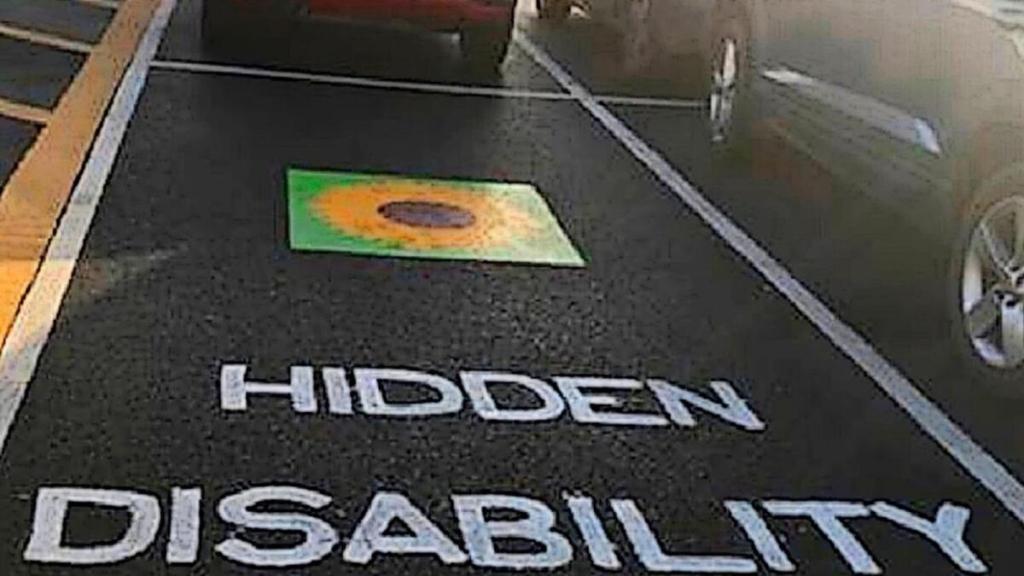
So I was recently out looking for parking in my local shopping centre and was surprised to see a sign for ‘Autism Friendly Parking’ with designated spaces for autistic drivers/autistic passengers. Parking is perhaps, in my experience, one of the most stressful aspects of driving on the spectrum. The stress of trying to find a space, efforts to get into available spaces, the panic from holding up traffic when it takes you an age to get into an awkward spot- I would love to see what my blood pressure readings are like after it sometime!🙈 In all my years of driving I have never come across an autism friendly parking system, so naturally I had to investigate.

Many businesses have now started providing designated autism friendly parking. These spaces are located closer to the door of business’s (just like disabled sparking spots), to make life easier for autists, especially for those with mobility issues.

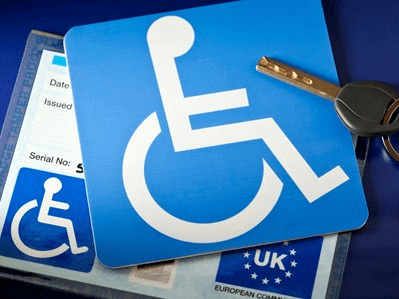
So in Ireland, you can apply to get an autism friendly parking permit. With proof of diagnosis and a small fee, you will be sent a permit to put in your car window which will allow you to avail of autism friendly parking spaces. These permits prevent abuse of the system and allow you to park in these spaces without fear of clamping. The permit also has the dual function of alerting emergency services that there may be an autistic driver/passenger in the car in the event of an accident, just like autism ID cards. So far this system is mainly provided by private businesses, but autism friendly towns like Dungarvan have implemented these parking schemes throughout the area. In recent weeks, Cork councilors are seeking to roll out a similar model to Dungarvan across the county, so this scheme could soon be a lot more readily available.

Similar schemes exist in other countries like the United States and the UK. In the UK for example, hidden disabilities like autism are now eligible for the blue badge scheme- the UK’s disability parking scheme, which enables autists to park in designated disabled parking spaces.

So if you find parking as stressful as I do, it’s worth investigating if there is an autism friendly parking scheme available in your area 🙂

Hope you enjoyed this post dear Earthlings!

Have a lovely weekend!

Aoife

Autism ID Cards

Greetings Earthlings! 🙂

As it’s autism awareness month, this week I’d like to discuss the topic of autism ID cards for individuals on the spectrum.

So what exactly are autism ID cards and what are the benefits?

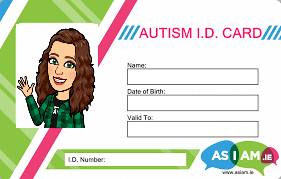
Many autism organizations and charities offer autists the opportunity to apply for an ID card stating their autism status which they can carry on their person. This card can be provided to people to alert them of your diagnosis if you are struggling to communicate. For example, you can show your card in a restaurant to alert staff that you may need a little extra time, assistance or that you might have awkward dietary requirements (especially as some places can be weird about specific requests and substitutions). This can help reduce stress for autists knowing they have the card to help them communicate their needs better in social situations.

It can also be useful to have in your wallet for emergency services in the event of an accident. Having a card you can quickly produce in a crisis can rapidly help to de-escalate situations with emergency services where there is often confusion and miscommunication. My friends have often joked how they would love to have my literal autism card so that they could throw it down on the table in a social situation to get out of a bad conversation🤣

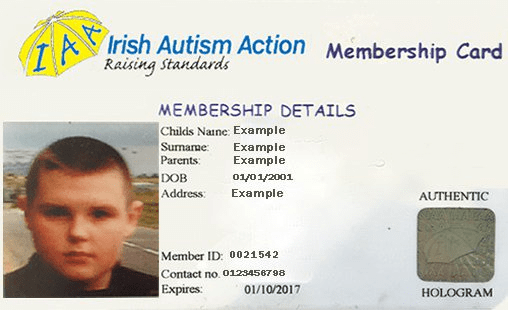
For a small fee, autists can fill out a form and provide a passport photo and proof of their autism diagnosis to the organization they are applying to to secure their card. Other organisations offer a simpler version of ID cards which inform the reader that the person showing them the card is autistic and provides emergency contact details.

In addition to their usefulness for emergency situations, depending on the ID card provider, some cards entitle you to discounts with corporate partners and free carer admittance. For example. you can see some of the discount benefits with ASD Ireland’s autism ID card here.

There is also another type of autism ID card called a JAM (just a minute) card. These free cards can be ordered for people with invisible disabilities like autism which can be presented in difficult social situations like in shops or on public transport so that people will be more understanding and give you extra time in an easy and private way. They also offer a JAM app if you do not want to use the card.

All in all, autism ID cards can be a very useful tool to have in your back pocket.

Hope you enjoyed this post dear Earthlings! 🙂

Have a lovely weekend!

Aoife

Autism and AI

Greetings Earthlings,

This week I’d like to discuss a bit of a hot button topic at the moment- Artificial intelligence (AI).

Once upon a time, AI used to mean that atrocious Steven Spielberg film, but now AI is creeping into our every day lives. Chat-bots, deepfakes, AI research models, advanced searches and content recommendations- we can’t escape it. The applications are seemingly limitless, with great potential for people with autism.

But first things first, what exactly is AI?

AI is the technology that enables computers and other digital devices to do the things that humans do like read, write, learn, talk, analyze etc. While not human, the combination of human-like abilities and machine thinking can make it a powerful tool to be reckoned with.

So how can we leverage AI when it comes to autism?

Now here’s where things get cool. Robots are being used to help manage autism! Researchers are training robots how to interact with children with autism so that autists can get practice identifying facial expressions and social cues and help them to learn how to respond appropriately. Robots are the ideal companions as they have limitless patience and allow autists to practice their skills in a safe, non-judgmental environment. There are also a number of new AI apps that similarly work to help autists to practice their social skills, with AI technology being used to help move and learn what works best for the autist and help suggest the right kind of calming exercises depending on their mood.

In addition, AI models can be used to study the MRI’s of autists to help us better understand the condition, particularly how neurological changes and autistic traits vary between neurodivergents.

Most recently new AI systems has been developed that can quickly and accurately diagnose autism- one system by measuring how water travels in the brain by analyzing MRI images; and another that detects autism by measuring responses to a flash of light in the eye. This could revolutionize how we diagnose autism, allowing autists to get access to services sooner for better overall outcomes. Other cool AI apps allow parents to upload videos of their child’s behaviours to be analyzed by clinicians for remote diagnosis using AI to help categorize and assess them.

On the other hand, AI is a force that we must be careful with. It has great potential for use, but we need to be careful where we tow the line. This is especially true of Elon Musk’s Neuralink- a computer chip that can be implanted in the human brain, allowing us to control mobile devices through the power of thought. This week saw the first reported successful (though the evidence remains to be seen) implant where the patient has recovered well and is able to control a mouse on a screen with their brain. What was once the stuff of science fiction is rapidly becoming a reality. Aside from these tech applications, Musk claimed in 2019 that Neuralink has untapped medical potential to help “solve” neurological diseases like Parkinson’s, Alzheimer’s, Schizophrenia and…. autism.

Now… this was naturally met with a lot of backlash from autism charities- especially given that Musk has openly discussed how his autism has contributed to his success. Autism is a different way of thinking, it is not something that the majority of autists would like to “solve”. New approaches to help autists navigate life in a neurotypical world yes, but most would not wish to get rid of their autism if given the choice. Would modifying autistic traits through AI really help autists, or could it make things worse by taking away our unique way of thinking?

It’s a very fine line we tread, so we must proceed optimistically with caution when applying AI to autism.

Hope you enjoyed (or were horrified by) this post dear Earthlings!

Have a lovely weekend!

Aoife

Learning and Autism

Greetings Earthlings! 😀

Leading on from my previous posts about autism and memory, IQ, and studying, this week I’d like to talk about the topic of autism and academic learning.

First things first, autism is NOT a learning disability. It’s a neurodevelopmental disorder which impacts how our brain develops and the rate at which it develops having an impact on motor learning, social learning, language learning etc. That being said, ASD‘s can be co-morbid with learning disabilities such as dyslexia, ADHD and dysgraphia.

Everyone’s academic learning journey is unique, especially among autists. Autists can have problems concentrating in classrooms due to sensory sensitivities, issues with social skills can make it harder to interpret teaching cues, and difficulties with executive functioning and information processing can make it hard to process new information.

I’ve always had a passion for academic learning, but even I’ve had my struggles. I struggled hugely with maths in my teenage years. Once letters came into equations I regularly had meltdowns and got overwhelmed when I couldn’t immediately make sense of the topic. One of my most enduring memories of school is throwing my maths book at the wall mid meltdown while doing my homework 🙈

Buuuuuttttt I would usually be able to make sense of the exercises once the meltdown had passed. My teachers unfortunately didn’t understand this (the joys of being undiagnosed) which often made my learning journey challenging. Had I been given the opportunity to work slowly 1:1 with maths, I would have picked topics up a lot quicker.

Everyone’s learning style is different, especially when considering the challenges of autism. There are several different learning styles:

  • Visual learning– where learners take in information better visually through pictures, graphs and mind maps to help make connections
  • Auditory learning– where learners listen to information for optimal processing
  • Verbal learning– using verbal approaches like reading out loud and mnemonic devices
  • Reading/writing learning– classical learning approach by reading and writing
  • Kinesthetic learning– physical learning by doing tasks or needing to move while learning
  • Logical learning– where logic and pattern recognition skills are used to connect concepts
  • Social/Interpersonal learning– where you learn best by observing others, and talking and communicating with a social group
  • Solitary/Intrapersonal learning– where you just need to be by yourself to learn on your own with no distractions

Sometimes a mix of learning styles can be the best approach- I have employed all of these styles at different points in my life, but I would largely fall into the visual and kinesthetic learner categories. Seeing things drawn out and or doing tasks is often the best way for me to process information. For example, I tend to take notes using coloured pens as the visual stimulation from the colours makes it easier to process and retain the information.

There are so many different ways to learn, it’s just a matter of sitting down and figuring out what kind of learning style works for you, or working out a plan to limit classroom issues like sensory challenges that can derail your learning process. Lot’s of apps and supports are available for autists these days that can help make learning a lot easier.

The key thing is to not get discouraged. No two autists are the same and it can take a while to find what learning style works for you. When I took maths and biostatistics in college, the lectures were overwhelming, but once I sat down to a tutorial session where we worked hands on with the sums in an intimate environment, I flew through the work and got excellent marks in my exams. It takes time, but once you find the right approach, learning can be a breeze 😊

Hope you enjoyed this post dear Earthlings! 🙂

Have a lovely weekend!

Aoife

Blog at WordPress.com.

Up ↑