Greetings Earthlings! 🙂
This week I’d like to discuss an autistic concept that you probably haven’t heard of- spiky profiles.
What on earth is that when it’s at home?!

Ok, it’s not THAT literal (as prickly as many of us can be)!
Spiky profiles describe the uneven distribution of skills and abilities where an autist might be gifted in one skill, but faces significant challenges with other skills.
I know what you’re thinking, where would you get ‘spiky profiles’ out of that? The name comes from plotting an autists skills and challenges on a graph where you have massive spikes in some areas like pattern recognition, memory and attention to detail, with large valleys for challenges like social skills, sensory processing and executive functioning. In contrast if you plot this out for a neurotypical, the graph remains a flat-ish line where skills are relative to challenges. You can see an example I created to depict spiky profiles below with the neurotypical trend for comparison in grey.
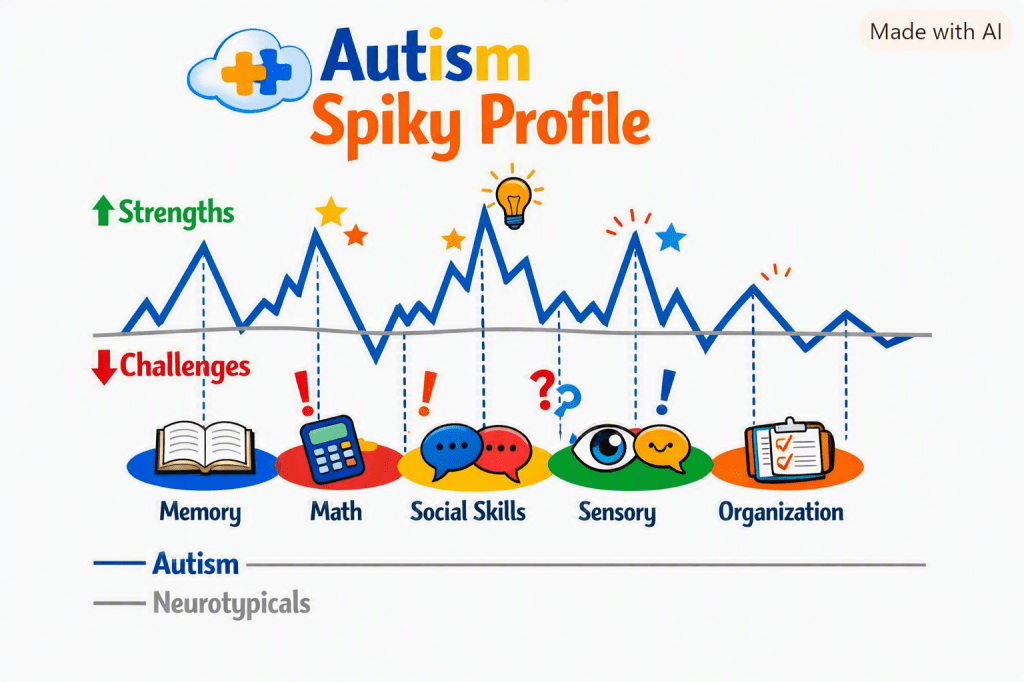
Spiky profiles certainly describe my experience of autism. My memory, my academic skills and reading levels were above average in school, buuuttttt then I would have valleys in my social skills, emotional regulation and fine motor skills. I was hyperlexic going through books faster than my mother could buy them, and yet I couldn’t tie my shoelaces- there was no in-between! A classic spiky profile.
Now you might wonder why these spiky profiles matter. It explains skill patterns, but what value does it actually bring?
It helps us to better understand that autists may have significant gaps in their skillset. Spiky profiles can hide support needs as high achievement in one area can give a false impression of the autists needs. If you’re really good at one thing, it can mislead a teacher to think that you just aren’t applying yourself in other areas, which may deny students support in their areas of need. Moreover, standardized testing and IQ scores will often average out these peaks and valleys which further gives a false impression of an autists daily needs.

In my case, no one ever picked up on my social valleys in school as my academic peaks distracted from them. It put all the onus back on me that I wasn’t trying hard enough with knitting, or that I was deliberately doing things socially that didn’t help myself, so no one figured out that I needed a different tact to support those needs. Teachers needs to be aware of spiky profiles if we are to properly give autists sufficient support as they travel through the education system.
Hope you enjoyed this post dear Earthlings! 🙂
Have a lovely weekend!
Aoife


Should have been more obvious in elementary school where my standardized test scores put me reading at a college sophomore level in 7th grade, math at a high school senior level, but I was failing school because of my abysmal ability to complete homework.
LikeLiked by 1 person