As I mentioned in last weeks post on taste sensitivity, this week we’re going to discuss sensitivity to smell in autism.
As with other senses we have discussed, autists can be either hyposensitive or hypersensitive to odours. One autist may enter a malodorous environment without noticing anything amiss, another autist may wretch, or worse!
As a child, my nose was particularly sensitive to my environment (although judging by how I could taste the beer my friends were drinking yesterday evening from the fumes alone, this may still be the case on occasion 😛 ). Bad smells were especially trying- the smell of salads, fish, cigarette smoke, incense, even something so simple as a bag of popcorn could easily turn my stomach.
But it wasn’t all bad- this sensitivity comes with a heightened appreciation for pleasant smells too 🙂
Baking, chocolate, nice perfumes, the outdoors, the smell of metal (don’t ask me why I love this one so much- must be something to do with my taste in music! 😛 😉 )- in fact, such smells are not only a sensory sensation, but can also be used to help calm an autist.
As easily as an unpleasant smell could unsettle me, the right smell could calm me back down again as a child. I always kept a teddy or a blanket near at hand that I could smell to help soothe and calm me and to lull me off to sleep- I couldn’t sleep without one particular teddy until I was 16!
^^^^My teddy was a lot more raggedy than this…😬
So why does smell affect autists so much?
Interestingly, some studies indicate that there are no differences in sensitivity to smell between autists and their neurotypical peers, however, much research points to the cortex of the brain. This region is heavily involved in smell processing, and yep, you guessed it- the autistic brain shows signs of dysfunction in this region. In fact, the pre-frontal cortex shows signs of overgrowth and excessive linkage in the neurons (just like an overloaded plug), so no wonder sensory perception is altered in autists! This region is also associated with the formation and retrieval of long term memories, which could also explain why smells are often tied to memory recall in autists (which I will explore in more detail at a later stage 🙂 ).
One study also shows that autists may not inhale smells in the same way to their neurotypical peers. Evidence suggests that autists inhale deeply and intensely for both pleasant and unpleasant smells, whereas neurotypicals will tentatively sniff in the presence of an offending odour, which could further explain differences in scent processing.
In addition to this, research suggests that alterations in smell can influence social behaviours. A recent study in fact suggest that autists cannot smell fear and that there is a reversal in their response to fear. In this study, a group of autists were calm when presented with a sample of sweat from a skydiver, whereas their neurotypical peers exhibited classic signs of fear. In contrast, their fear levels increased when presented with the sweat sample from a calm individual!
In other words, an autists social behaviour may be affected by an inability to interpret social cues carried in odours- the mind boggles!
So there we have it dear Earthlings- hope this post didn’t ‘stink’ too badly 😛 😉
As twinkling Christmas lights are rapidly being erected around me, I’ve been thinking a lot about autism and light sensitivity this week.
Light sensitivity, also known as photophobia (although the phobia part has never really made sense to me! 😛 ), is quite common for autists.
We are hypersensitive to other sensory stimuli such as sound, so naturally, light too can cause sensory issues for many autists. The wrong lighting environment can cause a whole host of problems that can exacerbate behavioural issues.
If lighting is too bright, this can distort vision, cause headaches and sleep disturbances, and of course, sensory overload and meltdowns. Equally, some autists can be hypo or under sensitive to light. This can cause issues with depth perception, coordination and clumsiness in addition to blurred vision.
In my experience, I have some minor sensitivities to light. Bright lights don’t bother me as such, but I find that I sometimes need to wear sunglasses to take the edge off of a sunny day- sometimes even on a grey one. There exists many photos of me climbing a mountain in the midst of a rain storm wearing my sunnies without a care in the world!😂
Getting to sleep can also be a minor issue for me if the lighting is wrong- a past trip to Norway during 24 hours of light was an absolute nightmare! (it’s just not right!! 😛 )
So why are we more sensitive to light?
Well, as with many aspects of autism, there has been little research into this particular trait. One study has shown that the pupillary light reflex (the reflex that causes our pupils to either shrink or dilate in response to light) is noticeably different between autists and neurotypicals. Results from this study indicated that this reflex is delayed in autists, where the pupils constricted at a slower velocity and a smaller amplitude (i.e. the maximum size the pupil could constrict to) to neurotypicals. If our pupils are not regulating the entry of light into our eyes as efficiently as our neurotypical peers, this could explain why light can sometimes overwhelm us.
Optic nerve hypoplasia (a condition where the nerve connecting the eyes and the brain is underdeveloped) has also been indicated in a number of cases of autism, with photophobia being one of the main symptoms. So perhaps the development of the optic nerve may be impacted in the autistic brain.
So what can you do to help navigate this sensory issue?
Wear sunglasses– Ah, my best friends! I carry a pair in my handbag at all times as you never know when the sun might unexpectedly peep out- even in Ireland! 😛 For night time, why not try an eye mask (although if you’re as fidgety as I am at night, this could end up on the floor before dawn! 😂)!
Install a dimmer switch– A useful tool to help optimize light levels to suit the individual (and loads of fun to play with! 😉 )
Coloured Filters (overlays or lenses)– These are designed to block specific wavelengths of light which a person may be sensitive to in order to manage visual stress; however, there is no real research to support this claim. But as I always say- if it works for you, give it a try! 🙂
So leading on from my recent post about sound sensitivity and autism, today I’m going to expand a little bit more on the subject.
Fun Fact: Did you know that an estimated 65% of autists are sensitive to sound?
Being sensitive to sound can be quite challenging for those on the spectrum, but that doesn’t mean that it can’t be managed.
So here are some of my top tips for managing sound sensitivity:
Earplugs/Noise Cancelling Headphones- I know, it’s the obvious one, but it has to be said! Using these can really help to take the edge off for many autists in noisy environments. These can be especially helpful if you are a fan of live music, but find gigs too loud- I have genuinely seen people wear noise canceling headphones, earplugs and cotton wool to gigs, you will not be alone! 😀 Added Bonus– it can also discourage unwanted conversations 😉 If you’re in the market for a pair, the nice folks at reviews.com have a really good article comparing the best on the market: https://www.reviews.com/noise-canceling-headphones/
Listen to music– if you don’t appreciate the sound of silence like Simon and Garfunkel, then hooking a set of headphones up to a music player is another great way to manage sound sensitivity. You can control what sounds you will hear, drown out potential triggers and have some fun while doing so! 🙂 This is particularly useful in the workplace to help focus your mind on your work whilst keeping distracting sounds out.
Top tip– headphones for leisure (comfier for long journeys, seal in the sound better, and will stop your parents complaining about the volume 😉 ); earbuds for the workplace (drown out sound whilst still allowing you to hear if you’re needed by colleagues).
Try a silent disco- If sound sensitivity is keeping you from partying the night away in the club, why not go to a silent disco (as seen in the final episode of Atypical)? These are quiet, but loads of fun- and they enable you to control both the volume and choice of music. As an added bonus, you can take off your headphones at any time and have a conversation without the need for shouting 😀
Move away from the offending stimulus– I know it sounds a little silly, but sometimes you just need to take a step away from offending sounds.
We can’t always walk around wearing noise cancelling headphones -they can really irritate your ears if you wear them for too long, especially if you happen to be wearing earrings at the time! 😛
Top Tip- If you’re feeling overwhelmed by an irritating sound, especially on a night out, take a few minutes to go outside or to the bathroom, or try stepping out to the quiet of the smoking area (although this may result in a different kind of sensory assault…)
Ask if an offensive sound can be stopped– Naturally, we can’t go around demanding that someone chew less loudly or ask the DJ to turn the music down (can’t commit social suicide!), but it doesn’t hurt to ask a friend/family member to turn down the car radio volume, not to pop balloons around you or to stop playing with that sonic app that makes your ears bleed (remember people playing with those in school as the teachers could never hear the frequency?)!
Magnesium supplements– Now this one is a little weird. Some people believe that magnesium deficiency attributes to our sensitivity to sound…this smells a bit like pseudoscience to me… but hey- if it works for you, who am I to question it!
So there we have it Earthlings, my top tips for managing sound sensitivity on the spectrum 😀
Have a good weekend everyone (unless you’re back to school next week- in that case, my condolences! 😛 😉 )
Leading on from my previous post on sensory processing, today I’m going to expand a little bit on sound sensitivity.
Many autists have a higher sensitivity to certain volume ranges and frequencies of different sounds. Also known as hyperacusis, this sound sensitivity can make encounters with seemingly innocuous every day noises a struggle.
For many, the wrong sound can even cause physical pain!
Sometimes autists can also be hyposensitive or under sensitive to sound, meaning that they may not react to certain sounds, or may even enjoy noisy environments- which would explain my preference for rock music 😛 😉
Luckily, I am only mildly sensitive to sounds, but I have my moments. Popping balloons, the unexpected blare of a drivers horn, a sudden change in the music I’m listening to- I may overreact to such sounds juuuuuust a teensy bit! 😛
I recently physically jumped at my desk after an unexpected change in the soundtrack to Phantom of the Opera!
Mortified! 😛
Sometimes it’s not just the volume of the noise, but the frequency or how it sounds to me. A person was recently whispering a rosary behind me at mass and the pitch of that whisper nearly drove me insane- inside my head I was silently screaming! 😛
A neurotypical may be able to ignore irritating noises like these, but I just cannot keep from focusing on it- it’s like I can’t concentrate on anything else.
For the most part I can keep my screams on the inside, but if a particular sound persists it can be quite upsetting, especially if I’m already stressed and on edge. A piece of lab equipment that kept backfiring with a giant pop one afternoon triggered a meltdown for example.
But why are our ears really so sensitive?
One study suggests that autists experience stronger autonomic reactions to noise (these are unconscious reactions triggered by the autonomic nervous system which controls a number of bodily functions such as heart rate, respiratory rate and digestion- i.e. “rest and digest”).
Another study, which examined the brains response to different sounds, found that certain areas are hyperactive in children with autism versus their peers. For example, there was increased activity in the Amygdala- an area of the brain associated with social and emotional behaviour, in addition to the cortices which process sensory information.
In other words, the autistic brain has an entirely different physiological response to sound!
So try to bear that in mind the next time you sneak up behind us to whisper in our ears! 😛 😉
Ah, live music! There’s nothing I love more than a decent rock concert!
“But wait- wutt?!
You’re autistic! Surely you can’t enjoy a loud, flashy, crowded rock concert?!”
Plleeeeeeeeeeeeeeease! 😛
What do I always say? No two autists are alike!!!!
Sure, sudden noises can make me jump, but in actual fact I love the noise! I relish the chaos of alternative rock! The vibration of the music through your body, the bright lights, the pyrotechnics, the showmanship- it’s really hard to beat a decent concert.
That being said, my love for gigs has not come without it’s challenges.
At my very first gig (Paramore’s Brand New Eyes tour, 2009), I suffered both a meltdown AND a shutdown! The crowd made me very unsettled and uncomfortable moshing during Paramore’s opening number, so I spent the remainder of the concert on the sidelines crying and alone! 😛 We subsequently almost missed our bus home, the stress from which brought on a shutdown.
Certainly a memorable and eventful night! 😛
Indeed, concerts can be overwhelming for both neurotypical and neurodiverse alike, but that does not mean that a concert can’t be an enjoyable experience. It’s all about finding what works for you 🙂
Here are my tips for finding comfort at a concert:
Outdoor vs indoor venues: This is one that I’m learning the hard way. Outdoor gigs, whilst a little easier on the ears than indoor venues, can be a real mixed bag in terms of enjoyment. Crowds are bigger, snagging a good vantage point can be tricky and security have far less control over crowd behaviour. I spent much of my last gig being kicked in the back by a girl sitting on her boyfriends shoulders. Take my advice- choose indoor gigs for your favourite artists.
Choose seating– After my first “pit” experience, I have made a point of always choosing to pay a few euros more for a decent seat in large arenas. This way you avoid strangers touching you, claustrophobia, tall people, reduce exposure to potentially unpleasant odours (outdoor gigs are a real pain if you hate smoking as I do) and prevent being unexpectedly hit by stray “balloons”, flying glasses of beer and, on one random occasion, black nail varnish! Don’t you just miss the emo kids of the mid noughties? 😛
Alternatively, if you’d rather be closer to the action, smaller venues (< 2000 capacity) generally offer more comfortable standing experiences. Crowds are spaced out more and are better behaved with security always close at hand 🙂
Sunglasses-Not as crazy as it sounds I promise! Sunglasses are my best friend as they really help to take the edge off bright lights. I’ve even been known to wear them on a night out in the club on occasion! Don’t worry about what other people think- it’ll be dark and everyone will be too focused on the stage to notice 🙂
Earplugs– This one may seem a little bit counter productive, but lot’s of people do it. Loud music is part and parcel when it comes to gigs, but sometimes the noise can be a little excessive. Take my most recent concert just last week. I was standing in front of a girl who insisted upon screaming every 5 seconds for 2 and a half hours- not like your average fangirl, but a murder victim (the kind of piercing scream that makes you jump every time you hear it)! Quite frankly, she’s lucky she wasn’t my murder victim! 😜😂 I was rather envious of a nearby concertgoer for having had the sense to bring a pair!
So there we have it, my top tips for managing autism at a gig!
As I always say, you should never allow an autism diagnosis to hold you back- if you can’t climb the mountain, there’s always a way around it 🙂
Ah the cinema- giant screens, surround sound, confectionery counters, reclining chairs; a perfect treat in many respects (until you need to dash for the loo, or eat too much sugar! 😛 ).
But for many people with autism, a trip to the cinema can present a number of sensory challenges- the brightness of the screen and overly loud audio can be quite distracting for example.
In recent years, a number of cinemas have begun to host special sensory screenings for children with autism.
In case you hadn’t noticed from all of the autism on screen posts I write, I’m a bit of a film buff, so naturally when I saw that my local cinema was hosting a sensory screening of ‘Diary of a Wimpy Kid: The Long Haul‘ I had to give it a try! 🙂
For anyone thinking of seeing the film, it’s not as good as the previous ones- the cast change didn’t really work! 😛
So what’s different about a sensory screening?
A sensory screening differs from the average cinema experience in the following ways:
A special sheet of acetate (it reminded me of a giant plastic pocket) appeared to cover the usual backdrop to reduce the screen brightness
There are no trailers (woohoo 😀 !)
Sound levels are reduced
The lights remain on throughout at a dimmed level
This last part was quite nice actually as I did not emerge from the cinema with the usual vampire-esque response to daylight! 😉
So what did I make of the experience?
Well, to be honest it was a little weird for me at first as someone who frequents the cinema quite regularly. I wasn’t expecting the lights to stay on, but you adapt pretty quickly. It was quite a pleasant transition to go from dark to light scenes without feeling blinded! 🙂
This did however, make it a little bit harder to see any of the night-time scenes which I found a tad distracting.
But all in all I found the experience quite nice and would highly recommend it for anyone who struggles with sensory issues 🙂
However, I would have a slight critique to make in the choice of sensory films that are shown. Any films that I have seen advertised as sensory friendly here in Ireland fall into the family friendly/childrens category. While it is brilliant that many children with autism are afforded the opportunity to attend these screenings, we often forget that children with autism grow into adults with autism, adults who may want to watch the latest Marvel or James Bond movie, or a racy rom com in sensory comfort.
Leading on from Friday’s post, I’d like to place the autistic meltdown under the microscope today.
So what exactly is a meltdown?
To an outsider, meltdowns appear like temper tantrums. You see a petulant, naughty child that didn’t get their way. Screaming, throwing things, violent behaviour- it seems like a tantrum, but the reality is very different.
Meltdowns are described as a temporary loss of behavioural control in response to an overwhelming situation or stimulus. This can manifest physically (lashing out, kicking, biting etc.), verbally (shouting, crying, screaming) or both.
So what’s happening in the brain that causes these outbursts?
The human body increases secretion of what are known as stress hormones (e.g. adrenaline, cortisol) in response to a stressful situation. Studies have shown that autists have higher levels of these stress hormones than their neurotypical peers.
When a stressful situation passes, stress hormones should return to normal levels. In the case of autism however, these hormones persist in the body for some time afterwards. The autist is left with residual levels of biological stress which make us more susceptible to stress related outbursts.
Release of stress hormones is controlled by the hypothalamic–pituitary–adrenal axis or HPA axis, a complex interconnecting network that comprises the hypothalamus, the pituitary gland andthe adrenal gland (i.e. HPA). This system controls how the body reacts to stress. Research suggests that this system is hyper-reactive to stress in the case of autism.
In particularly stressful or harmful situations, our bodies enter a heightened state of physiological stress which triggers the “fight or flight” response. High levels of stress hormones such as cortisol and adrenaline increase the release of glucose (to give a burst of energy) and increase blood pressure (to divert blood to the muscles) in order to prepare you to either fight the danger or run away from it.
This response is triggered in the case of a meltdown.
Excessive stress hormone release pushes the brain over the edge. The brain thinks it’s under attack and instructs the body to protect itself at all costs. The autist is in instinctual fight or flight mode at the mercy of their stress hormones.
Meltdowns manifest differently from person to person. When I would meltdown, it appeared as though I were throwing temper tantrums as I stood and fought my corner; other times I would run away from my trigger somewhere quiet. Sometimes I fought and then ran away.
My parents tried everything to get me to control my “tantrums”. Taking away toys, sending me to my room, bribery, guilt, you name it!
Bribery was perhaps one of the more successful tactics they used. My meltdowns were at their worst around the age of 6, so my mother implemented a sticker reward system. If I behaved myself, I got a sticker for the day on the calendar. At the end of the month if I had a full set of stickers I would get a present.
It didn’t really work though…I only managed maybe two months without incident, and I doubt that they were consecutive. I still think fondly of that hard earned Monkees greatest hits tape (such a Hipster child! 😛 ) and Hula Hair Barbie! 😉
Anyone else remember her?
One year, I was even asked to give up losing my temper for lent!!! 😛 I lasted about 4 weeks, had a meltdown and subsequently felt like the worst person in the world for letting Jesus down!
It seemed biology had a different plan- how naive we were! 😛
So what does a meltdown look like for me?
I like to classify the severity of a meltdown on a scale from 1 to 3:
Stage 1: These are very mild and normally pass within a few minutes. Usually these entail getting a little bit overwhelmed and starting to cry unexpectedly- often mid sentence! Think of these moments as opening the steam valve to cool the system 🙂 Maths classes for example triggered many of these mini meltdowns- I wouldn’t understand a concept or problem, get frustrated, aaaannnnd suddenly find myself choking back tears while my exasperated maths teacher attempted to break things down for me (or if this happened mid-homework I’ve been known to throw my book at the wall 😛 ).
Stage 2: This type of meltdown is a little more intense spreading out over several minutes, hours, and if particularly overwhelmed, on and off again over days. A situation, rumination or accumulation of stress tends to set these guys off. If wound particularly tightly, something very simple may tip the scales in this case- “You don’t want to play with me? FINE!” **Core meltdown activated**! Tears flow, your chest gets tighter and breathing can be difficult. This tends for me to be a “feeling” or cathartic stage. You’re in overload and need to feel, think and process the triggers until the storm passes.
TIP: I find that reasoning and music (songs that relate to the emotion or trigger) often work well to calm you and speed up the process. Hugs are also greatly appreciated as deep pressure calms and eases stress 🙂
In this stage I find that shutdowns can also happen, wherein I struggle to speak, think and even act (an experience I’ll delve into further on Friday 🙂 )
Stage 3: Enter the dragon! These are full scale, out of control meltdowns. Fight or flight is triggered and you are working on autopilot. The brain has been pushed too far and launches all out war. These tend to be brief, (gradually abating to a stage 2 meltdown when the adrenaline wears off), but are highly destructive. You can literally say or do anything in this heightened adrenal state. Your mind believes it’s at war and will act accordingly to protect itself. Reason is useless; scolds are futile. The real Aoife is locked outside her brain, banging on the door desperately trying to re-enter the cockpit. I’m aware that I’m out of control and want it all to stop, but am powerless to do so. Nothing can be done but wait until the door is unlocked once more.
TIP: Anger and attempts at restraint are useless in this situation, it only fuels the fire. Remaining as calm as possible until the mist passes is key.
I know these can sound a little scary, but they do decrease in frequency with time and stress management. It takes a significant stressor to trigger a stage 3 for me anymore 🙂 Happy stage 1 meltdown’s, like hearing the Phantom of the Opera overture, can even be quite amusing! 😛 😉
Meltdowns are tricky, but easily managed when you understand them for what they are. In the years leading to my diagnosis, without knowing it, I developed methods to help ease these passing hurricanes. Deep breathing, writing out my emotions, hugging a pillow or giant teddy, talking, and praying, but most importantly music. Music is key for me personally. The melodies, the riffs, but especially the lyrics; they soothe my soul. They verbalize the emotions I’m struggling to identify and process, guiding me safely past the storm 🙂
A meltdown is not a tantrum; it is not attention seeking behaviour; believe me- no one wants it to stop more than I do.
It is a biological response to excessive stress. We have no control over it. Punishments and judgments will only make things worse. Growing up would have been so much easier had my friends, family and (most importantly) I understood this.
Love, support and understanding are critical to meltdown management.
So try not to judge that kid crying hysterically in the corner at a party- there may be far more to it than you realize 🙂
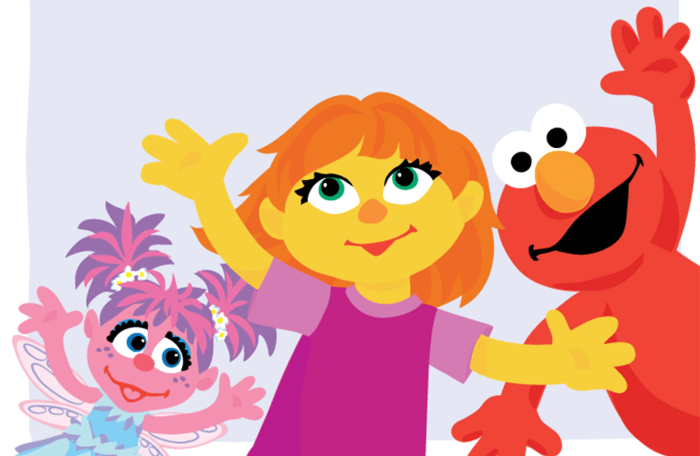
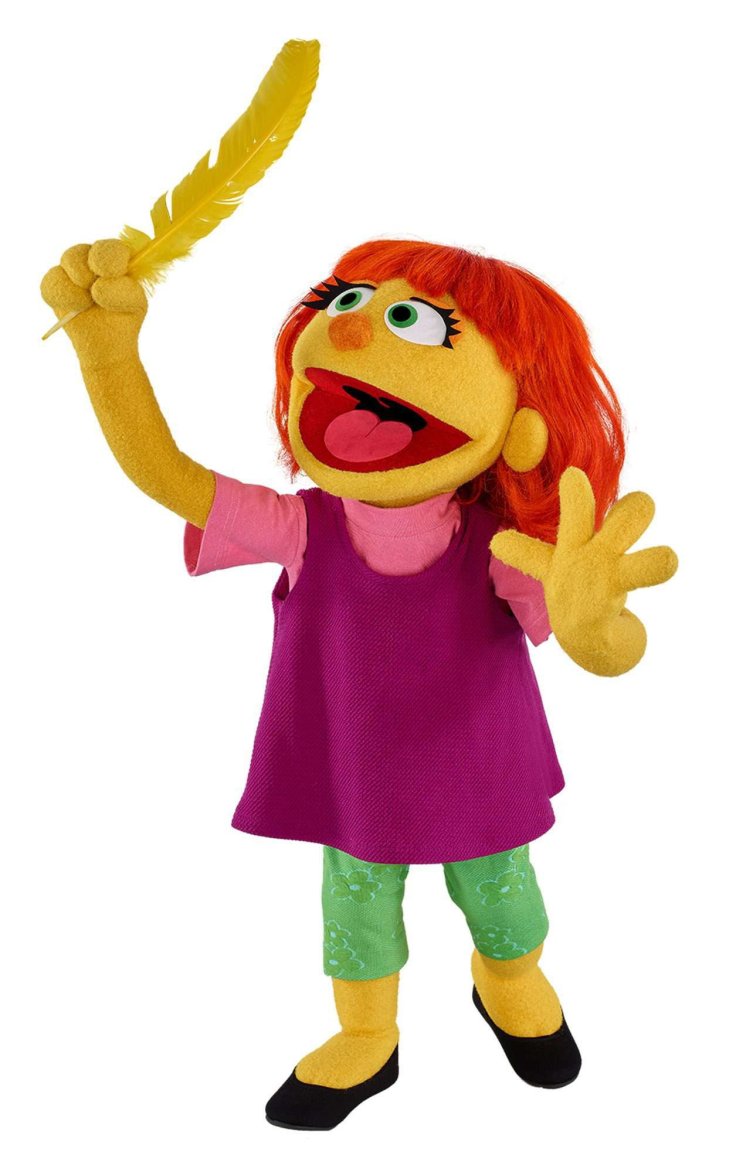
Earlier this week, popular children’s TV show Sesame Street officiallydebuted a new puppet with a twist- a puppet with autism! 😀 The character of Julia was introduced as part of Sesame Street’s autism initiative, first appearing on Monday to rave reviews from fans, experts and parents everywhere.
Whilst only making the news in recent months, Julia has in actual fact been around since 2015, having first appeared in an online storybook about autism as part of ‘Sesame Street’s’ autism initiative- ‘Sesame Street and Autism: See Amazing in All Children’.
The creators of Sesame Street established this initiative in 2015 in order to promote better understanding of the condition after a study revealed that children with autism are more than five times more likely to be bullied than their peers!! This initiative was developed in partnership with autism workers, advocates, parents and autists themselves in order to ensure that the topic is handled in the best possible way.
It’s a nifty little website providing videos for kids, videos for parents, daily routine cards and loads of other useful materials for children and adults alike 🙂
So what is Julia actually like?
Julia first appears onscreen quietly painting with her friends Elmo, the fairy Abby Cadabby and Alan. When Big Bird comes on the scene, Julia largely ignores him, completely engrossed in her painting. The other puppets are engaging in finger painting, but Julia makes noises of disgust and uses a paintbrush instead, with Abby remarking that Julia hates the feeling of paint on her fingers.
With their paintings finished, Abby gives Julia’s painting huge praise (it was easily better than Abby and Elmo’s efforts), remarking that she is very creative- casually demonstrating the talents that autists possess without veering into savant stereotypes. Big Bird tries to hive five Julia for her efforts, but still she ignores him, making no eye contact. When Julia hops off to play tag with the other puppets, Big Bird questions whether Julia likes him or not. This leads Alan to explain autism to Big Bird so that he understands that Julia does things a little differently, “in a Julia sort of way“- but she’s also lots of fun! 🙂
Later in the episode, Julia hears nearby sirens and covers her ears in response to the noise, needing to go somewhere quiet for a bit, subtly demonstrating how an autist can struggle with sensory sensitivity. Julia also carries around Fluster, a rabbit toy which she strokes to help her calm down, showing the audience ‘stimming’ in action.
The primary focus of this segment is to demonstrate that although Julia has autism, she can play and be your friend just like everyone else. After Big Bird remarks that Julia is not like any friend he’s ever had before, Elmo and Abby point out that none of them are exactly the same, bird, monster, fairy- they are all different, but are friends regardless. Julia talks a little differently, repeats sentences, flaps her arms when she gets excited- but she’s just another playmate, however different, at the end of the day 🙂
You can watch Julia’s debut in full in the video below 🙂 :
My school life would have been so much easier had other children been better able to understand and accept me as the other puppets accept Julia, but with initiatives like this at work I have great hope for the next generation 🙂
This episode was handled both sensitively and intelligently to provide children everywhere with an insight into autism. All behaviours are explained, little is left for the audience to guess at. Julia is different to the other puppets yes, but the episode normalizes her differences so that when children encounter real people like Julia, they will be treated with acceptance and understanding 🙂
Here’s a behind the scenes look at how the character was brought to life:
Fun Fact: Julia’s puppeteer (who can be seen in this video thumbnail) is a mother to an autistic son in reality!
This was a pleasure to watch and I look forward to seeing all of Julia’s future adventures in the show! 🙂
Today I’m going to talk about something that you may not be aware of in relation to autism- the issue of texture sensitivity.
During my assessment, I was asked by the psychologist if I had any issues with textures. Caught off guard (as I was unwittingly hoodwinked into attending the assessment 😛 ), I quickly answered no, only to realize hours later that in actual fact, textures influence my life hugely!
In all previous conversations about autism, I had never heard anything about textures, but these are in actual fact a common source of sensitivity for autists.
Rough seat belts, itchy labels and materials, even bras can be extremely irritating to the hypersensitive autist.
There was absolute war between my mother and I when I would refuse to wear a bra as a child! The sensation of the garment against my skin weirded me out and I found it extremely uncomfortable. I would even try wearing it over my thermal vest to place a barrier between me and it, buuuut it didn’t very work well…I was constantly fidgeting! 😛
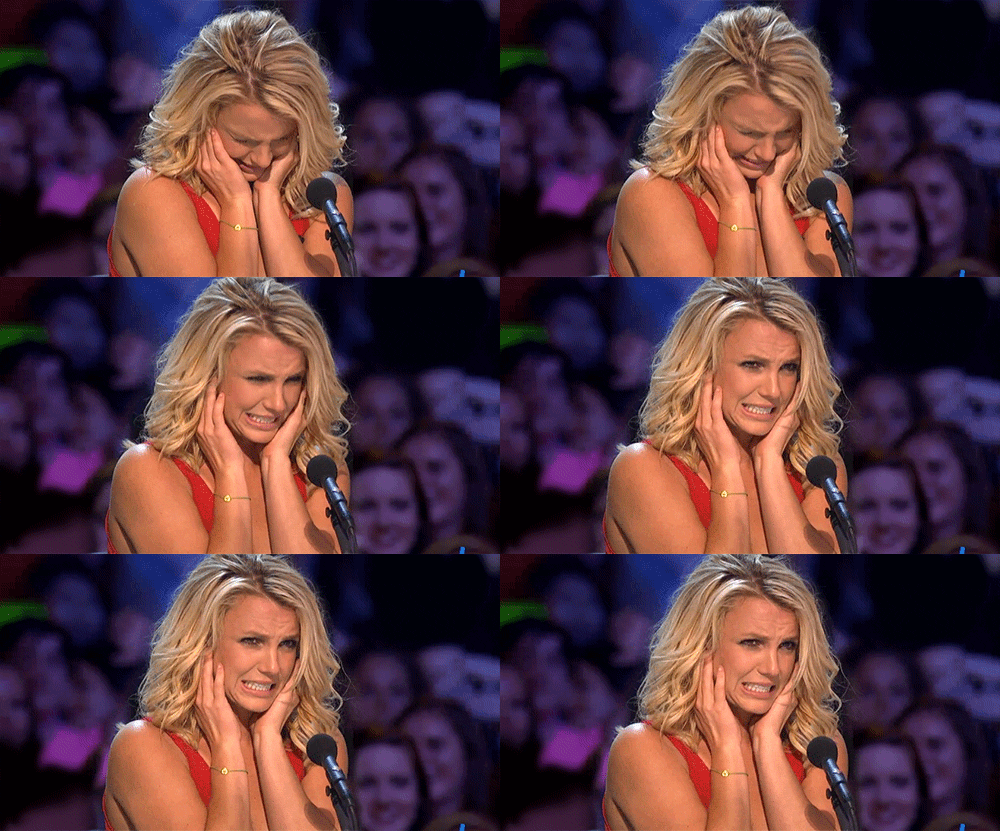
Weird textures completely freak me out- cornflour (a particular pet peeve), some fruits and veg, yogurts (or most foods) with lumps in them and nail files to name but a few.
Encounters with such textures can lead to reactions like these…:
(Fun fact about me- I genuinely shake my head like a dog when I shudder! 😛 )
It’s not all negative though- you can learn to adapt and condition yourself to stimuli 🙂 I never drank a glass of water until I was 11 years old as it felt really weird to me compared with other more flavorful drinks. I gradually conditioned myself to it by taking one gulp water followed by one gulp juice (my family found this hilarious 😛 ) until the glass was empty- I now drink pints of water daily without issue! 🙂
Pleasant textures on the other hand pose an entirely different sensory experience, lighting up my brain like a Christmas tree! 🙂
The creamy texture of ice cream or chocolate melting in my mouth, the strangely irresistible and soothing feel of metal against my skin or the drug-like euphoria that comes from stroking a fluffy puppy-sheer bliss! 🙂
As my sister remarked as I was writing this piece, it’s easier to list the textures that I do like than those I don’t! 🙂 😉
So what’s the scientific reason for this sensitivity?
As we have discussed in previous posts (Autism 101-Sensory Processing;Discussion-Trust, Intimacy and Sexuality), people with autism are hypersensitive to the sensation of touch. Dysfunctions in brain areas involved in sensory integration, in addition to hyper-connected and hyper-excitable neurons within the autistic brain, can greatly influence our responses to texture.
MRI studies of autistic brains also suggest that there is an exaggerated response to unpleasant stimuli in particular within the limbic system- a set of structures involved in such processes as emotions, behaviours and motivation.
It may seem like we’re consciously overreacting to certain textures, but our response is entirely neurological- so try to keep that in mind next time you see us pull a weird face after encountering an unpleasant texture! 😛 😉
In the next part of my autism on screen series, I’m going to explore the portrayal of autism in the Indian drama film ‘My Name Is Khan‘ (2010).
A dual Hindi and English language film, ‘My Name Is Khan‘ follows Rizwan Khan, a Muslim man with Asperger’s syndrome, who set’s out on a journey across America to tell the president that he is not a terrorist following a sectarian attack on his family in the wake of the events of 9/11.
Check out the trailer below! 🙂
So how does this film measure up in it’s portrayal of the realities of AS?
The film opens with a disclaimer stating that the film makers have endeavored to depict AS as authentically and sensitively as possible, however, as this is a work of fiction, they acknowledge that certain creative liberties were taken in the portrayal of autism- so as with ‘Rain Man‘, take the film with a grain of salt!
That being said, I found this film to be generally quite accurate from a symptomatic perspective. Granted, Khan appears slightly weirder than the average person with AS and many of his symptoms are exaggerated, but overall I felt that this was a solid onscreen portrayal of autism.
In particular I felt that this film gave a good representation of repetitive behaviors and sensory sensitivity.
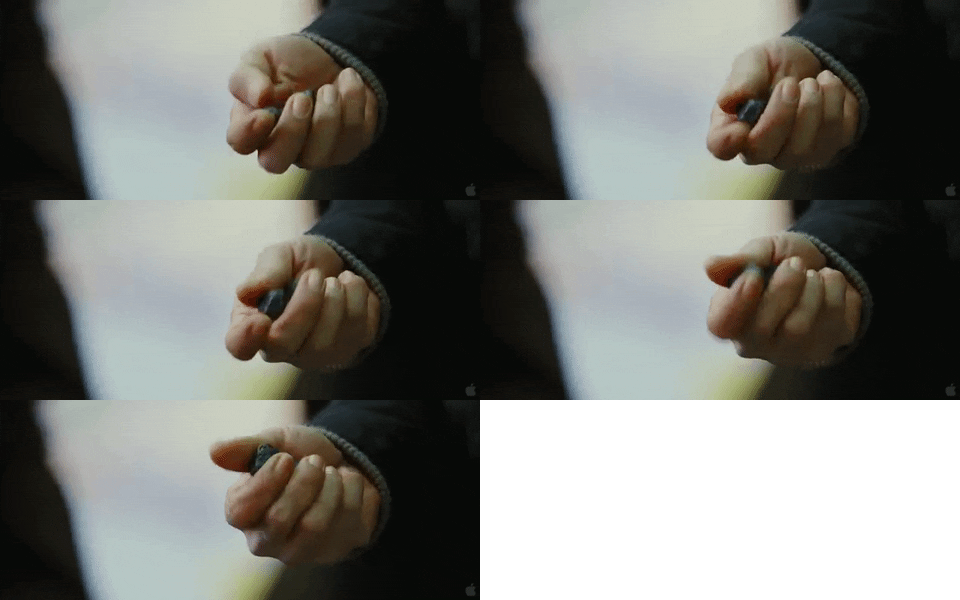
Throughout the film, Khan can be seen fiddling with some stones in a repetitive manner.
I may not carry stones around with me, but I am constantly fiddling with my jewelry in a similar manner. It’s a compulsive action- I have this constant need to reach out and feel my chain between my fingers. There’s something incredibly soothing about the motion, especially when you’re particularly stressed. Actions such as these are referred to as stimming or self stimulation. I’ll dedicate a post to stimming at another stage 🙂
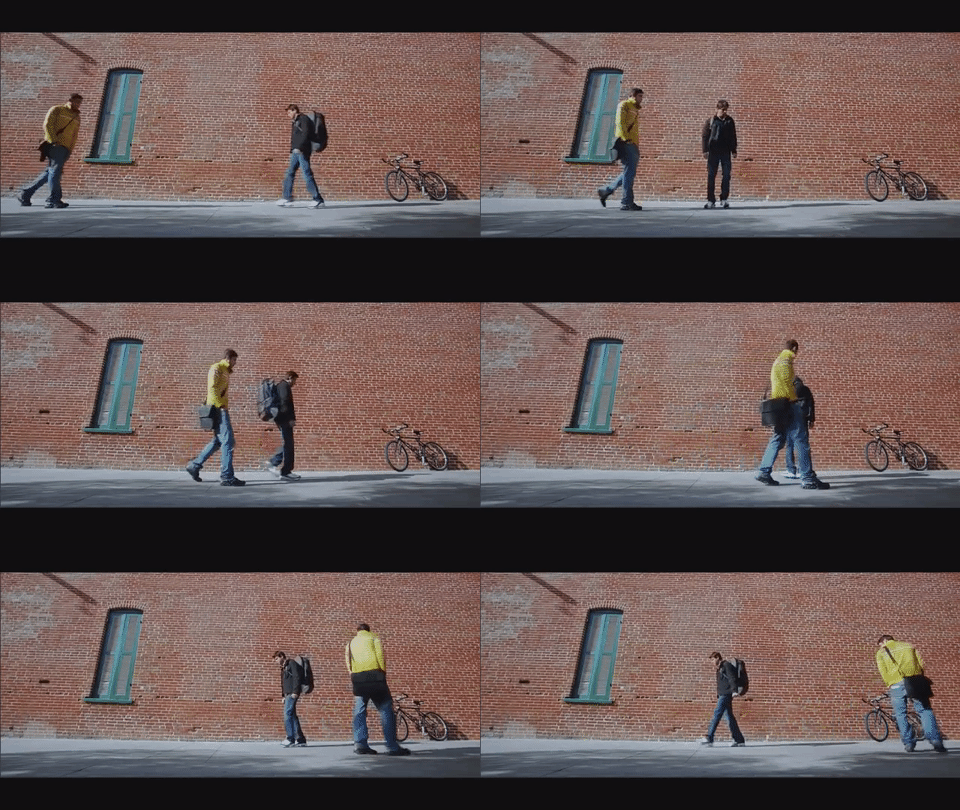
As regards sensory sensitivity, I thought that the film presented more of a normalized and subtle reaction to sensory stimuli than most films featuring autism, particularly in relation to Khan’s sensitivity to the colour yellow (there’s a particularly funny moment where he changes direction on the street to avoid looking at someone wearing a yellow top!).
When I first watched this film, I thought that this had to be an exaggeration, but in actual fact, as I mentioned in the last post, boys with autism really struggle to process the colour yellow! Scientists think that this may result from a sensitivity to luminance in autists. Alternatively this may occur as yellow is one of the most heavily sensory loaded colours, as it engages multiple colour detection cells (called cones) in the eye.
Comparing this film to ‘Rain Man‘, there is quite a difference in how autism is portrayed. There was a far greater focus on everything that is good about Khan rather than areas of disability in his life, which can often be exploited in film for dramatic effect. Unlike ‘Rain Man‘, modern films about autism, such as this, have the added benefit of over twenty years of research and observation of the autistic condition, leading to more accurate depictions/attitudes to difference on screen.
Unfortunately however, Khan is depicted as quite intelligent (even called a genius), with superb memory and a savant-like ability to fix any mechanical item known to man, further promoting the stereotype of the autistic savant. These traits however, are somewhat muted in comparison to ‘Rain Man‘, giving a slightly more realistic portrayal of autism.
So there we are- hope you all enjoyed this piece 🙂 I would highly encourage you all to watch this film at some stage. Autism aside, this is an amazing film- one of the best I’ve seen in a long time! In the latter half of the film, you start to forget that Khan is in any way different, finding yourself swept up in this powerful story of love, loss and acceptance. Having watched only the trailer to re-jog my memory, I really want to see this film again myself! 😀







 If you’re in the market for a pair, the nice folks at reviews.com have a really good article comparing the best on the market:












 A Is For Aoife Not Autism