Greetings Earthlings! 🙂
This week I’d like to talk about something rather unexpected-the first autistic Babie doll! 😀
I know what you’re thinking, Aoife, how can you make a Barbie look autistic? Well the folks at Mattel have certainly given it a try!
As part of their efforts to make Barbie more accessible to every child, Mattel collaborated with the Autistic Self Advocacy Network (ASAN) to make a doll that would allow autistic children to see something of themselves in Barbie.
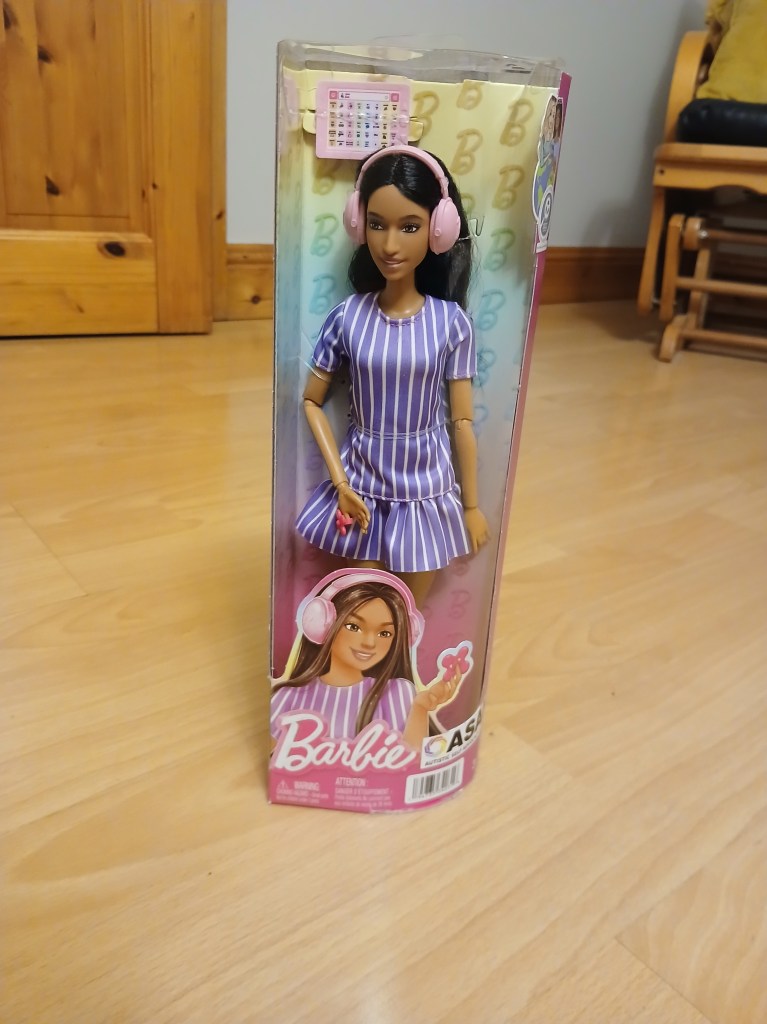
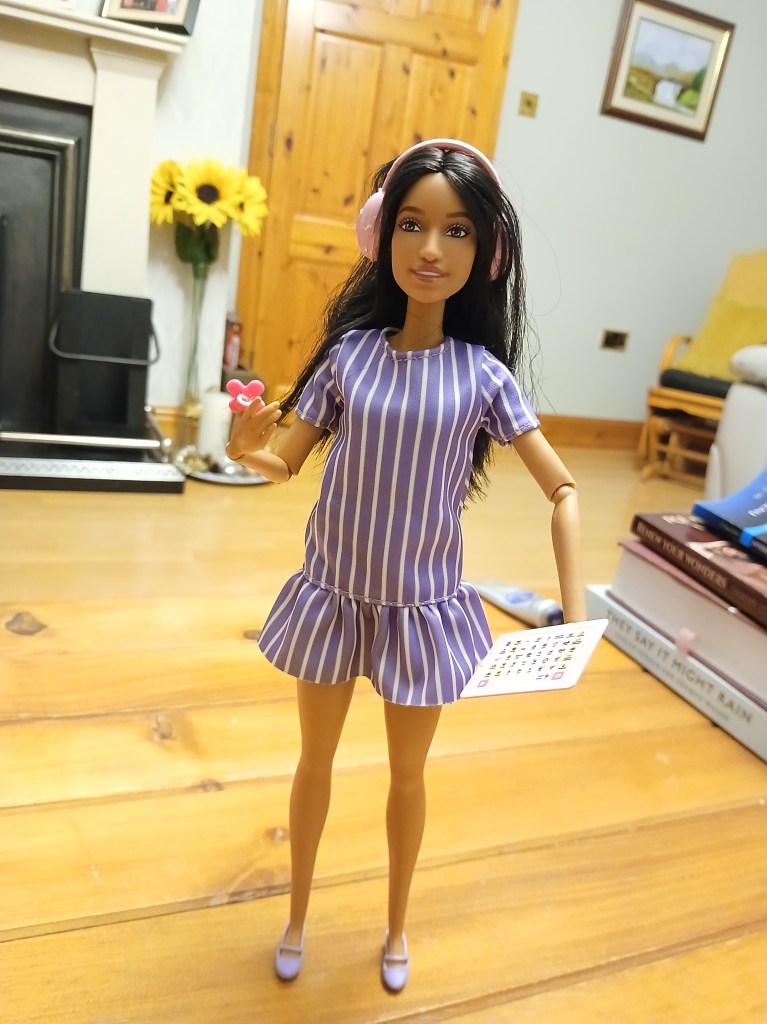
So what’s unique about autistic Barbie?
- She wears noise cancelling headphones, loose clothing (with no labels) and a spinnable fidget ring
- Carries an augmented and alternative communication (AAC) application that speaks aloud when buttons are pressed (kind of like the rapid prompting method)
- She has a sideways gaze indicating that she doesn’t make direct eye contact (it’s very subtle)
- Has flat feet and does not wear heels unlike OG Barbie (which is accurate given issues with gait and coordination)
- Has bendable elbows and hands allowing you to make the doll stim during playtime. Her finger positions are also atypical as if her hands are about to stim.
- Side observation- the way you can bend her hands and arms around is a little unnatural. While this is probably a coincidence, it is accurate as many autists do have hypermobile joints
You can check out a video about the new Barbie here:
The response from the autistic community has been polarizing. Some are thrilled to see such representation in a doll, some see it is a money grab given that autism is in fashion, while others think it’s an insult when what we really need is more investment in support services. In particular there have been a lot of concerns about how this doll misrepresents autistic women, especially given how many issues there have been with visibility.
Autistic psychologist Dr Kristyn Sommer has said: “I had hoped this Barbie was not going to be labelled autistic because it is every single stereotype of what is a palatable autistic girl and that isn’t true representation or visibility for autistic girls. It’s making them fit into a neuro-normative box yet again while simultaneously destroying one of the few safe spaces they have to just be themselves — their own imaginative world with their (already) autistic Barbies.“
But what did I think of autistic Barbie?
Personally, while the concept is great in theory, I didn’t really see the point of the doll and felt it was a little bit of a gimmicky, woke move by Mattel. Physically, autists don’t look any different to neurotypical Barbie, so I don’t really see the visibility issue that you would have with size, skin tone, or wheelchair users. Granted, I was not diagnosed until adulthood so autism wasn’t on the radar back when I played with Barbie, but were I a child today, I don’t think I would have seen a need for the doll either.
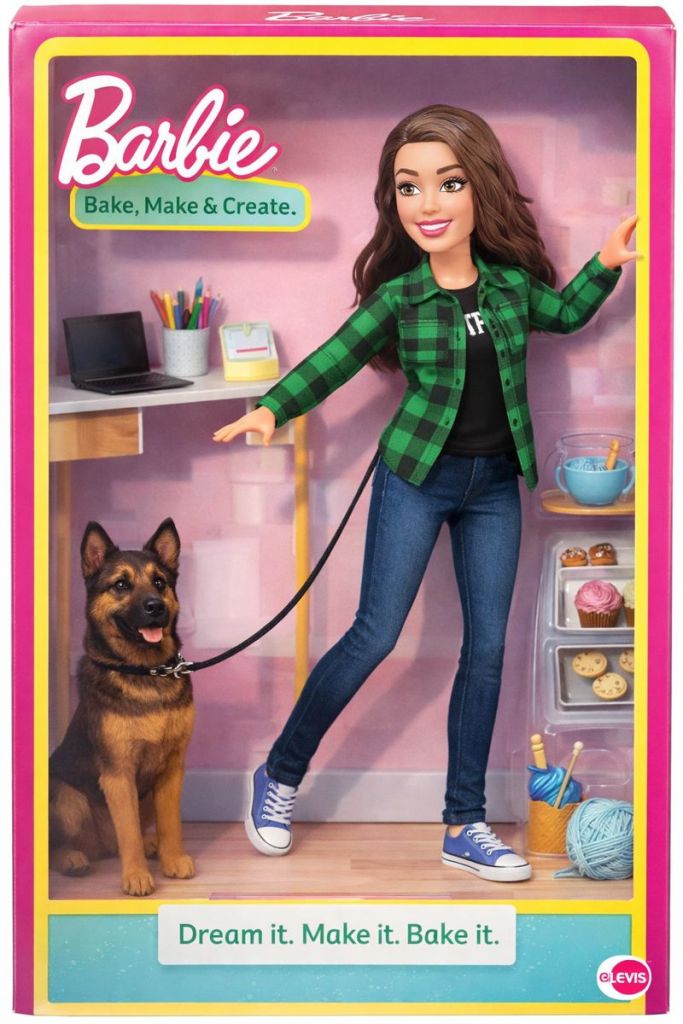
On another level, I worry that while Barbie is striving for diversity after years of stereotyping, I agree with the community that this doll may inadvertently perpetuate autistic stereotypes. I for one do not require ear defenders, don’t need a communication device nor do I tend to favour loose clothing (I’m quite fond of skinny jeans). Whilst there are indeed many autists who do fit Barbie’s description, it does further promote autistic stereotypes that are not relevant for higher functioning autists, especially women. We don’t fit into a box like Barbie, we would need a range of different autistic Barbie’s like the creative autist, animal whisperer or nerdcore Barbie. For example ChatGPT thinks the Aoife Barbie would probably look a little something like this:
I also found that the packaging wasn’t the most autism friendly. It was very fiddly and I ended up accidentally cutting off some of her hair trying to get the plastic tags off 🙈It’s really not practical to put those thin plastic tags that they use to put price tags on clothes into a Barbie’s head, I had to push the remnants into her skull I couldn’t completely get them off. I do not remember it being this hard to unbox a Barbie back in the 90’s! 🤣
All in all, while I’m not the biggest fan of the concept, it was a lot of fun to return to my childhood for a while- athough I must say, I don’t remember Barbie being so tall, or having walkable legs. Making her hop was half the fun!
Hope you enjoyed this post dear Earthlings!
Have a lovely weekend! 🙂
Aoife



 A Is For Aoife Not Autism