Greetings Earthlings! 🙂
Leading on from my previous post about autism and ADHD, this week I’d like to expand on the topic by discussing the concept of AuDHD- aka autism + ADHD.
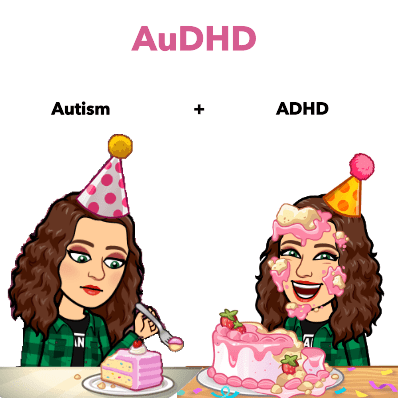
ADHD has been getting a lot of online attention in the last couple of years with many adults getting late life diagnoses as knowledge of the condition has advanced. Up to 10 years ago, it was thought that both autism and ADHD were completely separate diagnoses with no overlap. Now, it’s thought that 30-80% of autists also have ADHD, with many discovering they had autism during an ADHD diagnosis and vice versa.
When I previously wrote about this topic, I estimated that I was mildly ADHD, but the more stories I have been hearing about the experiences of female ADHDers, I exhibit a lot more traits than I originally thought. Because I wasn’t fitting the classic impulsive/hyperactive model of ADHD, I never thought to dig much deeper, buuutttttt, just like autism, it turns out that there are differences in symptoms between men and women. The original research observed more men than women (there’s a whole history of women being under researched in medicine) and so it was believed to impact more males than females, but, as with autism, sex differences and masking behaviours have made it very difficult to diagnose ADHD in women. ADHD also operates on a severity spectrum which can make it difficult to pick up on.
With all this overlap, enter the concept of AuDHD.
One of the most fascinating aspects of AuDHD is it’s paradoxical nature:
- Autists like routine, but ADHD makes it difficult to maintain
- ADHDers crave stimulation, but autists get easily overstimulated
- Autists are rigid with rules, timekeeping and planning, but ADHDers suffer from time-blindness, impulsivity and hyperactivity making it difficult to follow plans and rules
- ADHDers can be messy and chaotic, but autists like order and systemising
Effectively in AuDHD, the paradoxes can camouflage each other, making it much harder to diagnose either disorder. It’s like having 2 different brains fighting for control, but only one or the other will win out at any given time. For example, today you might do a weeks worth of work, tomorrow you might struggle to find the dopamine to do anything.
At other times, the symptoms are symbiotic. For example in my case, I can have complete time-blindness when I’m in the middle of something, but if I need to keep an appointment, the social rules governing lateness force me to be on time. AuDHD is a constant seesaw between the two conditions, a separate presentation in itself.
While it’s not a separate diagnosis yet, given the prevalence of comorbidity, who knows what the future will hold as neurodivergent research increases.
Hope you liked this post dear Earthlings! 🙂
Have a lovely weekend!
Aoife





















 A Is For Aoife Not Autism