Autism- Are We Making Excuses?

Greetings Earthlings,

So today, my title is a little bit different, but I’ve been musing on this question a lot of late- are we making excuses for autists?

hmm

Don’t get me wrong, I’m the first person to advocate the need for understanding and acceptance for those of us on the spectrum- but there is a fine line between making exceptions and making excuses.

I have seen people that were given all of the support and understanding that I grew up without, and yet they do not seem to function as well as I do. Granted there are varying levels of need and functionality within the community, but one has to wonder if excuses have been made. Certainly teachers have told me about spectrum kids where parents have insisted that their child is “not able” for various school activities.

If raised in a protective autism friendly bubble, what happens when your supports go away in adulthood? How can you cope in the real world if people have spent your whole life excusing your behaviour?

Tells a stranger they look like a troll- “He has Asperger’s!”

Struggles with a maths problem- “She’s not able, she’s autistic!”

Throws a plate in a restaurant- “I can’t help it, I’m on the spectrum!”

If you tried anything like that last one as an adult you would be arrested not excused!

police.png

Yes being autistic is a challenge, yes we can’t always control impulses, meltdowns or our tongues, but it doesn’t mean that we can’t improve. If we are never called out on our behaviour, we will continue to think that it’s ok to tell people that they look like a troll for example, and one day we will say it to the wrong person- bye bye friend, or job opportunity; maybe even hello fist!

I know it’s not easy to scold an autistic child, we don’t understand how or why we’re in trouble, or even what we did wrong sometimes- which often triggered meltdowns for me growing up; but here are some tips on how to approach this situation:

  • Reassure them that they are not in trouble- This can be critical. As you know, we autists are black and white thinkers. We see the world in good and bad. If something we do is bad, then we perceive our whole selves to be bad. Our brains struggle to handle anything less than perfection- and we all know what happens when our brains can’t handle something! #meltdownalert

Image result for there there gif

  • Explain why the behaviour was bad- The key here is to not excuse the behaviour, but to explain it to us. If we understand why, then we are far less likely to be overwhelmed. “You’re not in trouble Aoife, but it’s not nice to….because… So try to remember that next time ok?
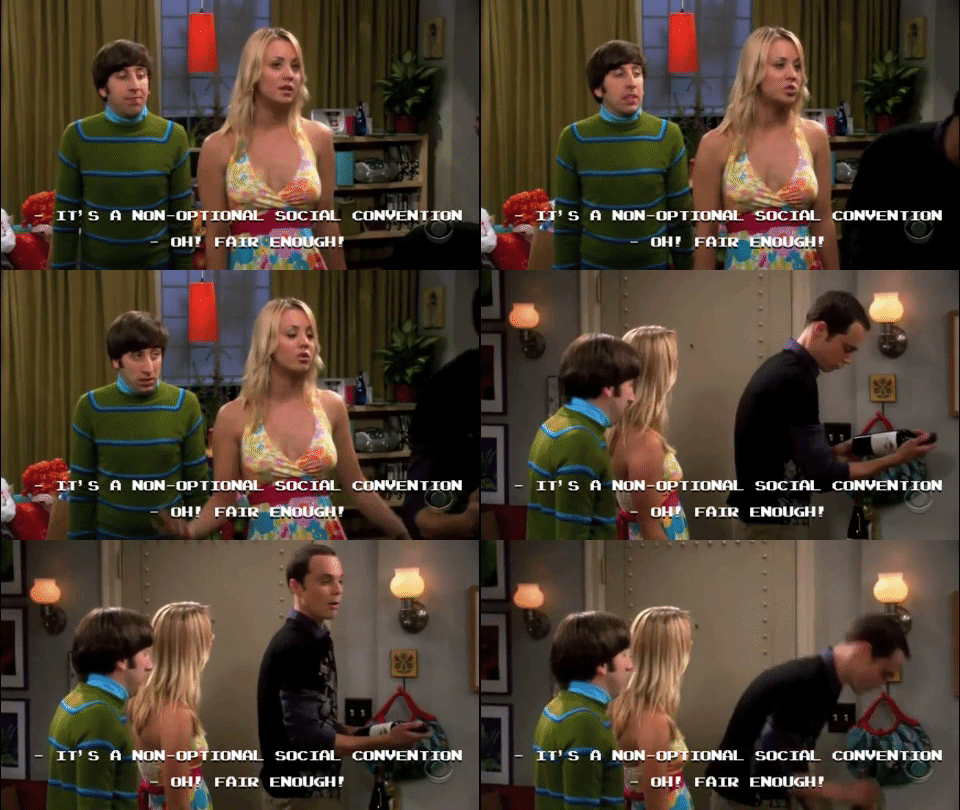
  • Create Rules– Rules are essential to modifying our behaviours. We live our lives by them, and yet when it comes to social rules we just don’t have a clue! If you create some for us however, we will be all the better for it 🙂  penny big bang theory sheldon autism aspergers GIF
  • Use reward systems to encourage positive behaviours- As I’ve discussed previously, my mother found it particularly effective to use rewards to encourage me towards better habits such as studying and holding my temper

I’m not saying that we autists need to conform and be “normal” (as I always say- it’s overrated!), but for our own sakes, we cannot make excuses for every single autistic behaviour. So try new things, fall off that bike a dozen times or tackle that equation.  If we automatically say that we “can’t”- then we will never reach our potential.

We may get it wrong, but oh, what if we succeed? 🙂

Aoife

Repetitive Behaviours- Skin Picking

Greetings Earthlings! 🙂

Today I’m going to give you an insight into a particular form of repetitive behaviour- skin picking.

Related image

Ok- I know it sounds disgusting, but it is common for those with autism! The statistics are limited, but as many as 14.8% of autists exhibit this type of behaviour.

Skin picking, also known as neurotic excoriation or dermatotillomania  (I really do like the sound of these terms! 😀 ), is characterized by excessive rubbing, scratching, digging, squeezing and gouging of healthy skin. In chronic cases, the urge to pick and scratch can lead to scarring, tissue damage and infection.

If I were you though I probably wouldn’t look the condition up…some of the pictures of these chronic cases are disgusting!

In my own experience, I have a mild tendency towards skin picking. I prod and poke at bites and burns, pick at cuts and scabs etc., but squeezing my skin would be my biggest issue- I find it so addictive and it can be quite hard to stop! I also have a particular tendency to press hard against injured skin, like pinching an infected finger or pressing a sore toe against a hard surface- for some odd reason I find it comforting! It hurts, but I feel better about the injury after doing it. I suppose it must link back to the calming sensation of deep pressure stimulation or something!

bitmoji551804739

Now before we call the men in the white coats, let’s see if there’s a physiological reason for all of this! 😛

Research suggests that the dopamine pathway may play a particular role in this behaviour.

Dopamine is involved in reward motivated behaviours in the brain. Drugs such as cocaine and methamphetamine activate dopamine, which is thought to contribute to the sensation of skin crawling and subsequent picking often experienced by addicts. So experts believe that dopamine dysfunction may be at play in this behaviour.

As I’ve discussed in other posts (sleep, ADHD, curiosity, inside the autistic brain etc.) dopamine is often dysregulated in the case of autism, so it stands to reason that this neurotransmitter may play an important role in skin picking behaviour in ASD’s.

Other experts point to a psychological reason for the behaviour as there is a strong link between skin picking and co-morbid psychiatric diseases. Skin picking is thought to act as a form of  communication in times of stress in the case of autism and is believed by some to act as a sensory outlet for sensory stimulation and or soothing.

Furthermore, as I’ve previously discussed, we autists tend to have more sensitive skin than the average person, this too could influence our tendency towards picking and scratching our skin.

Ah- so I’m not crazy after all! 😉

bitmoji-560727177.png

But is there anything we can do to manage it?

Dermatologists and physicians find this one particularly difficult to treat and often seek drug and behavioural interventions to counter skin picking.

For me personally, this is difficult to advise as the reasons for picking differ from person to person, annnnnnd I tend to indulge the behaviour rather than avoid it 😛

However, I have been making conscious attempts to reduce the frequency in recent years to help protect my skin, and to avoid looking like a weirdo in public! Don’t want people thinking I have fleas if I persistently keep scratching myself!

Image result for dog scratching gif

The best advice that I can give is to keep your hands busy- if they’re occupied, you won’t pick! Gaming and crafting I find can be useful to keep my hands from wandering 🙂

So there we are Earthlings! 🙂 Hope I didn’t disgust you all with this post! 😛

Enjoy the weekend everyone! 🙂

Aoife


Autism Management- Concerts

Greetings Earthlings! 🙂

Ah, live music! There’s nothing I love more than a decent rock concert!

“But wait- wutt?! 

You’re autistic! Surely you can’t enjoy a loud, flashy, crowded rock concert?!”

Image result for wrongo gif

Plleeeeeeeeeeeeeeease! 😛

What do I always say? No two autists are alike!!!!

Sure, sudden noises can make me jump, but in actual fact I love the noise! I relish the chaos of alternative rock! The vibration of the music through your body, the bright lights, the pyrotechnics, the showmanship- it’s really hard to beat a decent concert.

That being said, my love for gigs has not come without it’s challenges.

At my very first gig (Paramore’s Brand New Eyes tour, 2009), I suffered both a meltdown AND a shutdown! The crowd made me very unsettled and uncomfortable moshing during Paramore’s opening number, so I spent the remainder of the concert on the sidelines crying and alone! 😛 We subsequently almost missed our bus home, the stress from which brought on a shutdown.

Certainly a memorable and eventful night! 😛

Indeed, concerts can be overwhelming for both neurotypical and neurodiverse alike, but that does not mean that a concert can’t be an enjoyable experience. It’s all about finding what works for you 🙂

Here are my tips for finding comfort at a concert:

bitmoji-1572203057

  • Outdoor vs indoor venues: This is one that I’m learning the hard way. Outdoor gigs, whilst a little easier on the ears than indoor venues, can be a real mixed bag in terms of enjoyment. Crowds are bigger, snagging a good vantage point can be tricky and security have far less control over crowd behaviour. I spent much of my last gig being kicked in the back by a girl sitting on her boyfriends shoulders. Take my advice- choose indoor gigs for your favourite artists.
  • Choose seating– After my first “pit” experience, I have made a point of always choosing to pay a few euros more for a decent seat in large arenas. This way you avoid strangers touching you, claustrophobia, tall people, reduce exposure to potentially unpleasant odours (outdoor gigs are a real pain if you hate smoking as I do) and prevent being unexpectedly hit by stray “balloons”, flying glasses of beer and, on one random occasion, black nail varnish! Don’t you just miss the emo kids of the mid noughties? 😛

 emo ryan higa nigahiga how to be emo GIF

Alternatively, if you’d rather be closer to the action, smaller venues (< 2000 capacity) generally offer more comfortable standing experiences. Crowds are spaced out more and are better behaved with security always close at hand 🙂

  • Sunglasses-Not as crazy as it sounds I promise! Sunglasses are my best friend as they really help to take the edge off bright lights. I’ve even been known to wear them on a night out in the club on occasion! Don’t worry about what other people think- it’ll be dark and everyone will be too focused on the stage to notice 🙂
  • Earplugs– This one may seem a little bit counter productive, but lot’s of people do it. Loud music is part and parcel when it comes to gigs, but sometimes the noise can be a little excessive. Take my most recent concert just last week. I was standing in front of a girl who insisted upon screaming every 5 seconds for 2 and a half hours- not like your average fangirl, but a murder victim (the kind of piercing scream that makes you jump every time you hear it)! Quite frankly, she’s lucky she wasn’t my murder victim! 😜😂 I was rather envious of a nearby concertgoer for having had the sense to bring a pair!

So there we have it, my top tips for managing autism at a gig!

As I always say, you should never allow an autism diagnosis to hold you back- if you can’t climb the mountain, there’s always a way around it 🙂

So rock on dear Earthlings! 😉

bitmoji-725899322.png

Aoife

Eye Contact and Autism

Greetings Earthlings! 🙂

Today I’m going to discuss one of the most common autistic traits- difficulty with eye contact. This can be particularly troublesome when it comes to situations such as job interviews where good eye contact is important to success.

Image result for eye contact gif

Growing up, I was often told by my family that I had trouble with eye contact, but I never really noticed much myself until I was older. On some level I knew that making eye contact made me feel uncomfortable, but I never really gave much thought as to the reason. We just sort of assumed that I cast my eyes away for lack of self confidence.

In my experience, making eye contact just feels awkward and weird to me. I’ve never really been able to explain why, it just does.

Image result for eye contact gif

Over the years, at my family’s insistence, I gradually learned to force myself to make eye contact. There are still times when I find eye contact uncomfortable (if I’m mid or teetering on the edge of a meltdown, any attempt to lock eyes goes out the window!), but I’ve found ways to get through it.

Since receiving my diagnosis, I’ve noticed that I seem to have automatically adopted a coping system for making eye contact in close quarters. I make the contact, hold the gaze for an appropriate amount of time, then look away briefly before returning to centre. Other times, I move my gaze around to focus on different group members, breaking the contact just enough to remain comfortable without coming across as weird (I hope 😛 😉 )!

It kind of looks something like this:

eye contact.png

Top Tip: If you feel uncomfortable making eye contact as you’re walking along the street, I find that wearing sunglasses (provided the weather is somewhat appropriate 😉 ) can be a great help 🙂

So what does the scientific community make of our struggles with eye contact?

One study suggests that the reason we avoid eye contact is actually related to how we process visual information. In this study, children with autism were shown images in both the centre and periphery of their vision. In a neurotypical brain, a large portion of the brain’s cortex is dedicated to processing information in the centre of your visual field. In the autistic brain, a larger portion of the cortex was engaged when the image was shown in the child’s peripheral vision.

In other words, we have more neurons dedicated to processing peripheral visual information, hence why direct, central eye contact is often avoided.

We’ve known for a while that autists perceive the world in a unique way, now we know that we actually see the world differently too! 😉

Have a good weekend everyone! 🙂

Aoife

Change to Schedule

Greetings Earthlings! 🙂

Just a quick post to tell you about a temporary change to the blog schedule.

I’m really, really busy at present and can’t dedicate as much time to writing this blog as I would like to. So, for the moment I have to change the schedule to one new blog post a week.

Instead of Mondays and Fridays, I’ll be posting once a week on Friday’s at 8pm.

When my schedule frees up again I’ll reassess the situation and start posting more frequently, but rest assured:

bitmoji727412600.png

Until then Earthlings! 🙂

Aoife

Blog at WordPress.com.

Up ↑