Autism and Textures

Greetings Earthlings! 🙂

Today I’m going to talk about something that you may not be aware of in relation to autism- the issue of texture sensitivity.

During my assessment, I was asked by the psychologist if I had any issues with textures. Caught off guard (as I was unwittingly hoodwinked into attending the assessment 😛 ), I quickly answered no, only to realize hours later that in actual fact, textures influence my life hugely!

In all previous conversations about autism, I had never heard anything about textures, but these are in actual fact a common source of sensitivity for autists.

Rough seat belts, itchy labels and materials, even bras can be extremely irritating to the hypersensitive autist.

There was absolute war between my mother and I when I would refuse to wear a bra as a child! The sensation of the garment against my skin weirded me out and I found it extremely uncomfortable. I would even try wearing it over my thermal vest to place a barrier between me and it, buuuut it didn’t very work well…I was constantly fidgeting! 😛

Weird textures completely freak me out- cornflour (a particular pet peeve), some fruits and veg, yogurts (or most foods) with lumps in them and nail files to name but a few.

Encounters with such textures can lead to reactions like these…:

(Fun fact about me- I genuinely shake my head like a dog when I shudder! 😛 )

It’s not all negative though- you can learn to adapt and condition yourself to stimuli 🙂 I never drank a glass of water until I was 11 years old as it felt really weird to me compared with other more flavorful drinks. I gradually conditioned myself to it by taking one gulp water followed by one gulp juice (my family found this hilarious 😛 ) until the glass was empty- I now drink pints of water daily without issue! 🙂

Pleasant textures on the other hand pose an entirely different sensory experience, lighting up my brain like a Christmas tree! 🙂

The creamy texture of ice cream or chocolate melting in my mouth, the strangely irresistible and soothing feel of metal against my skin or the drug-like euphoria that comes from stroking a fluffy puppy-sheer bliss! 🙂

dfdsfhsae.PNG

As my sister remarked as I was writing this piece, it’s easier to list the textures that I do like than those I don’t! 🙂 😉

So what’s the scientific reason for this sensitivity?

As we have discussed in previous posts (Autism 101-Sensory Processing;Discussion-Trust, Intimacy and Sexuality), people with autism are hypersensitive to the sensation of touch. Dysfunctions in brain areas involved in sensory integration, in addition to hyper-connected and hyper-excitable neurons within the autistic brain, can greatly influence our responses to texture.

MRI studies of autistic brains also suggest that there is an exaggerated response to unpleasant stimuli in particular within the limbic system- a set of structures involved in such processes as emotions, behaviours and motivation.

It may seem like we’re consciously overreacting to certain textures, but our response is entirely neurological- so try to keep that in mind next time you see us pull a weird face after encountering an unpleasant texture! 😛 😉

Image result for nasty taste gif

Have a good week everyone! 🙂

Aoife

Discussion:Women & Autism

Greetings Earthlings! 🙂

Today, I’m going to discuss a very important issue within the autistic community- gender bias and the misdiagnosis of women with autism.

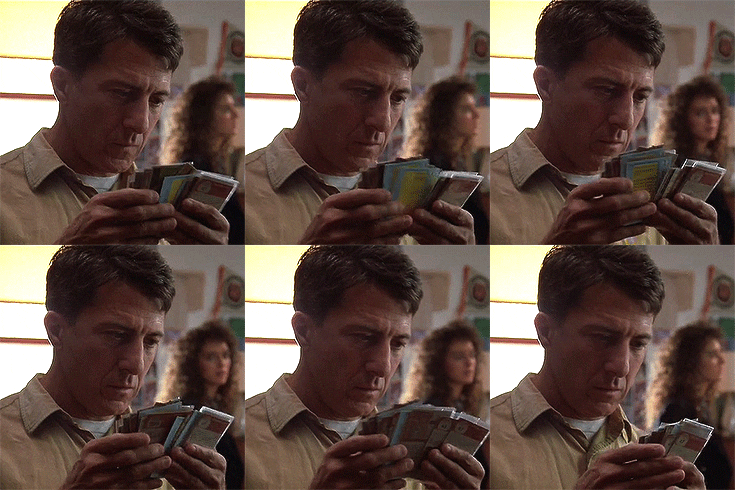
If I asked you to close your eyes and picture a person with autism, the majority of you will have pictured a man (most likely Dustin Hoffman! 😛 ).

Image result for rain man gif

The current ratio for male to female diagnosis of autism is estimated at 4:1 as the condition is thought to be rarer in women; however, many experts now believe that this figure may be as low as 2:1.

So why the discrepancy?

Did you know: Women with autism present differently to males on the spectrum?!

bitmoji169946342.png

Yep- as neurotypical men are from Mars and women from Venus, so too are autistic men and women from entirely different planets (maybe Krypton and Daxam for the DC nerds out there 😉 )!

So how do women with autism differ from men?

For starters, several neurobiological studies have shown distinct anatomical differences between the male and female autistic brain (which I will explore in a separate post at a later stage 🙂 ). Girls with autism are thought to have more active imaginations than boys and participate more in pretend play, often creating elaborate fantasy worlds (I had a particular penchant for this. My sister and I created an elaborate world for our teddies each night, so elaborate that our star couple had their own imaginary portable mansion when we went on holidays!! 😀 ). Reports also indicate that women have lower levels of restrictive and repetitive behaviours than men.

Evidence has also shown that women are better at recognizing emotions than males, almost as well as their neurotypical peers in fact, and demonstrate signs of better attentiveness in social situations.

As a gender, women are more socially inclined than men, and so female autists feel a greater need to make an effort socially. It is expected that women should be more social than men when it comes to communication, and as a result, we are often held to greater social standards. I can’t count how many times a teacher/my mother pulled me aside to advise or chastise me for my social ineptitude! 😛 It was thought that I struggled, not because something was wrong, but that I simply didn’t try hard enough socially. Had I been a boy this would not have been the case.

One of the biggest differences between men and women with autism is the tendency among women towards social mimicry. Girls are particularly adept in masking their symptoms through observation of their peers, obscuring them from the view of parents, teachers and medical professionals.

I’m particularly guilty of doing this. For example, when someone asks ‘How are you?’, I honestly don’t know how to respond! Should I just say fine? Should I reciprocate the sentiment? Should I detail the many ways my life sucks at present?! Three of the simplest words in the English language and I struggle to respond! I eventually developed a mental phrase card in my head for common questions like these so that I would have a standard answer when called for, and 90% of the time you pass for a functioning human being! Other times you get caught off guard and situations like this happen 😛 :

15978097_10209539652072238_4508618477815437814_n.jpg

My life is full of these little social coping mechanisms, which I’ll expand on separately at a later stage 🙂

Finally, as previously discussed, when it comes to specialist interests, female autists tend to have interests resembling those of their neurotypical peers (horses, books, soap operas, boybands etc.), which can additionally hide them from view. Psychologists have also noted a ‘mothering’ tendency among peers of autistic girls, taking autists under their wing and adopting them into a social group. This further creates an illusion of social functioning for teachers, allowing these women to further slip beneath the radar.

As a result of all these differences, women are diagnosed much later than men, (men on average are diagnosed in childhood (~7 years); women as teenagers or adults)  if at all.

But why it it only now that these gender differences are emerging?

Gender bias in autism can trace it’s lineage to the original observations of both Leo Kanner (described autism) and Hans Asperger (described Asperger’s syndrome) in the 1940’s. In Kanner’s work, ‘Autistic Disturbance of Affective Contact’ (1943), Kanner observed a group of 8 boys, but only 3 girls with autism. Hans Asperger on the other hand, exclusively observed groups of boys, believing that AS was uniquely male! As a result, AS was not described in women until the 1990’s!!

whatgif_zps8269bc70.gif

I know!

Consequently, the diagnostic criteria for autism has been largely based on the male model of the condition, and as such, many women like me have slipped under the diagnostic radar.

Due to our inherent talent for social mimicry, women with autism unknowingly find themselves hidden from view. The warning signs that are obvious in males are not always visible, and as a result thousands of women go un-diagnosed, or worse still are misdiagnosed.

Mental health issues such as OCD, eating disorders, ADD, bipolar disorder, anxiety and depression are frequently linked with ASD’s and are particularly prevalent among women.
Experts believe that women with autism tend to internalize their autistic symptoms, leading them to exhibit greater depressive symptoms and experience higher levels of anxiety than male autists.

Women are frequently mis-diagnosed with mental health issues, whilst the underlying root ASD goes unnoticed.

The internet is filled with stories of these women who spent years in mental anguish without receiving the one diagnosis they needed. I recently came across an article where it took “10 years, 14 psychiatrists, 17 medications and 9 diagnoses” before a 21 year old girl got her autism diagnosis! You can read the article here: (https://spectrumnews.org/features/deep-dive/the-lost-girls/).

Researchers and clinicians have in recent years begun to adapt the diagnostic criteria to better serve autistic women, but there is much work still that needs to be done.

Rain Man‘ has dominated for too long- we need now to focus on “Rain Woman”.

bitmoji-1475045929.png

Aoife

Discussion: Love and Romance

Greetings Earthlings! 🙂

In continuation from my previous post, today I’m going to expand a little bit more on the social problems autists experience in romantic situations.

We’ve already explored some science on the subject, so now I’m going to try and clue you in a little bit on what it’s like inside my head 🙂

As a person with autism, my life is often governed by rules- don’t tell lies, never go over the speed limit, don’t put raisins in a scone (a serious crime against cake! 😛 )!

Hence when it comes to socializing, things start to get tricky. Even trickier in matters of the heart. Rules exist when it comes to love, but these rules are in a constant state of flux- and I just can’t seem to keep up! 😛

man trips over ever hurdle dr heckle funny wtf gifs.gif

Social rules are a cornucopia of contradictions- a source of constant frustration for the black and white autistic mind.

Opposite’s attract, but birds of a feather flock together. Absence makes the heart grow fonder, but out of sight is also out of mind. Treat them mean to keep them keen,  but do unto others as you would have them do unto you.

It’s enough to make your brain explode!

j-d-exploding-head-o.gif

The majority of autistic people want to love and be loved as much as anyone else, however, when the goalposts keep moving and the game keeps changing, it can be extremely difficult to navigate the battlefield of love.

Growing up, love always seemed so easy on screen. Boy meets girl, boy asks girl out on a date- both know where they stand and so relationships blossom.

Easy peasy right?

Wrong! 😛

Boy was I in for a shock when I got smacked with the reality stick! I was in no way prepared for the games that teenage boys play with your mind and heart.

Wide eyed and innocent, I believed the boys who said they fancied me, I believed the so called friends who encouraged me- but all along I was being set up for a fall. It was all just a game to mess with the weirdo who’d never been kissed, and I never saw it coming.

bitmoji-959104985.png

In hindsight when I see pictures of my atrocious hair cut at the time, I really should have seen through them! 😛

I was in for an even bigger reality check when it came to night’s out.

People grabbing you on the dance floor, stinking of booze and cigarettes, expecting you to just fall into their arms! Whatever happened to chat up lines, buying someone a drink, or even just learning their name? I struggle with things as innocent as hugs, how was I meant to cope with this invasion of space, not to mention the sensory fallout?!

This wasn’t the path to romance, this was carnage! 😛

If you are one of the lucky few who can get past this awkward stage to forge a real connection, communicating one’s feelings can be a real struggle for an autist. Saying the words ‘I love you’, even to family members, does not come naturally for me. I can tell my dogs I love them a thousand times a day, but ask me to say it to my parents and I freeze. It’s not that I don’t love them, I just can’t seem to get the words out…

Advice for family and significant others (SO): Don’t take this struggle personally. Your child/SO does really care about you, they just struggle to show it 🙂

Psychologists are of the opinion that we don’t see a need to repeatedly tell people that we love them, and hence we don’t say the words. Personally, I’m not sure that I’d agree with this explanation. I do want to say the words, they just won’t come out. In their absence, I’ve learned to do what I can through action to show people I care- a cake or a knitted present say more than I ever could 🙂

When it comes to romantic situations, this struggle for words is multiplied tenfold! With so many conflicting rules about showing affection or revealing your feelings, as with empathy, sometimes it’s easier to stay silent. I weigh up all the options, assess every social rule, turn myself upside down and inside out over my feelings- and then do absolutely NOTHING about it by default! 😛 Painful as it is, sometimes it just feels like the easiest option. There’s no drama, no outright rejections, no awkward moments…but also no requited love! As a result, I’ve landed myself in the friend-zone more times than I can count! 😛

giphy (17).gif

Over the years I’ve become a little more assertive in this regard. I eventually work up some bit of courage to communicate my emotions, but it’s still a real struggle to get there. I frequently undergo these periods of hyper-analysis prior to opening my mouth!

Advice for SO’s/potential SO’s: Be direct and let us know how you feel. We can’t read between the lines, we struggle to comprehend the rules of love and fathom the games- the direct approach is the way to go. The object of your affections may seem aloof, but they might simply not know how to act on their emotions. Just ask them out- their answer may surprise you 🙂

If my future husband happens to be reading this- when you meet me, no games please! 😛 😉

raw (5).gif

Happy Valentine’s Day everyone! 🙂

bitmoji732211657.png

Aoife

Discussion-Trust, Intimacy and Sexuality

Greetings earthlings! 🙂

As we are approaching Valentines Day, I thought it would be interesting to explore the romantic side of autism a little bit.

bitmoji1582252040

When it comes to romance and the spectrum, this is what most people think of:

Prior to my diagnosis, I too would have pictured this scene.

Asexuality, or lack of sexual attraction/interest, is often associated with autism. However, whilst asexuality occurs more frequently in the autistic community compared with the neurotypical population, one size does NOT fit all.

Stereotype Alert!!! The majority of people with autism are not asexual- we want to experience love just as much as the next person!

In fact, studies have shown no marked differences in sexual interests and behaviours when compared with neurotypicals…we’re just a little bit worse at the whole initiation/communication side of relationships! 😛

b0meq.gif

Our social struggles can make it quite difficult to convey our intentions and feelings in romantic situations. As previously discussed (see empathy), we struggle to identify our own emotions to ourselves, let alone convey them to another person!

According to Asperger’s expert Tony Attwood, there is a tendency among adolescents with AS to seek out the relationship advice we are lacking from rather unreliable sources… Males tend to derive their information from pornography, while girls turn to soaps, rom-coms and books, failing to recognize that these works are not reflective of the real world.

You may think that surely we would be able to tell fact from fiction…. buuuutttt, this is a fairly accurate description. I’ve be been burned this way in the past! Let’s just say that I attempted to apply something I read in a book to reality…and it backfired…spectacularly! 😛

In addition to these social struggles, the sensation of touch can also be an issue for many people with autism in romantic entanglements. Studies have shown that gene mutations associated with autism can cause hypersensitivity to the sensation of touch. As a result, we oftentimes shy away from physical contact, which can give the impression of romantic indifference.

Advice for friends, family & significant others: If we brush off your touch, it’s generally nothing personal. Just be patient. We can learn to condition ourselves to touch over time 🙂

In my own experience, trust can be especially important when it comes to physical intimacies.

Thankfully, I’m not particularly sensitive to touch, but I don’t like people I don’t trust having physical contact with me.

For example, contrary to common autism stereotypes, I very much enjoy a nice hug- but only if I trust/feel comfortable around that person.

9-Frozen-quotes.gif

I’ve always felt that hugs are an intimate experience, so for me to hug someone that I don’t like or trust feels wrong. Over time I’ve conditioned myself to accept unwanted hugs to uphold social etiquette, but my heart’s not in the action.

Many people with autism have issues with trust. In a world that doesn’t make sense , it can be very hard to discern what is trustworthy from what is not. Where black and white thinking is concerned, one bad experience can ruin your trust in an instant.

But ruins can be rebuilt- it just takes a little bit of time 🙂


Considering all these challenges that we face in the pursuit of love, might there be any underlying biological factors contributing to our romantic ineptitude?

Few studies have explored sexuality and relationships in autism, however, from my reading of the research one hormone stands out from the crowd- oxytocin.

Oxytocin, also known as the ‘love’ or ‘cuddle’ hormone, has been linked to autism in a number of studies. Research has shown that levels of oxytocin are dysregulated in individuals with autism.

This is basically a fancy science term meaning that our oxytocin levels are out of sync! 😛 😉

Oxytocin is thought to contribute to a human’s ability to effectively socialize. For example, studies correlate oxytocin levels to degree of social functioning where low oxytocin levels are linked with diminished social functioning and high oxytocin concentrations are associated with augmented social functioning.

Evidence suggests that levels are lower in cases of autism, with the lowest concentrations in low functioning forms and higher concentrations in high functioning cases.

Oxytocin is perhaps best known for it’s role in the formation of emotional bonds, as it is released when we cuddle up to or bond socially with a person. Research suggests that it even plays an important role in emotional bonding with man’s best friend, with levels rising in both owner and pet after several minutes of stroking! 🙂

giphy (15).gif

Oxytocin has further been shown to increase trust in humans, so it stands to reason that lower oxytocin levels present in autism can make it harder to trust, interact with and connect with a person romantically.

Moreover, recent studies indicate that oxytocin also plays an important role in the strengthening of negative social memories. It appears that following a stressful social encounter, such as bullying or romantic rejection, oxytocin activates a part of the brain which causes the memory to intensify, promoting anxiety and fear in similar situations.

Seeing as oxytocin is dysregulated, this could also explain why autists find romantic situations difficult. I’ve certainly found that previous failures in this area have made me quite hesitant to reveal my feelings to guys for fear of reliving those moments!

Autism, like love, is truly complicated 😛

In keeping with my Valentine’s theme, I’ll discuss love and the spectrum in greater detail on Monday! 🙂

bitmoji7867777.png

Aoife


Discussion-Neurodiversity

Greetings Earthlings! 🙂

Today I’m going to discuss the movement of neurodiversity within the autistic community.

Originating in the late 1990’s, neurodiversity is a concept which suggests that neurological conditions such as autism, are simply a variation in thinking or wiring, rather than a disease that needs to be cured.

Think of iPhones and Windows Phones- both perform similar functions, but each have different circuitry.

Neurodiversity advocates that neurological differences should be considered a separate social category (such as sexual orientation, gender and ethnicity) and respected as such.

The movement is represented by this symbol:

Autism_spectrum_infinity_awareness_symbol.svg.png

^^^ These colours make my brain happy 🙂 😉

Further to this, neurodiveristy classifies people as being either ‘neurotypcial’ (exhibit “normal” cognitive functioning) or ‘neurodiverse’ (autistic).

In a nutshell- neurodiverse people are wired differently, so we think differently; BUT, this difference is the same as any other genetic variation- like having blue eyes or brown.

You follow? 🙂

raw (9).gif

However, this movement is seen as controversial and problematic in some circles as this broad term covers both low and high functioning forms of autism. It is thought that the concept of neurodiversity is skewed in favour of higher functioning and milder forms of autism.

This is a tricky one, but not necessarily relevant.

Let’s look at the case of Iris Grace, an autistic child artist.

Iris at 7 years old, is world-renowned for her astonishing and mesmerizing paintings, however, Iris has severe autism. Indeed, she struggles greatly with speech and communication, but her paintings are truly the product of a gifted and neurodiverse mind.

You can see Iris in action below:

Neurodiversity is central to one of the biggest discussions in the autistic community- the search for a cure.

Now if we consider neurodiversity to be a regular genetic variation, this begs an important question- should we be seeking a cure for autism?

Think of the Windows Phone again. Sure it’s not as slick as the iPhone and doesn’t have the same range of apps, but you wouldn’t try to change it very much would you? Updates can be installed to improve the model, but ultimately we accept that a Windows Phone will never be an iPhone. We see them as a separate smart phone category- individual in their own right.

Ironically, I’m a Windows Phone girl in real life! 😛

(^^^Update- Withdrawal of apps has since forced me to go Android 😦 )

If we can accept diversity in the world of electronics, why then do we seek to expunge it from the human race?

The autistic mind is wonderful and unique in its own right. With it comes new insights, quirks and ideas, unique gifts and talents. If we endeavor to cure the autistic community, do we risk the destruction of this uniqueness?

Personally, I would not wish a cure for myself. Don’t get me wrong, there are indeed times when life would be much easier if I could be just like everyone else, but I wouldn’t have my brain any other way.

If I had to pop a camouflage pill everyday to pass for “normal”, how could I still be me? If you took away my autism, would I still see the world as a source of infinite curiosity? Would I still have the same talents and interests?

A family member asked me shortly after my diagnosis, what was I going to do now? What was my plan- as if I had some terrible disease! 😛

Neurodiversity challenges us to rethink our perceptions of autism. It should not be seen as something to be cured, but managed with love and support.

Leading autism expert Simon Baron-Cohen once said that:

“having autism [is] like being a fresh water fish in salt water. In that environment, [we] are disabled. In the right environment, the disability reduces and [we] not only blossom but can fulfill [our] potential.”

It is not autism that needs to be cured, but our attitudes towards it.

And yes for those of you wondering- he is the first cousin of this guy 😉 :

a7a2de36832ad4261de3c440afb8b3fe74f217f77188d61818274587cbc8e23d

Freshwater and saltwater fish, Windows Phones and iPhones, neurotypical and neurodiverse- these are all natural variants.

What makes one more desirable than another? Why should one be changed while the other stays the same?

At the end of the day, “normal” is subjective.

Autism is my normal-why would I ever want to change that?

No cure? No cure needed.

bitmoji-1537264962.png

I may not want to change my brain, but hopefully I can help to change people’s perceptions of autism with this blog.

Autists may think in black and white, but autism itself is a spectrum of colour 🙂

Aoife

Discussion-Emotions and Empathy

Greetings Earthlings! 🙂

Today I’m going to talk about one of the most prominent stereotypes for people with autism- that we don’t feel emotion.

We struggle to empathize, and as such, we are often perceived to be emotionless robots.

Nothing could be further from the tru-

Kill….Aoife must KILL…!’

So sorry about that… I don’t know what just happened! Now where was I?

giphy-13tumblr_lwnfdj8ah31qzdf0go1_500giphy-12

Ah yes- murder…I mean emotions! 😉

The notion that autists are incapable of experiencing or showing emotion is entirely false.

In reality we feel too much, so much in fact that we have difficulty processing what we are feeling.

When I’m feeling something, I have a tendency to get overwhelmed by the emotion. Where a normal person may demonstrate no physical response to their feelings, I will likely dissolve into tears.

This may sound normal enough in certain emotional situations…but not for all!

Exhausted? Tears!

Frustrated by maths homework? Tears!

Holding a puppy? Tears!

Just hearing the Disney overture? Tears!!!

The smallest of emotions can completely trigger the waterworks because I simply feel the emotion on a much greater scale. Going to musicals can be a real problem- from the moment I hear the first note I have to catch my breath and swallow hard to keep the floods at bay! 😛

mean_girls_i_just_have_a_lot_of_feelings

As you can imagine, I’ve spent much of my life as a blubbering mess, but you gradually learn to get a better grip on your emotions 🙂

This past year in particular must be a new record for ‘least amount of time spent crying for no good reason in public‘! 😛 😉

Advice for friends and family: While this behavior is normal, try not to be too dismissive of it. With this emotional hypersensitivity can come a lot of mental anguish. I was branded a drama queen so often that when I was genuinely suffering, very few noticed.

In addition to emotional processing, autists can often struggle to identify and/or describe the emotion that they are feeling.

This is known as alexithymia.

You find yourself gripped by emotion, knowing that you feel something but haven’t the slightest clue what that something is! It can take days, months, sometimes even years to pinpoint what the emotion is in my experience.

Alexithymia makes it difficult for us to not only identify or describe our own emotions, but also to distinguish and appreciate the emotions of others. This is why we often struggle to show empathy. We are not incapable of empathy (scientists have found our emphatic response to equal that of normal peers in areas of moral dilemma, showing even greater responses at the thought of harming others), but we find it hard to correlate your emotions with our own.

For me personally, I often find that in order for me to effectively empathize, I must have firsthand experience of the emotion.

Certainly this has been my experience with grief.

Growing up, I was quite fortunate in that I didn’t lose anyone close to me. As a result, I never really understood how to show empathy or relate to someone going through this experience. Sure I had been to my fair share of funerals, but I never had to interact with mourners.

This caused a lot of problems as a teenager at school…

Tragedy struck, and I did not respond appropriately. I didn’t know the parties involved and as such I carried on as normal with my schoolwork, much to the chagrin of my peers. I knew that the situation was sad yes, but I felt no impact. To my mind I saw no reason to stop the world.

I was branded heartless and widely criticized by teachers and pupils alike, all because I simply couldn’t understand what I had never felt.

It took the death of my dog Oscar to help me appreciate how others felt. For much of my teenage years, I felt as though he were my only real friend, so naturally I was devastated when he died.

Okay, I know he wasn’t human, but that didn’t diminish my experience of grief.

Now when I see other’s grieving, I struggle not to cry to seeing them in pain. Even watching old films from my childhood that never made me cry in the past now leave me in floods of emphatic tears!!

giphy (9).gif

But even with this newfound understanding, I still struggle to convey empathy.

I can see that you’re upset, but I’m never sure of what the appropriate response should be. Do I hug you, hold your hand, touch your arm etc.? One person may want me to hold their hand, another could shove me if I try to comfort them in the same way.

It’s extremely confusing!

I want nothing more than to take your pain away, but I just never know how to show you that.

Sometimes it’s just easier to do nothing rather than the wrong thing.

We may appear cold and aloof, but it’s a very different story on the inside (like a reverse baked Alaska! 😛 ).

Proof if ever there was that you can’t judge a book by it’s cover! 😉

Aoife

Discussion-Black Logic

Greetings Earthlings! 🙂

It had been my intention to discuss another topic today, however, after reading this article in the Irish Independent yesterday, I felt the need to postpone:

http://www.independent.ie/world-news/europe/britain/why-didnt-you-just-kill-me-when-i-was-born-eu-legal-campaigner-reveals-request-from-daughter-with-autism-35369028.html

In the article, EU legal campaigner Gina Miller discusses a recent interaction with her autistic daughter-Lucy Ann. Having watched her siblings grow up differently to her, Lucy-Ann grew depressed, angry and frustrated.

One day, she asked her mother “Why didn’t you just kill me when I was born?”

raw-4

Whilst this broke my heart to read, this reaction is not entirely a surprising one. This reaction is one that I know well- a logical one.

The autistic mind is highly logical. Black and white thinkers, we struggle to understand the rainbow world surrounding us. It doesn’t necessarily mean that we will never understand it, but it can take time to upgrade to a technicolor lens.

In a confusing world of complex emotions and social contradictions, logic provides a safe haven. Logic is structured, formulaic and rational, guiding us through the unfathomable. When everything gets too much, it is our default setting.

Whilst it would be unusual for me to propose a viewpoint this extreme, I am no stranger to such statements.

Growing up un-diagnosed was a struggle for both me and my family. I would frequently meltdown, throw tantrums, lash out with my tongue…Without knowing the true cause for my behavior, I was regularly punished by my parents. One night when I was 6, I put on my shoes and coat and tried to run away! Luckily my mother was working in the office by the front door.

When asked why I was trying to leave, I told her that I had to go because I couldn’t be good!!

snigger.gif

Funny as this incident was, to me, my actions were the logical solution to my behavior!

When we find ourselves in the midst of a storm of emotion, it can be difficult to process what we are feeling. We can become so overwhelmed that the rational parts of our brain can biologically shut down.

From here,  what I like to call ‘black logic’ is born.

Overwrought and emotionally confused, we attempt to logically make sense of the situation. However, in my experience, the emotional storm clouds these attempts, tainting my logical conclusions and staining them black.

My response to the situation is logical, but a twisted logic.

Logical but equally illogical!

On another such occasion, this black logic led me to conclude that my mother did not love me as much as my younger sister as she used to tuck her in before me! I was so confused by my emotions that I failed to see the true logic in that my sisters bed was the closest to the door!

facepalm

Sometimes my emotional investment in love stories in television and film also twists my thinking, wherein I morbidly conclude that the death of a romantic rival may be the logical way to ensure the union of star crossed lovers! 😛

Black logic generally comes from a place of emotional turmoil- but there is ultimately method in the madness.

It is not my intention to be deliberately morbid, but sometimes my brain inadvertently leads me down some twisted paths! Over the years I’ve gradually learned to reign in these outbursts of black logic, but the odd one creeps through my filter. With so many thoughts travelling through my head at once, it’s bound to get clogged and let rubbish through occasionally 😉

After reading that article, I felt compelled to give you a little bit of context into how things can get processed in the autistic mind. Journalists oftentimes seek the sensational when reporting about autism, giving false impressions and promoting stereotypes.

When it comes to autism, what we really need is understanding- something which I hope that I can provide with this blog.

Growing up with autism is a challenge, yes, but it is by no means the end of the world.

To think that would be black logic indeed! 😉

Aoife

Blog at WordPress.com.

Up ↑