Greetings Earthlings! 🙂
This week I’d like to talk about a recent trip I took to Google’s Accessibility Discovery Centre (ADC) in Dublin- the first of it’s kind in the EU. Now I know you might be wondering what a trip to Google has to do with autism- but bear with me!

So the ADC is a dedicated space where researchers and engineers develop new technologies that can help people with disabilities including those with autism. Not only do they develop new technologies, Google also uses this space to engage more effectively with disability communities to better understand our needs. The space is specifically designed to facilitate different disabilities- it’s wheelchair accessible, the colour scheme was designed to suit different disabilities with muted tones, and the lighting can be easily adjusted for sensitivities.
There were a number of really cool, innovative technologies that will really help the quality of life for people with physical disabilities including games that can be controlled with a chin joystick and ones that track eye movements- you can literally drive a car on the screen using your eyes! They are also working on some amazing tools for those with nonverbal autism such as a picture based program where you can click on images to make sentences (kind of like the rapid prompting method). You can see this in the image below:
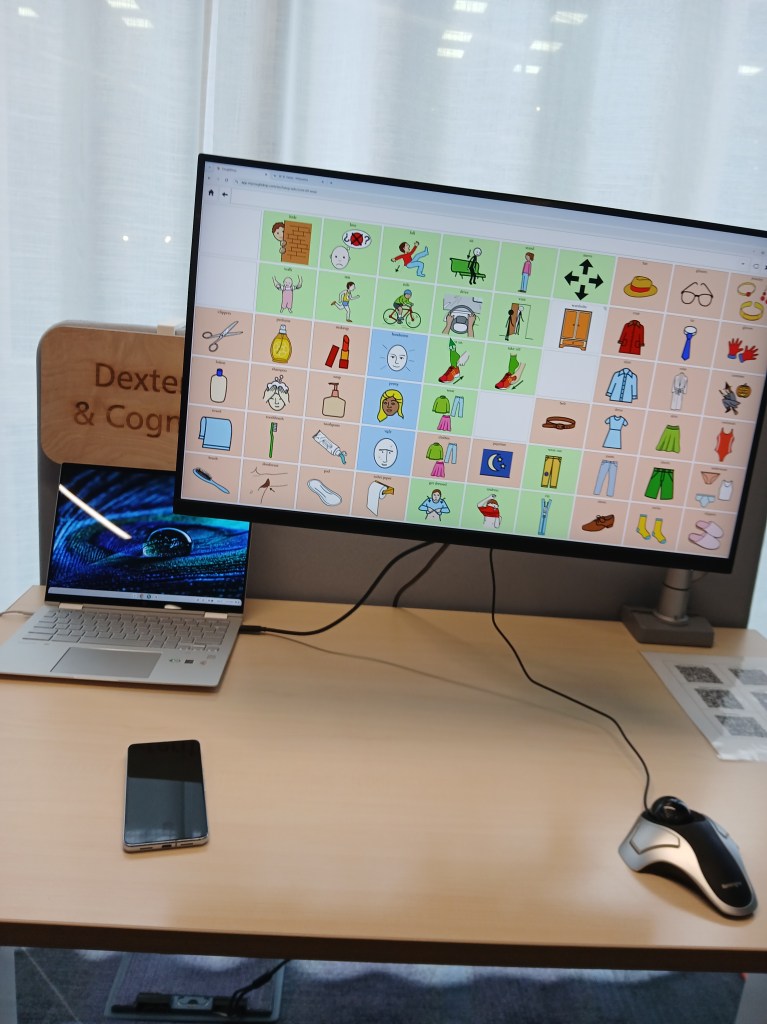
They also showed us around their suite of accessibility tools and extensions available when using Google Chrome, including dyslexic font to help make reading easier- who knew such things could exist?🤯 One of my favourite parts of the tour was the neurodivergent corner where they had a range of nifty sensory toys you could play with which were great for stimming. They also had some glasses for light sensitivity issues, loop earplugs and a sliding social battery pin- which I could really do with getting my hands on 🤣.

It is a really cool facility and it’s great to see new dedicated spaces like these that are working on making life easier for neurodivergents and others with disabilities. If you’d like to tour the ADC, you can email Google at adc-dublin@google.com to set it up- I highly recommend the experience! 😀
Hope you enjoyed this post dear Earthlings!
Have a lovely weekend!
Aoife


 A Is For Aoife Not Autism