Autism in Doctor Odyssey

Greetings Earthlings! 🙂

This week I’d like to discuss the recent depiction of an autistic character in the medical drama Doctor Odyssey.

For those who haven’t seen the show yet (not that I’d recommend it, I mainly stuck with it for closure on how the series ended 🫠), Doctor Odyssey follows Max Bankman (played by Dawson’s Creek alum Joshua Jackson) who has just taken a job as the on-board doctor for the luxury cruise ship ‘The Odyssey’. This overhyped drama from producer Ryan Murphy (known for Glee, American Horror Story, Monsters and 9-11) was 90% unrealistic rubbish, BUT it did provide us with a somewhat true depiction of autism.

During episodes 9 and 10 of the first series (which by current reports seems likely to be it’s last 🫠), the ship receives a distress call from a group who’s charter ship sank after a shark attack. Among the rescued is first mate Ray (played by AuDHD actor Liam Johnson), a straight talking, literal thinking, awkward autist who is a little out of sorts on the ship as his routine has been disrupted following the shark attack. Following a rocky start after inadvertently annoying staff on the ship, Ray quickly becomes an asset using his mathematic and marine skills to chart the quickest course to port, in addition to advising the ships captain when The Odyssey is besieged by a pod of orcas (as if the sharks weren’t enough…).

Now while Ray’s onscreen traits and manner are relatively stereotypical (there’s a lot of scenes about sound sensitivity around using sound cannons and fireworks to get rid of the orcas), what was refreshing was how the show chose to depict him as a handsome, stoic, naval character. When men are depicted with autism, they are generally overtly nerdy, skinny, outcasts working in some form of STEM, but here we find a jock-esque first mate confidently navigating the seas, showing us all that with a little support and understanding, autists can do anything they set their mind to.

All in all, while the show is rather far fetched, it does sort of get autism right (though I still wouldn’t recommend watching it- stick with The Pitt and The Good Doctor 😉).

Hope you enjoyed this post dear Earthlings!

Have a lovely weekend!

Aoife

Autism and T-Rex Arms

Greetings Earthlings! 🙂

This week I’d like to talk about a somewhat unusual aspect of the spectrum that has been brought to my attention in recent months- T-Rex arms.

Yes- you read that correctly, and no I have not joined the spectrum dinosaur brigade (I don’t think I’ll ever understand the fascination 🙈).

So what on earth are T-Rex arms?🦖

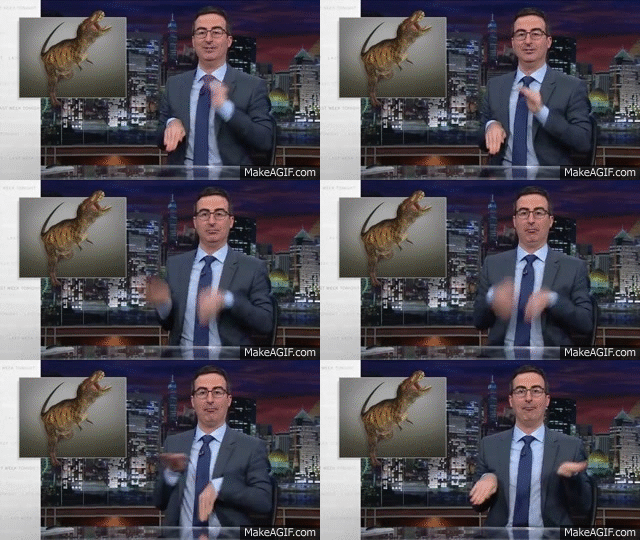
Well, it’s pretty much what it says on the tin. T-Rex arms are when an autist holds their arms in a position reminiscent of the mighty T-Rex- arms shortened and tucked into chest, hands bent forward and curled in like claws.

Ok… but how does this behaviour relate to autism?

This unique posture is commonly observed in autism (and in some overlapping ADHD cases) with many autistic and ADHD content creators poking fun at the behaviour. Since I’ve been made aware of this phenomenon, I keep catching myself holding my hands in this position at random times- most notably when I’m in the middle of a busy task like baking or cleaning.

So why do we do it?

The reasons are quite varied. Some autists say it’s because it feels natural and comforting, some say it’s because they don’t know what to do with their hands. Others, like myself, see it as more of an accessibility issue, where you keep your hands close to your chest ready for action mid-task, or a spatial issue where you have greater control of your hands by clutching them close rather than at your sides.

But is there a scientific reason?

Here’s where things get interesting. Scientists think that T-Rex arms are a form of stimming, so it’s likely to be a sensory related behaviour. They believe that autists keep their arms close to their chest as a natural coping mechanism to comfort and calm when experiencing sensory overload. In some cases T-Rex arms can be viewed as a sign of impending sensory overload, a form of non-verbal communication that experts advise parents to look out for so that they can anticipate a meltdown and take action as needed.

T-Rex arms have been particularly linked to sleep, with many autists adopting this position when they lay down at night. Experts believe that this helps neurodivergents to relax and sleep better, kind of like how weighted blankets work on the nervous system by applying deep pressure to release calming neurotransmitters. Maybe this explains why I often wake up with numb arms in the morning 🙈😂🦖.

Hope you enjoyed this post dear Earthlings! 🙂

Have a lovely weekend!

Aoife

Autism and AuDHD

Greetings Earthlings! 🙂

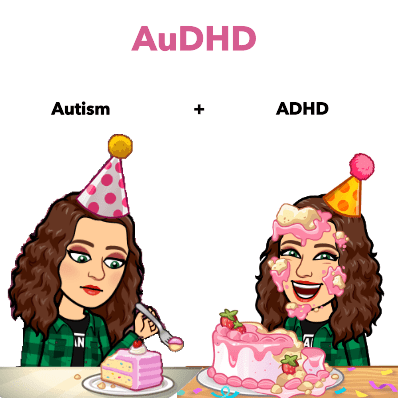
Leading on from my previous post about autism and ADHD, this week I’d like to expand on the topic by discussing the concept of AuDHD- aka autism + ADHD.

ADHD has been getting a lot of online attention in the last couple of years with many adults getting late life diagnoses as knowledge of the condition has advanced. Up to 10 years ago, it was thought that both autism and ADHD were completely separate diagnoses with no overlap. Now, it’s thought that 30-80% of autists also have ADHD, with many discovering they had autism during an ADHD diagnosis and vice versa.

When I previously wrote about this topic, I estimated that I was mildly ADHD, but the more stories I have been hearing about the experiences of female ADHDers, I exhibit a lot more traits than I originally thought. Because I wasn’t fitting the classic impulsive/hyperactive model of ADHD, I never thought to dig much deeper, buuutttttt, just like autism, it turns out that there are differences in symptoms between men and women. The original research observed more men than women (there’s a whole history of women being under researched in medicine) and so it was believed to impact more males than females, but, as with autism, sex differences and masking behaviours have made it very difficult to diagnose ADHD in women. ADHD also operates on a severity spectrum which can make it difficult to pick up on.

With all this overlap, enter the concept of AuDHD.

One of the most fascinating aspects of AuDHD is it’s paradoxical nature:

  • Autists like routine, but ADHD makes it difficult to maintain
  • ADHDers crave stimulation, but autists get easily overstimulated
  • Autists are rigid with rules, timekeeping and planning, but ADHDers suffer from time-blindness, impulsivity and hyperactivity making it difficult to follow plans and rules
  • ADHDers can be messy and chaotic, but autists like order and systemising

Effectively in AuDHD, the paradoxes can camouflage each other, making it much harder to diagnose either disorder. It’s like having 2 different brains fighting for control, but only one or the other will win out at any given time. For example, today you might do a weeks worth of work, tomorrow you might struggle to find the dopamine to do anything.

At other times, the symptoms are symbiotic. For example in my case, I can have complete time-blindness when I’m in the middle of something, but if I need to keep an appointment, the social rules governing lateness force me to be on time. AuDHD is a constant seesaw between the two conditions, a separate presentation in itself.

While it’s not a separate diagnosis yet, given the prevalence of comorbidity, who knows what the future will hold as neurodivergent research increases.

Hope you liked this post dear Earthlings! 🙂

Have a lovely weekend!

Aoife

Blog at WordPress.com.

Up ↑