Autism 10 years on

Greetings Earthlings! 🙂

This week marks a bit of a milestone in my autism journey- the 10 year anniversary of my diagnosis. It’s mind boggling how fast these years have flown by, not to mention how much my life has changed in that time.

In September 2014, I was a complete wreck. I was suffering with social anxiety, my mental health was a mess, and I was struggling with work and the social dynamics of my workplace. I had never been so stressed in my entire life (which is saying something given that I was bullied in school) and was at breaking point. Out of nowhere, I found myself tricked into an autism assessment (kudos to my parents for that 😛 ) and my entire world flipped- but in the best possible way.

Admittedly, things were rough for the first year as I learned to adjust to this newfound knowledge, and it took an additional year to relax enough to not mention the diagnosis every 5 minutes, but my life has ultimately changed for the better. I spent my first 24 years on this earth feeling like I didn’t belong, like a wonky puzzle piece that couldn’t slot into society. Everyone misunderstood me, but I guess when I didn’t even understand myself, how could the rest of the world? Most twenty somethings will have a quarter life crisis on their journey of self discovery, but I had the ultimate one. One little word held the key that allowed me to fully embrace the person I was always meant to be.

10 years later, I barely recognize myself. I’m in a job that I enjoy, I have amazing, supportive friends, and a (very) busy social life. Looking back on my past through the lens of autism, I have become a lot kinder to my younger self, learning to laugh and channel my experiences to help others like me. I feel less self conscious of my differences, know my triggers and how to sidestep them. This has enabled me to grow in confidence to a point where I have never felt more comfortable in my own skin.

Before my diagnosis, I was always shy and introverted, but by fully understanding myself, I’ve been able to unleash my inner extrovert, comfortably smiling and chatting with strangers wherever I go. Having a name for my differences normalized my feelings and gave me ownership, allowing me to overcome my anxieties and manage my sensory issues. I have autism, but autism does not have me.

If you had told me ten years ago what this one little word would do to my life, I don’t think I would have believed you.

I find it quite hard to imagine what my life would look like now had I not received my diagnosis. I have previously discussed if parents should tell their child about their diagnosis, and while the decision depends on the individual, based on my experience I would highly recommend divulging. It was initially a tough pill to swallow, but my life is better for it.

There’s so many things I wished I knew about autism before I was diagnosed, even now I’m still learning every day, but I suppose the biggest thing was to know that I would still be me at the end of it all- just a shiny, happier model. As I’ve discussed on many occasions, while an autism diagnosis shouldn’t change anything in theory, knowledge changes everything for the autist. It’s a lot to process, and it can be hard to see beyond the label, but you will emerge from the chrysalis a fully fledged butterfly. Initially it seemed like autism weighed me down, but that was just my wings poking through ready for flight 🦋

So for those of you working through your diagnosis right now, cringey cliché that it is to say, it does get better. To quote ‘The Middle‘ by Jimmy Eat World:

“It just takes some time
Little girl, you’re in the middle of the ride
Everything, everything’ll be just fine
Everything, everything’ll be alright, alright.”
❤️

Hope you enjoyed this post dear Earthlings! 🙂

Have a lovely weekend!

Aoife

Autism in ‘Grey’s Anatomy’

Greetings Earthlings! 🙂

I’ve recently been re-watching clips from medical drama ‘Grey’s Anatomy’ on Facebook, and came across some old episodes featuring a doctor with Asperger’s syndrome. As I watched these episodes prior to my diagnosis (and never made any connection to my own experiences), this week I’d like to take a closer look at Dr. Dixon and the depiction of autism.

For those of you who are unfamiliar, Grey’s Anatomy is the longest running primetime medical drama of all time (entering into it’s 21st season in the coming weeks), following the personal and professional adventures of Dr. Meredith Grey through her surgical internship (and beyond).

In 2008 during it’s 5th season, the show introduced the character of Dr. Virginia Dixon for 3 episodes- a renowned heart surgeon with Asperger’s syndrome. This was perhaps the first on screen depiction of autism I had ever seen, and it’s easy to see why I didn’t connect with the character at the time.

Despite being a woman with autism (which given this was 2008 was quite progressive), Dr. Dixon’s character has been completely panned by the autistic community and branded as difficult to watch. She’s highly stereotyped with a high IQ, monotone voice, no social skills, rule oriented and completely emotionless– a particular pain point for misunderstood autists everywhere. In addition, the stereotyping isn’t even consistent with how most autistic women present as she doesn’t make any attempt to mask her differences whatsoever. A lot of autists were particularly irked by a scene where Dr. Dixon has a complete meltdown after a patient excitedly hugs her. Given that she is a high functioning adult with autism, her response to the incident has been seen as completely over the top given that most of us by this age have adapted coping mechanisms to deal with these sorts of situations.

Here’s a video with some clips of Dr. Dixon in action:

I personally didn’t find issue with the episodes when I initially watched the show, but given what I now know about autism, I would have to agree with the community. While I can appreciate the attempt to raise awareness about the condition, it really wasn’t handled the best. I found it particularly irksome during the meltdown scene, as when a fellow doctor was asked to hug Dr. Dixon to help calm her, she made a quip about giving a thorazine shot instead (a common anti-psychotic medication). Autists aren’t crazy, it’s just a different operating system 😒.

All in all, it will not be taking a spot on my recommendation list. Great show, bad autism.

Hope you enjoyed this post dear Earthlings!

Have a lovely weekend! 🙂

Aoife

Autism and ‘Pebbling / Penguin Pebbling’

Greetings Earthlings! 🙂

This week I’d like to discuss another more unusual autistic behaviour- pebbling.

Ah Aoife, you must be making these up now!

You couldn’t be more wrong!

Before I lose you completely, let me explain.

Pebbling is where an autist spontaneously shows their loved ones affection through thoughtful gestures and tokens. The behaviour is so named as it mimics the act of pebbling in penguins. Gentoo penguins mate for life, so when a male penguin is interested in a female, he will collect, smooth shiny rocks for her as part of the courtship ritual. If she is interested, she will use the pebbles to build a nest to lay eggs in. Here’s a clip of the penguins in action:

Autists often struggle with social interactions and displaying affection, but pebbling can be our way of making up for it. ‘I love you’ isn’t always easy to say, but pebbling does the talking. It’s our way of showing we love you and are thinking about you- a unique form of affection, communication and connection.

Personally, when I heard about pebbling, I immediately identified with it! I’ve been unconsciously pebbling the ones I love my entire life. If I’m out shopping, I will often pick up little trinkets that remind me of my loved ones and their interests, or I might grab their favourite treats to bring home. Other times I might bake their favourite sweets for no reason, or craft them something they might like, or just a simple gesture like offering to do something for them.

This video explains it pretty well:

Not all autists display pebbling behaviours, and pebbling can take various forms, but it’s a pretty cool way to show love to the people you care about 🙂

Hope you enjoyed this post dear Earthlings!

Have a lovely weekend! 🙂

Aoife

Autism and T-Rex Arms

Greetings Earthlings! 🙂

This week I’d like to talk about a somewhat unusual aspect of the spectrum that has been brought to my attention in recent months- T-Rex arms.

Yes- you read that correctly, and no I have not joined the spectrum dinosaur brigade (I don’t think I’ll ever understand the fascination 🙈).

So what on earth are T-Rex arms?🦖

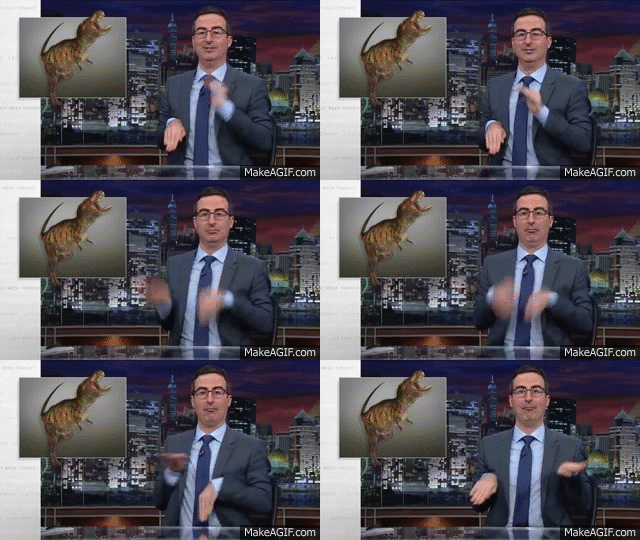
Well, it’s pretty much what it says on the tin. T-Rex arms are when an autist holds their arms in a position reminiscent of the mighty T-Rex- arms shortened and tucked into chest, hands bent forward and curled in like claws.

Ok… but how does this behaviour relate to autism?

This unique posture is commonly observed in autism (and in some overlapping ADHD cases) with many autistic and ADHD content creators poking fun at the behaviour. Since I’ve been made aware of this phenomenon, I keep catching myself holding my hands in this position at random times- most notably when I’m in the middle of a busy task like baking or cleaning.

So why do we do it?

The reasons are quite varied. Some autists say it’s because it feels natural and comforting, some say it’s because they don’t know what to do with their hands. Others, like myself, see it as more of an accessibility issue, where you keep your hands close to your chest ready for action mid-task, or a spatial issue where you have greater control of your hands by clutching them close rather than at your sides.

But is there a scientific reason?

Here’s where things get interesting. Scientists think that T-Rex arms are a form of stimming, so it’s likely to be a sensory related behaviour. They believe that autists keep their arms close to their chest as a natural coping mechanism to comfort and calm when experiencing sensory overload. In some cases T-Rex arms can be viewed as a sign of impending sensory overload, a form of non-verbal communication that experts advise parents to look out for so that they can anticipate a meltdown and take action as needed.

T-Rex arms have been particularly linked to sleep, with many autists adopting this position when they lay down at night. Experts believe that this helps neurodivergents to relax and sleep better, kind of like how weighted blankets work on the nervous system by applying deep pressure to release calming neurotransmitters. Maybe this explains why I often wake up with numb arms in the morning 🙈😂🦖.

Hope you enjoyed this post dear Earthlings! 🙂

Have a lovely weekend!

Aoife

Autism and AuDHD

Greetings Earthlings! 🙂

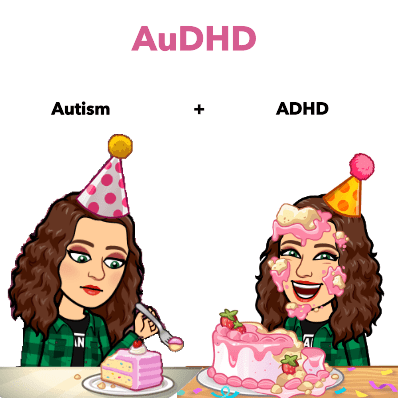
Leading on from my previous post about autism and ADHD, this week I’d like to expand on the topic by discussing the concept of AuDHD- aka autism + ADHD.

ADHD has been getting a lot of online attention in the last couple of years with many adults getting late life diagnoses as knowledge of the condition has advanced. Up to 10 years ago, it was thought that both autism and ADHD were completely separate diagnoses with no overlap. Now, it’s thought that 30-80% of autists also have ADHD, with many discovering they had autism during an ADHD diagnosis and vice versa.

When I previously wrote about this topic, I estimated that I was mildly ADHD, but the more stories I have been hearing about the experiences of female ADHDers, I exhibit a lot more traits than I originally thought. Because I wasn’t fitting the classic impulsive/hyperactive model of ADHD, I never thought to dig much deeper, buuutttttt, just like autism, it turns out that there are differences in symptoms between men and women. The original research observed more men than women (there’s a whole history of women being under researched in medicine) and so it was believed to impact more males than females, but, as with autism, sex differences and masking behaviours have made it very difficult to diagnose ADHD in women. ADHD also operates on a severity spectrum which can make it difficult to pick up on.

With all this overlap, enter the concept of AuDHD.

One of the most fascinating aspects of AuDHD is it’s paradoxical nature:

  • Autists like routine, but ADHD makes it difficult to maintain
  • ADHDers crave stimulation, but autists get easily overstimulated
  • Autists are rigid with rules, timekeeping and planning, but ADHDers suffer from time-blindness, impulsivity and hyperactivity making it difficult to follow plans and rules
  • ADHDers can be messy and chaotic, but autists like order and systemising

Effectively in AuDHD, the paradoxes can camouflage each other, making it much harder to diagnose either disorder. It’s like having 2 different brains fighting for control, but only one or the other will win out at any given time. For example, today you might do a weeks worth of work, tomorrow you might struggle to find the dopamine to do anything.

At other times, the symptoms are symbiotic. For example in my case, I can have complete time-blindness when I’m in the middle of something, but if I need to keep an appointment, the social rules governing lateness force me to be on time. AuDHD is a constant seesaw between the two conditions, a separate presentation in itself.

While it’s not a separate diagnosis yet, given the prevalence of comorbidity, who knows what the future will hold as neurodivergent research increases.

Hope you liked this post dear Earthlings! 🙂

Have a lovely weekend!

Aoife

Patron Saint of Autism- St. Thorlak Thorhallsson

Greetings Earthlings! 🙂

In the midst of some recent Googling, I accidentally came upon a suggested search for the patron saint of autism and was surprised to learn that there is such a saint- Thorlak Thorhallsson (Icelandic: Þorlákur Þórhallsson)! Naturally as a practicing catholic, I had to investigate.

So who was Thorlak Thorhallsson and how has he come to be associated with autism?

Relatively little is known about this saint compared with many others of the time, but here’s a snippet of what researchers have found:

Born in Iceland in 1133 (he’s also the Icelandic patron saint), Thorlak grew up on a farm in Hlíðarendi. A child prodigy, Thorlak taught himself to read at a very young age, and impressed the locals round the farmstead with his kindness, curiosity and knowledge of the world around him. At age 7 due to a bad fishing season, his mother moved with Thorlak and his sisters to a different farm where influential locals educated him, leading to his ordination as deacon at age 15 and a priest by 18. He later went abroad to study theology in England and France, returning to Iceland in 1168 where he set up an Augustinian monastery. 10 years later he was ordained bishop of the diocese of Skalholt.

Thorlak was often rigid with a fondness for rules, as evidenced by his decision to reject marriage and remain celibate in line with church laws- a rule (one of many) which the Icelandic clergy generally did not observe. After studying the strict monastic rules of St. Augustine abroad, Thorlak dedicated himself to church reform after he became bishop, implementing many reforms of the Western Church from Pope Gregory VII. He enforced stricter religious observance to improve public morality, his efforts resulting in the expansion of the church in wealth, power and influence, often going head to head with powerful chieftains who almost killed him on several occasions. He died on the 23rd of December 1193 at the age of 60 and was officially cannonized in 1984 by St. Pope John Paul II.

Thorlak is believed to have had many autistic traits which is why autists have adopted him as their patron saint. His intelligence, determination, love for the rules (and rigidity in enforcing them) and fondness for strict routine moulded by his monastic life all indicate that he was quite likely autistic.

So for any autists of faith out there, be sure to spare a moment to pray to St. Thorlak Thorhallsson for your intentions 🙏🏻

Bonus fun fact– for those of you who also have co-morbid ADHD or other mental health issues, Irish St. Dymphna is your patroness.

Hope you enjoyed this post dear Earthlings!

Have a lovely weekend!

Aoife

Autism in ‘Geek Girl’

Greetings Earthling! 😀

This week I’d like to talk about the new young adult series Geek Girl on Netflix (they’re really on the ball with neurodiversity the last few years!) and it’s accurate depiction of the struggles of an autistic teenage girl.

Based on the Geek Girl books by Holly Smale (which I have purchased and will write about eventually), the series follows awkward “geek” Harriet Manners who’s life completely changes after being scouted by a modelling agency. Mercilessly bullied at school, she sets out on her modelling journey to reinvent herself. You can check out a trailer for the series here:

But you haven’t mentioned anything about autism yet Aoife?

So- the author Holly Smale wrote these books based on her own experiences of being an awkward teen model, BUT Holly was diagnosed with autism at the age of 39 and has retrospectively described Harriet as autistic. As such, it seems that the TV series is planning to incorporate an autism diagnosis down the line, as lead actress Emily Carey is autistic, and there have been many hints to her neurodivergence including a conversation between her agent and her father about seeking a professional and not wanting to label her.

So what did I make of the show?

Well I absolutely loved it- a lovely wholesome show with an authentic portrayal of neurodivergence, I was hooked! Harriet’s autistic traits were subtle (as they are for most high functioning autists)- stimming, coordination issues, minor issues reading social cues etc. What really sets the series apart from others though is Harriet’s narration. We get to see her internal monologue, how she thinks and processes, which really helps to give an insight into what we autists go through on the inside (though I will say that my internal monologues speak waaaaaaay faster than Harriet’s 😂). Harriet’s friend Toby is also clearly on the spectrum, albeit he presents far more like the traditional autistic oddball that we often see in media depictions of autism- which while a little stereotypical, really helps to show how different male and female presentations of autism can differ.

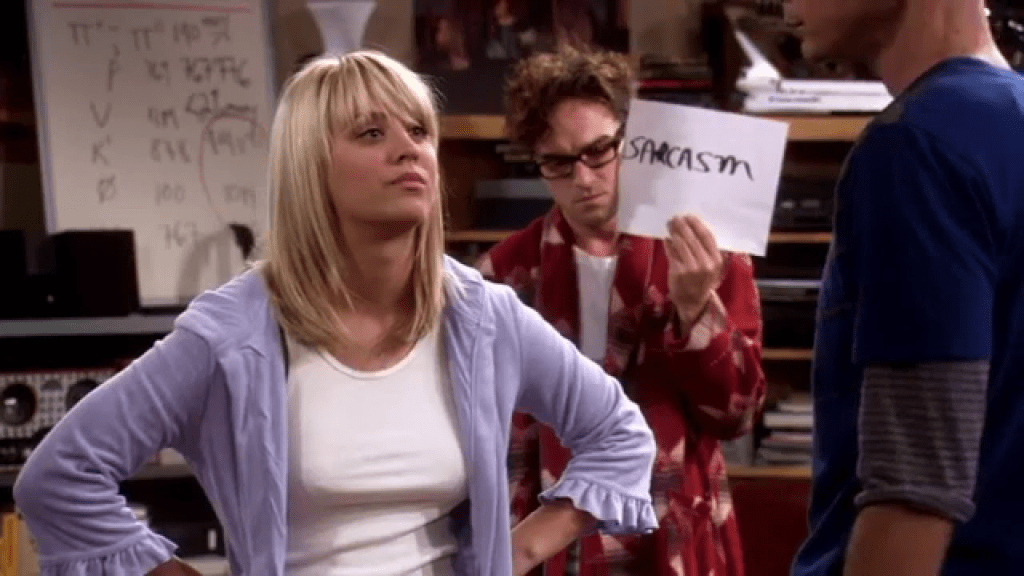
One of the other things I found most interesting was how Harriet’s dad also appears to be neurodivergent. He seems to struggle with work, is quite nerdy and eccentric (he drives Harriet to school in his PJs one day) and is described by his wife as very childish. At one point during an online job interview his wife holds up flashcards for him coaching him on what to say, reminding me of how people have tried to guide me in certain social situations. Very often with on screen portrayals of autism we focus on the child or the oddball single adult, we don’t tend to see neurodivergence in the wider family like between parent and child 0r other spectrum siblings. Autism is highly genetic with many parents discovering their neurodivergence after their child is diagnosed, and there can often be multiple autistic children within a family (I once came across a family with 5 sons on the spectrum).

My one criticism, again like Dinosaur, was Harriet’s stereotypical love of dinosaurs and desire to be a paleontologist, buuutttt as a real autist wrote the show, I can’t really argue with lived experience 😜. I’m really starting to wonder- did I miss the autism memo that you need to be obsessed with dinosaurs cause I have never really seen the fascination 🤣🙈 Dogs are much more my vibe!

Interestingly, many critics have branded the show an “inauthentic” representation of autism… to which Holly Smale had the following to say:

“It’s based on books written by me (autistic), about me as a teen (autistic). I wrote all of Harriet for the show (still autistic) and the lead actor is autistic. It’s the DEFINITION of authentic. I think people are so used to seeing inauthentic representation they don’t recognise it when it’s in front of them.”

You can’t get more authentic than that folks! 🤣🙈

All in all I highly recommend this show and look forward to seeing Harriet’s journey in future seasons!

Hope you enjoyed this post dear Earthlings! 🙂

Have a lovely weekend!

Aoife

Autism friendly festivals

Greetings Earthlings! 🙂

This week I’d like to talk about the subject of autism friendly festivals.

Yes- you heard me correctly! 😀

Festivals and autism are not really two words that tend to go together, what with the crowds, noises, smells and flashing lights, but recent years have seen large music festivals such as Electric Picnic and Glastonbury set up specific sensory friendly tents for neurodivergent attendees. In addition to this, there are now a number of specific autism friendly festivals.

Autism charity ASIAM recently launched the Sensoria festival in Dublin as part of a 3 year plan to make Dublin the world’s first autism friendly city. A free ticketed event, the festival took place at two different times in the day to keep crowds to a minimum, offering sensory domes, pods and gardens, a messy play tactile zone, neurodiversity information tents and therapy dogs. In addition to these sensory friendly modifications, a number of sensory activities and performances were arranged including non verbal street theatre, sensory movement workshops, sensory silent films, and a unique show titled ‘Squish, Stomp, Spin – The Magic of Stim’ by ADHD artist Moss Russell.

Similarly in the UK, the Spectrum Autism Friendly Festival has been running since 2017. The festival is run by staff that are fully trained about autism, and offers attendees an enriching experience with sensory areas and quiet spaces in addition to fun activities such as cooking classes, arts and crafts, bouncy castles, treasure hunts, pedal carts, and even light saber training!

Whilst these autism friendly festivals are a great incentive, they are largely geared at children, which is a little disheartening for autistic adults with sensory issues. In Reading in the UK however, the A Different World Festival has been established to cater to older autists. Inspired by their teenage son who could not access the Reading Festival as an autist, the organizers set up A Different World to allow young people and adults with additional needs to experience a real rock festival. This festival follows normal festival formats, but limits numbers to reduce crowding and ensure space, allows no strobe lighting or pyrotechnics, has a sensory village, a service dog tent, and a wellness tent to cater for everyone’s needs.

Hope you enjoyed this post dear Earthlings!

Have a lovely weekend 🙂

Aoife

Autism in ‘Baby Reindeer’?

Greetings Earthlings! 🙂

The new Netflix drama ‘Baby Reindeer‘ has been getting a lot of coverage in the media lately, so this week I’d like to have a quick discussion about it. ‘Baby Reindeer’ tells the gripping, but harrowing, true story of comedian Richard Gadd’s experiences of being stalked by an older woman named Martha (name was changed for privacy) over the course of a 3 year period.

Here’s a trailer for the show to give you a taste:

The world has been gripped by the story with many amateur sleuths digging through the internet to uncover the true identity of the woman that inspired the character of Martha. Their efforts have led us to this week where the supposed real “Martha”, Fiona Harvey, came forward to tell her story on Piers Morgan.

That’s great that you liked the show Aoife, but what has this got to do with autism?

In the show, Martha is clearly depicted as being mentally ill by the sheer intensity of her stalking efforts. Martha sends Richard’s character Donny 41,071 emails, 744 tweets, 46 Facebook messages, letters totaling 106 pages, and 350 hours worth of voicemails. She is completely obsessed, in such a way that it reminded me of how intensely an autist can take their specialist interest.

Fun fact– an autists specialist interest can be a person, not just a topic, especially for women on the spectrum.

Other than her obsessive nature, outbursts of rage, social ineptitude and tendency to ramble on a bit, the character didn’t really display any obvious autistic traits, but there has been speculation online from people that claim to know the real Martha that she has Asperger’s syndrome. In fact, a clinical psychologist recently wrote about the character and mentioned that these types of stalker are often on the spectrum.

If Martha is autistic, this really depicts the more sinister side of the spectrum, a side that is often overlooked in on screen depictions. I know in my own experience, my specialist interests in the past have been intense and compulsive, even at times controlling my behaviour. The kind of behaviour Martha displays in the show really shows what can happen when an autist isn’t properly nurtured and supported. I often shudder at the thought of the kind of person I could have been had I not had my family around me to keep me in check.

We can’t be certain if Martha (or her real life counterpart) is autistic, but if she were, it could certainly explain the characters obsessive behaviour; an explanation, but not an excuse.

Hope you enjoyed this post dear Earthlings!

Have a lovely weekend! 🙂

Aoife

Autism in ‘Dinosaur’

Greetings Earthlings! 🙂

As autism awareness month comes to a close, this week I’d like to talk about autism in the new BBC Scotland sitcom Dinosaur.

So what exactly is Dinosaur about?

Dinosaur follows autistic palaeontologist Nina (played by autistic actress, comedian and show co-writer Ashley Storrie) who is content with her life in Glasgow, but finds her life upended by her sister’s impulsive decision to marry a man she has known for only 6 weeks. Cue hilarious chaos as Nina tries to navigate this transition whilst balancing the pressures of work, love, and being her sisters maid of honour.

You can check out a trailer for the series here:

So what did I make of it?

Aside from the fact that Nina’s dinosaur obsessions is ever so slightly stereotypical, I loved this sitcom and found it a refreshingly honest portrayal of life on the spectrum. Too often scriptwriters tend towards the hyperbolic when it comes to autism, but this show hits the mark perfectly for what life is like for a high functioning autist.

The show is highly self-aware tackling common stereotypes head on in humorous fashion. When Evie’s fiancé Ranesh starts talking about Nina’s autism, Nina pre-empts his stereotypes muttering “Don’t’ say it!” under her breath, before Ranesh describes having autism as a “superpower!” Another episode see’s Nina’s boss, (while reprimanding her for saying that Jurassic Park should have been named ‘Cretaceous Park’), tell her that they don’t want to give the impression of paleontologists as being “rigid and a bit autistic” for her to respond, “But I am autistic!” leaving her boss completely mortified.

More importantly, Nina doesn’t take herself too seriously. In one conversation with her sister (in an episode where everyone was pretending to be something they were not for Evie’s soon to be father-in-law), Nina gives Evie a pep talk telling her that she can keep up the pretense if Nina can and ” [she is] literally autistic”! This particularly made me chuckle as I have often made this remark with regard to neurotypicals claiming they aren’t able to do some basic things that I as an autist have no issues doing! 🙈

Nina’s unfiltered moments land casually without the need for exaggeration. Her stimming is subtle, like playing with her necklace, and tapping and fidgeting with her fingers when she is getting overwhelmed. No stereotypical hand flapping or head banging here! I particularly liked how they showed Nina having a meltdown when trying on bridesmaid dresses- shopping being a situation where I often get overwhelmed. The pressure from the salespeople, being under pressure for time after she arrived late, the heat of the shop, the itchy fabric, being told a dress is fabulous on her that really does not suit her etc. Nina promptly had to exit the shop and scream into a bush from the pressure of the task- a feeling I know all too well.  In a later episode they showed Nina crying and struggling to breathe during a meltdown- finally showing a realistic portrayal of how most of my meltdowns manifest.

Another positive aspect of the show was the portrayal of Nina naturally pursuing a relationship. Often these types of storylines are forced like ‘I want to have/should have a girlfriend/boyfriend, so I’m on a mission to get one and here’s how I’m going to do it’, buuuuuuut that isn’t exactly realistic. In the show, Nina starts to connect with her new barista and bravely decides to ask him out. Her autism is casually discussed, it’s not a huge issue like in other shows- she’s just a neurospicy girl going out on an awkward first date like anyone else. Moreover, the show doesn’t portray her as a sexually inept weirdo as many shows tend to. In a particularly humorous moment during a spicy confession game at her sisters hen party, Nina’s mother tells her to cover her ears, only for Nina to boldly tell her mother that she’s done it 13 times (much to her mothers surprise)! 🤣🙈 The show truly does Nina justice by showing the world that we’re just out here living our lives like everyone else; we just think a little bit differently.

While it would have been nice if Nina had had a slightly more ordinary job, especially given that it tends to be more male autists that obsess over dinosaurs than women, all in all this show is an excellent depiction of autism with some great laugh out loud moments to boot.

Hope you enjoyed this post dear Earthlings! 😊

Have a lovely weekend!

Aoife

Blog at WordPress.com.

Up ↑