Autism on Screen- My Name Is Khan

Greetings Earthlings! 🙂

In the next part of my autism on screen series, I’m going to explore the portrayal of autism in the Indian drama film ‘My Name Is Khan‘ (2010).

My Name Is Khan film poster.jpg

A dual Hindi and English language film, ‘My Name Is Khan‘ follows Rizwan Khan, a Muslim man with Asperger’s syndrome, who set’s out on a journey across America to tell the president that he is not a terrorist following a sectarian attack on his family in the wake of the events of 9/11.

Check out the trailer below! 🙂

So how does this film measure up in it’s portrayal of the realities of AS?

The film opens with a disclaimer stating that the film makers have endeavored to depict AS as authentically and sensitively as possible, however, as this is a work of fiction, they acknowledge that certain creative liberties were taken in the portrayal of autism- so as with ‘Rain Man‘, take the film with a grain of salt!

That being said, I found this film to be generally quite accurate from a symptomatic perspective. Granted, Khan appears slightly weirder than the average person with AS and many of his symptoms are exaggerated, but overall I felt that this was a solid onscreen portrayal of autism.

In particular I felt that this film gave a good representation of repetitive behaviors and sensory sensitivity.

Throughout the film, Khan can be seen fiddling with some stones in a repetitive manner.
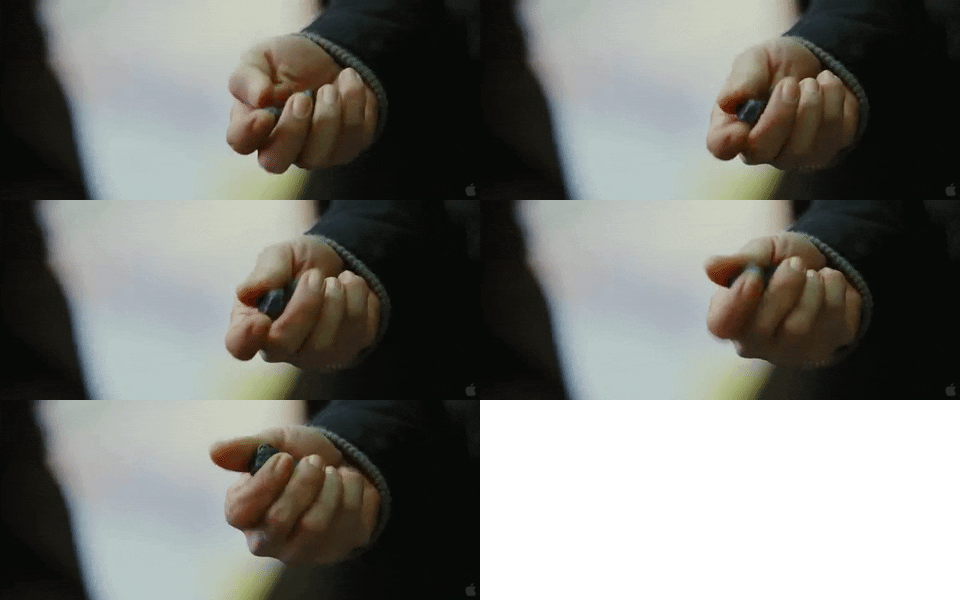
autism stones my name is khan aspergers syndrome repetitive behvaiour

I may not carry stones around with me, but I am constantly fiddling with my jewelry in a similar manner. It’s a compulsive action- I have this constant need to reach out and feel my chain between my fingers. There’s something incredibly soothing about the motion, especially when you’re particularly stressed. Actions such as these are referred to as stimming or self stimulation. I’ll dedicate a post to stimming at another stage 🙂

As regards sensory sensitivity, I thought that the film presented more of a normalized and subtle reaction to sensory stimuli than most films featuring autism, particularly in relation to Khan’s sensitivity to the colour yellow (there’s a particularly funny moment where he changes direction on the street to avoid looking at someone wearing a yellow top!).
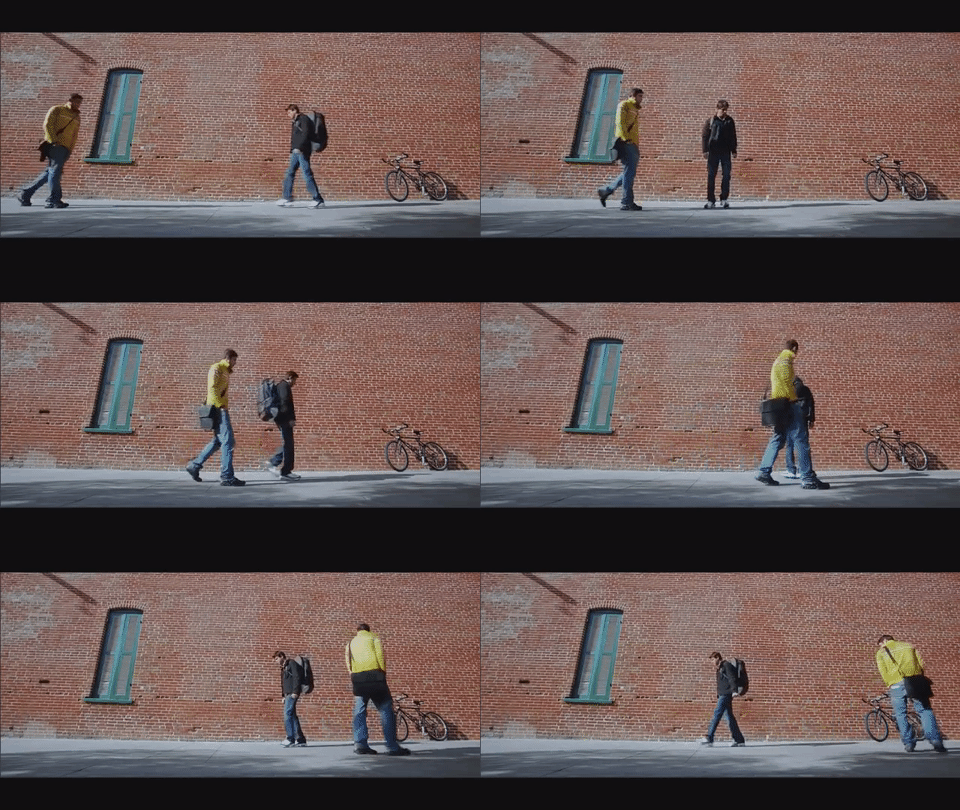
yellow my name is khan

When I first watched this film, I thought that this had to be an exaggeration, but in actual fact, as I mentioned in the last post, boys with autism really struggle to process the colour yellow! Scientists think that this may result from a sensitivity to luminance in autists. Alternatively this may occur as yellow is one of the most heavily sensory loaded colours, as it engages multiple colour detection cells (called cones) in the eye.

Comparing this film to ‘Rain Man‘, there is quite a difference in how autism is portrayed. There was a far greater focus on everything that is good about Khan rather than areas of disability in his life, which can often be exploited in film for dramatic effect. Unlike ‘Rain Man‘, modern films about autism, such as this, have the added benefit of over twenty years of research and observation of the autistic condition, leading to more accurate depictions/attitudes to difference on screen.

Unfortunately however, Khan is depicted as quite intelligent (even called a genius), with superb memory and a savant-like ability to fix any mechanical item known to man, further promoting the stereotype of the autistic savant. These traits however, are somewhat muted in comparison to ‘Rain Man‘, giving a slightly more realistic portrayal of autism.

So there we are- hope you all enjoyed this piece 🙂 I would highly encourage you all to watch this film at some stage. Autism aside, this is an amazing film- one of the best I’ve seen in a long time! In the latter half of the film, you start to forget that Khan is in any way different, finding yourself swept up in this powerful story of love, loss and acceptance. Having watched only the trailer to re-jog my memory, I really want to see this film again myself! 😀

Weekend plans sorted! 😉

bitmoji-1592672837.png

Aoife

Autism 101-Sensory Processing

Greetings Earthlings! 🙂

So today I’m going to briefly introduce you to the issue of sensory processing for people on the spectrum. This is a very broad topic, but I’ll expand on the issues in more detail at a later stage 🙂

Many individuals on the autistic spectrum struggle to process every day sensory information. Sounds, textures, smells, lights, even colours (boys in particular struggle to process the colour yellow) can overload the nervous system and greatly upset us, effect our behavior or even trigger a meltdown.

But why?

In autism, our senses can be either hyper or hypo sensitive (sometimes even both) to stimuli at different times. Our senses are heightened- smells are stronger, sounds are louder. As a result of this, stimuli reverberate all the more intensely in our brains.

Think of the brain as a computer server at exam time where everyone is logging in at once. Too much information has been entered into the system, but the server can only cope with so much. The entire system becomes overwhelmed and the server crashes.

giphy (24).gif

Here’s just a quick video simulation of sensory overload.

Warning for those on the spectrumthis video contains flashing lights, bright colours and loud, sudden noises

For me personally, I have many (mild) issues with sensory processing. Smells, tastes and textures are a daily struggle. For example, I don’t think I’ll ever be able to eat a salad as the smell alone makes me want to throw up- I’m dreading what pregnancy may one day bring! 😛 😉

Loud or irritating  noises, (especially repetitive ones), too can be a challenge. Don’t get me started on the shock I get when a passing bus makes that giant hiss/woosh sound or a car honks the horn unexpectedly!! 😛

schauble.gif

Most days, you’re lucky and the offending stimulus passes quickly, but other times it can get the better of you. I recently had a near meltdown on holiday from a cocktail of excessive heat, hunger, exhaustion and social frustration.

Top Tip– Keep on top of your hunger/thirst. I’ve discovered this past year that an excess of either will make me act really loopy! 😛

When you’re hit by sensory overload, it feels as though your head is caught in a vice grip. Your mind is screaming, unable to focus on anything else but the source of discomfort.

bitmoji-943797920.png

The worst part of it I find is coming across as a complete basket case when overloaded. You don’t get the most sympathetic of looks when you complain about a persistent noise- few can understand how it’s making your brain hurt.

giphy (23).gif

So what does science have to say about sensory processing?

Sensory integration involves three basic sensory systems:

  • The tactile system (touch)- comprises a series of nerves passing information from the skin to the brain
  • The vestibular system (sound)- comprises a series of structures in the inner ear involved in movement detection
  • The proprioceptive system-a series of receptors in the muscle (proprioreceptors) which feed information to the brain about the body’s position

These three systems share a close but complicated relationship which allow us to experience, process and respond to different stimuli. Dysfunction in this network can cause hyper/hypo sensitivity, in addition to problems with coordination, behavior and academic issues.

Evidence from brain imaging studies has also shown that autists experience stronger responses in the brain to sensory stimuli in areas that process sensory information and the amygdala- an area that is involved in attention, emotional reactions and threat response.

But why is this?

Several studies have found evidence of hyper-excitability and hyper-connectivity in the autistic brain.

Evidence shows that in many cases of autism, the neurons located in the sensory cortex of the brain are more sensitive and excitable than others. This is kind of like how a person can be more ticklish in some parts of the body than another- the nerves in the underarm are more excitable than those of the arm.

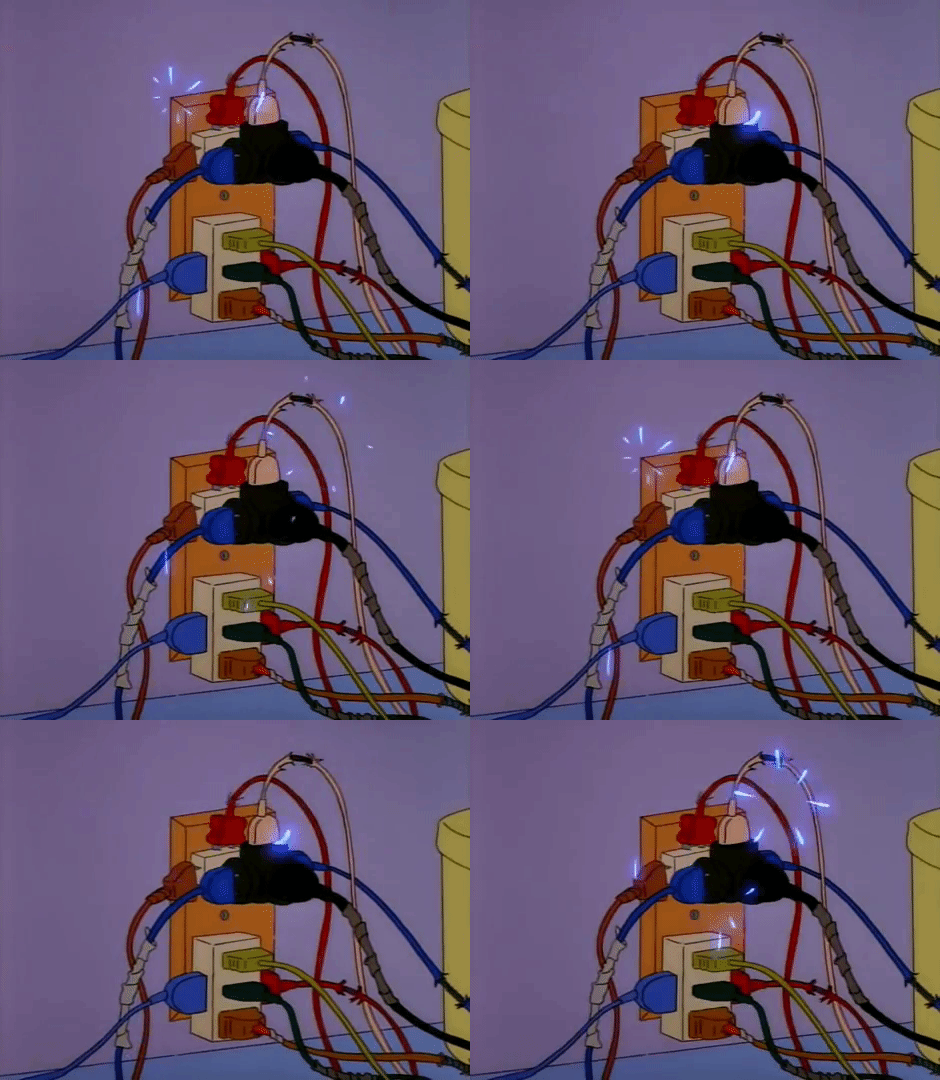
The autistic brain has also shown signs of hyper-connectivity, where regions of the brain are excessively connected- like an overloaded plug!

giphy (22).gif

This amplifies memory formation, sensory processing and causes an autist to be hyper-emotional, which can make the world painfully intense. Scientists have theorized that autists prefer safe, controlled and predictable environments as a coping mechanism to actively avoid this pain.

Finally, studies have indicated that sensory issues, in addition to a number of other autistic behaviors, may be linked to neurotransmitter (chemical messengers between body and brain) levels in the body. As previously discussed, some neurotransmitters are dysregulated in autism. Evidence suggests that in cases of autism, there are higher levels of excitatory neurotransmitters, and lower levels of inhibitory (i.e. calming) neurotransmitters. These high levels of excitatory neurotransmitters cause neurons to fire excessively, which can influence sensory perception and processing.

I’ll expand a little bit more on the individual sensory issues at a later stage 🙂

Enjoy your week everyone 🙂

Aoife

Autism on Screen- Rain Man

Greetings Earthlings! 🙂

I’m going to change things up a little today with a new series examining the portrayal of autism on screen.

Film scholars have remarked that the portrayal of autism on film is generally inaccurate and highly stereotyped, so I’ve decided to take a closer look at things from a personal and scientific perspective 🙂

So let’s start at the very beginning with perhaps the most famous portrayal of autism in cinema- 1988’s ‘Rain Man‘.

Rain_Man_poster.jpg

For those of you who have not seen the film, ‘Rain Man’ focuses on the relationship between brothers Charlie and Raymond ‘Rain Man‘ Babbitt as they embark on a cross country road trip to Los Angeles (Raymond refuses to fly unless it’s with Qantas- the safest airline in the world!). Charlie grew up without any knowledge of Raymond, only discovering his existence upon learning that his father’s multi-million dollar fortune had been bequeathed to the mental institution in which he resides. And so Charlie sets out to be Raymond’s carer in order to access the fortune, but *SPOILER ALERT*- ultimately has a change of heart. Classic Hollywood ending.

Here’s a trailer for anyone who’s thinking of watching it 🙂

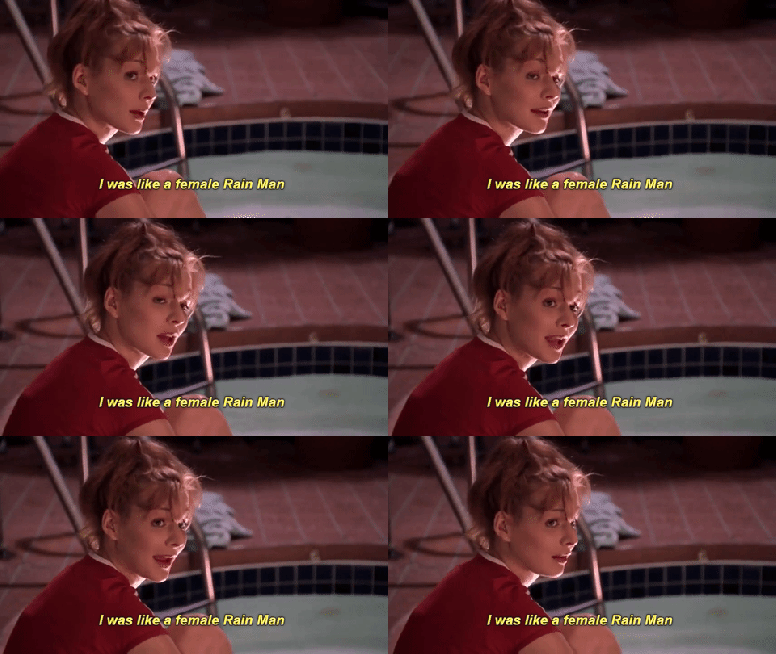
‘Rain Man’ is often considered to be the main reference point for autism on film, as it prompted the breakthrough of autism into the wider conscious of the public. Prior to this, characters displayed autistic like traits in film, but autism itself was not discussed- likely due to the fact that the diagnostic criteria for autism was only just emerging in the late 1980’s. The term ‘Rain Man‘ has also become synonymous with autism and other mental disabilities in popular culture, as seen in this example from the film ‘Miss Congeniality‘ (2000):

jttgfdurgiphy

As a “female rain man”, I find this highly insulting, so try not to brand autistic people using the term 😛

Winner of  4 Oscar’s, ‘Rain Man’ has been highly critically acclaimed- but does the film match up to the reality?

Rain Man‘ is generally thought to be an accurate portrayal of the autistic condition in scholarly papers. Indeed, there are many areas in the film in which Raymond perfectly demonstrates some of the classical signs of autism- sensitivity to touch, restrictive and repetitive behaviors, specialist interests, coordination issues, deficits in social communication, autistic meltdowns etc.

Interestingly while I thought that I would not be able to relate to Raymond from previous viewings, I found that his literal thinking had me written all over it. There’s a scene in the film (which you can see in the trailer) where Raymond stops in the middle of the road on a pedestrian crossing after the light flashes “DON’T WALK”! I have a terrible habit of dawdling at pedestrian crossings. Oftentimes I can see that the road is clear, but still I’ll wait for the green man (although this may be related to getting clipped on the ankle by a car crossing the road in Dublin as a teenager! 😛 ). However, I’m not as bad as I used to be since learning to drive; hesitation gets you nowhere on a roundabout after all! 😉

The story where Raymond inadvertently burned Charlie in the bathtub as a child (which led him to be institutionalized), also brings back many memories from my childhood. There have been many cases where I have inadvertently harmed my siblings- why just yesterday I threw a foam roller at my sister in an attempt to help her stretch out her legs, only for it to whack her in the throat…oops!

Bad Aoife! 😛

Lindsay-facepalm.gif

But my intentions were good!!

Acting without thinking is something that I tend to do an awful lot of (probably why I overthink and don’t act when it comes to love 😛 ). My mother had to keep a really close eye on me growing up after she found me attempting to push hair-clips down my sisters throat…I have no real answer for why I did that, but based on similar experiences, I’d say scientific curiosity probably had a role to play! 😛 😉 We’ll explore curiosity and impulsivity a little bit more in the coming weeks.

On the other hand however, this film has largely perpetuated the stereotype that autists typically have superb memories and savant skills. As I’ve stated previously, these traits are rare, and the vast majority of autists do not possess them. The same goes for card counting- a family friend actually inferred that I should be able to do it once! 😛

In addition to this, Raymond is also described as ‘high functioning’ in the film, BUT Raymond is incapable of living independently. Whilst the definition of what constitutes high functioning autism varies, for many, Raymond does not fit the high functioning category and therefore does not come across as a true reflection of autism.

One of the biggest issues here I believe, is the fact that the character of Raymond is based on Kim Peek- a “megasavant” who did not in fact have autism, but FG syndrome (a rare genetic syndrome characterized by intellectual disabilities, low muscle tone and an abnormally large head).

Kim_Peek_on_Jan_16,_2007.png

Bit hard to write a film about autism when the inspiration doesn’t actually have autism if you ask me! 😛

On top of this, Dustin Hoffman famously prepared for the role by observing autistic adults for months in psychiatric institutions. However, Hoffman by his own admission describes Raymond’s character as an unrealistic grouped composite of high functioning autists he encountered during his research.

With this in mind, don’t believe everything you see in the movies folks! 😉

When I first got my diagnosis, this film naturally came to mind, however, I really struggled to relate what was presented on screen to my reality. Indeed, ‘Rain Man‘ reflects some of the realities of autism, but not all. ‘Rain Man‘ is an excellent film with superb acting from Dustin Hoffman, but it comes from a time before the ‘spectrum‘ when knowledge of autism was limited.

So when it comes to films about autism remember- autism is a spectrum; one size does not fit all 🙂

Aoife

Discussion: Love and Romance

Greetings Earthlings! 🙂

In continuation from my previous post, today I’m going to expand a little bit more on the social problems autists experience in romantic situations.

We’ve already explored some science on the subject, so now I’m going to try and clue you in a little bit on what it’s like inside my head 🙂

As a person with autism, my life is often governed by rules- don’t tell lies, never go over the speed limit, don’t put raisins in a scone (a serious crime against cake! 😛 )!

Hence when it comes to socializing, things start to get tricky. Even trickier in matters of the heart. Rules exist when it comes to love, but these rules are in a constant state of flux- and I just can’t seem to keep up! 😛

man trips over ever hurdle dr heckle funny wtf gifs.gif

Social rules are a cornucopia of contradictions- a source of constant frustration for the black and white autistic mind.

Opposite’s attract, but birds of a feather flock together. Absence makes the heart grow fonder, but out of sight is also out of mind. Treat them mean to keep them keen,  but do unto others as you would have them do unto you.

It’s enough to make your brain explode!

j-d-exploding-head-o.gif

The majority of autistic people want to love and be loved as much as anyone else, however, when the goalposts keep moving and the game keeps changing, it can be extremely difficult to navigate the battlefield of love.

Growing up, love always seemed so easy on screen. Boy meets girl, boy asks girl out on a date- both know where they stand and so relationships blossom.

Easy peasy right?

Wrong! 😛

Boy was I in for a shock when I got smacked with the reality stick! I was in no way prepared for the games that teenage boys play with your mind and heart.

Wide eyed and innocent, I believed the boys who said they fancied me, I believed the so called friends who encouraged me- but all along I was being set up for a fall. It was all just a game to mess with the weirdo who’d never been kissed, and I never saw it coming.

bitmoji-959104985.png

In hindsight when I see pictures of my atrocious hair cut at the time, I really should have seen through them! 😛

I was in for an even bigger reality check when it came to night’s out.

People grabbing you on the dance floor, stinking of booze and cigarettes, expecting you to just fall into their arms! Whatever happened to chat up lines, buying someone a drink, or even just learning their name? I struggle with things as innocent as hugs, how was I meant to cope with this invasion of space, not to mention the sensory fallout?!

This wasn’t the path to romance, this was carnage! 😛

If you are one of the lucky few who can get past this awkward stage to forge a real connection, communicating one’s feelings can be a real struggle for an autist. Saying the words ‘I love you’, even to family members, does not come naturally for me. I can tell my dogs I love them a thousand times a day, but ask me to say it to my parents and I freeze. It’s not that I don’t love them, I just can’t seem to get the words out…

Advice for family and significant others (SO): Don’t take this struggle personally. Your child/SO does really care about you, they just struggle to show it 🙂

Psychologists are of the opinion that we don’t see a need to repeatedly tell people that we love them, and hence we don’t say the words. Personally, I’m not sure that I’d agree with this explanation. I do want to say the words, they just won’t come out. In their absence, I’ve learned to do what I can through action to show people I care- a cake or a knitted present say more than I ever could 🙂

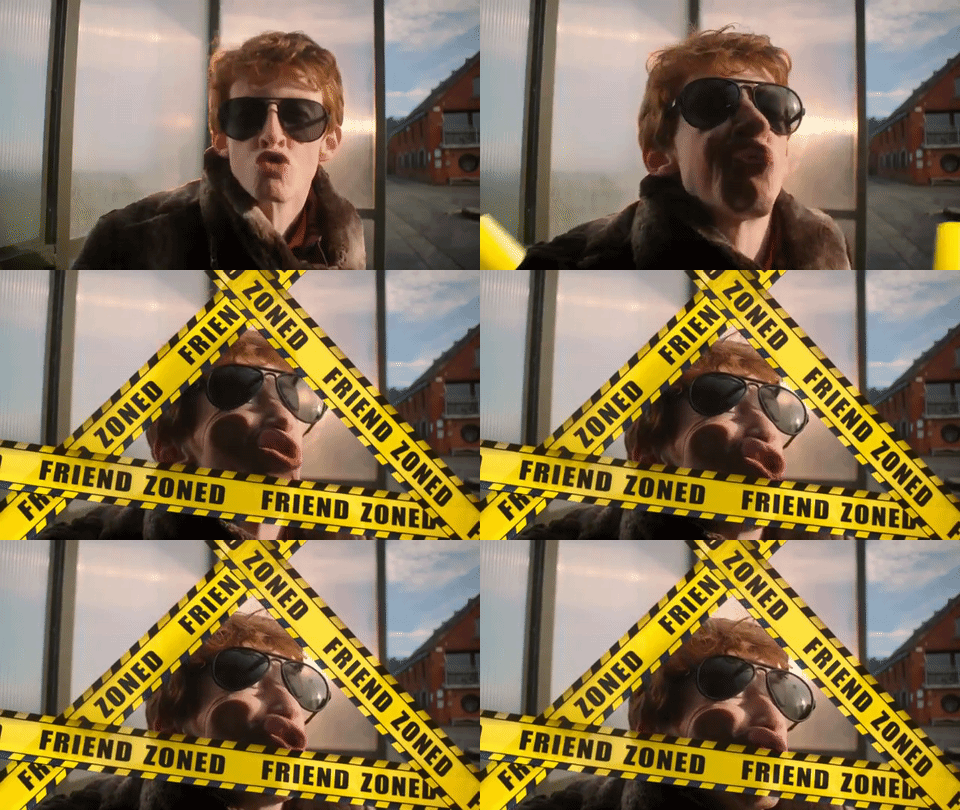
When it comes to romantic situations, this struggle for words is multiplied tenfold! With so many conflicting rules about showing affection or revealing your feelings, as with empathy, sometimes it’s easier to stay silent. I weigh up all the options, assess every social rule, turn myself upside down and inside out over my feelings- and then do absolutely NOTHING about it by default! 😛 Painful as it is, sometimes it just feels like the easiest option. There’s no drama, no outright rejections, no awkward moments…but also no requited love! As a result, I’ve landed myself in the friend-zone more times than I can count! 😛

giphy (17).gif

Over the years I’ve become a little more assertive in this regard. I eventually work up some bit of courage to communicate my emotions, but it’s still a real struggle to get there. I frequently undergo these periods of hyper-analysis prior to opening my mouth!

Advice for SO’s/potential SO’s: Be direct and let us know how you feel. We can’t read between the lines, we struggle to comprehend the rules of love and fathom the games- the direct approach is the way to go. The object of your affections may seem aloof, but they might simply not know how to act on their emotions. Just ask them out- their answer may surprise you 🙂

If my future husband happens to be reading this- when you meet me, no games please! 😛 😉

raw (5).gif

Happy Valentine’s Day everyone! 🙂

bitmoji732211657.png

Aoife

Discussion-Trust, Intimacy and Sexuality

Greetings earthlings! 🙂

As we are approaching Valentines Day, I thought it would be interesting to explore the romantic side of autism a little bit.

bitmoji1582252040

When it comes to romance and the spectrum, this is what most people think of:

Prior to my diagnosis, I too would have pictured this scene.

Asexuality, or lack of sexual attraction/interest, is often associated with autism. However, whilst asexuality occurs more frequently in the autistic community compared with the neurotypical population, one size does NOT fit all.

Stereotype Alert!!! The majority of people with autism are not asexual- we want to experience love just as much as the next person!

In fact, studies have shown no marked differences in sexual interests and behaviours when compared with neurotypicals…we’re just a little bit worse at the whole initiation/communication side of relationships! 😛

b0meq.gif

Our social struggles can make it quite difficult to convey our intentions and feelings in romantic situations. As previously discussed (see empathy), we struggle to identify our own emotions to ourselves, let alone convey them to another person!

According to Asperger’s expert Tony Attwood, there is a tendency among adolescents with AS to seek out the relationship advice we are lacking from rather unreliable sources… Males tend to derive their information from pornography, while girls turn to soaps, rom-coms and books, failing to recognize that these works are not reflective of the real world.

You may think that surely we would be able to tell fact from fiction…. buuuutttt, this is a fairly accurate description. I’ve be been burned this way in the past! Let’s just say that I attempted to apply something I read in a book to reality…and it backfired…spectacularly! 😛

In addition to these social struggles, the sensation of touch can also be an issue for many people with autism in romantic entanglements. Studies have shown that gene mutations associated with autism can cause hypersensitivity to the sensation of touch. As a result, we oftentimes shy away from physical contact, which can give the impression of romantic indifference.

Advice for friends, family & significant others: If we brush off your touch, it’s generally nothing personal. Just be patient. We can learn to condition ourselves to touch over time 🙂

In my own experience, trust can be especially important when it comes to physical intimacies.

Thankfully, I’m not particularly sensitive to touch, but I don’t like people I don’t trust having physical contact with me.

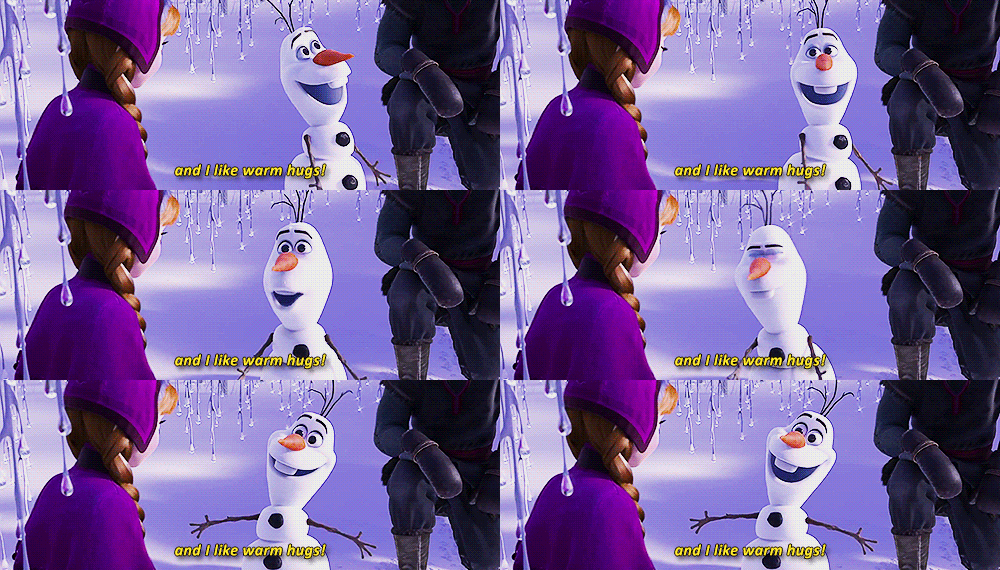
For example, contrary to common autism stereotypes, I very much enjoy a nice hug- but only if I trust/feel comfortable around that person.

9-Frozen-quotes.gif

I’ve always felt that hugs are an intimate experience, so for me to hug someone that I don’t like or trust feels wrong. Over time I’ve conditioned myself to accept unwanted hugs to uphold social etiquette, but my heart’s not in the action.

Many people with autism have issues with trust. In a world that doesn’t make sense , it can be very hard to discern what is trustworthy from what is not. Where black and white thinking is concerned, one bad experience can ruin your trust in an instant.

But ruins can be rebuilt- it just takes a little bit of time 🙂


Considering all these challenges that we face in the pursuit of love, might there be any underlying biological factors contributing to our romantic ineptitude?

Few studies have explored sexuality and relationships in autism, however, from my reading of the research one hormone stands out from the crowd- oxytocin.

Oxytocin, also known as the ‘love’ or ‘cuddle’ hormone, has been linked to autism in a number of studies. Research has shown that levels of oxytocin are dysregulated in individuals with autism.

This is basically a fancy science term meaning that our oxytocin levels are out of sync! 😛 😉

Oxytocin is thought to contribute to a human’s ability to effectively socialize. For example, studies correlate oxytocin levels to degree of social functioning where low oxytocin levels are linked with diminished social functioning and high oxytocin concentrations are associated with augmented social functioning.

Evidence suggests that levels are lower in cases of autism, with the lowest concentrations in low functioning forms and higher concentrations in high functioning cases.

Oxytocin is perhaps best known for it’s role in the formation of emotional bonds, as it is released when we cuddle up to or bond socially with a person. Research suggests that it even plays an important role in emotional bonding with man’s best friend, with levels rising in both owner and pet after several minutes of stroking! 🙂

giphy (15).gif

Oxytocin has further been shown to increase trust in humans, so it stands to reason that lower oxytocin levels present in autism can make it harder to trust, interact with and connect with a person romantically.

Moreover, recent studies indicate that oxytocin also plays an important role in the strengthening of negative social memories. It appears that following a stressful social encounter, such as bullying or romantic rejection, oxytocin activates a part of the brain which causes the memory to intensify, promoting anxiety and fear in similar situations.

Seeing as oxytocin is dysregulated, this could also explain why autists find romantic situations difficult. I’ve certainly found that previous failures in this area have made me quite hesitant to reveal my feelings to guys for fear of reliving those moments!

Autism, like love, is truly complicated 😛

In keeping with my Valentine’s theme, I’ll discuss love and the spectrum in greater detail on Monday! 🙂

bitmoji7867777.png

Aoife


Discussion-Neurodiversity

Greetings Earthlings! 🙂

Today I’m going to discuss the movement of neurodiversity within the autistic community.

Originating in the late 1990’s, neurodiversity is a concept which suggests that neurological conditions such as autism, are simply a variation in thinking or wiring, rather than a disease that needs to be cured.

Think of iPhones and Windows Phones- both perform similar functions, but each have different circuitry.

Neurodiversity advocates that neurological differences should be considered a separate social category (such as sexual orientation, gender and ethnicity) and respected as such.

The movement is represented by this symbol:

Autism_spectrum_infinity_awareness_symbol.svg.png

^^^ These colours make my brain happy 🙂 😉

Further to this, neurodiveristy classifies people as being either ‘neurotypcial’ (exhibit “normal” cognitive functioning) or ‘neurodiverse’ (autistic).

In a nutshell- neurodiverse people are wired differently, so we think differently; BUT, this difference is the same as any other genetic variation- like having blue eyes or brown.

You follow? 🙂

raw (9).gif

However, this movement is seen as controversial and problematic in some circles as this broad term covers both low and high functioning forms of autism. It is thought that the concept of neurodiversity is skewed in favour of higher functioning and milder forms of autism.

This is a tricky one, but not necessarily relevant.

Let’s look at the case of Iris Grace, an autistic child artist.

Iris at 7 years old, is world-renowned for her astonishing and mesmerizing paintings, however, Iris has severe autism. Indeed, she struggles greatly with speech and communication, but her paintings are truly the product of a gifted and neurodiverse mind.

You can see Iris in action below:

Neurodiversity is central to one of the biggest discussions in the autistic community- the search for a cure.

Now if we consider neurodiversity to be a regular genetic variation, this begs an important question- should we be seeking a cure for autism?

Think of the Windows Phone again. Sure it’s not as slick as the iPhone and doesn’t have the same range of apps, but you wouldn’t try to change it very much would you? Updates can be installed to improve the model, but ultimately we accept that a Windows Phone will never be an iPhone. We see them as a separate smart phone category- individual in their own right.

Ironically, I’m a Windows Phone girl in real life! 😛

(^^^Update- Withdrawal of apps has since forced me to go Android 😦 )

If we can accept diversity in the world of electronics, why then do we seek to expunge it from the human race?

The autistic mind is wonderful and unique in its own right. With it comes new insights, quirks and ideas, unique gifts and talents. If we endeavor to cure the autistic community, do we risk the destruction of this uniqueness?

Personally, I would not wish a cure for myself. Don’t get me wrong, there are indeed times when life would be much easier if I could be just like everyone else, but I wouldn’t have my brain any other way.

If I had to pop a camouflage pill everyday to pass for “normal”, how could I still be me? If you took away my autism, would I still see the world as a source of infinite curiosity? Would I still have the same talents and interests?

A family member asked me shortly after my diagnosis, what was I going to do now? What was my plan- as if I had some terrible disease! 😛

Neurodiversity challenges us to rethink our perceptions of autism. It should not be seen as something to be cured, but managed with love and support.

Leading autism expert Simon Baron-Cohen once said that:

“having autism [is] like being a fresh water fish in salt water. In that environment, [we] are disabled. In the right environment, the disability reduces and [we] not only blossom but can fulfill [our] potential.”

It is not autism that needs to be cured, but our attitudes towards it.

And yes for those of you wondering- he is the first cousin of this guy 😉 :

a7a2de36832ad4261de3c440afb8b3fe74f217f77188d61818274587cbc8e23d

Freshwater and saltwater fish, Windows Phones and iPhones, neurotypical and neurodiverse- these are all natural variants.

What makes one more desirable than another? Why should one be changed while the other stays the same?

At the end of the day, “normal” is subjective.

Autism is my normal-why would I ever want to change that?

No cure? No cure needed.

bitmoji-1537264962.png

I may not want to change my brain, but hopefully I can help to change people’s perceptions of autism with this blog.

Autists may think in black and white, but autism itself is a spectrum of colour 🙂

Aoife

Discussion-Emotions and Empathy

Greetings Earthlings! 🙂

Today I’m going to talk about one of the most prominent stereotypes for people with autism- that we don’t feel emotion.

We struggle to empathize, and as such, we are often perceived to be emotionless robots.

Nothing could be further from the tru-

Kill….Aoife must KILL…!’

So sorry about that… I don’t know what just happened! Now where was I?

giphy-13tumblr_lwnfdj8ah31qzdf0go1_500giphy-12

Ah yes- murder…I mean emotions! 😉

The notion that autists are incapable of experiencing or showing emotion is entirely false.

In reality we feel too much, so much in fact that we have difficulty processing what we are feeling.

When I’m feeling something, I have a tendency to get overwhelmed by the emotion. Where a normal person may demonstrate no physical response to their feelings, I will likely dissolve into tears.

This may sound normal enough in certain emotional situations…but not for all!

Exhausted? Tears!

Frustrated by maths homework? Tears!

Holding a puppy? Tears!

Just hearing the Disney overture? Tears!!!

The smallest of emotions can completely trigger the waterworks because I simply feel the emotion on a much greater scale. Going to musicals can be a real problem- from the moment I hear the first note I have to catch my breath and swallow hard to keep the floods at bay! 😛

mean_girls_i_just_have_a_lot_of_feelings

As you can imagine, I’ve spent much of my life as a blubbering mess, but you gradually learn to get a better grip on your emotions 🙂

This past year in particular must be a new record for ‘least amount of time spent crying for no good reason in public‘! 😛 😉

Advice for friends and family: While this behavior is normal, try not to be too dismissive of it. With this emotional hypersensitivity can come a lot of mental anguish. I was branded a drama queen so often that when I was genuinely suffering, very few noticed.

In addition to emotional processing, autists can often struggle to identify and/or describe the emotion that they are feeling.

This is known as alexithymia.

You find yourself gripped by emotion, knowing that you feel something but haven’t the slightest clue what that something is! It can take days, months, sometimes even years to pinpoint what the emotion is in my experience.

Alexithymia makes it difficult for us to not only identify or describe our own emotions, but also to distinguish and appreciate the emotions of others. This is why we often struggle to show empathy. We are not incapable of empathy (scientists have found our emphatic response to equal that of normal peers in areas of moral dilemma, showing even greater responses at the thought of harming others), but we find it hard to correlate your emotions with our own.

For me personally, I often find that in order for me to effectively empathize, I must have firsthand experience of the emotion.

Certainly this has been my experience with grief.

Growing up, I was quite fortunate in that I didn’t lose anyone close to me. As a result, I never really understood how to show empathy or relate to someone going through this experience. Sure I had been to my fair share of funerals, but I never had to interact with mourners.

This caused a lot of problems as a teenager at school…

Tragedy struck, and I did not respond appropriately. I didn’t know the parties involved and as such I carried on as normal with my schoolwork, much to the chagrin of my peers. I knew that the situation was sad yes, but I felt no impact. To my mind I saw no reason to stop the world.

I was branded heartless and widely criticized by teachers and pupils alike, all because I simply couldn’t understand what I had never felt.

It took the death of my dog Oscar to help me appreciate how others felt. For much of my teenage years, I felt as though he were my only real friend, so naturally I was devastated when he died.

Okay, I know he wasn’t human, but that didn’t diminish my experience of grief.

Now when I see other’s grieving, I struggle not to cry to seeing them in pain. Even watching old films from my childhood that never made me cry in the past now leave me in floods of emphatic tears!!

giphy (9).gif

But even with this newfound understanding, I still struggle to convey empathy.

I can see that you’re upset, but I’m never sure of what the appropriate response should be. Do I hug you, hold your hand, touch your arm etc.? One person may want me to hold their hand, another could shove me if I try to comfort them in the same way.

It’s extremely confusing!

I want nothing more than to take your pain away, but I just never know how to show you that.

Sometimes it’s just easier to do nothing rather than the wrong thing.

We may appear cold and aloof, but it’s a very different story on the inside (like a reverse baked Alaska! 😛 ).

Proof if ever there was that you can’t judge a book by it’s cover! 😉

Aoife

Autism 101-Lesser known ASD’s

Greetings Earthlings! 🙂

Today’s post is going to be short and sweet exploring two of the lesser known ASD’s:

  • Pervasive Developmental Disorder-Not Otherwise Specified (PDD-NOS)
  • Childhood disintegrative disorder (or Heller’s syndrome)

1f56201fec8c07fca69952fb509a7459.gif

I know… these are a bit of a mouthful, but once you get past the names they’re not that difficult to understand 🙂

Pervasive Developmental Disorder-Not Otherwise Specified (PDD-NOS):

As discussed in my Intro to the Spectrum, a pervasive developmental disorder impairs normal growth and development of the brain resulting in a wide range of effects (i.e. autism). PDD-NOS is basically a catch all term to describe individuals who are on the spectrum, but do not fit the criteria for specific ASD’s.

So if you had some of the traits of Asperger’s syndrome for example, but didn’t fully fit the bill, you may be given a diagnosis of PDD-NOS.

This is often referred to as atypical autism.

Childhood disintegrative disorder/Heller’s syndrome:

Childhood disintegrative disorder (CDD) is a rare ASD, estimated to be 60 times less prevalent than classic autism. In comparison to other ASD’s, this low functioning form of autism is quite unusual in it’s late onset.

Children with CDD appear to develop normally before suddenly showing signs of developmental delay around 3-4 years of age. In some cases, there are even reversals in development with loss of speech, motor skills and social function- as if someone hit the rewind button in your brain.

giphy (7).gif

This is known as regressive autism.

Discovered 35 years prior to autism, to this day, doctors remain baffled as to the cause of this condition.

So there we have it- not quite as complicated as the names suggest 😉

As this is a little more clinical than some of my other posts, I’d like to end on an encouraging note.

Last year, some of you may have come across this viral interview with actor Channing Tatum:

In the video, Channing is interviewed by Carly Fleischmann- a remarkable young woman with non-verbal autism. As a child, Carly was diagnosed with autism, cognitive delay and oral-motor apraxia (the inability to properly coordinate oral movements for speech). At first, such a diagnosis appears devastating, but in this video, Carly proves an ASD diagnosis is not the end of the world.

Through years of persistent therapy and hard work, Carly found ways to communicate by typing with one finger. Although still confronted with the serious challenges of autism, in this video, Carly achieves her dream of becoming the world’s first autistic, non-verbal chat show host! 😀

giphy (10).gif
When a diagnosis of autism is given, it can be difficult to remain positive. Unlike Dante in Inferno however, we need not abandon hope.

It very much exists.

Whatever your spectrum diagnosis may be, Carly’s story shows that we can succeed in spite of our difficulties 🙂

Aoife

Abbreviations: ASD- Autism spectrum disorder


Autism 101- Specialist Interests

Greetings Earthlings! 🙂

Today I’m going to expand on the topic of specialist interests (SI’s).

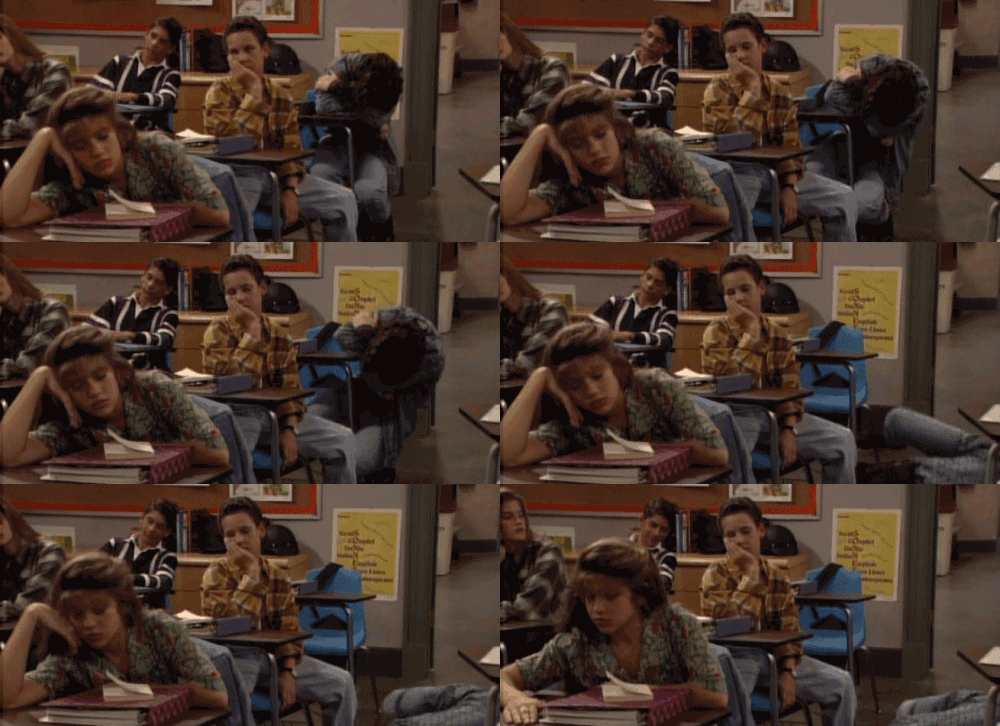
SI’s are one of the defining features of Asperger’s syndrome in particular. Hans Asperger originally described us as ‘little professors‘ due to our ability to talk about our interests in great detail- often droning on in lengthy lectures, completely oblivious to our bored audience….

http-%2f%2fmashable-com%2fwp-content%2fgallery%2f25-exhuastion-gifs-for-when-you-cant%2fboy-meets-world-sleep

….so I’ll try my best not to bore you today 😛 😉

As discussed in the previous post, specialist interests are subjects which autists are intensely preoccupied with. These are generally associated with higher functioning forms of autism, but have also been noted in lower forms. Interests can be random items (e.g toilet brushes and deep fat fryers- I have genuinely come across these examples in a research paper!), subjects that are unusual to focus so intently on (dinosaurs, trains, Star Trek etc.) and finally topics that overlap with the hobbies of normally developing peers (horses, music, gaming etc.).

Women in particular tend to have SI’s akin to those of their peers, which can make it harder to diagnose them.

This would have been my experience of SI’s. My most intense interest growing up was that of Harry Potter. It would have been seen as perfectly normal to be ‘potty about Potter’ as a teenage girl during the noughties, but few would have shared my intensity.

This intensity is the major difference between normal ‘fandom’ and SI.

Unlike fandom, your interest can entirely consume you. It’s like an addiction- you are hooked on your interest. It’s not a case of want, but you physically HAVE to get your fix. If you don’t get it, your brain feels like it’s going to explode.

If I didn’t get to see the latest Harry Potter film at the first possible showing, it literally felt like the end of the world. I once made a phone call to my mother after seeing gameplay footage for Harry Potter and the Chamber of Secrets to say that I needed the game NOW (why Aoife!)…even though I knew it was under the tree for Christmas!

But I just HAD to have it in that moment!

Oh but when I got that game- what a feeling!! Even better when I got to experience TWO different versions of the game on both PC and PS2!!!

Talk about shooting up on dopamine! 😀

It’s a little difficult to explain the feeling in words. It’s not just a sense of happiness or excitement, it’s like the atomic bomb version of Beatlemania has gone off in my head- if that makes sense?

Let me try to explain the feeling with gifs, I think these sum it up better:


If you combine all of these at once- that’s what it’s like in my brain.

Kind of a miracle that it hasn’t full on exploded yet 😛

Your interest is more than just obsession- it’s compulsion. Every time that I saw a still from the Harry Potter films in a newspaper or magazine, I was compelled to cut them out to add to my collection. It didn’t matter that I had the same picture six times already, I had to have it! If I didn’t get it, I would genuinely torture myself about that one lost picture, or missed TV special for years afterwards! Even now the residual memory of those missed moments still bother me! 😛

As with all addictions however, you can take things a little too far to get your hit…

One of the most memorable examples of this was my dedication to reading the latest Harry Potter books. Determined to be the first to finish the book, I would read in the car! This doesn’t sound too extreme at first….however, I can get motion sick from looking down while travelling in the car… but I didn’t care!

I read until I threw up and then read some more!!

In addition to this, I was also caught sneaking into my mothers room in the dead of night to nab the Half Blood Prince from her after the midnight opening! 😛 Luckily, we had the sense to buy two copies for the Deathly Hallows midnight release 😉

Such are the lengths we are willing to go to for our specialist interests. You become so intensely focused that you are often blinded as to the lows to which you sink…

penny-needs-help-for-her-computer-addiction-on-the-big-bang-theory

In addition to subjects, people can often become SI’s- especially in women. I’ve definitely been guilty of this at times.

You connect with a person, and like other areas of interest, you want to know everything about them- even the things that are socially unacceptable to ask! When you spend time with that person, it’s never enough. If you see them hanging out with other friends on social media, you feel a pang of regret/jealousy that you weren’t there- as genuinely irrational as you know your feelings to be. I suppose it’s like any other interest, every missed moment with your friend feels like a missed concert for your favorite band- a one off event that can never be recaptured.

You know you’re obsessing and that you shouldn’t feel like this, but you just can’t seem to stop yourself.

mean-girls-obsessed-gif.gif

Even worse when you inadvertently cling on so tightly that you end up smothering your SI…We don’t mean to act like crazy people, but sometimes it happens.

Word of advice to human SI’s: Just wait it out. We’ll move on to our next interest before long. Just try to understand and love your friend as they are 🙂

So why are we so inclined towards these interests?

Scientists are of the opinion that SI’s reflect some of the heightened abilities unique to autism such as systemizing- the drive to explore, analyze or construct a system. SI’s are also thought to correlate to the severity of social impairment in individuals with autism, serving a role in reducing stress and anxiety.

For me personally, I find that SI’s provide a source of comfort. Life can be pretty overwhelming for people with autism, and sometimes we need to escape. In my own life I have found that some of my more intense interests were born of the flames of turbulent times.

When I was 11, we sold my childhood home and I was completely knocked out of sync. This simple change combined with the joyous trials of puberty had a devastating effect on me. My world was, to my mind, spinning out of control, and I wasn’t coping very well. Around the same time, the Hogwarts Express was just leaving the station, and I jumped on board to escape. The books, the films and the games transported me to another world away from all of my problems. Harry Potter gave me a sense of control, an oar to navigate the rapids of life- which is kind of ironic given the intense hold that SI’s can have over us! 😛

For any parents out there reading this, don’t worry too much about our SI’s. This is perfectly normal behavior! 🙂 And if you’re sick of hearing about your child’s subject- they’ll move on eventually 😉

Top Tip- Experts in the area recommend using  SI’s to encourage your child in other areas they may struggle with. I really struggled to study for my exams when I was a teenager, so my mother encouraged me through an SI- gaming. For every hour of study I managed, I was awarded with an equal amount of gaming time. Before long, I was studying without any incentive at all!! 🙂

DiStPqF.gif

Have a good weekend everyone! 🙂

Aoife
 

Autism 101- Asperger’s Syndrome

Greetings Earthlings! 🙂

In continuation from my previous post, I’d like to introduce you properly to Asperger’s syndrome or AS. More and more frequently are we hearing of the condition, but very rarely is it explained to us. I  myself knew relatively little about the disorder upon diagnosis, and that was with a degree in physiology!

So what exactly is Asperger’s syndrome?

Asperger’s syndrome is a form of high-functioning autism. As with all ASD’s, the normal development of the brain is impaired in AS,  however, the symptoms are considered less severe. For example, the social communication difficulties experienced by those with AS are much milder than other ASD’s. We may struggle to communicate our intentions, to empathize or to make eye contact, but much of this can be learned and improved with time 🙂

Unlike classic autism, individuals with AS show relatively normal intelligence and language skills. AS is in fact often associated with higher IQ’s, and in some cases savant skills (mathematical genius, eidetic memory, musical/artistic genius etc.).

itMcsy5.gif

Stereotype alert!!!- The majority of Hollywood portrayals of autistic individuals depict us as having savant skills. This is a RARE condition affecting between 0.5 and 10% of autists. (So no- I can’t count cards in Vegas with you like ‘Rain Man‘ 😛 ).

Motor development can also be affected in AS. In comparison to my peers, it took me a lot longer to hit some of my finer motor milestones (nearly 3 years to master shoelaces for example). Additionally, people with AS are often quite clumsy- something that I may know a thing or two about…

PeteFallsDownVulture.jpg

It’s gotten to the stage where I fall down the stairs so often that my family rarely come to my rescue (I’ve learned to fall with style sustaining minimal injury)! I’m also quite adept at falling over my own feet…the worst fall of my life came after tripping myself up, and not letting go of the Alsatian I was holding…

raw (8).gif

…at least we were still in the driveway! 😛

Unusual use of language is also associated with AS. This doesn’t mean that we create our own language or anything weird, but that we have a tendency towards unusual turns of phrase.

I, for example, am particularly fond of using big words- ruminate, cornucopia and ethereal are particular favorites! In my head I can’t see why you wouldn’t use a fancy word like ephemeral or fleeting instead of temporary! 😉 Although this did get me into trouble once with my supervisor for using the word ‘multitudinous’ in a research paper…

Restrictive and repetitive behaviors (like OCD) are additionally found in cases of AS.

6405d183a382fb193920ceba696a2ad5.jpg

These can manifest in a number of ways. There is a tendency towards routine in AS for example- we don’t like change and the uncertainty it brings. In a world that doesn’t always make sense, routine offers stability and control.

One of the most striking features of AS is our tendency towards having a specialist interest. These are intense areas of interest in which we accumulate mountains of information about a single molehill! If you stumble upon one of my interests in conversation, advanced warning- you could be there a while! 😛 😉  I’ll write a separate post discussing specialist interests in detail on Friday 🙂

So there you have it- a quick overview of Asperger’s syndrome! 🙂

These are just some of the typical characteristics associated with AS. If I were to fully explore the symptoms today, this post would likely be the length of a book! But I’ll do my best to break everything down for you as I go along 🙂

Aoife 🙂

Abbreviations: ASD- Autism Spectrum Disorder, AS- Asperger’s syndrome, OCD- Obsessive compulsive disorder


Blog at WordPress.com.

Up ↑