Do people with autism look younger?

Greetings Earthlings! 🙂

Leading on my from my previous post about autism and ageing, this week I’d like to discuss whether or not people with autism look younger.

Yep, apparently there appears to be a link between autism and looking younger!

In my own experience, it has been mentioned that I look far younger than my age. I’ve always had a youthful complexion, but I’d just chalked it down to good skincare, genes and the lack of a man to turn my hair grey 😂 Never in my wildest dreams did I think that my autism might be linked to my appearance!

So let’s explore why autists look younger.

As I’ve discussed in my previous post about autism and joint hypermobility, some autists have co-morbid hypermobility conditions such as Ehlers-Danlos Syndrome (EDS). This causes structural tissues like collagen to be weaker and more elastic which causes stretchy joints. However, this increased elasticity can result in a more youthful appearance as the skin is more resistant to damage, which can delay or even prevent the appearance of wrinkles🫨

Facial expressions may also contribute to a youthful visage, as autists tend to produce facial expressions less frequently and for shorter durations than neurotypicals. A less expressive face = less wrinkles.

It’s also possible that our youthful appearance may be more behavioural than biological. A lot of autists tend to be introverted and prefer indoorsy activities away from the elements, especially those with light sensitivity. As a result, lower UV exposure may be preserving our skin from the ageing impact of the sun. My nickname was ‘Dracula’ as a teenager as I would spend summers indoors reading, often returning from sun holidays with little to no tan🙈. On another level, our tendency towards naivety, more childish interests and behaviours can make us seem younger by association rather than looks.

However, while the evidence does seem to suggest autists do look younger, there equally is evidence that some autists look a lot older. As much as EDS increases skin elasticity, it can also lead to thin, fragile skin that can be more prone to bruising, resulting in premature ageing. One study even suggests that autists experience a faster rate of ageing and that they have an older facial age. This may however be correlated to poor self care, lifestyle and the higher levels of biological stress experienced by autists, buuuttt the same can largely be said for neurotypical ageing🤷‍♀️.

Hope you enjoyed this post dear Earthlings! 🙂

Happy Easter!

Aoife

Autism and Boredom

Greetings Earthlings! 🙂

This week I’d like to discuss a topic that many autists struggle with- boredom. We all know the feeling, that mental itch that makes you want to jump out of your skin, but for autists boredom can be so much worse.

Many autists, especially those with co-morbid ADHD, crave constant stimulation. As a result, boredom occurs more easily than neurotypicals. A simple lack of interest in a topic, if a task is too easy, or feeling overwhelmed can trigger boredom and autists will tune out fast. When this happens, it can lead to negative behaviours where an autist will act out and be destructive and disruptive, it might even trigger a meltdown in chronic scenarios (I have had this happen in work following months of tedious tasks🙈).

Boredom has always been a challenge for me. I constantly need to be working on something. In school I often got in trouble for reading/drawing/writing during class as I would get ahead of my work and need to keep my hands busy while waiting for the lesson to move forward. If anything they should have encouraged my habit for productivity in my downtime! 🤷‍♀️

But what does the science have to say?

As I’ve discussed previously, autists have higher levels of stimulating neurotransmitters and lower levels of calming neurotransmitters, so their neurons are firing excessively in the brain. When they aren’t able to channel this excess stimulation into something, boredom takes over which can lead to negative behaviours that cause problems. Autists also have dysregulated levels of the neurotransmitter dopamine- the chemical involved in motivation, pleasure and reward systems. When dopamine levels are low, motivation is low, so when an activity is not enjoyable, autists won’t have the brain power to engage and boredom will set in.

On another level, there have been reports from doctors claiming that FMRI scans of ADHD brains show that areas of the brain associated with pain light up when they experience boredom, suggesting that boredom might actually be a painful experience for neurodivergents. However, other neuroscientists have refuted this claim as the human pain response largely remains a mystery, so making this assumption from the data is a bit of a stretch.

Hope you enjoyed this post dear Earthlings!

Have a lovely weekend!

Aoife

Teaching a Student with Autism

Greetings Earthlings! 😀

This past week it’s been brought to my attention that I’ve written very little about autism and education/schooling (don’t know how I missed that 🫢), so for the next couple of posts I’d like to dive into this important topic. I’ve previously discussed the topic of learning and autism, so today I’m going to focus in on some pointers for teaching students with autism.

There are so many different pieces of advice for teaching an autist, but here are a couple of the stand out items based on my schooldays:

  • Find positive ways to keep them stimulated– I have a tendency to get bored pretty easily, which would happen a lot in school once I had completed my work. I’d often take out non-school books from my bag to read, or scraps of paper to write and doodle on to keep my mind and hands busy. Buuuuut some of my teachers didn’t like it, and confiscated my stuff 🙈. I understand it feels like an insult to the teacher and the lesson plan, but many autists have ADHD and need stimulation in these moments of downtime. If you notice that your student has a tendency to race ahead of the class, keep extra worksheets or puzzles around, encourage them to read a book (you could recommend a book on the class subject), do their homework or revise something for a test. If they’re already being productive as I used to be, leave them be- check in if you feel they’re not working, but if they aren’t causing trouble let sleeping dogs lie
  • Avoid routine disruption (if possible)- I know this can’t always be helped as schedules change from day to day, but try not to rock the boat where possible. In my experience, I was generally fine with changes to timetables, as long as I had advanced notice. Fire drill during Maths? Fine. A talk from a guest speaker during PE? Super. But drag me out of class when I was already settled in the middle of something… During my final year of secondary school, I had just settled down to my painting in double Art when a teacher pulled me out for a meeting about an upcoming debate (which I was already doing under duress). Well…I threw my paintbrushes down in frustration, I stormed into the meeting with my sleeves up and my apron on and I maaaaayyy have given out to him for interrupting me🙈 I get it, teachers have to try and organize extra curriculars around their free periods, but plucking an autist out of class without warning is best to be avoided (unless it’s something they hate, like if I’d been taken out of Business class😜). Try to catch them between classes and give advanced warning if you can
  • Try to understand their behaviours and perspectives- growing up undiagnosed, I was very lucky with the school that I was in. As a rule follower I didn’t generally have behavioural issues in class, buuuut as any autist will tell you, you’re not in a rational state during a meltdown. I had moments where I acted in ways that would have garnered a note home or detention for other students, but thankfully as I was a good student that was frequently bullied, my teachers put it down to stress and looked the other way. Now I know that we can’t look the other way for everything, autists have to be held accountable like everyone else, but take the time to try and understand the situation and assess why something might have happened. If they didn’t get homework done for example, it could be that they didn’t understand it, or were too overwhelmed. Giving out for non-completion won’t help anyone, but if you take a moment to talk to the student, the issue could be resolved calmly, and may help you to better support them in the future
  • Avoid sarcasm- autists can be so literal, it’s best not to use sarcasm to avoid any issues on clarity. When I was a teenager, we were discussing entering a drama competition in class. I can never remember the exact sequence of events and context, but my teacher seemingly asked me to write the play. I was so excited when I went home feeling privileged to have been asked. In the end however, I got busy, the teacher never circled back and so I never wrote anything. After years with this teacher I eventually realized that she was quite sarcastic. To this day, I still don’t know if the request was genuine or if it was a sarcastic comment to something stupid I said (and with my lack of filter that’s highly likely 😛 ). There were many other incidents with sarcasm and teachers which left their mark, so if you know/suspect that you have a spectrum student, just avoid it
  • Keep your cool, be kind, and don’t let them see you frustrated– this one’s a biggie. I know for a fact that I was difficult to teach at times, and you know how I knew? My teachers didn’t always hide their feelings. It made me feel awful, especially when I would be put down for being myself, never really understanding why they were mad. In one particular incident, I was struggling with a mathematical concept as a young teenager. I didn’t get it immediately and I had a crying meltdown. The teacher went over the concept a second time on the board, and when I still didn’t get it, she was annoyed and frustrated, and angrily moved on implying I was stupid for not getting it. Naturally I understood it perfectly after I had calmed down and my friend went over it slowly with kindness and patience. That incident stayed with me for many years. In Freya Harte is not a Puzzle by autistic author Méabh Collins, this book is full of similar moments like this, moments that can be devastating for a vulnerable student. I know how hard it can be to teach a ‘Me’, I have found myself equally irritated by autists like myself, but you can’t let them know. Patience and kindness are the biggest tools in your arsenal

This list of tips for teaching autists is also a really helpful resource, especially for teachers at the primary level: http://capacity-resource.middletownautism.com/wp-content/uploads/sites/6/2017/04/21-Tips-for-Teaching-Students-with-Autism-Spectrum-Disorders.pdf

As I am high functioning who was largely educated undiagnosed, I can only speak to my own experience. No two autists are the same, what would have helped me may not work for someone else, but I hope you find this post helpful nonetheless 🙂

Hope you enjoyed this post dear Earthlings!

Have a lovely weekend! 🙂

Aoife

Autism and ‘Pebbling / Penguin Pebbling’

Greetings Earthlings! 🙂

This week I’d like to discuss another more unusual autistic behaviour- pebbling.

Ah Aoife, you must be making these up now!

You couldn’t be more wrong!

Before I lose you completely, let me explain.

Pebbling is where an autist spontaneously shows their loved ones affection through thoughtful gestures and tokens. The behaviour is so named as it mimics the act of pebbling in penguins. Gentoo penguins mate for life, so when a male penguin is interested in a female, he will collect, smooth shiny rocks for her as part of the courtship ritual. If she is interested, she will use the pebbles to build a nest to lay eggs in. Here’s a clip of the penguins in action:

Autists often struggle with social interactions and displaying affection, but pebbling can be our way of making up for it. ‘I love you’ isn’t always easy to say, but pebbling does the talking. It’s our way of showing we love you and are thinking about you- a unique form of affection, communication and connection.

Personally, when I heard about pebbling, I immediately identified with it! I’ve been unconsciously pebbling the ones I love my entire life. If I’m out shopping, I will often pick up little trinkets that remind me of my loved ones and their interests, or I might grab their favourite treats to bring home. Other times I might bake their favourite sweets for no reason, or craft them something they might like, or just a simple gesture like offering to do something for them.

This video explains it pretty well:

Not all autists display pebbling behaviours, and pebbling can take various forms, but it’s a pretty cool way to show love to the people you care about 🙂

Hope you enjoyed this post dear Earthlings!

Have a lovely weekend! 🙂

Aoife

Autism and T-Rex Arms

Greetings Earthlings! 🙂

This week I’d like to talk about a somewhat unusual aspect of the spectrum that has been brought to my attention in recent months- T-Rex arms.

Yes- you read that correctly, and no I have not joined the spectrum dinosaur brigade (I don’t think I’ll ever understand the fascination 🙈).

So what on earth are T-Rex arms?🦖

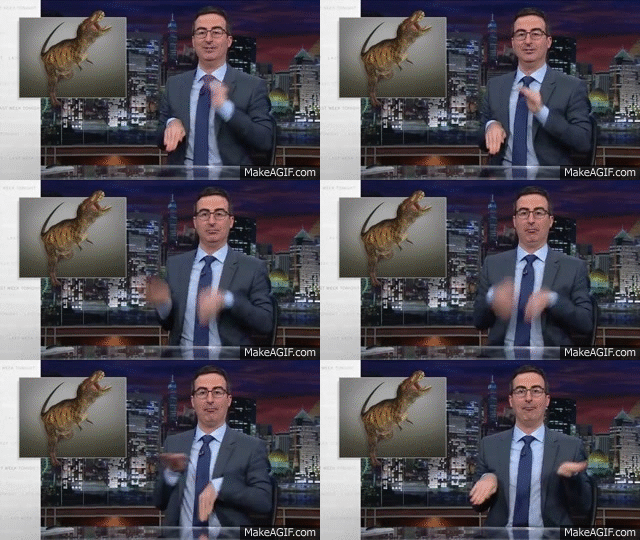
Well, it’s pretty much what it says on the tin. T-Rex arms are when an autist holds their arms in a position reminiscent of the mighty T-Rex- arms shortened and tucked into chest, hands bent forward and curled in like claws.

Ok… but how does this behaviour relate to autism?

This unique posture is commonly observed in autism (and in some overlapping ADHD cases) with many autistic and ADHD content creators poking fun at the behaviour. Since I’ve been made aware of this phenomenon, I keep catching myself holding my hands in this position at random times- most notably when I’m in the middle of a busy task like baking or cleaning.

So why do we do it?

The reasons are quite varied. Some autists say it’s because it feels natural and comforting, some say it’s because they don’t know what to do with their hands. Others, like myself, see it as more of an accessibility issue, where you keep your hands close to your chest ready for action mid-task, or a spatial issue where you have greater control of your hands by clutching them close rather than at your sides.

But is there a scientific reason?

Here’s where things get interesting. Scientists think that T-Rex arms are a form of stimming, so it’s likely to be a sensory related behaviour. They believe that autists keep their arms close to their chest as a natural coping mechanism to comfort and calm when experiencing sensory overload. In some cases T-Rex arms can be viewed as a sign of impending sensory overload, a form of non-verbal communication that experts advise parents to look out for so that they can anticipate a meltdown and take action as needed.

T-Rex arms have been particularly linked to sleep, with many autists adopting this position when they lay down at night. Experts believe that this helps neurodivergents to relax and sleep better, kind of like how weighted blankets work on the nervous system by applying deep pressure to release calming neurotransmitters. Maybe this explains why I often wake up with numb arms in the morning 🙈😂🦖.

Hope you enjoyed this post dear Earthlings! 🙂

Have a lovely weekend!

Aoife

Blog at WordPress.com.

Up ↑