Autism and Weighted Plushies/Toys

Greetings Earthlings! 🙂

In continuation of my previous post about weighted blankets for autists, this week I’d like to discuss another weighted item- weighted plushies!

I’ve always had a fondness for soft and cuddly bears (gotta love that texture 😉 ) so when I found out that they made weighted plushies I just had to give it a whirl! I bought Sleepy the Sloth (or as he’s been renamed in our house SĂ©amus the Sloth, which we thought suited him better) on Amazon a couple of weeks ago to see how I fared.
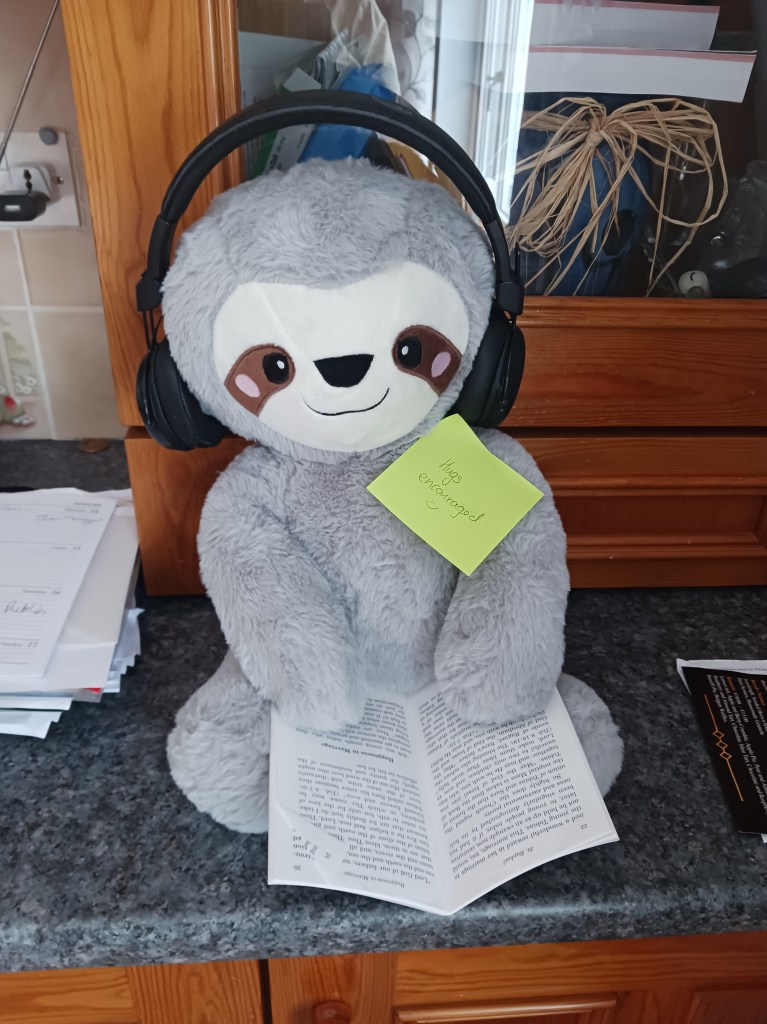
My sister had some fun staging him one night while I was out at a concert 😂

But first things first, what exactly is a weighted plushie?

A similar product to weighted blankets, weighted plushies are filled with beads or pellets instead of conventional stuffing to exert calming deep pressure to the skin to mimic the effect of a hug. Weighted plushies are usually much lighter than weighted blankets (SĂ©amus is 1.5kg and my current blanket is 7kg) so they are a much more portable option when on the go with a child with autism. There are also heatable versions that you can put in the microwave so you have the double whammy of soothing weight and heat. Disney have even launched a line of weighted plushies so your favourite characters can be used for sensory relief! 😀

So how does it work?

Like weighted blankets, research is limited but they seem to work through the same mechanism. As I’ve discussed previously, autists have higher levels of stimulatory neurotransmitters and lower levels of calming neurotransmitters, meaning that our brains are more “switched on” and harder to turn off than most. The deep pressure exerted by the plushie is designed to stimulate the release of the calming neurotransmitters serotonin (which helps regulate the sleep cycle and temperature) and dopamine to relax and soothe the racing mind. It’s also thought that deep pressure can stimulate the limbic system, the emotional centre of the brain, which could potentially help calm you down during a meltdown.

So how did I get on?

Aside from all the fun we’ve had playing with SĂ©amus, he really provides a lovely sensory experience. It’s reminiscent of having a sleeping puppy on your chest when you drape him round your neck, (minus the warmth, wriggling and gentle snuffling sounds). You get that same sense of calm wash over you like with the weighted blanket, so it’s great for when you’re sitting watching TV or travelling and need something less cumbersome. However, a plushie does not cover the entire body, so it doesn’t quite have that same fully enveloping sense of relaxation that comes from being completely covered by a weighted blanket.

All in all I would highly recommend giving a weighted plushie a try, but they can be a little pricey, so if you’re buying it for a child be sure to involve them in the decision in case they don’t like the animal/character you intend buying.

Hope you enjoyed this post dear Earthlings!

Have a lovely weekend! 🙂

Aoife

Autism in Girl Meets World

Greetings Earthlings! 🙂

This week I’d like to discuss the depiction of autism in the Disney + coming of age comedy series ‘Girl Meets World‘ (the spin-off/sequel to the 90’s classic ‘Boy Meets World‘) in an episode from 2015 that has been doing the rounds on Tik Tok in recent months.

The clip from the series depicts the shows protagonist Riley and her group of friends finding out that their best friend Farkle may be on the autistic spectrum, specifically he may have Asperger’s syndrome. Farkle was recently given an aptitude test that affirmed, what he always knew, that he is a genius. Following additional tests to confirm his IQ, it was decided that he should also be tested for autism as he presents with many traits such as touch aversion, social awkwardness, specialist interests etc. (we won’t get into how they automatically jumped to spectrum from a genius test 🙄).

Now while it’s great that such an important topic is getting airtime on a channel as big as Disney, the clip has been viewed quite negatively by the autistic community. After telling his friends that he may have autism, their reactions are somewhat overdramatic. Riley’s friend Maya automatically jumps off the couch and vehemently proclaims “You don’t!”, while Riley similarly jumps up saying “Let’s go tell them you don’t!” Moreover, Riley and Farkle’s parent’s set quite a serious and sombre tone in the room about his potential diagnosis which doesn’t help the vibe. Although not included in the original viral clip, the gang later study up on Asperger’s and every time that Farkle agrees with a trait and gives an example, Maya grabs him and tells him to “Stop doing that! He’s going to stop doing that!” Needless to say, autists everywhere have been highly offended by the reactions as they are treating autism like a terminal disease! This has even made many afraid to disclose their diagnosis to their friends based on this reaction (although I would argue that this is an overreaction as my friends have been nothing but accepting and supportive when I have disclosed my diagnosis).

The clip has since been edited/removed, but you can watch the episode in full on Disney + (Season 2 Episode 15). Here’s a clip instead introducing us to Farkle:

Ultimately, it turns out that Farkle isn’t on the spectrum, so there was a whole lot of hullabaloo about nothing, BUT it is revealed later on in the episode that Farkle’s female nemesis (and later girlfriend) Smackle was diagnosed with Asperger’s at 5 years old. She like Farkle is also a genius (whhhhyyy must we perpetuate these stereotypes!!!), with an aversion to hugs, difficulty reading social cues and struggles to make friends. Her depiction is very stereotypical Aspergers male and doesn’t tie in with how most women with autism actually present- although it is nice to see another woman on screen where autistic men are the media majority.

The episode ends with everyone accepting Smackle and showing her that none of them in the group identify as “normal” nor aspire to be “normal”, ending everything on a slightly better note of acceptance- something that most of the online chatter didn’t delve into following the disastrous reaction to Farkle’s potential diagnosis.

All in all, this type of representation is not great, but at least the tone does even out by the end of the episode. It’s a very stereotyped depiction and the initial reaction of the gang can be quite triggering for some autists, but I’ve definitely seen way worse handling of this issue. That being said, this episode does come from 2015 and media depictions have come a long way since then, with many shifting to cast autistic actors for accurate on screen portrayals- like the character of Quinni in Heartbreak High. As with history, we should learn from the past and look to examples like this as ‘what not to do’ so that media portrayals going forward will be far more reflective of the real autistic experience.

Hope you enjoyed this post dear Earthlings! 🙂

Have a lovely weekend!

Aoife

Autism in Tuner and Hooch (TV Series)

Greetings Earthlings! 🙂

This week I’ve been binge watching the Disney+ TV revival of Turner and Hooch, and in the midst of my fading interest in the show (it’s a bit meh, but grand background watching while you’re doing other things), I encountered some autistic characters on screen, so I decided to give my 2 cents on the representation of autism in this series.

Turner & Hooch (TV Series 2021– ) - IMDb

Based on the 1989 film starring Tom Hanks, the series picks up in the present day following Turner’s son Scott as he enters the police force shortly after the passing of his father. Suddenly, his life get’s turned upside down as his father has willed his dog Hooch to him, a police dog in training whom his dad believed to be a reincarnation of his first canine buddy Hooch. Together, Turner and the wayward Hooch embark on a series of wacky adventures, solving crimes and making friends along the way.

Here’s a trailer for the TV series if you haven’t checked it out yet:

So where does autism fit in with the show?

For starters, Hooch’s trainer Erica has an autistic brother Curtis, who helps her out with the police dog training program. We don’t get to see much of Curtis, but as it turns out, the actor who plays Curtis, Jonathan Simao, does in fact have Asperger’s syndrome; so when you are seeing him on screen, you’re getting the real deal.

In episode 9 of the series, we get a much closer look at autism. Scott and Hooch have been assigned to protect an autistic child Anthony, who has witnessed an attack on his neighbour by an assassin, but due to his communication difficulties, he finds it hard to give the police a description. What follows is an endearing episode where Erica is brought in to help Turner and Hooch to communicate with Anthony, where Hooch is instrumental in getting him to open up.

Interestingly, Lucas Yao who portrays Anthony, is a renowned child prodigy and is himself mildly on the spectrum. You can read more about him here. This is very positive to see the show runners employing autistic actors to play autistic roles- something that many in the community have been crying out for.

The episode handles autism with great sensitivity without resorting to overt stereotypes (although having Anthony obsessed with trains is veering a little bit into this territory). It was particularly lovely to see the “paws-itive” impact that Hooch has on Anthony, as studies have shown significant benefits for autists who own dogs as I’ve discussed in a previous post.

While the TV show itself may not be the most thrilling, this was a lovely episode to see, and is a real step forward in screen portrayals of autism.

Hope you enjoyed this post dear Earthlings! 🙂

Have a lovely weekend!

Aoife

Blog at WordPress.com.

Up ↑