Autism and Sensory Socks

Greetings Earthlings! 🙂

This week I’d like to discuss a rather unusual item that can be used for management of autism- the sensory sock! Here’s a picture of what it looks like:
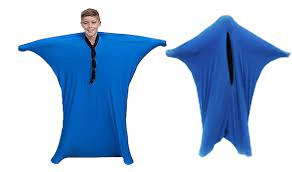
So what exactly is it?

The sensory sock (also known as the body sock) is a stretchy Lycra suit of sorts that is designed to provide a unique, fun and intense sensory experience for autists. Once inside, the suit provides tactile and deep pressure stimulation to the wearer while increasing spatial awareness and improving balance. These sensory inputs can be quite calming for autists which can help us to regulate sensory issues. This can also be used for neurotypical kids to explore their environment and encourage creative movement.

But how exactly does it work?

The stretchy Lycra provides resistance to the wearer as they move around applying deep pressure to the joints which, as previously explained in my post about weighted blankets, causes the release of calming neurotransmitters in the brain, reducing the levels of excitatory neurotransmitters which are elevated in the autistic brain. The enclosed space can help the wearer feel calm and safe, allowing them to regulate their emotions- many autists find enclosed spaces to be particularly therapeutic, so having a portable space like this can be really handy!

I came across the video below of someone trying out a sensory sock online, so naturally I had to get one to try it out!

So how did I get on?

Well…it was…an experience! 😛 While I won’t terrify you with the images of me waddling around my kitchen like a deformed bright green T-Rex, the sock was certainly worth the laugh! My first impressions however, were not the most positive from a sensory perspective. I didn’t really like the smell or the feeling of my arms being so constricted, and found the velcro opening at the front quite distracting as it was reluctant to stay shut (sensory socks don’t seem to be designed for adult women of a certain chest size 🙈). I did try the sock again a week later, but this time I chose to lie down while wearing it which proved to be a much more positive experience. This time I felt the relaxing deep pressure around my limbs that was reminiscent of my weighted blanket. Despite my best efforts, I wasn’t able to bring myself to spend more than a couple of seconds with my head inside the suit. It either wouldn’t stay closed or the smell and claustrophobia got to me so I wasn’t really able to assess that feature.

All in all, I can certainly see the benefits this sensory sock might have for younger autists, but personally I think I’ll stick with my weighted blanket for now.

Hope you enjoyed this post dear Earthlings!

Have a lovely weekend! 🙂

Aoife

Autism and Weighted Blankets

Greetings Earthlings! 🙂

After many posts where I’ve mentioned them, this week, I’ve finally bought a weighted blanket! I have been dying to try one out for years, but they are often quite expensive, usually retailing around the 100-200 euro-ish region for a full blanket. However on a Googling whim, I recently found that Dunnes Stores here in Ireland stocks them for as little as €35, so naturally I couldn’t say no!

So first things first, what exactly is a weighted blanket?

Weighted blankets (also known as gravity blankets) are pretty self explanatory- they are flat blankets that usually contain metal, glass or plastic beads in evenly spaced, quilted pockets across the entire surface of the blanket. The blanket is designed to evenly apply deep, calming pressure to the user across their body, like simulating a hug. As the blankets are weighted, you are also more restricted, making it harder to toss and turn in your sleep. Many of these blankets are even designed to stay cool in summer and warm in winter. For optimal use, blankets shouldn’t exceed 10% of the user’s weight.

But how does this benefit autists?

As I’ve discussed previously, autists have higher levels of stimulatory neurotransmitters and lower levels of calming neurotransmitters, meaning that our brains are more “switched on” and harder to turn off than most. The deep pressure applied by the blanket is designed to stimulate the release of the calming neurotransmitters serotonin (which helps regulate the sleep cycle and temperature) and dopamine to relax and soothe the racing mind. It’s also thought that deep pressure can stimulate the limbic system, the emotional centre of the brain, which could potentially help calm you down during a meltdown.

So how did I find using it?

It was quite an unusual sensation to begin with- as you would expect from having a 6kg blanket pressing down on your body 😛 It’s somewhat of a workout moving it about when making the bed and moving it around the house! 😂 I found it was quite restrictive getting used to the sensation of the blanket on my body and learning how to move onto my side beneath it. It sometimes feels like someone is sitting on your chest at times, but in a good way!

After an adjustment period, I did find that my mind was much slower at night when I lay beneath it. The heaviness mimics that heaviness you experience just before you fall asleep which can be quite hard to resist. In general I found it a lot easier to sleep with the blanket on, and if I did wake during the night, the added weight made it very easy to slip back into sleep again. On the downside however, it can be a lot harder to get out of bed in the morning trying to push off the extra weight if you aren’t a morning person😂 I’ve had some pretty epic naps using the blanket as the weight keeps it from moving and prevents any nasty draughts from getting into your cosy burrito.

It will be quite interesting to know going forward how the blanket may work in a meltdown situation for me in the future.

Weighted blankets are not for everyone however, as they can be difficult for kids to get in and out of bed without the help of an adult They are also not easily transportable for travel so it isn’t the best idea to get a child dependent on them for sleeping. You can however buy weighted lap pads or weighted vests that can be much easier to use for children with autism and ADHD.

Hope you enjoyed this post dear Earthlings!

Have a lovely weekend,

Aoife

Blog at WordPress.com.

Up ↑