Greetings Earthlings! 🙂
I’m going to change things up a little today with a new series examining the portrayal of autism on screen.
Film scholars have remarked that the portrayal of autism on film is generally inaccurate and highly stereotyped, so I’ve decided to take a closer look at things from a personal and scientific perspective 🙂
So let’s start at the very beginning with perhaps the most famous portrayal of autism in cinema- 1988’s ‘Rain Man‘.

For those of you who have not seen the film, ‘Rain Man’ focuses on the relationship between brothers Charlie and Raymond ‘Rain Man‘ Babbitt as they embark on a cross country road trip to Los Angeles (Raymond refuses to fly unless it’s with Qantas- the safest airline in the world!). Charlie grew up without any knowledge of Raymond, only discovering his existence upon learning that his father’s multi-million dollar fortune had been bequeathed to the mental institution in which he resides. And so Charlie sets out to be Raymond’s carer in order to access the fortune, but *SPOILER ALERT*- ultimately has a change of heart. Classic Hollywood ending.
Here’s a trailer for anyone who’s thinking of watching it 🙂
‘Rain Man’ is often considered to be the main reference point for autism on film, as it prompted the breakthrough of autism into the wider conscious of the public. Prior to this, characters displayed autistic like traits in film, but autism itself was not discussed- likely due to the fact that the diagnostic criteria for autism was only just emerging in the late 1980’s. The term ‘Rain Man‘ has also become synonymous with autism and other mental disabilities in popular culture, as seen in this example from the film ‘Miss Congeniality‘ (2000):

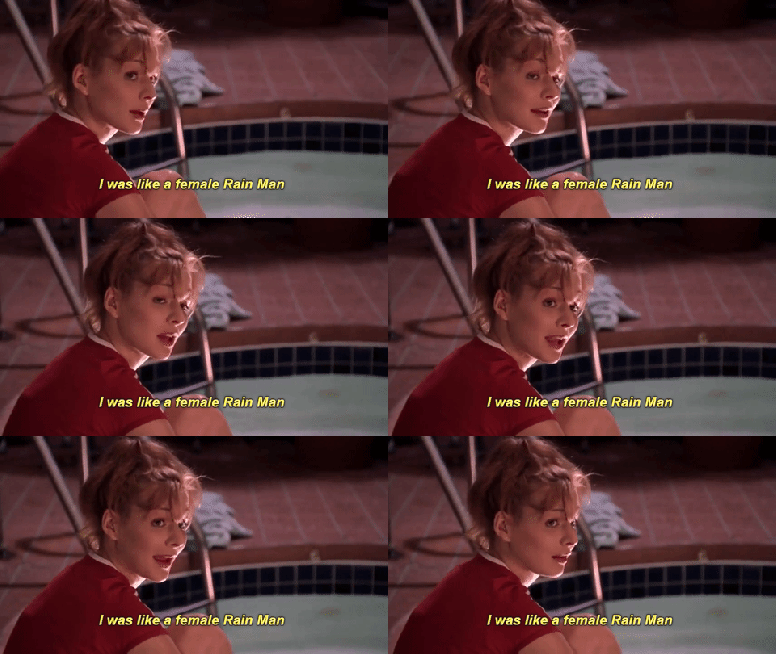
As a “female rain man”, I find this highly insulting, so try not to brand autistic people using the term 😛
Winner of 4 Oscar’s, ‘Rain Man’ has been highly critically acclaimed- but does the film match up to the reality?
‘Rain Man‘ is generally thought to be an accurate portrayal of the autistic condition in scholarly papers. Indeed, there are many areas in the film in which Raymond perfectly demonstrates some of the classical signs of autism- sensitivity to touch, restrictive and repetitive behaviors, specialist interests, coordination issues, deficits in social communication, autistic meltdowns etc.
Interestingly while I thought that I would not be able to relate to Raymond from previous viewings, I found that his literal thinking had me written all over it. There’s a scene in the film (which you can see in the trailer) where Raymond stops in the middle of the road on a pedestrian crossing after the light flashes “DON’T WALK”! I have a terrible habit of dawdling at pedestrian crossings. Oftentimes I can see that the road is clear, but still I’ll wait for the green man (although this may be related to getting clipped on the ankle by a car crossing the road in Dublin as a teenager! 😛 ). However, I’m not as bad as I used to be since learning to drive; hesitation gets you nowhere on a roundabout after all! 😉
The story where Raymond inadvertently burned Charlie in the bathtub as a child (which led him to be institutionalized), also brings back many memories from my childhood. There have been many cases where I have inadvertently harmed my siblings- why just yesterday I threw a foam roller at my sister in an attempt to help her stretch out her legs, only for it to whack her in the throat…oops!
Bad Aoife! 😛

But my intentions were good!!
Acting without thinking is something that I tend to do an awful lot of (probably why I overthink and don’t act when it comes to love 😛 ). My mother had to keep a really close eye on me growing up after she found me attempting to push hair-clips down my sisters throat…I have no real answer for why I did that, but based on similar experiences, I’d say scientific curiosity probably had a role to play! 😛 😉 We’ll explore curiosity and impulsivity a little bit more in the coming weeks.
On the other hand however, this film has largely perpetuated the stereotype that autists typically have superb memories and savant skills. As I’ve stated previously, these traits are rare, and the vast majority of autists do not possess them. The same goes for card counting- a family friend actually inferred that I should be able to do it once! 😛
In addition to this, Raymond is also described as ‘high functioning’ in the film, BUT Raymond is incapable of living independently. Whilst the definition of what constitutes high functioning autism varies, for many, Raymond does not fit the high functioning category and therefore does not come across as a true reflection of autism.
One of the biggest issues here I believe, is the fact that the character of Raymond is based on Kim Peek- a “megasavant” who did not in fact have autism, but FG syndrome (a rare genetic syndrome characterized by intellectual disabilities, low muscle tone and an abnormally large head).

Bit hard to write a film about autism when the inspiration doesn’t actually have autism if you ask me! 😛
On top of this, Dustin Hoffman famously prepared for the role by observing autistic adults for months in psychiatric institutions. However, Hoffman by his own admission describes Raymond’s character as an unrealistic grouped composite of high functioning autists he encountered during his research.
With this in mind, don’t believe everything you see in the movies folks! 😉
When I first got my diagnosis, this film naturally came to mind, however, I really struggled to relate what was presented on screen to my reality. Indeed, ‘Rain Man‘ reflects some of the realities of autism, but not all. ‘Rain Man‘ is an excellent film with superb acting from Dustin Hoffman, but it comes from a time before the ‘spectrum‘ when knowledge of autism was limited.
So when it comes to films about autism remember- autism is a spectrum; one size does not fit all 🙂
Aoife



















 A Is For Aoife Not Autism