Animal Whisperer Autism

Greetings Earthlings! 🙂

Leading on from my previous posts about autism and animals, alpacas, and assistance dogs, this week I’d like to discuss a concept that has been floating around the neurodiversity reels on social media- “animal whisperer autism”.

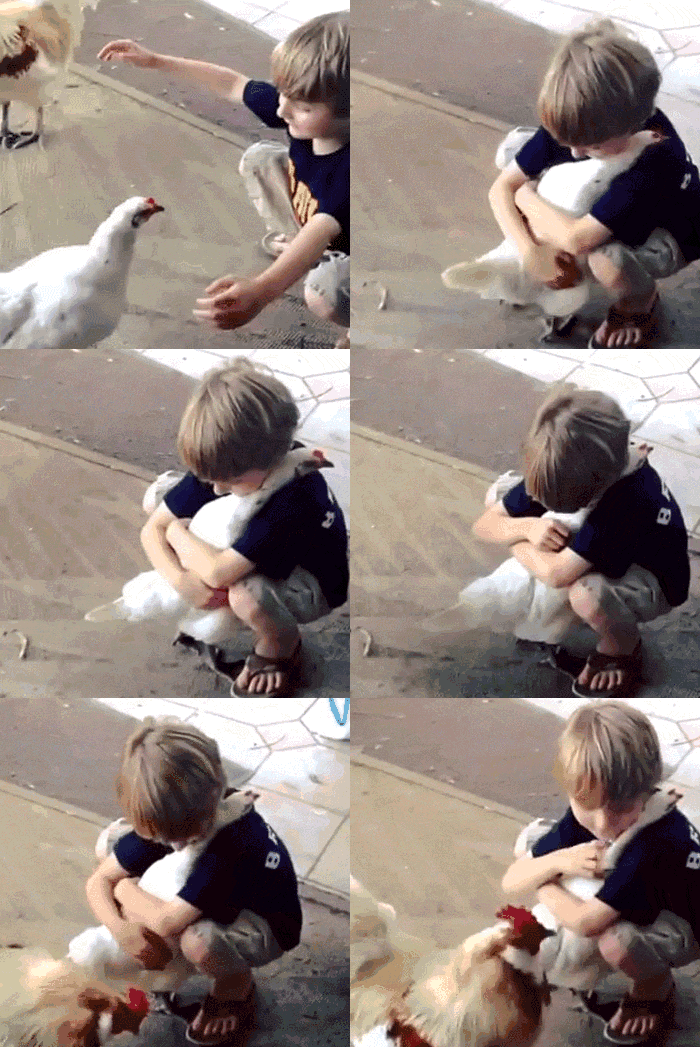
There have been a number of reels floating around where autists claim to have “animal whisperer autism” and not “good at maths autism”, and I have to admit this sums me up in a nutshell 😂 I have always had a love and affinity with animals that has become increasingly apparent in recent years. It’s gotten to the stage lately where random dogs have pulled their owners towards me for snuggles walking down the street! 🙈

It’s not just dogs, all kinds of animals just tend to gravitate towards me- when I’m out walking my dog the local horses, cows and sheep all come up to the gate or follow along beside us in the field as we go. Once I was pulled out of bed to herd some cows that had escaped into our field (I’ve never herded cows in my life), I just walked up to them and they all randomly formed a line in front of me 😂🐄

But is there any explanation for our animal magnetism?

The evidence for this phenomenon is mainly anecdotal, so it’s not an easy one to explain. As I’ve discussed previously, animals have a calming influence on autists, so it’s possible that animals are responding to that calm- like a mutually shared vibe. In addition, studies have shown that some autists have an altered fear response wherein they show less fear than neurotypicals in a scary situation, so where many people might feel nervous around animals, an autist might not have that same fear.
Other explanations could be linked to our intuition and keen observational skills. Temple Grandin, one of the most famous autism advocates, is a leading livestock expert with particular expertise in the area of animal handling. Her observations on animal behaviour and their interactions with their environment have revolutionized humane animal treatment- the ultimate animal whisperer. With animals, there are no confusing social rules or games, so it’s easier for an autist to understand them.

Another wild explanation could be linked to body odour as different smells can control social behaviours. Studies have linked body odour to imitating behaviours in autists where an autist imitates the behaviour of their family in response to smell. If we were to apply this observation to animals, perhaps autists are becoming animal whisperer’s through imitation behaviours where we are subconsciously learning how to socially interact with animals through smell. In other words, the animals could be teaching us how to communicate with them!

However, some autists impaired perception of body odours causes them to misread social cues, so maybe this one is a long shot (or this group are not of the animal whisperer autism persuasion 🤷🏻‍♀️).

Maybe one day researchers will investigate this phenomenon properly. Who knows, maybe there’s a genetic mutation that makes us smell better to animals or some other random biological phenomenon that makes us irresistible to our feathered and furry friends? 🙃

Hope you enjoyed this post dear Earthlings!

Have a lovely weekend!

Aoife

Autism and the Benefits of Animals

Greetings Earthlings! 🙂

We all love our furry and feathered friends dearly don’t we? Seems hard to imagine the internet without funny animal videos these days!

Image result for funny animal gifs

Animals are so important to us that they are not just friends, but an integral part of the family.

For autists, an animal in the home can be this and so much more (#specialistinterest 😉 )!

Research suggests that animals can play a very important role in the social, emotional and cognitive development of children and can also aid the development of empathy. Animals such as assistance dogs (which I hope to write a post on at a later stage), cats, horses, guinea pigs, and interestingly keeping chickens is the latest trend to help improve these skills in the autistic community!

Image result for hugging animal gif

Studies have shown that the social skills of autists who live with an animal are much greater than those who do not have a pet. Pets are often considered “social lubricants” wherein they provide autists with a source of conversation which can encourage better engagement.

Sometimes we find it a lot easier to relate to animals. I’ve often remarked growing up that life would be so much easier if we were all dogs for example. With a dog, life is black and white (fun fact– they aren’t colour blind!). You take care of them, they love you forever-simple. There are no games or tricks (well, unless like my dog yours spins round in circles when you try to brush him to make you dizzy in the hope that you will go away 😛 ), you never have to wonder where you stand with a dog, they’ll make it very clear if they love or hate you!

dfgerhrtsghs

Studies have also shown that animals in fact can have a measurable biological effect on people with autism! A recent study measured “excitement” levels in children with autism when performing such tasks as reading out loud and playing with a group. The results showed that in these situations, the excitement levels were higher in the brain indicating stress. However, when these levels were measured whilst playing with an animal they  plummeted as stroking the animal induced biological calm.

Finally!

Scientific proof that I should spend more time cuddling my dogs!!! 😉


However, as beneficial as animals can be, experts advise that the individual needs and sensitivities of the child are taken into consideration when choosing a pet. A dog might seem like a good idea, but whilst many autists may gravitate towards the soft and furry, others may be repulsed by the texture of their hair, the smell or may even be overwhelmed by their energetic nature.

Aoife’s Top Tip– Try to expose your child to different animals to gauge their reactions before making any firm decisions on a pet- they are a big commitment! The research shows that any pet, even a spider, can be beneficial 🙂

There we have it dear Earthlings- another, scientifically proven reason to love animals all the more! 😀

What better way is there to spend the bank holiday weekend than relaxing with your pet? 😉

bitmoji1415319073

Aoife

Can animals have autism?

Greetings Earthlings! 🙂

Today I’d like to explore something I’ve been wondering about a lot recently: can animals be autistic?

We’ve often been told how closely related human and animal genomes are, but what about our brains?

I often look at my German Shepherd and see a lot of autistic traits in him- he has ADHD and anxiety, behaves inappropriately, thinks creatively (he once buried a bone in a mattress) and never really grew out of his puppy brain despite recently turning 6!

Image result for crazy dog gif

^^^Not my dog, but similarly bonkers! 😛 😉

Naturally, I could be imagining it (as a scientist it’s hard not to over analyse), but what does the evidence have to say?

In clinical research, there are a number of animal models which have been genetically bred to exhibit autistic traits including rats, fruit flys, monkeys and most commonly mice. These animals will have mutations in genes that have been linked to autism which causes them to exhibit some common autistic traits. In the mouse model for example, mice show signs of repetitive behaviours, deficits in social interaction and reciprocation, memory deficits and increased aggression.

But what about in nature?

There is very little evidence to suggest that animals can be autistic, however, a recent study by veterinary behaviorists in the USA has indicated that there is evidence of canine autism! 

 whoa shock waynes world waynes world 2 GIF

I know!

Maybe I should get my dog diagnosed… 😉

In fact, vets have considered the possibility of autism like symptoms in dogs since 1966!!

The 2015 study examined tail chasing behaviours in bull terriers in addition to running DNA analysis.  These researchers found that tail chasing was associated with trance-like behaviour and random outbursts of aggression in these dogs. In addition to this, tail chasing was more common in males than females- just like human ASD’s. This group also suggested that the physical features of these bull terriers (long face, high-arched palate, and large ears) could be indicative of Fragile X Syndrome-  a genetic condition where 15-60% of this population are additionally diagnosed with autism.

This study is not definitive, but it does open us up to the possibility that autism may naturally exist in the animal kingdom.

As autism can be difficult enough to diagnose in humans, you never know- other animals could quite possibly have autism, we’ve just never considered it! 🙂

bitmoji-1628445894.png

Aoife

Blog at WordPress.com.

Up ↑