Autism and Light Sensitivity

Greetings Earthlings! 🙂

As twinkling Christmas lights are rapidly being erected around me, I’ve been thinking a lot about autism and light sensitivity this week.

Light sensitivity, also known as photophobia (although the phobia part has never really made sense to me! 😛 ), is quite common for autists.

Image result for the light it burns gif

We are hypersensitive to other sensory stimuli such as sound, so naturally, light too can cause sensory issues for many autists. The wrong lighting environment can cause a whole host of problems that can exacerbate behavioural issues.

If lighting is too bright, this can distort vision, cause headaches and sleep disturbances, and of course, sensory overload and meltdowns. Equally, some autists can be hypo or under sensitive to light. This can cause issues with depth perception, coordination and clumsiness in addition to blurred vision.

In my experience, I have some minor sensitivities to light. Bright lights don’t bother me as such, but I find that I sometimes need to wear sunglasses to take the edge off of a sunny day- sometimes even on a grey one. There exists many photos of me climbing a mountain in the midst of a rain storm wearing my sunnies without a care in the world!😂

rain sun.png

Getting to sleep can also be a minor issue for me if the lighting is wrong- a past trip to Norway during 24 hours of light was an absolute nightmare! (it’s just not right!! 😛 )

So why are we more sensitive to light?

Well, as with many aspects of autism, there has been little research into this particular trait. One study has shown that the pupillary light reflex (the reflex that causes our pupils to either shrink or dilate in response to light) is noticeably different between autists and neurotypicals. Results from this study indicated that this reflex is delayed in autists, where the pupils constricted at a slower velocity and a smaller amplitude (i.e. the maximum size the pupil could constrict to) to neurotypicals. If our pupils are not regulating the entry of light into our eyes as efficiently as our neurotypical peers, this could explain why light can sometimes overwhelm us.

Optic nerve hypoplasia (a condition where the nerve connecting the eyes and the brain is underdeveloped) has also been indicated in a number of cases of autism, with photophobia being one of the main symptoms. So perhaps the development of the optic nerve may be impacted in the autistic brain.

So what can you do to help navigate this sensory issue?

  • Wear sunglasses– Ah, my best friends! I carry a pair in my handbag at all times as you never know when the sun might unexpectedly peep out- even in Ireland! 😛 For night time, why not try an eye mask (although if you’re as fidgety as I am at night, this could end up on the floor before dawn! 😂)!
  • Install a dimmer switch– A useful tool to help optimize light levels to suit the individual (and loads of fun to play with! 😉 )
  • Coloured Filters (overlays or lenses)– These are designed to block specific wavelengths of light which a person may be sensitive to in order to manage visual stress; however, there is no real research to support this claim. But as I always say- if it works for you, give it a try! 🙂

sun.png

Hope you enjoyed this post Earthlings! 🙂

Have a great weekend! 😀

Aoife


Autism and Pensivity

Greetings Earthlings! 🙂

This week I’m going to talk a little bit about pensivity and autism, or as my sister describes it in my interview with her, “staring into the abyss.” 😛

We all have those moments where we retreat into ourselves. Our eyes glaze over, we tune out from our surroundings and make weird, subconscious facial expressions as we dreamily ride the thought train round and round.

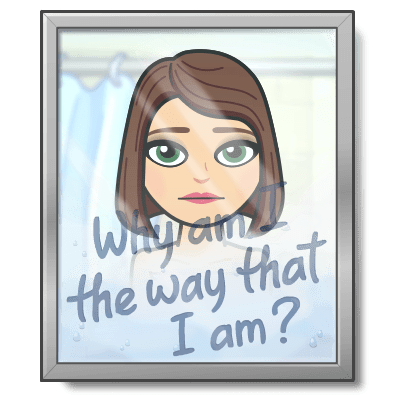
why am i the way i am.png

For an autist, these spells of introspection tend to happen a little more frequently. Our minds move so fast that we often find it hard to concentrate, and somehow we slip into this abyss of swirling thoughts:

‘What do I want for dinner tomorrow?’

‘Is evolution real?’

‘What would I look like as a blonde?’

‘What would it be like to have an Alpaca farm!?’ (genuinely spent a weekend considering the practicalities once!)

These are just a few of the millions of questions that I spend my time pondering in the abyss, proceeding to explore these thoughts in minute detail! 😛

I’ve been known to spend almost an hour lying on my bed, staring into space without saying a single word to anyone!

bed

Once I’ve fallen in, my mind could literally go anywhere-I’ve even conjured up a musical based on the music of My Chemical Romance during one of these particular spells!

It’s not a bad thing in my experience, I get some of best ideas wandering the abyss, but people just don’t know what to make of me in this state in social situations. As my sister says, it really creeps her out watching me! 😛

I suppose I can’t blame her when I often sit around staring like this for 40 minutes:


bitmoji1032267440.png

Half the time, I’m not even aware that I’m doing it, which can be awkward on a night out.  If it get’s very loud or the conversation goes stale, I just slip down into the depths, awoken from my reverie several minutes later by bemused friends and colleagues! 😬

What people fail to understand however, is that I am perfectly content in my little bubble. Yes I look strange, and my face may not show it, but I’m perfectly fine 🙂 In fact I sort of enjoy thinking, just floating around exploring the darkness of the abyss. It’s actually a little bit soothing in an odd way.

Autists are not good with the unknown. We like structure, things we can predict and prepare for. By questioning, or pondering the unknown in our minds, this can help to make the world seem a little less scary. Knowledge is power after all!

So don’t panic if you see me stumbling into the abyss- I’m probably just wondering where I can buy an alpaca! 😛 😉

Enjoy the weekend everyone! 🙂

Aoife

Autism and Nail Trimming

Greetings Earthlings! 🙂

So this post might seem a little unusual, but as the difficulties faced by autists when it comes to haircuts has been doing the rounds on social media of late (for the record- I LOVE getting my hair cut! 😀 ), I thought I’d write a quick post about something small that I find a sensory challenge- trimming my nails.

My friends have been complimenting my nails a lot this week, which is a little odd seeing as I have not cut them since 2002! 😲

Yep- nail trimming freaks me out that much! 😂

Once my mother stopped trimming them for me, I have refused to put a nail scissors or file anywhere near them (save for a manicure in 2005- an experience I have not sought to repeat! 😛 )!

Don’t worry they aren’t freakishly long- I use my hands so much with my hobbies that they never seem to make it past a certain length!

Ow GIF

Trimming/filing my fingernails has always freaked me out. It’s really hard to describe, but for some reason it feels really wrong to me! There’s just something unnerving about nail scissiors cutting so close to the skin that it sends unsettling shivers up and down my spine. Nail filing in particular sends me into cringing convulsions-my hands are tensing up into balls just now at the thought of that abrasive piece of cardboard against my skin! 🤣

Image result for shudder gif

Oddly enough I’m fine with toenails, unless I cut too close to the skin 😛

I know I shouldn’t be unnerved by such an innocuous every day process, buuuuttt my brain just doesn’t seem to want to deal with this type of stimulus! 😛

Nail trimming issues are actually quite common among autists. This can be particularly troublesome if an autist is prone to skin picking or self injurious behaviours.

But there are some tricks that can help:

  • Trim your/your childs nails after a bath– this can soften the nail to make the task more comfortable
  • Pressing down on the nail before trimming– this application of deep pressure can temporarily reduce sensitivity
  • Distraction and Bribery– if you are cutting nails for an autistic person, try using bribes or distracting the person with something (particularly their specialist interest) to get the job done
  • Try not to keep the nail too short– aside from the weirdness of cutting my nails, if they were cut too short, or if I sustained a bad break, I found (and still sometimes find) this particular sensation quite unsettling (for want of a better term)

And if all that fails, you can always allow life to trim your nails for you like me (just maybe try to steer clear of your siblings if your nails are a little bit on the long side…😬)

finger

Enjoy the weekend everyone! 🙂

Aoife

Should I Tell My Child They Have Autism?

Greetings Earthlings! 🙂

So today we’re going to discuss a very important question when it comes to growing up with autism- should autists be made aware of their diagnosis?bitmoji185739333

Now this question is a little bit tricky.

On one hand, we have the parents who do not want their child to know at all; they want their child to grow up as “normally” as possible so that they may never be held back by the autistic label.

In a sense, part of me would agree with this approach. In a lot of ways, growing up undiagnosed was a blessing in disguise. I was never treated differently (well, by teachers at least- children are another kettle of fish!) and I grew up to be a “normally” functioning adult with a job and friends, never held back by the autistic label.

Buuuuuuutttttttt…

Whilst I can appreciate a parents desire for their child to thrive, the decision not to tell a child about their diagnosis ultimately amounts to sticking your head in the sand.

bitmoji1733715277

We cannot ignore autism and pretend that it’s not happening. There needs to be interventions, strategies and most importantly, understanding.

We don’t just grow out of autism, we need to cultivate an environment so that we can grow around autism. Without self awareness, this will ultimately make life difficult for your child.

What if they found out some other way that they were autistic? If they overheard a teacher, accidentally caught sight of their notes or were taunted by another child? How would you feel if your parents kept something like this from you?

At the end of the day, your child needs to know about their diagnosis; maybe not today or tomorrow, but when the time is right, they will need to know.

Yes, there were some advantages to getting a later diagnosis, but ultimately, life would have been so much simpler for both my parents and I had we known that I was on the spectrum. We would have known how to manage meltdowns, my peers would have understood me better, I wouldn’t have tortured myself for being different- I would have understood and learned to better accept and love me all the sooner.

hugs.png

So don’t worry about holding your child back, or upsetting them; take a deep breath and find a way to tell them- they will thank you for it in the end 🙂

Aoife

Blog at WordPress.com.

Up ↑